6 - LITHOSPHERE
- Solid outer part of the earth
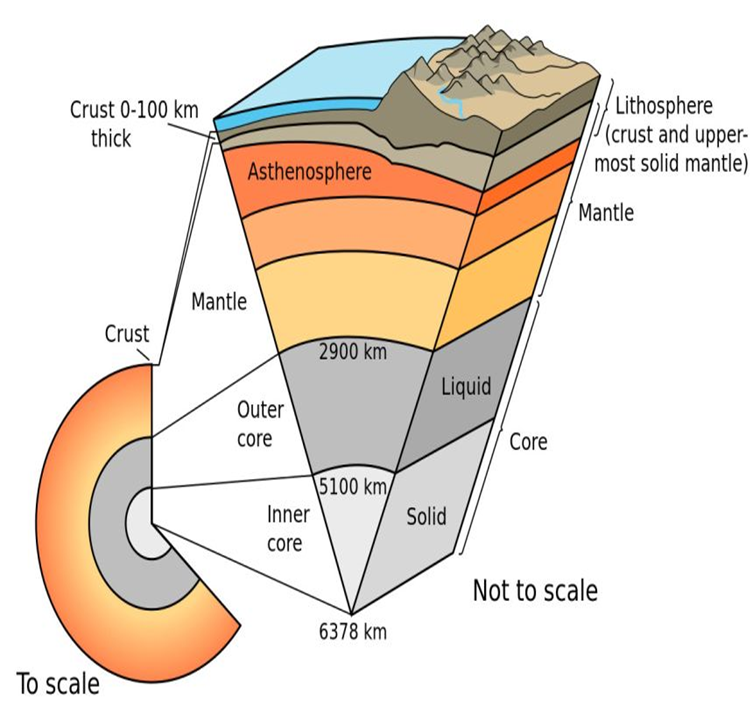
- Earth’s internal structure is made out of core, mantle, asthenosphere, crust and lithosphere
- lithos = rocks, sphaeros = sphere
- Solid naturally occurring substances on the Earth’s lithosphere
- Composed of minerals, they are classified into igneous, sedimentary and metamorphic types
- It forms the earth’s crust and undergoes geological processes.
TYPES OF ROCKS
Igneous
- Forms from magma or lava solidification
- Hard, no layers
- Intrusive - Slow magma cooling (Granite)
- Extrusive - Rapid lava cooling (Obsidian)
Sedimentary
- Forms of sediment compaction
- Crumbly layer
- Clastic - Compacted broken rocks (Sandstone)
- Chemical - Compacted dissolved minerals (Limestone)
- Organic - Compacted biogenic matter (Coal)
Metamorphic
- Transformation of other rocks
- Relatively hard, may or may not have layers
- Foliated - has layers (Slate)
- Non-Foliated - no layers (Marble)
- A mixture of minerals, organic matter, water and air
- Found in the uppermost layer of the earth known as the lithosphere or sometimes called “pedosphere”.
- Derived from the Latin word SOLUM; meaning earthy material in which plants grow
- Soil is the loose surface material that cover most land
- Soil is a biologically active porous medium present in the uppermost layer on the uppermost layer of the Earth’s crust
- PEDOLOGY – study of soil
- Helpful in agriculture, horticulture, forestry, irrigation, use of fertilizers
- Useful in science like: geology, petrology, mineralogy, paleobotany, paleozoology
FORMATION OF SOIL
- Soil forms through the weathering of rock.
- A change or difference in any of the weathering processes results to different kinds of soils.
- Likewise, the development of the same parent material under different climatic regimes and vegetation covers can result in different soils.
1. Weathering
- The disintegration of parents rocks by either physical, chemical or biological agents.
- Physical – temperature, water, ice, gravity, wind
- Chemical – solution, hydrolysis, oxidation, carbonation, hydration
- Biological – plant roots, lichen, algae, decaying plants
2. Pedogenesis
- Also known as soil development
- 5 principle factors:
- Parent material - Local or transported rock/plant debris
- Climate - Includes temperature and moisture
- Topography - Shape and position
- Living matter - Mainly microscopic and macroscopic plants, may also include animals that depend on the vegetation or the residue
- Time - The period during which the interactions takes place
SOIL TERMS TO REMEMBER
1. Soil Moisture
- The volumetric water content of soil held within the spaces the soil particles or soil aggregates
- Two types:
- Surface Soil Moisture - the water present on the upper layer of the soil
- Root Zone Moisture - water available available to plants generally present within the soil
- Considered an indicator of the quality of soil and the fertility of the soil
2. Soil Gas
- Soil gases are different types of gases that are present within the pores between soil particles or soil aggregates
- Include carbon dioxide, oxygen, and nitrogen. Other atmospheric gases include methane and radon.
- Pores in the soil are filled by gases after the water present in such pores are evaporated or after they are absorbed by the root.
- In the case of environmental contaminants, soil gas might include gases diffused from landfill wastes, mining activities, and petroleum products.
3. Soil Matrix
- All the solid particles found in soil that include the soil particles, organic matter, and other inorganic materials.
- Soil particles may either be sand, silk or clay
- Humus - Organic matter of soil
- Humus - final stage degradation of dead plants and animals
- It might even form organic colloid with water and other inorganic substances
- Determines various physical and chemical properties of soil like water retention capacity, nutrient content, and pH.
SOIL COMPOSITION
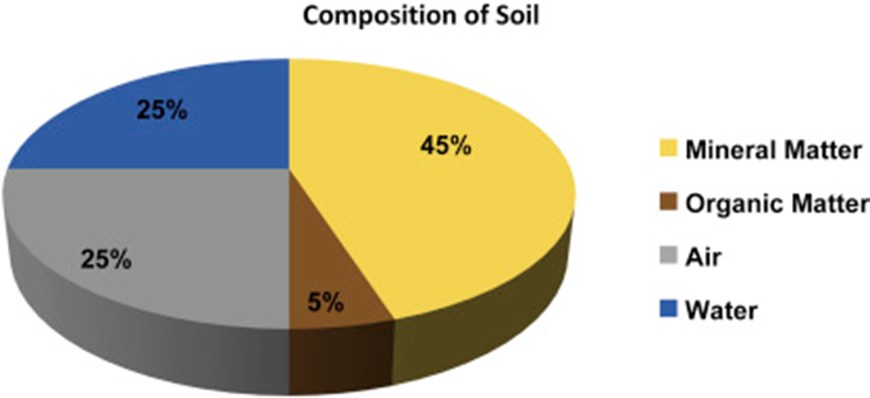
- 45% - Mineral Matter
- 5% - Organic Matter
- 25% - Air
- 25% - Water
- Mineral organic matter make up the solid part of the soil called the soil solids
- Air and water make up the pore space.
- Mineral Matter - obtained by the disintegration and decomposition of rocks.
- Composed of sand, silt, clay, and gravel
- Organic Matter - obtained by the decay of plant residues and animal remains
- Composed of organisms like bacteria, fungi, nematodes, 10% algae and 10% roots.
- Contribute to stable soil aggregates by binding soil particles together and prevent soil erosion.
- Water - obtained from the atmosphere and the reactions in soil.
- Air or gases - from atmosphere reactions of roots, microbes and chemicals of the soil.
GENERALIZED SOIL PROFILE
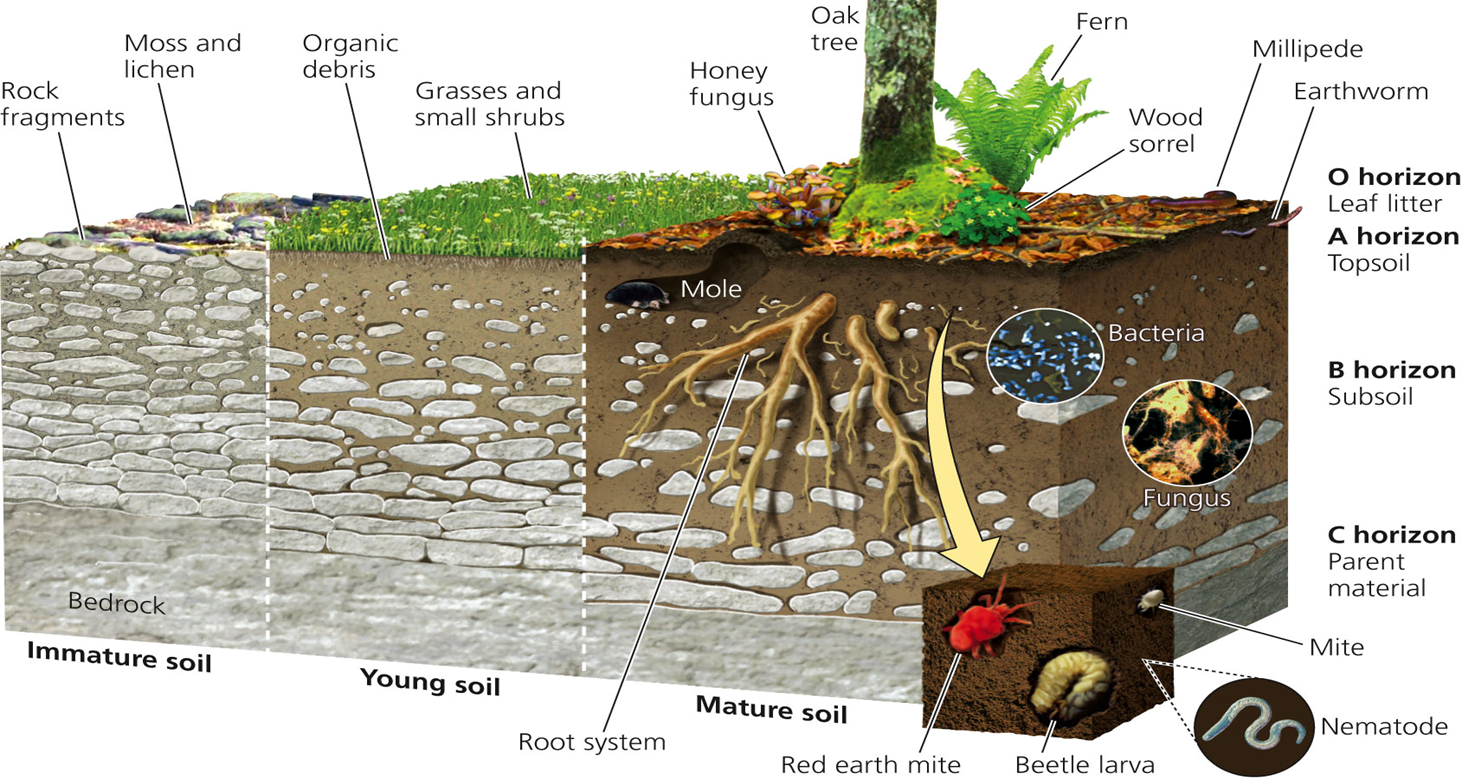
O Horizon |
|
|---|---|
A Horizon |
|
B Horizon |
|
C Horizon |
|
Bedrock |
|
- The horizons or layers may vary in number, composition, thickness depending on the type of soil
- Understanding the horizons can help assess soil fertility, drainage and the overall suitability for various purposes including agriculture and construction.
PROPERTIES OF SOIL
- Determined by the composition of the soil depending on different amounts of biotic and abiotic components
- The combinations of this components determine the physical and chemical property of soil
Physical
- Texture - Size of the soil particles
- Gritty - Sand
- Smooth - Silt
- Stick and Moldable - Clay
- Structure - The textural components of soil including sand, silk and clay might result in aggregates as a result of their clumping
- Density - Average soil particle density ranges form 2.60 - 2.75 g per cm^3
- Porosity - The number of pores present within the soil
- Consistency - The ability of the soil to stick to itself or other objects and to resist deformation and rupture.
- Color - Determined primarily by the organic composition of the soil.
- Cation Exchange Capacity (CEC) - maximum amount of total cations that a soil sample is capable of holding at a given pH.
- Soil pH - reactivity of soil expressed in terms of soil pH which determines the acidity and alkalinity of the soil.
- Salinity - Salts in the soil are transported in salt tables in water resources that then accumulate due to evaporation.
- The most common salts present in soil are: Magnesium Sulfate (MgSO4), Potassium Sulfate (K2SO4), and Carbon Trioxide (CO3).
MAJOR TYPES OF SOIL
1. Clay
- Comparatively heavy as it has higher water retention capacity and a higher concentration of nutrients
- Made up of over 25% clay particles that are smaller in size and thus hold a large amount of water
- Drains water slowly and thus takes longer to warm up in the summer without drying out
- However, it is a heavy and dense type of soil, it doesn’t provide space for plant roots to flourish
2. Loam
- A mixture of sand, silt, and clay soil that combines the properties of all three types of soil to make it more fertile
- Has enough pores as well as water retention capacity to promote crop production
- Has appropriate level of calcium and pH
3. Sand
- Contains a higher proportion of sand and less clay
- Light, dry, and warm
- Tends to be more acidic
- Larger particle size they have low water retention capacity and fewer nutrients
- Lack of moisture and nutrients makes the soil less suitable for crop production
- However, sandy soil can be made suitable by adding organic matter to increase water and nutrient content
Silt
- A light soil with a higher fertility rate with soil particles that are large than clay but smaller than sand
- Smooth and of fine quality that holds water better than the sandy soil
- Can also be easily transported by moving currents, and it is found near water bodies
- Considered the best type of soil for agricultural practices as it has sufficient nutrients and enough moisture for plant growth
FUNCTIONS OF SOIL
- Medium for plant growth, it provides an anchor for plant roots and acts as an water holding tank for necessary moisture
- The degradation of plant and animal matter
- Creates a pool of available water
- Acts as a regulator for water supplies
- Allows the cycling of different organic and inorganic compounds from the atmosphere to the soil and back
- A habitat for soil organisms
- Base for building homes, roads, and buildings, acting as a landscape or engineering medium
- Provides the raw material for different purposes like clay for ceramic production
LAND USE
- Term used to describe the human use of land
- Land Use denotes the sum of human activities and arrangements aimed at harnessing terrestrial ecosystem services.
- Classification:
- Residential - Where people live
- Commercial - use for buying and selling goods and service
- Industrials - Land for used for industries (factories, power plants)
- Institutional - Land occupied by schools, hospitals, government offices
- Parks - lands for recreational use
- Open Space - Land that is vacant, left in its natural state
- Roads and Utilities - Use for moving people and goods from one place to another
- Soil acts as a substratum for life on Earth that serves as a reservoir of water and nutrients, a medium for the breakdown of organic materials, and as a participant of various biogeochemical cycles.
- Soil in any particular area evolves through a series of weathering processes that are influenced by biological, topographical, climatic, and geological factors.
- Soil is one of the most important elements of an ecosystem as it contains both biotic and abiotic components.