AP Psych Review Vocab Terms
History and Approaches (2-4%)
- Psychology is derived from physiology (biology) and philosophy
- EARLY APPROACHES
- Structuralism – used INTROSPECTION (act of looking inward to examine mental experience) to determine the underlying STRUCTURES of the mind
- Functionalism – need to analyze the PURPOSE of behavior
- APPROACHES KEY WORDS
- Psychoanalytic/dynamic – unconscious, childhood
- Behavioral – learned, reinforced
- Humanistic – free will, choice, ideal, actualization
- Cognitive – Perceptions, thoughts
- Evolutionary – Genes
- Biological – Brain, NTs
- Sociocultural – society
- Biopsychosocial – combo of above
- PEOPLE:
- Mary Calkins: First Fem. Pres. of APA
- Charles Darwin: Natural selection & evolution
- Dorothea Dix: Reformed mental institutions in U.S.
- Stanley Hall: 1st pres. of APA1st journal
- William James: Father of American Psychology – functionalist
- Wilhem Wundt: Father of Modern Psychology – structuralist
- Margaret Floy Washburn–1st fem. PhD
- Christine Ladd Franklin – 1st fem.
- RANDOM TERMS
- Basic research – purpose is to increase knowledge (rats)
- Applied research – purpose is to help people
- Psychologist – research or counseling – MS or PhD
- Psychiatrist – prescribe medications and diagnose – M.D.
Research Methods
(8-10%)
- EXPERIMENT : Adv: researcher controls variables to establish cause and effect Disadv: difficult to generalize
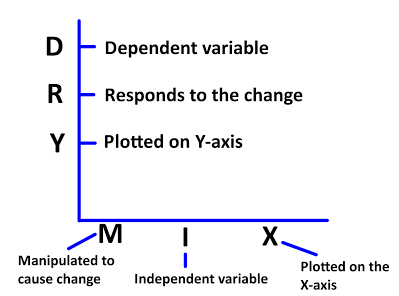
- Independent Variable: manipulated by the researcher
- Experimental Group: received the treatment (part of the IV)
- Control Group: placebo, baseline (part of the IV)
- Placebo Effect: show behaviors associated with the exp. group when having received placebo
- Double-Blind: Exp. where neither the participant or the experimenter are aware of which condition people are assigned to (drug studies)
- Single-Blind: only participant blind – used if experimenter can’t be blind (gender, age, etc)
- Dependent Variable: measured variable (is DEPENDENT on the independent variable)
- Independent Variable: manipulated by the researcher
- Operational Definition: clear, precise, typically quantifiable definition of your variables – allows replication
- Confound: error/ flaw in study
- Random Assignment: assigns participants to either control or experimental group at random – minimizes bias, increase chance of equal representation
- Random Sample: method for choosing participants – minimizes bias
- Assignment and sampling can be done via names in a hat, computer generation
- Validity: accurate results
- Reliability: same results every time
- NATURALISTIC OBSERVATION: Adv: real world validity (observe people in their own setting) Disadv: No cause and effect
- CORRELATION: Adv: identify relationship between two variables Disadv: No cause and effect (CORRELATION DOES NOT EQUAL CAUSATION)
- Positive Correlation – variables increase & decrease together
- Negative Correlation – as one variable increases the other decreases
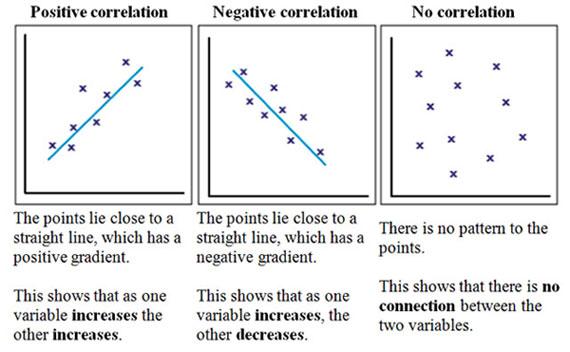
- The stronger the # the stronger the relationship REGARDLESS of the pos/neg sign
- 3rd variable problem – diff. variable is responsible for relationship (breast implants & suicide)
- Illusory correlation – belief of correlation that doesn’t exist (old man predicts rain from arthritis)
- The stronger the # the stronger the relationship REGARDLESS of the pos/neg sign
- CASE STUDY: Adv. Studies ONE person (usually) in great detail – lots of info Disadv: No cause and effect
- DESCRIPTIVE STATS:shape of the data
- Measures of Central Tendency:
- Mean: Average (use in normal distribution)
- Median: Middle # (use in skewed distribution)
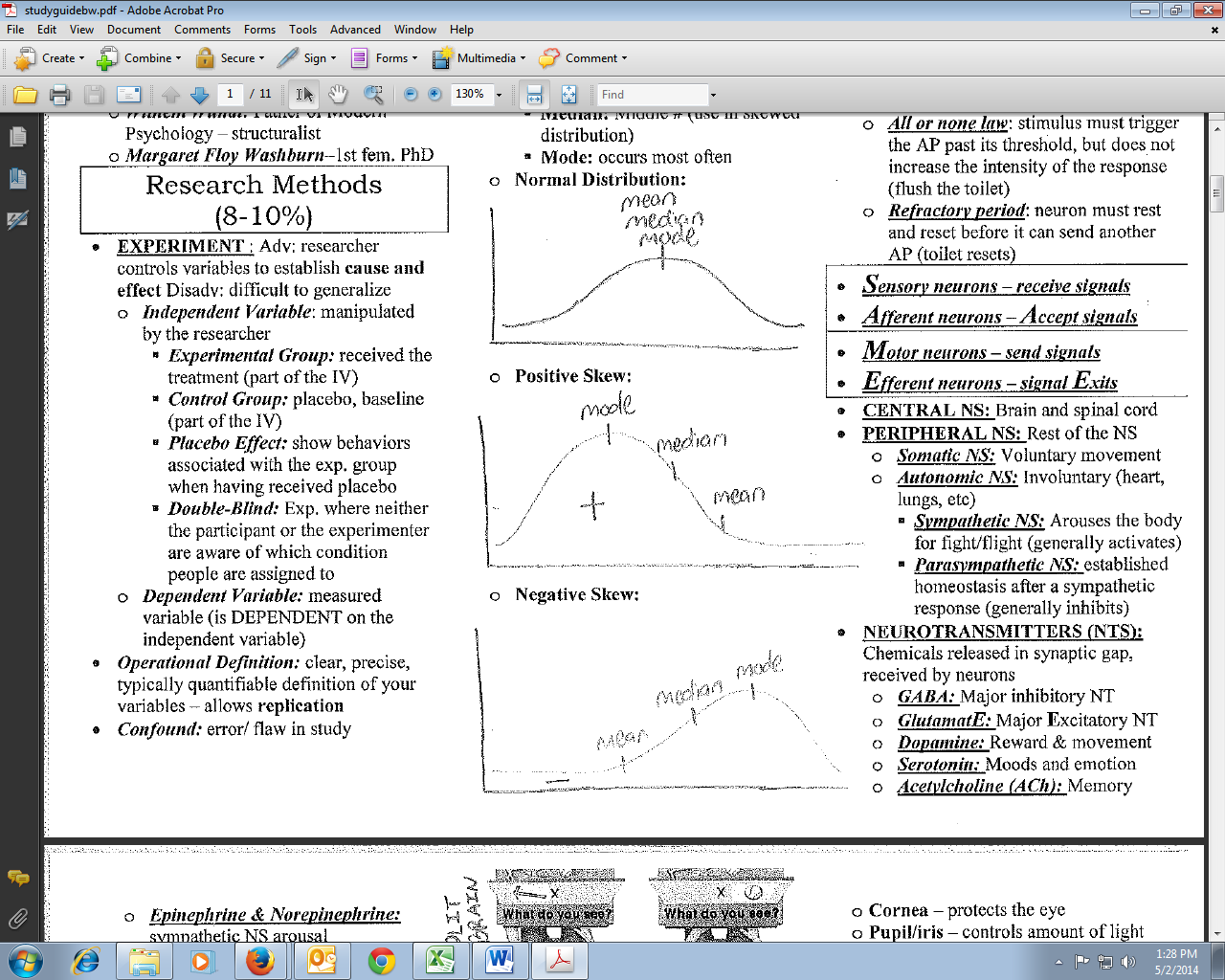
- Mode: occurs most often
- Measures of Central Tendency:
- INFERENTIAL STATISTICS: establishes significance (meaningfulness)
- STATISTICAL SIGNIFICANCE = results not due to chance
- ETHICAL GUIDELINES (APA)
- Confidentiality
- Informed Consent
- Debriefing
- Deception must be warranted
Biological Basis
(8-10%)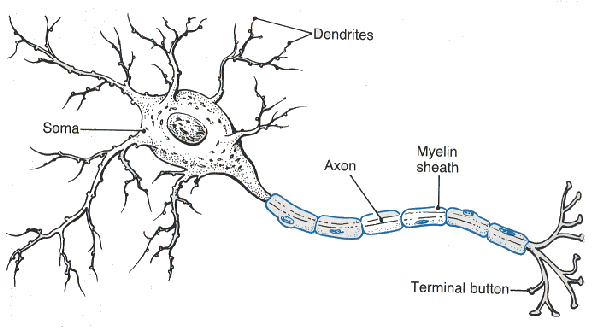
- NEURON: Basic cell of the NS
- Dendrites: Receive incoming signal
- Soma: Cell body (includes nucleus)
- Axon: AP travels down this
- Myelin Sheath: speeds up signal down axon, protects axon
- Terminals: release NTs – send signal onto next neuron
- Synapse: gap b/w neurons
- Action Potential: movement of sodium and potassium ions across a membrane sends an electrical charge down the axon
- All or none law: stimulus must trigger the AP past its threshold, but does not increase the intensity of the response (flush the toilet)
- Refractory period: neuron must rest and reset before it can send another AP (toilet resets)

- Sensory neurons – receive signals
- Afferent neurons – Accept signals
- Motor neurons – send signals
- Efferent neurons – signal Exits
- Interneurons – cells in spinal cord responsible for reflex loop
- CENTRAL NS: Brain and spinal cord
- PERIPHERAL NS: Rest of the NS
- Somatic NS: Voluntary movement
- Autonomic NS: Involuntary (heart, lungs, etc)
- Sympathetic NS: Arouses the body for fight/flight (generally activates – sympathetic to you getting eaten by a tiger helps you run away)
- Parasympathetic NS: established homeostasis after a sympathetic response (generally inhibits)
- NEUROTRANSMITTERS (NT): Chemicals released in synaptic gap, received by neurons
- GABA: Major inhibitory NT
- GlutamatE: Major Excitatory NT (get excited when seeing your mates!
- Dopamine: Reward & movement
- Serotonin: Moods and emotion
- Acetylcholine (ACh): Memory
- Epinephrine & Norepinephrine: sympathetic NS arousal
- Endorphins: pain control
- Oxytocin: love and bonding
- Agonist: drug that mimics a NT
- Antagonist: drug that blocks a NT
- Reuptake: Unused NTs are taken back up into the sending neuron. SSRIs (selective serotonin reuptake inhibitors) block reuptake – treatment for depression
- AREAS OF THE BRAIN:
- Hindbrain: oldest part of the brain
- Cerebellum – movement (what does it take to ring a bell)
- Medulla – vital organs (HR, BP)
- Pons – sleep/arousal (Ponzzzzzz)
- Midbrain
- Reticular formation: alertness (if you can’t pay attention, You R F’d)
- Forebrain: higher thought processes
- Limbic System
- Amygdala: emotions, fear (Amy, da! You’re so emotional!)
- Hippocampus: memory (if you saw a hippo on campus you’d remember it!)
- Hypothalamus: Reward/pleasure center, eating behaviors – link to endocrine system
- Thalamus: relay center for all but smell (you MUST (thalaMUST) use your thalamus, unless its MUSTY – smell)
- Cerebral Cortex: outer portion of the brain – higher order thought processes
- Occipital Lobe: located in the back of the head – vision – mom’s eyes!
- Frontal Lobe: decision making, planning, judgment, movement, personality
- Parietal Lobe: located on the top of the head - sensations
- Temporal Lobe: located on the sides of the head (temples) – hearing and face recognition
- Somatosensory Cortex: map of our sensory receptors –in parietal lobe
- Motor Cortex: map of our motor receptors – located in frontal lobe
- Left hemisphere only – damage results in aphasia (damaged speech)
- Broca’s Area: Inability to produce speech (Broca – Broken speech)
- Wernicke’s Area: Inability to comprehend speech (Wernicke’s what?)
- Corpus Callosum: bundle of nerves that connects the 2 hemispheres – sometimes severed in patients with severe seizures – leads to “split-brain patients”
- Lateralization: the brain has some specialized features – language is processed in the L Hemisphere
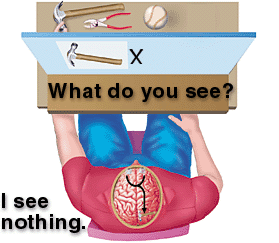
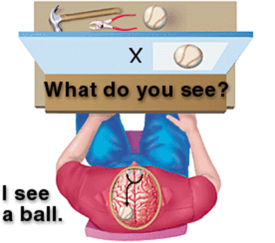
- Split-brain experiments: done by Sperry & Gazzanaga.
- Images shown to the right hemisphere will be processed in the left (& vice versa), patient can verbally identify what they saw
- Limbic System
- BRAIN PLASTICITY: Brain can “heal” itself
- NATURE VS. NURTURE: ANSWER IS BOTH
- Twin Studies:
- Identical twins – Monozygotic (MZ)
- Fraternal twins – Dizygotics (DZ)
- Genetics: MZ twins will have a higher percentage of also developing a disease
- Environment: MZ twins raised in different environments show differences
- Twin Studies:
- ENDOCRINE SYSTEM: sends hormones throughout the body
- Pituitary Gland: Controlled by hypothalamus. release growth hormones
- Adrenal Glands: related to sympathetic NS: releases adrenaline
- BRAIN IMAGING:
- EEG: brain activity – not specific
- XRAY: not useful, doesn’t show tissues
- CT / MRI: shows structures
- PET: glucose shows brain activity (when in doubt pick this one)
- fMRI: glucose shows activity in real time
- lesion – brain damage
Sensation & Perception
(6 – 8%)
- ABSOLUTE THRESHOLD: detection of signal 50% of time (is it there)
- DIFFERENCE THRESHOLD (also called a just noticeable difference (JND) and follows WEBER’S LAW: two stimuli must differ by a constant minimum proportion. (Can you tell a change?)
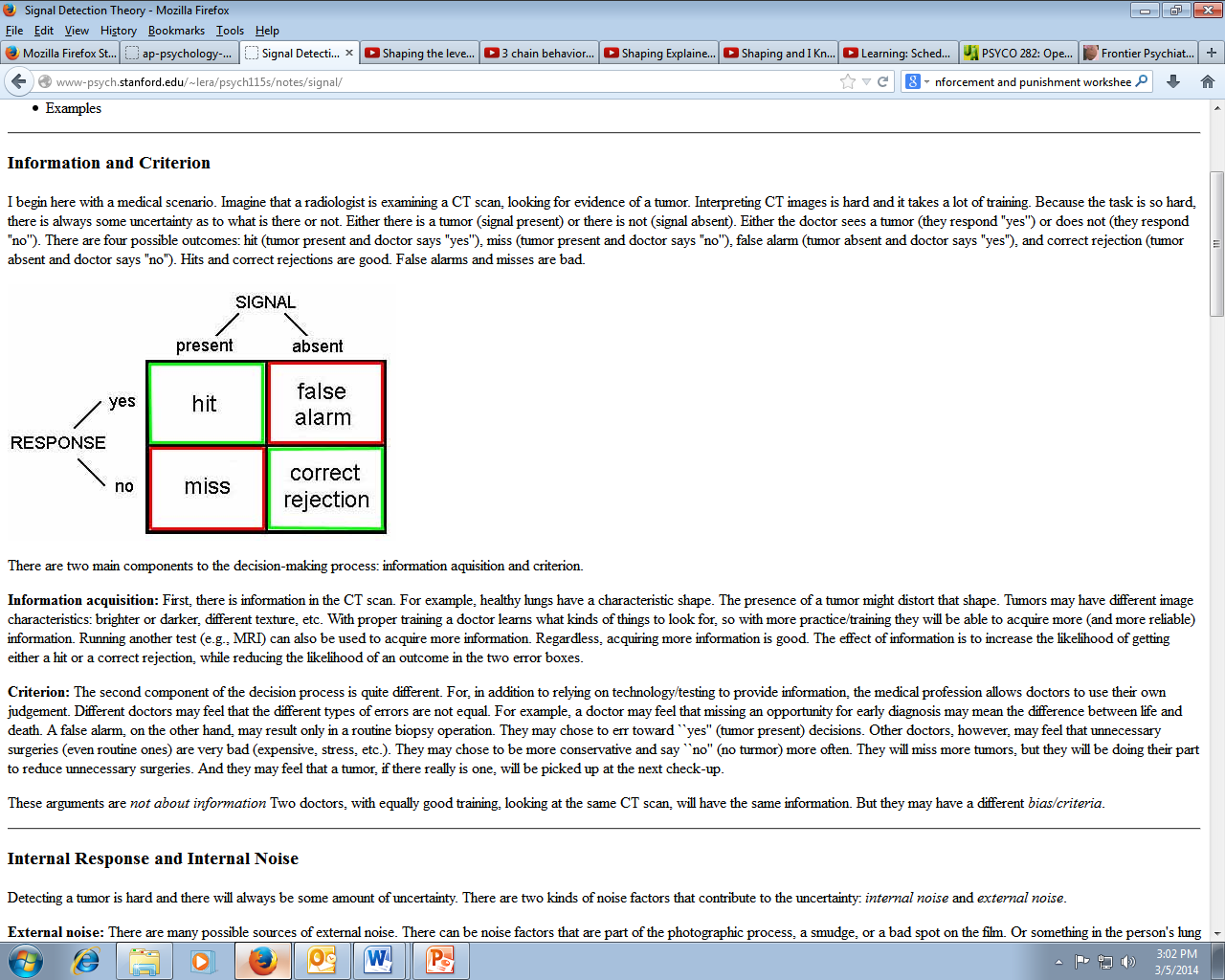
- SIGNAL DETECTION THEORY
- Sensory Adaptation: diminished sensitivity as a result of constant stimulation (can you feel your underwear?)
- Perceptual Set: tendency to see something as part of a group – speeds up signal processing
- Inattentional Blindness: failure to notice something b/c you’re so focused on another task (gorilla video)
- Cocktail party effect: notice your name across the room when its spoken, when you weren’t previously paying attention
- VISUAL SYSTEM:
- Pathway of vision: light → cornea →pupil/iris → lens → retina → rods/cones → bipolar cells → ganglion cells → optic nerve → optic chiasm → occipital lobe
- Cornea – protects the eye
- Pupil/iris – controls amount of light entering eye
- Lens – focuses light on retina
- Fovea–area of best vision(cones here)
- Rods – black/white, dim light
- Cones – color, bright light (red, green, blue)
- Bipolar cells – connect rods/cones and ganglion cells
- Ganglion cells – opponent-processing occurs here
- Blind spot – occurs where the optic nerve leaves the eye
- Feature detectors – specialized cells that see motion, shapes, lines, etc. (experiments by Hubel & Weisel)
- THEORIES OF COLOR VISION:
- Trichromatic – three cones for receiving color (blue, red, green)
- Explains color blindness - they are missing a cone type
- Opponent Process – complementary colors are processed in ganglion cells – explains why we see an after image
- Trichromatic – three cones for receiving color (blue, red, green)
- Visual Capture: Visual system overwhelms all others (nauseous in an IMAX theater – vision trumps vestibular)
- Constancies: recognize that objects do not physically change despite changes in sensory input (size, shape, brightness)
- Phi Phenomenon: adjacent lights blink on/off in succession – looks like movement (traffic signs with arrows)
- Stroboscopic movement: motion produced by a rapid succession of slightly varying images (animations)
- MONOCULAR CUES (how we form a 3D image from a 2D image)
- Interposition: overlapping images appear closer
- Relative Size: 2 objects that are usually similar in size, the smaller one is further away
- Relative Clarity: hazy objects appear further away
- Texture Gradient: coarser objects are closer
- Relative Height: things higher in our field of vision look further away
- Linear Perspective: parallel lines converge with distance (think railroad tracks)
- BINOCULAR CUES: (how both eyes make up a 3D image)
- Retinal Disparity: Image is cast slightly different on each retina, location of image helps us determine depth
- Convergence: Eyes strain more (looking inward) as objects draw nearer
- TOP-DOWN PROCESSING: Whole → smaller parts
- BOTTOM-UP PROCESSING: Smaller Parts → Whole
- AUDITORY SYSTEM:
- Pathway of sound: sound → pinna → auditory canal →ear drum (tympanic membrane) → hammer, anvil, stirrup (HAS) → oval window → cochlea → auditory nerve → temporal lobes
- Outer Ear: pinna (ear), auditory canal
- Middle Ear: ear drum , HAS (bones vibrate to send signal)
- Inner Ear: cochlea – like COCHELLA (sounds 1st processed here)
- THEORIES OF HEARING: both occur in the cochlea
- Place theory – location where hair cells bends determines sound (high pitches)
- Frequency theory – rate at which action potentials are sent determines sound (low pitches)
- OTHER SENSES:
- Touch: Mechanoreceptors → spinal cord → thalamus → somatosensory cortex
- Pain: Gate-control theory: we have a “gate” to control how much pain is experienced
- Kinesthetic: Sense of body position
- Vestibular: Sense of balance (semicircular canals in the inner ear effect this)
- Taste (gustation): 5 taste receptors: bitter, salty, sweet, sour, umami (savory)
- Smell (olfaction): Only sense that does NOT route through the thalamus 1st. Goes to temporal lobe and amygdala
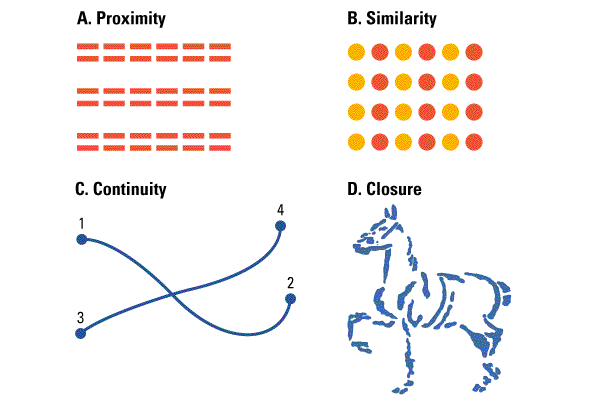
- GESTALT PSYCHOLOGY: Whole is greater than the sum of its parts
- Gestalt Principles:
- Figure/ground: organize information into figures objects (figures) that stand apart from surrounds (back ground)
- Gestalt Principles:
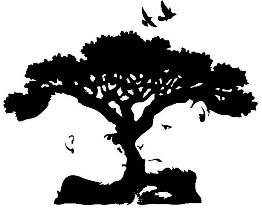
- Closure: mentally fill in gaps
- Proximity: group things together that appear near each other
- Similarity: group things together based off of looks
- Continuity: tendency to mentally form a continuous line
States of Consciousness (2 – 4%)
- STATES of CONSCIOUSNESS:
- Higher-Level: controlled processes – totally aware
- Lower-Level: automatic processing (daydreaming, phone numbers)
- Altered States: produced through drugs, fatigue, hypnosis
- Subconscious: Sleeping and dreaming
- No awareness: Knocked out
- METACOGNITION: Thinking about thinking
- SLEEP:
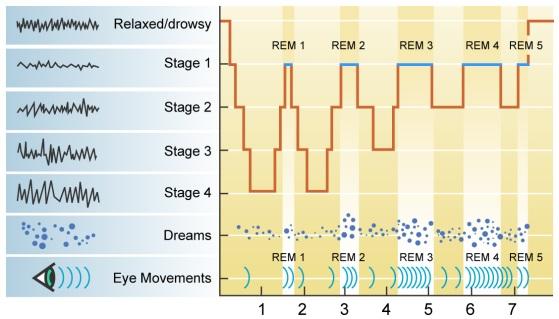
- Beta Waves: awake (you betta be awake for the exam)
- Alpha Waves: high amp., drowsy
- NREM (non REM) stages-
- Stage 1: light sleep
- Stage 2: bursts of sleep spindles
- Stage 3 delta waves: Deep sleep
- Stage 4: extremely deep sleep
- Rapid Eye Movement (REM): dreaming, cognitive procesing
Entire cycle takes 90 minutes, REM occurs inb/w each cycle. REM lasts longer throughout the night
- CIRCADIAN RHYTHM: 24 hour biological clock
- Body temp and awareness change due to this
- Controlled by the Suprachiasmatic nucleus (SCN) in the brain
- Explains jet lag
- SLEEP DISORDERS
- Insomnia: Inability to fall asleep (due to stress/anxiety)
- Sleep walking: (due to fatigue, drugs, alcohol)
- Night terrors: extreme nightmares – NOT in REM sleep – typical in children
- Narcolepsy: fall asleep out of nowhere (due to deficiency in orexin)
- Sleep Apnea: stop breathing suddenly while asleep (due to obesity usually)
- DREAM THEORIES:
- Freud’s Unconscious Wish Fulfillment: Dreaming is gratification of unconscious desires and needs
- Latent Content: hidden meaning of dreams
- Manifest Content: obvious storyline of dream
- Freud’s Unconscious Wish Fulfillment: Dreaming is gratification of unconscious desires and needs
- Activation Synthesis: Brain produces random bursts of energy – stimulating lodged memories. Dreams start random then develop meaning
- HYPNOSIS
- It Can: Reduce pain, help you relax
- It CANNOT: give you superhuman strength, make you regress, make you do things against your will
- PSYCHOACTIVE DRUGS:
- Triggers dopamine release in the brain
- Depressants: Alcohol, barbiturates, tranquilizers, opiates (narcotics)
- Decrease sympathetic NS activation, highly addictive
- Stimulants: Amphetamines, Cocaine, MDMA (ecstasy), Caffeine, Nicotine
- Increase sympathetic NS activation, highly addictive
- Hallucinogens: LSD, Marijuana
- Causes hallucinations, not very addictive
- Tolerance: Needing more of a drug to achieve the same effects
- Dependence: Become addicted to the drug – must have it to avoid withdrawal symptoms
- Withdrawal: Psychological and physiological symptoms associated with sudden stoppage. Unpleasant – can kill you.
Learning
(7-9 %)
- CLASSICAL CONDITIONING: PAVLOV!
- Unconditioned Stimulus (US): brings about response w/o needing to be learned (food)
- Unconditioned Response (UR): response that naturally occurs w/o training (salivate)
- Neutral Response (NS): stimulus that normally doesn’t evoke a response (bell)
- Conditioned Stimulus (CS): once neutral stimulus that now brings about a response (bell)
- Conditioned Response (CR): response that, after conditioning, follows a CS (salivate)
- Contiguity: Timing of the pairing, NS/CS must be presented immediately BEFORE the US
- Acquisition: process of learning the response pairing
- Extinction: previously conditioned response dies out over time
- Spontaneous Recovery: After a period of time the CR comes back out of nowhere
- Generalization: CR to like stimuli (similar sounding bell)
- Discrimination: CR to ONLY the CS
- CONTINGENCY MODEL: Rescorla & Wagner – classical conditioning involves cognitive processes
- CONDITIONED TASTE AVERSION (ONE-TRIAL LEARNING): John Garcia – Innate predispositions can allow classical conditioning to occur in one trial (food poisoning)
- COUNTERCONDITIONING: Little Albert and John Watson (father of behaviorism) – conditioned a fear in a baby (only to countercondition – remove it- later on)
- OPERANT CONDITIONING: SKINNER!
- LAW OF EFFECT (Thorndike): Behaviors followed by pos. outcomes are strengthened, neg. outcomes weaken a behavior (cat in the puzzle box)
- PRINCIPLES OF OPERANT COND:
- Pos. Reinforcement: Add something nice to increase a behavior (gold star for turning in HW)
- Neg. Reinforcement: Take away something bad/annoying to increase a behavior (put on seatbelt to take away annoying car signal)
- Pos. Punishment: Add something bad to decrease a behavior (spanking)
- Neg. Punishment: Take away something good to decrease a behavior (take away car keys)
- Primary Reinforcers: innately satisfying (food and water)
- Secondary Reinforcers: everything else (stickers, high-fives)
- Token Reinforcer: type of secondary- can be exchanged for other stuff (game tokens or money)
- Generalization: respond to similar stimulus for reward
- Discrimination: stimulus signals when behavior will or will not be reinforced (light on means response are accepted)
- Extinction / Spontaneous Recovery: same as classical conditioning
- Overjustification Effect: reinforcing behaviors that are intrinsically motivating causes you to stop doing them (give a child 5$ for reading when they already like to read – they stop reading)
- Shaping: use successive approximations to train behavior (reward desired behaviors to teach a response – rat basketball)
- Chaining: tie together several behaviors
- Continuous Reinforcement schedule: Receive reward for every response
- Fixed Ratio schedule: Reward every X number of response (every 10 envelopes stuffed get . No happiness
- Career – work for advancement. Some happiness
- Calling – work because you love it. Lotsa happiness
Development
(7-9%)
- Prenatal Development:
- Zygote: 0 – 14 days, cells are dividing
- Embryo: until about 9 weeks, vital organs being formed
- Fetus: 9 wks to birth, overall development
- Teratogens: external agents that can cause abnormal prenatal development (alcohol, drugs, etc)
- Fetal alcohol syndrome (FAS): large amount of alcohol leads to FAS, causes deformities, mental retardation, death
- Physical Development:
- Maturation: natural course of development, occurs no matter what (walking)
- Reflexes: innate responses we’re born with
- Rooting, sucking, swallowing, grasping, stepping
- Habituation: after continual exposure you pay less attention – used to test babies
- Eyes have the most limited development, takes till 1 year
- Visual cliff: babies have to learn depth perception, so they will cross a “cliff”
- Other senses are fairly developed
- Brain development continues for a few years
- JEAN PIAGET’S COGNITIVE DEV.
- Schemas – concepts or frameworks that organize info
- Assimilation: incorporate new info into existing schema (aSSimlation – same stuff)
- Accommodation: adjust existing schemas to incorporate new information (ACcommodation - All Change)
- Sensorimotor Stage: Birth to 2 years: focused on exploring the world around them
- Lack Object Permanence: Objects when removed from field of view are thought to disappear (peek-a-boo)
- Dev. Sense of Self: by 2 yrs can recognize themselves in the mirror
- Pre-operational Stage: 2 – 7 years: use pretend play, developing language, using intuitive reasoning
- Lack Conservation: recognize that substances remain the same despite changes in shape, length, or position (girls with juice in glasses)
- Lack Reversibility: cannot do reverse operations (count out both 4+2 and 2+4)
- Are egocentric: inability to distinguish one’s own perspective from another’s – think everyone sees what they see
- Concrete Operational Stage: 7-11 yrs: use operational thinking, classification, and can think logical in concrete context
- Formal Operational Stage: 11-15 yrs: use abstract and idealist thoughts, hypothetical-deductive reasoning
- Problems with Piaget’s theory: stages to discrete, dev. differs b/w kids
- VYGOTSKY’S THEORY: cognitive development is a social process too, need to interact w/ others
- Zone of Proximal Development: gap b/w what a child can do on their own and w/ support. Need scaffolding (teachers)
SOCIOEMOTIONAL DEVELOPMENT
- Temperament: patterns of emotional reactions and babies (precursor to personality)
- Imprinting: baby geese believe the first thing they see after hatching is their mom – happens during a critical period (from LORENZ)
- HARRY HARLOW: discovered that contact comfort is more important than feeding (monkeys fed on wire or cloth mothers). Monkeys raised in isolation couldn’t socialize
- MARY AINSWORTH: developed the strange situation paradigm (children left alone in a room w/ a stranger, then reunited w/ mom – determines your attachment style
- Secure attachment (60% of infants): upset when mom leaves, easily calmed on return. Tend to be more stable adults
- Avoidant attachment (20% infants): actively avoids mom, doesn’t care when she leaves
- Ambivalent attachment(10% infants): actively avoids mom, freaks out when she leaves
- Disorganized attachment (5%): confused, fearful, dazed – result of abuse
- BAUMRIND: parenting styles
- Authoritarian: rules & obedience, “my way or the highway” – kids lack initiative in college
- Permissive: kids do whatever – no rules – kids lack initiative in college
- Authoritative: give and take w/ kids – kids become socially competent and reliable
- KOHLBERG’S MORAL DEV
- Preconventional morality: Children: they follow rules to avoid punishment
- Conventional morality: adolescents: follow rules b/c rules exist to keep order
- Postconventional morality: adults: they do what they believe is right (even if it goes against society)
- Carol Gilligan: said moral reasoning and moral behaviors are two different things (what you say isn’t always what you do)
- ERIKSON’S SOCIOEMOTINAL DEV. : 8 stages, each stage represents a crisis that must be resolved, results in competence or weakness
- Trust vs Mistrust (birth – 18 months): if needs are dependably met infants dev basic trust
- Autonomy vs shame&doubt (1 -3 yrs): toddlers learn to exercise their will and think for themselves
- Initiative vs guilt (3-6 yrs): learn to initiate tasks and carry out plans
- Industry vs inferiority (6 yrs to puberty): learn the pleasure of applying themselves to tasks
- Identity vs role confusion: (adolescence thru 20s): refine a sense of self by testing roles and forming an identity
- Intimacy vs isolation: (20s—40s): form close relationships and gain capacity for love
- Generativity vs stagnation: (40s-60s): discover sense of contributing to the world, thru family & work
- Integrity vs despair: (60s and up): reflect on your life, feel satisfaction or failure
- PUBERTY! (rapid skeletal and sexual maturation)
- Primary sex characteristics: necessary structures for reproduction (ovaries, testicles, vagina, penis)
- Secondary sex characteristics: nonreproductive characteristics that dev during puberty (breasts, hips, deepening of voice, body hair)
- Frontal lobe continuous dev (not fully developed till 25)
- GENDER DEVELOPMENT: sex = chromosomes, gender = what you identify yourself as
- Gender roles: expected behaviors (norms) for men/women
- Social learning theory: we learn gender roles and identity from those around us
- AGING:
- Cellular clock theory: cells have a maximum # of divisions before they can’t divide anymore
- Free-radical theory: unstable oxygen molecules w/in cells damage DNA
- Over time skills decrease (reaction time, memory)
- CROSS-SECTIONAL STUDY: studies ppl of different ages at the same point in time
- Adv: inexpensive & quick
- Disadv: can be differences due to generational gap
- LONGITUDINAL STUDY: studies same ppl over time
- Adv: eliminates groups differences, lots of detail
- Disadv: expensive, time consuming, high drop out rates
- Problem-focused coping: solving or doing something to alter the course of stress (planning, acceptance)
- Emotion-focused coping: reducing the emotional distress (denial, disengagement)
Personality
(5-7%)
PSYCHODYNAMIC EXPLANATION
SIGMUND FREUD said personality was largely unconscious.
- Conscious: immediate awareness of current environment
- Preconscious: available to awareness (phone #s)
- Unconscious: unavailable to awareness
- id: our hidden true animalistic wants and desires – operates on the pleasure principle, all about rewards and avoiding pain (devil on your shoulder – entirely unconscious)
- superego: our moral conscious (angel on your shoulder, all 3 consciousness)
- ego: reality principle, has to deal w/ society, stuck mediating b/w the id and superego (its you! – conscious and preconscious)
When ego cannot mediate b/w the id and superego, we use defense mechanisms
- Repression: push memories back into the unconscious mind (sexual abuse is too traumatic to deal w/ so you repress it)
- Projection: attribute personal shortcomings & faults on to others (man who wants to have an affair accuses his wife of having one)
- Denial: refuse to acknowledge reality (refuse to believe you have cancer)
- Displacement; shift feelings from an unacceptable object to a more acceptable one (can’t tell at teacher, go home and yell at the dog)
- Reaction formation: transform unacceptable motive into his opposite (woman who fears sexual urges becomes a religious zealot)
- Regression: transform into an earlier development period in the face of stress (during exam week you start to suck your thumb)
- Rationalization: replace a less acceptable reasoning with a more acceptable one (don’t get into your college – justify it was a sucky college anyway)
- Sublimation: replace unacceptable impulse w/ a socially acceptable one (man w/ strong sexual urges paints nudes. Dexter)
FREUD’S PSYCHOSEXUAL STAGES
- Oral stage (0-18 months): pleasure focuses on the mouth (id)
- Anal stage (18 – 36 months): pleasure involves eliminative functions (ego forms)
- Phallic stage (3 – 6 yrs): pleasure focuses on genitals (superego forms)
- Oedipal complex: young boys learn to identify w/ their father out of fear of retribution (castration anxiety)
- Electra complex: young girls learn to identify w/ their mother b/c they cannot with their father (penis envy)
- Latency stage (6 yrs to puberty): psychic time out – personality is set
- Genital State (adulthood): sexual reawakening – oedipal and electra “feelings” are repressed, turn sexual wants onto an appropriate person
- FIXATION: can become “stuck” in an earlier stage – influences personality (oral stage smokes/drinks, anal is “anal retentive”, phallic is promiscuous)
What’s wrong w/ Freud theory? – unverifiable, descriptive not predictive
What’s good about it? – 1st theory about personality, sparked psychoanalysis
How do we test this approach?
- Psychoanalysis: analyze a person’s unconscious motives thru the use of:
- Free Association: say aloud everythying that comes to mind w/o hesitation
- Transference: looks for feelings to transferred to psychoanalyst
- Dream interpretation: analyze the manifest (seen message) and latent (hidden messages) content
- Projective Tests: ambiguous stimuli shown to look at your unconscious motives (THESE SUCK B/C THEY ARE VERY SUBJECTIVE)
- Thematic apperception test (TAT) : tell a story about a picture (when someone has a tattoo (tatt) you ask what it means
- Rorschach inkblot: show an inkblot
NEO-FREUDIANS
- CARL JUNG: believed in the collective unconconcious (shared inherited reservoir of memory – explains common myths across civilizations & time)
- KAREN HORNEY: said personality develops in context of social relationships, NOT sexual urges (security not sex is motivation, men get womb envy)
TRAIT PERSPECTIVE
- Traits are enduring personality characteristics, people can be described by these – have strong or weak tendencies. They are stable, genetic, and predict other attributes.
- Use factor analysis to find these: statistical procedure used to identify similar components
- TRAIT THEORIES:
- Big Five: (by Costa & McCrae) (acronym OCEAN) You vary on each of these
- Openness : imaginative, independent, like variety
- Conscientiousness: organized, careful, disciplined
- Extraversion: sociable, fun-loving, affectionate (opoosite it introversion: shy, timid, reserved)
- Agreeableness: soft hearted, trusting, helpful
- Neuroticism (emotional stability): calm, secure
What’s wrong with trait theory? – ignores the role of the situation in behavior
What’s good about it? - identifying traits gives us perspectives about careers, relationships, health
How do we test this approach?
- MMPI – helpful for mental health and job placement
- Myer’s Briggs – gave you 4 letter combo
What’s wrong w/ these tests?
- They’re long, social desirability can be an influence, and they’re too broad
HUMANISTIC PERSPECTIVE
- Emphasized personal growth and free will. You don’t like yourself? So change!
- CARL ROGERS: talked about our self-concept (idea of who we are). Your self-concept is the center of your personality
- Actual (social) self: what others see
- Ideal (true) self: who you WANT to be
- A positive self-concept makes us perceive the world positively (optimist)
- A negative self-concept makes us feel dissatisfied and unhappy
What wrong with humanistic theory? - too optimistic about human nature, abstract concepts are difficult to test
What’s good about it? – emphasizes conscious experiences and change
- Individualistic Cultures: give priorities to own goals over group goals. Define your identify in terms of you (American society)
- Collectivistic Cultures: give priority to the goals of the group, your identity is part of that group (China)
SOCIAL-COGNITIVE PERSPECTIVE
- Behavior is a complex interaction of inner process and environmental influence – which influences personality
- Emphasizes conscious awareness, beliefs, expectations, and goals
- BANDURA! Talked about RECIPROCAL DETERMINISM: interaction of behavior, cognitions, and environment make up you.
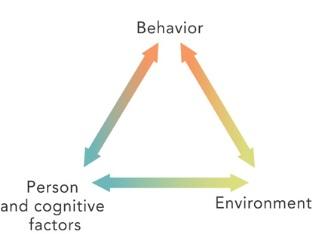
{I’m outgoing (behavior), I choose to teach b/c it lets me be outgoing (environment), and I have thought this through which is why I teach despite making less money (cognitive)}
- Self-efficacy: belief that one can succeed, so you ensure you do
- Internal locus of control: you control your own fate
- External locus of control: chance / outside forces control your fate
What’s wrong with social-cognitive? – Too specific, cannot generalize
What’s good about it? – Highlights situations, and cognitive explanations of personality
How do we test it? – Observations & interviews (time consuming)
Testing &
Individual Differences
(5-7%)
Individual Theories about Intelligence
- GALTON: 1st to suggest intelligence was inherited. Intelligence based on muscle strength, size of head, reaction time, etc.
- CATTELL: 2 clusters of mental abilities
- Crystalized intelligence: reasoning and verbal skills - what you learn in school – the cold hard (like crystals!) facts
- Fluid intelligence: spatial abilities, rote memory, things that come natural to you – can’t learn in school. Also decrease over time
- SPEARMAN’S G FACTOR: said a general intelligence (g) underlies all mental abilities (typical IQ of today)
- GARDNER: multiple intelligences (8): linguistic, logical-mathematical, musical, spatial, bodily-kinesthetic, intrapersonal (self), interpersonal (social), naturalist
- STERNBERG: TRIARCHIC THEORY
- Analytical: mental components to solve problems, what IQ tests assess (book smarts)
- Practical: ability to size up new situations and adapt to real-life demands (street smarts)
- Creative: intellec tual and motivational processes that lead to novel solutions, idea, products
- BINET: developed 1st intelligence test, combined with TERMAN – developed the STANFORD-BINET IQ TEST
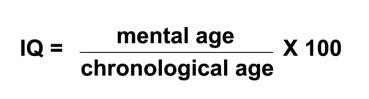
- Chronological age = actual age
- Mental age = tested age compared to other of that age
- 100 is average
- WECHSLER: developed the WAIS and WISC – most commonly used today
- FLYNN effect: IQ has steadily risen over the past 80 years – probably due to education standards and better IQ tests
- Extremes of Intelligence: high IQ = above 135; mentally retarded = below 70
- Causes of mild retardation:
- PKU – liver fails to produce an ezyme needed to breakdown chemicals – leads to brain damage
- Down syndrome – extra copy of 21st chromosome
- Fragile X – higher chance in boys due to ONE X chromosome
- Influence on IQ:
- Genetics: MZ twins have similar IQ, adopted kids more similar to biological parents
- Environment: early neglect leads to lower IQ, good schooling to higher IQ
- Types of Tests:
- Aptitude: predicts your abilities to learn a new skill (ASVAB)
- Achievement: tests what you know(SAT)
- TEST CREATION:
- Standardization: administer a test to a representative sample of future test takers to establish a basis for meaningful comparison (test it out 1st)
- Should be reliable: same results over time
- Split-half reliability: compare two halves of the test
- Test-retest reliability: use the same test on 2 different occasions
- Should be valid: test is accurate – measures what it is intended to
- Content validity: test measures what you want it to (an IQ test actually measures IQ)
- Predictive validity: test is able to accurately predict a trait (high math scores predicts good engineer)
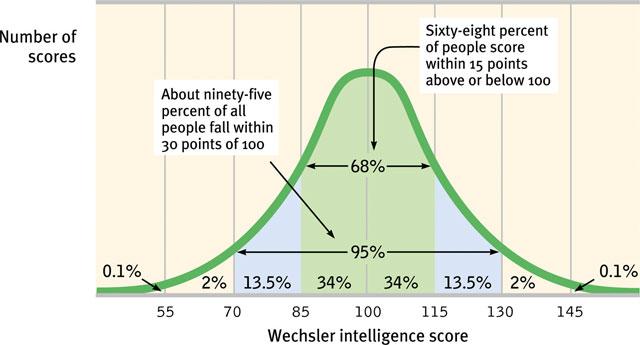
- Standardized tests establish a normal distribution
- Standard deviations are used to compare scores.
- Standard deviation measures how much the scores vary from the mean. The percentages stay the same in every curve
Abnormal Behavior
(7 – 9%)
- Defining abnormal behavior:
- Requires “clinically significant” disturbance in cognition, emotional regulation or behavior AND
- Significant distress or disability social situations, occupations or other important activities
- Historical causes: biology, psychological issues, supernatural issues (demons)
- Medical model: emphasizes treatment of disorders, as they have a biological origin. Came through the reformation of institutions in U.S. (DORTHEA DIX)
- Biopsychosocial model: currently used model – stress biological, psychological, and social causes
- Diagnosing abnormal behavior:
- DSM: manual listing all currently accepted psychological disorders. Classifies them based on criteria – provides no explanation of causes or treatments
ANXIETY DISORDERS
Most common disorders in the U.S.
- Generalized Anxiety Disorder (GAD): person is generally anxious, all the time, for NO REASON
- Panic Disorder: person is prone to frequent panic attacks (feeling like you’re having a heart attack). Can come w/ agoraphobia: anxiety about being in places you cannot escape (fear of public spaces / people)
- Phobias: irrational fear that disrupts your life
CAUSES OF ANXIETY DISORDERS:
- Psychodynamic: repressed thoughts & feelings manifest in anxiety and rituals
- Behaviorist: fear conditioning leads to anxiety, which is then reinforced. Phobias might be learned through observational learning
Biological: natural selection favored those with certain phobias (heights). Twins often share disorders. Often see less GABA in the brain
- Obsessive-compulsive Disorders (OCD): person sf overwhelmed with both:
- Obsessions: persistent unwanted thoughts (did I leave the stove on?)
- Compulsions: senseless rituals (hand washing)
- Post-traumatic stress disorders (PTSD): characterized by flashbacks, problems w/ concentration, and anxiety following a traumatic event (war, natural disasters)
SOMATOFORM DISORDERS
- Psychological disorders w/ no apparent physical cause
- Conversion disorder: loss of feeling or usage of a limb or body part (sight) – absolutely no physiological cause though
- Illness Anxiety Disorder: person interprets normal symptoms as a major disease – must disrupt their life
DISSOCIATIVE DISORDERS
- Dissociative Identity Disorder: formerly multiple personalities – person fractures into several distinct personalities who normally have no awareness of each other. NOT SCHIZOPHRENIA!
- Usually caused by traumatic childhood abuse
- Legitimacy is doubted by some, more common in those w/ good health insurance
- Treatment involves integration of the personalities
- Dissociative Amnesia + Fugue: following a traumatic event a person leaves, taking on a whole new life & personality w/ no memory of the previous one
DEPRESSIVE DISORDERS
- Major depressive disorder: extreme sadness and despair, apathy towards life, w/ no known cause
- Disruptive mood regulation disorder: Frequent temper tantrums inconsistent with developmental level
- Seasonal Affective Disorder (SAD): form of depression that occurs typically winter – found mostly in Northern areas (Alaska, Ireland) UNIQUE TREATMENT = LIGHT THERAPY
BIPOLAR DISORDERS
- Bipolar disorder: bouts of severe depression & manic episodes
- Mania: heightened mood, characterized by risky behaviors, fast talking, flights of ideas
CAUSES OF DEPRESSIVE AND BIPOLAR DISORDERS
- Biology: lower levels of serotonin & norepinephrine linked to depression, higher levels of norepinephrine linked to mania. Runs in families suggesting GENES. Twin studies also support this.
- Cognitive: negative thought patterns leads to depression
SCHIZOPHRENIA
NOT MULTIPLE PERSONALITIES! THEY HAVE ONE PERSONALITY!
- SYMPTOMS
- Positive Symptoms (not good – means something added))
- Hallucinations: sensory experiences w/o sensory stimulation (seeing and/or hearing things)
- Delusions: fixed, false beliefs (people are out to get them, grandiose thoughts (I am God)
- Disorganized thinking
- Disorganized speech
- Negative Symptoms (something taken away)
- Flat affect: lack ability to show emotions
- Impaired decision making, inability to pay attention
- Catatonia: become frozen over periods of time (exhibit waxy flexibility: can move them into new positions)
- Positive Symptoms (not good – means something added))
- CAUSES OF SCHIZOPHRENIA
- Brain abnormalities: enlarged ventricles (atrophy), smaller frontal cortex
- Genetics: runs in families, MZ twins at higher risk
- Dopamine hypothesis: too much dopamine in the brain
- Diathesis – Stress: individual has a genetic predisposition, disease must be “turned-on” by environmental stimuli (like stress) – explains why it is most commonly developed during college years
PERSONALITY DISORDERS
- Marked by disruptive, inflexible, enduring behavior patterns – makes this very difficult to treat!
- Antisocial: NOT “avoidant of socialization” – more like “anti-society” – disregard for others, manipulative, breaks laws
- Borderline: instable interpersonal relationships & self-image, “I hate you, don’t leave me”
- Histrionic: excessive emotionality & attention seeking
- Narcissistic: need for admiration & lack of empathy (who cares about everyone else – look at me!)
Treatment of Psychological Disorders (5-7%)
- PSYCHODYNAMIC APPROACH: SEE PERSONALITY SECTION
- HUMANISTIC APPROACH:
- Client-centered therapy: (developed by CARL ROGERS) techniques include active listening, accepting environment, focuses on patient growth (you figure out what needs to change and do it)
- COGNITIVE APPROACH:
- Rational-emotive therapy: (developed by ELLIS) techniques include analyzing self-defeating behaviors to change thought patterns – and then change behaviors associated w/ said patterns
- Best for anxiety disorders
- Very confrontational
- Cognitive therapy: (developed by BECK) illogical thoughts → psychological problems, challenges those thoughts
- Best for depression
- Self-directed – you figure out your errors
- Rational-emotive therapy: (developed by ELLIS) techniques include analyzing self-defeating behaviors to change thought patterns – and then change behaviors associated w/ said patterns
- BEHAVIORAL APPROACH (typically used for anxiety disorders / phobias)
- Classical Conditioning:
- Counterconditioning Little Albert & Watson
- Aversive conditioning: associate an unpleasant experience (e.g. nausea) w/ an unwanted behavior (e.g. drinking alcohol)
- Exposure therapy: slowly expose people to whatever it is that makes them anxious
- Systematic desensitization: associate a pleasant relaxed state w/ gradually increasing anxiety triggering stimuli (create a desensitization hierarchy – ex. List of things about flying that makes you nervous – step through each one till you can do it)
- Intensive exposure therapy (Flooding): force someone to experience the fear (afraid of drowning, throw you in a pool)
- Counterconditioning Little Albert & Watson
- Operant Conditioning: use behavior modification (reward good behaviors w/ token reinforcers ). Used in schools, w/ autistic children, etc.
- Classical Conditioning:
- OTHER THERPAIES:
- Family therapy: treats the family as a system, individual behaviors are influenced by family dynamics
- Group therapy: therapy through a group – lets patients see “they’re not alone”
- BIOLOGICAL APPROACH: CALLED BIOMEDICAL THERAPIES
- Drug therapies (psychopharmacology):
- Anti-psychotics: decrease dopamine: treats schizophrenia
- Side effects: TARDIVE DYSKINESIA: hand tremors (similar to Parkinson’s- due to lack of dopamine), worsening of negative symptoms, extreme sedation
- Drug names: thorazine, clozapine
- Anti-depressants: increase serotonin through REUPTAKE inhibition
- Side effects: drowsiness, anxiety, can increase suicide risk in teens
- Drug names: SSRIs (selective serotonin reuptake inhibitors) like Prozac, Zoloft, Paxil. SNRIs (selective norepinephrine reuptake inhibitors) Cymbalta, Effexor
- Mood stabilizers: used in the treatment of BIPOLAR disorder : LITHIUM
- Anti-anxiety drugs: depress the central nervous system (dangerous in combo w/ alcohol) Xanax, Ativan
- Anti-psychotics: decrease dopamine: treats schizophrenia
- Electroconvulsive therapy (ECT): send electricity into the brain to induce minor seizures. Used (rarely) to treat depression (when nothing else works). Thought to “reboot” the brain
- Psychosurgery (frontal lobotomy): frontal lobe is surgically destroyed. Used to treat depression or violent individuals – almost never used anymore
- Drug therapies (psychopharmacology):
Social
(8-10%)
SOCIAL THINKING
- Attribution theory: we explain others behaviors by crediting the situation or the person’s disposition (they only passed b/c they cheated)
- Fundamental attribution error (very similar to Actor-observer bias): tendency for observers to underestimate the importance of the situation and overestimate the impact of personal disposition (that guy cut me off b/c he’s a jerk – not that his wife could be in labor)
ATTITUDES AND ACTIONS
- Central route to persuasion: change people’s attitudes through logical arguments and explanations. Leads to long term behavior change
- Peripheral route to persuasion: change people’s attitudes through incidental cues (like a speaker’s attractiveness). Leads to temporary behavior changes
- Foot in the door phenomenon: complying w/ a small request then leads to going along w/ a larger request (can I have $5? Yes. Now can I have $25?)
- Door in the face phenomenon: a large request is turned down, when then leads you to be more likely to comply w/ a small request (can I have $100? Heck no! How about $20? Okay)
- STANFORD PRISON EXPERIMENT (ZIMBARDO): classic “experiment” where individuals were assigned to be guards / prisoners. w/in days they took on their roles and went too far. Highly unethical
- Cognitive dissonance (FESTINGER): two opposing thoughts conflict w/ each other, causing discomfort (dissonance), which makes us find ways to justify the situation (cult that was going to be abducted by aliens, smokers)
SOCIAL INFLUENCE
- Conformity: classic experiment done by ASCH – showed lines of different lengths, confederates gave wrong answers to see if others would go along w/ it
- Normative social influence: we conform to gain approval or to not stand out from the group (be part of the norm
- Informational social influence: we conform to others b/c we think their opinions must be right
- Obedience: classic experiment done by MILGRAM: participants were to “teach” another individual using shocks. 60% of participants would administer lethal shocks to another person simply b/c they were told to
GROUP INFLUENCE
- Social facilitation: perform better on simple or well learned tasks in the presence of others
- Social loafing: tendency for ppl in a group to exert less effort when pooling their effort together (tug of war)
- Deindividuation: loss of self-awareness and self-restraint occurring in group situations that foster arousal and anonymity (mob mentality)
- Group polarization: the more time spent w/ a group the more similar (polarized) their thoughts / opinions will become
- Groupthink: desire for harmony w/in a group leads to everyone going along w/ the same thinking, ignoring other possibilities or bad ideas
- Risky shift: groups make riskier decisions together rather than alone
PREJUDICE
- Ingroup: “US” – ppl w/ whom we share a common identity
- Outgroup: “them” – ppl perceived as different or not part of the group
- Ingroup bias: tendency to favor our own group
- Scapegoat theory: prejudice offers an outlet for anger by providing someone else to blame
- Ethnocentrism: tendency to see your own group as more important than others
- Just-world phenomenon: tendency for ppl to believe that the world is just and therefore ppl get what they deserve (homeless ppl)
AGGRESION
- Genetic influence: runs in families, can breed for in animals
- Lower serotonin, higher testosterone
- Environmental influence: social learning theory (BANDURA) – observing violence in others makes us more violent for a time
- Also: pollution, crowding, heat, humidity
- Frustration-aggression hypothesis: frustration creates anger, which leads to aggression
ATTRACTION
- Mere exposure effect: repeated exposure to novel stimuli increases liking of them (the more time you spend around something the more you like it)
- Physical attractiveness: pretty ppl are thought to be more credible, less likely to do bad things
- Similarity: we prefer ppl similar to us
ALTRUISM
- Altruism: unselfish regard for the welfare of others

- Bystander effect: the more ppl around the less likely we are to help someone in need (Kitty Genovese)
- Social exchange theory: social behavior (helping) is an exchange process – aim is to maximize benefits and minimize cost
- Reciprocity norm: we give so we can get
CONFLICT
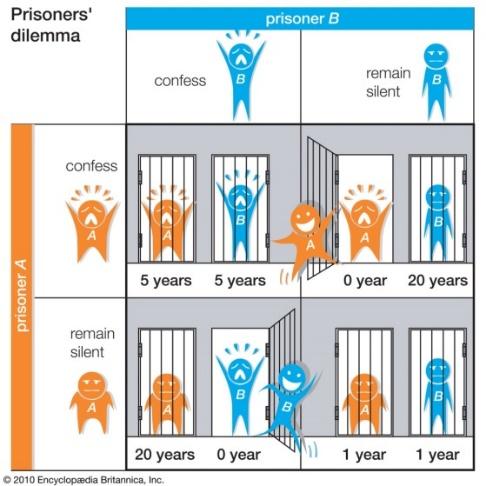
- Social trap: conflicting parties pursue their own best interests, which can result in destructive results (prisoner’s dilemma – game theory)
- Approach approach conflict: win – win situation; conflict is which win you have to choose (you can eat out at ONE of your two favorite restaurants – you can only choose one though)
- Approach avoidance conflict: win – lose situation; outcome has positive and negative aspects (marriage)
- Avoidance avoidance conflict : lose – lose; both outcomes are bad but you have to choose one (clean your room or do your homework)
- Multiple approach avoidance conflict: two (or more) win-lose situations; conflict is which to choose (College A is good for your major but no scholarship, College B is bad for your major but has a scholarship)
SOCIAL SELF
- Self-concept bias: what we consider important in ourselves is what we consider important in others
- False-consensus effect: we overestimate the degree to which everyone else thinks / acts the way we do
- Self-fulfilling prophecy: a belief that leads to its own fulfillment (I expect you all to pass, you know this, you study – fulfilling my prophecy)
- Self-serving bias: readiness to perceive ourselves as favorably
- Spotlight effect (self-objectification) : tendency of an individual to overestimate the extent to which others are paying attention to them