Critical Thinking

The most important thing human beings do is learn how to think. This is important for two reasons: it is important to human beings because thinking is the most distinctively unique fact about humans—both rationally and abstractly. Thinking is also important because it is the most wide-reaching capacity humans have—touching virtually all aspects of their lives. Having a heart pumping blood or a body capable of certain physical activities might be more fundamental, meaning more crucial to simply surviving, but thinking underlies a broad range of activities without which human beings would be living less than full human lives.
Lesson 1.1: Critical Thinking
Critical Thinking Defined
Critical thinking is primarily the ability to think carefully about thinking and reasoning—to criticize your own reasoning. "Criticize" here is not meant in the sense of being mean or talking down or making fun of. Instead, it is used in the sense of, for example, how a coach might take a critical stance toward a players' skills—he throws high every time, she does not lead with her foot, they ride too forward in the saddle, etc. "Critical" here means something more like "reflective," "careful," or "attentive to potential errors."
To engage in critical thinking is to engage in self-critical, self-reflective, self-aware thinking and reasoning—thinking and reasoning aimed at self-improvement, at truth, and at careful, deliberate, proper patterns of reasoning.
Critical thinking has many definitions, but here are just a few:
Being curious and thinking creatively: not believing things are simple and settled, being willing to go the next step and think about all relevant positions and arguments before settling into a belief.
Separating the thinker from the position: being able to discuss a position without attacking or judging the person holding the position, without getting caught up in our own attachment to a position, and without having our identities wrapped up in a particular viewpoint or opinion.
Knowing oneself enough to avoid biases and errors of thought: being aware of the flawed patterns of reasoning we are disposed to engage in, being aware of cognitive biases and mental heuristics (rough rules that work well enough to survive but don't work in many cases) that we're prone as a species to have, all in the interest of counteracting these biases and flaws.
Having intellectual honesty, humility, and charity: being honest about what we know and how we know it, what evidence we have and what questions are not yet settled; being humble in recognizing the vast number of things we don't yet know or understand and in recognizing how very difficult it is to truly know anything at all and so recognizing that the standards are high and we, most of the time, don't meet them (and that's okay); and being charitable or having the disposition to attribute the best intentions and most sophisticated positions and arguments that we can imagine to our opponents in arguments.
Understanding arguments, reasons, and evidence: thinking carefully about thinking, about arguments and positions.
Being a critical thinker involves training yourself to have a lot of good habits and dispositions. It involves developing rational virtues so that when the time comes to think about something complex, you are naturally disposed to think well. It does not happen overnight and no one is born with it. We all need to train ourselves and educate ourselves to stay guarded against errors in reasoning.
Lesson 1.2: Propositions
Propositions
What makes good arguments good and bad arguments bad? How can you make a series of statements and then have "proven" or "demonstrated" a further statement? To understand arguments, start with the fundamental building blocks: propositions or statements.
Propositions are statements that can be true or false. This is the fundamental concept. Take the time to understand it clearly.
If a sentence can be true or false, then it expresses a proposition. Note that a sentence and a proposition are not the same thing. Not all sentences express propositions.
When we reason, we make statements or consider statements and then we back those statements up with reasons and evidence, draw out the implications of those statements, and so on. For our purposes, a statement and a proposition are the same thing.
Non-propositions
Some sentences do not express propositions at all. This means they cannot be true or false. You cannot disagree with them; you cannot argue about whether they are right or wrong; you cannot question them simply because it would not make any sense to disagree with them.
If I said, "Can we please go out to dinner tonight?" you cannot respond with disagreement, saying, "I don't know about that claim. It doesn't sound right to me." I have not made a statement, so you cannot say I have stated something false. Similarly, if you say, "Wash your hands before dinner," I cannot respond with "That's false." It would not make any sense.
These types of sentences do not express propositions. They are non-propositions.
Non-propositions are not statements about matters of fact. They do not make a claim that can be true or false.
They do these things:
Exhort: Let's go get dinner! Let’s go hiking on Tuesday!
Command: Go to the store later to buy me some cheese. Don't do that.
Plead/Request: Would you please stop that? Please read me a bedtime story!
Question: What is the capital of Florida? How much do the pineapples cost?
Perform: I hereby adjourn this meeting. I pronounce you husband and wife!
Lesson 1.3: Complex Propositions
Complex Propositions
Sometimes propositions are simple, and sometimes they are complex. This means sometimes they can be broken down into simpler propositions, and sometimes they are already as simple as they could be.
Simple propositions have no internal logical structure, meaning whether they are true or false does not depend on whether a part of them is true or false. They are simply true or false on their own.
The Gross Domestic Product (GDP) of Canada is $1.7 trillion.
The sky is blue.
Freedom should be the highest value for its citizens.
Harry Potter wears glasses.
Complex propositions have internal logical structure, meaning they are composed of simple propositions. Whether complex propositions are true or false depends on whether their parts are true or false and how those parts are connected.
The GDP of Canada is either $3 trillion or it is $12 trillion.
True whether the GDP is $3 trillion or the GDP is $12 trillion
The sky is blue, but it does not look blue to me right now.
True if the sky is blue and it does not look blue to me right now
If freedom should be the highest value for its citizens, then we should promote it in our laws and policies.
True if it cannot be that "freedom should be the highest value for its citizens" is true while "we should promote freedom in our laws and policies" is false.
Complex Propositions Continued
In short, each proposition is either a simple proposition or a combination of simple propositions. Simple propositions are true or false just based on how the world is, whereas complex propositions are true or false just based on whether or not the simple propositions that make them up are true or false and the logical relationships between those simple propositions.
I am an elephant.
This is a false proposition if I say or think it. It is false because of the way the world is—I am not, in fact, an elephant.
I am an elephant, or I am a human.
This is a true complex proposition if I say or think it. The way "or" propositions work is that only one of the simple propositions needs to be true. The left proposition, "I am an elephant," is false, but the right one, "I am a human," is true.
Breaking Down Complex Propositions
We can learn to break complex propositions down into parts. This is an important skill to grasp so that you can understand all of the separate claims someone is making in a single sentence. People often make a host of claims in a single sentence, and you will want to be able to separate them.
Breaking down complex propositions usually involves identifying the little sentences that make up a complex sentence. In the sentence "Bobby doesn't want to play basketball, but he does want to play video games," Notice that the "but" connects two independent thoughts: Bobby does not want to play basketball. Bobby wants to play video games.
"Either you know everything there is to know, or I'm a fool and you're not as smart as I thought you were." This sentence breaks down into three separate propositions, since there is an "either . . . or . . ." and also an "and."
Breaking down complex propositions means separating out the statements that can be independently true or false. It is a bit tricky and interpretive, but we are just trying to grasp the basic concept here.
Words Used to Identify Independent Propositions
For now, it is good to understand the basic idea: some propositions do not have multiple parts that can be true or false independently, while others do. Words like "and," "or," "either . . . or . . .," "but," and "if . . . then . . ." are used to identify multiple independent propositions.
Marcos is taking four courses this semester and working in his parents' store 20 hours a week.
○ Marcos is taking four courses this semester.
○ Marcos is working in his parents' store 20 hours a week this semester.
Frankie, Johnny, and Luigi went to dinner
○ Frankie went to dinner
○ Johnny went to dinner.
○ Luigi went to dinner.
Karen is smart but not very motivated to do well in school or to try to find a job that uses her talents.
○ Karen is smart.
○ Karen is not very motivated to do well in school.
○ Karen is not very motivated to try to find a job that uses her talents.
Now it is clear there is an important difference between sentences that express propositions and those that do not. In addition, some sentences express multiple simple propositions, and some express only one simple proposition.
Lesson 1 Summary
Take a moment to reflect on what you have learned: (10 minutes):
Propositions are statements that can be true or false.
Propositions are either simple or complex. Complex propositions are composed of multiple simple propositions.
Simple propositions are true or false based on how the world is, while complex propositions are true or false based on whether the simple propositions that make them up are true or false and how they are connected.

Lesson 2.1: Premises and Conclusions
Premises and Conclusions: Argument Anatomy
All arguments have a common anatomy:
Premise: All poodles have curly hair
Premise: Some humans have curly hair
Conclusion: Therefore, some poodles are humans.
There may be many premises, but they are all supposed to be statements (propositions) that support or demonstrate the conclusion—whether directly or indirectly. A premise is a proposition lending support to the conclusion. Premises are supposed to be statements that, if you accept they are true, give you reason to believe that the conclusion is also true. Here is an example of an argument:
All roses are red
All red things are ugly
All roses are ugly
If it is, in fact, true, all roses are red, and if it is, in fact, true, all red things are ugly, then it follows that all roses are ugly.
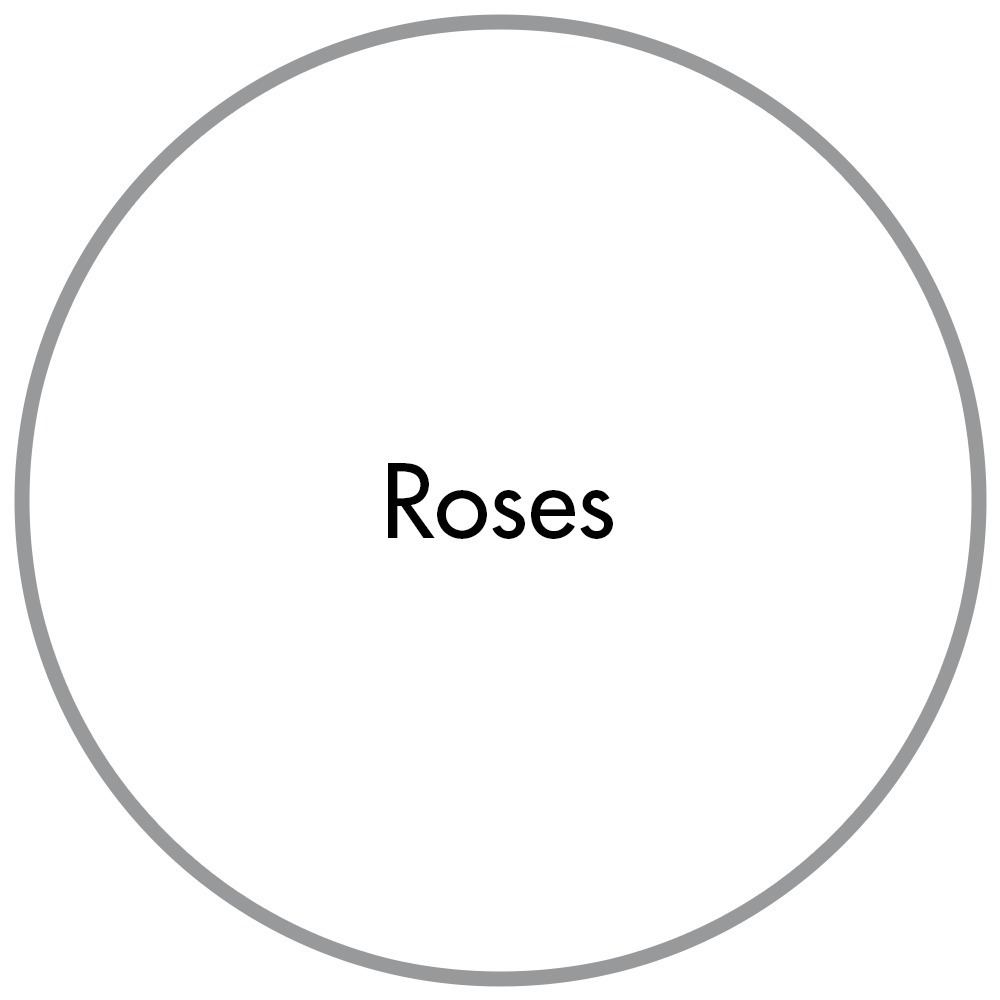
Here are all the roses:
Here are all the red things:
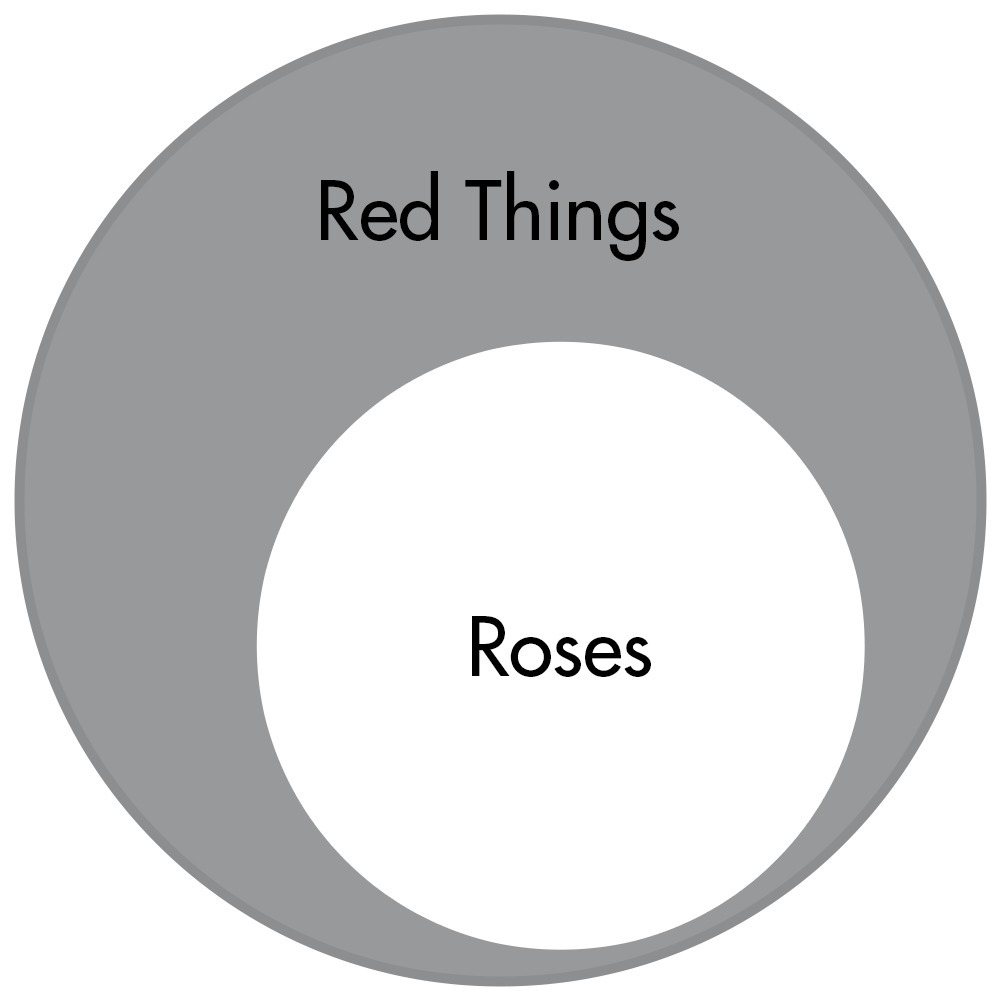
According to the first premise, all the roses are red things. Notice how all of the roses fit inside all the red things? This is a graphical way of representing the claim that there are no roses outside of the category of red things. If you are looking for a rose, you are looking for a red thing. No non-red roses. All roses are red.
Here are all the ugly things:
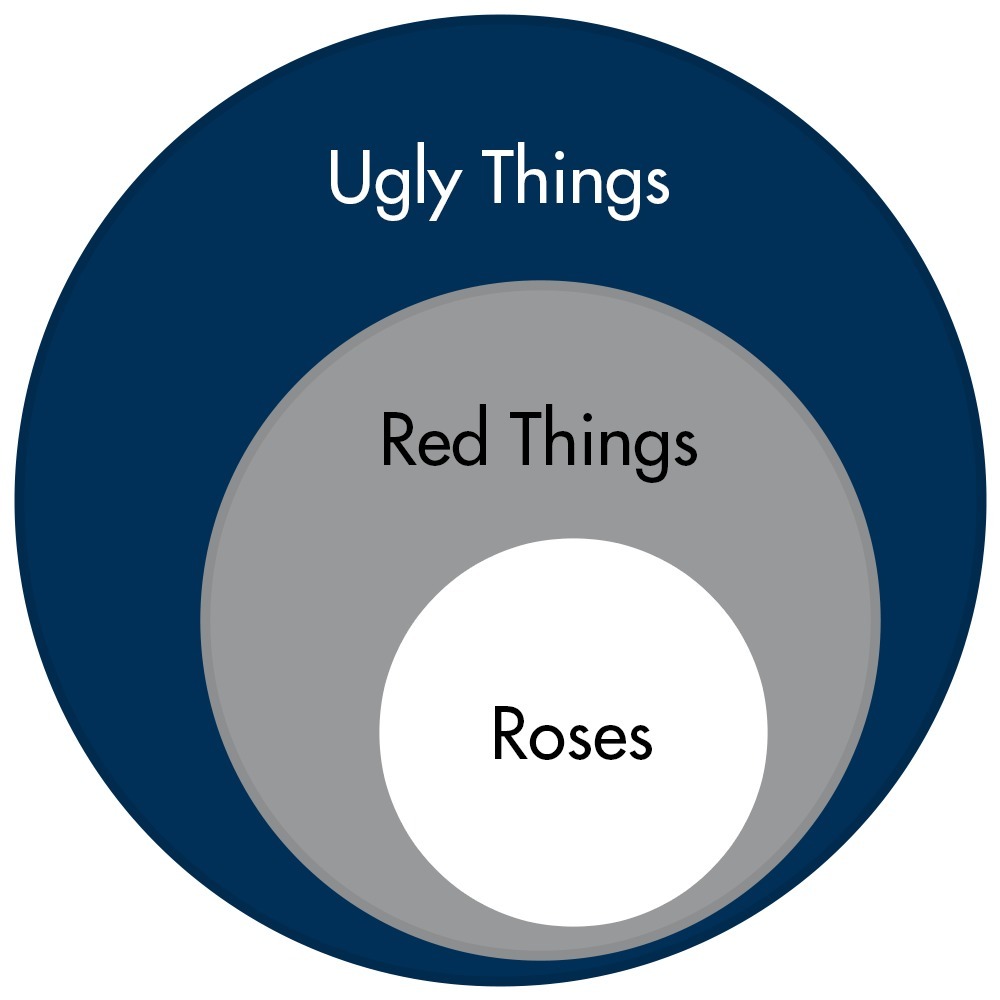
According to the second premise, all the red things are ugly things. See how they all fit inside the circle? Well, if the roses are in the red things circle and the red things circle is in the ugly things circle, it follows that the roses circle is in the ugly things circle.
Notice how we probably do not want to accept the conclusion here. Most of us think roses are beautiful or at least they are not ugly. So we do not like this argument. But we cannot, when rejecting an argument, reject the conclusion directly. Why? Because the premises logically lead to the conclusion. If the premises are true, then the conclusion is true. We have to, therefore, reject one of the premises here. The second premise is clearly false. There are many pretty and red things. Red roses for instance. Furthermore, not all roses are red! The two premises were false in this case. If, however, you thought both premises were true, logically you would have to accept the conclusion as well.
Logical Relationship
Imagine your two friends are dating. If you want to invite one of them to hang out in a group setting, both of them will generally want to come.
They have a relationship with one another such that if you invite one, you have to invite the other as well. This is sort of how premises and conclusions work. They have a logical relationship with one another such that if you think the premises are true, and the argument is well formed, you should also think that the conclusion is true.
The previous argument illustrates the point that arguments sometimes are bad. There are sometimes reasons to reject an argument (mind you, not to decide that its conclusion is false, but instead to decide it did not demonstrate its conclusion).
Arguments can go wrong in only two ways:
Bad inferential structure: In arguments with a bad form or structure, the premises do not, in fact, demonstrate or maybe even support the conclusion. In other words, we can accept the premises as true without being logically compelled to accept the conclusion.
False premise: In arguments with false premise(s), there is something wrong with their particular content.
Argument Defined
Matthew J. Van Cleave wrote this about premises and conclusions in Introduction to Logic and Critical Thinking:
All arguments are composed of premises and conclusions, which are both types of statements. The premises of the argument provide a reason for thinking the conclusion is true. And arguments typically involve more than one premise. A standard way of capturing the structure of an argument is by numbering the premises and conclusion. (1)
For example, consider the following argument:
"The new tax proposal is a good idea because it will help our school system, and anything that can help our school system is a good idea."
We would capture the structure of that argument like this:
Anything that can help our school system is a good idea.
The new tax proposal will help our school system.
Therefore, the new tax proposal is a good idea.
Van Cleave continues:
By convention, the last numbered statement (also denoted by the “therefore”) is the conclusion and the earlier numbered statements are the premises. This is what we call putting an argument into standard argument form. We can now give a more precise definition of an argument. An argument is a set of statements, some of which (the premises) attempt to provide a reason for thinking that some other statement (the conclusion) is true. (1)
Note that this argument example, like all the examples in this course, is not an attempt to convince you (the learner) that the conclusion really is true. Ultimately, the examples here are meant to illustrate key critical thinking concepts so you can effectively analyze and evaluate claims and arguments for yourself.
How do we identify premises and conclusions?
We can sometimes identify premises and conclusions simply by recognizing the role they play in an argument. Here is an example argument:
The overdevelopment of land is endangering butterfly populations. In developing land, humans often remove milkweed, which is an essential food source for butterflies.
Two claims are being made here. The first asserts that there is a connection between overdevelopment and endangering butterfly populations. But this raises the question: Why should we believe there is any such connection? The second claim answers that question: Because overdevelopment removes a food source that is essential for sustaining butterfly populations. So, the second claim provides a reason to believe the first claim. That means the first sentence is the conclusion of the argument (the claim being supported), and the second sentence is the premise (the claim supporting the conclusion).
A second way we can recognize conclusions and premises is by identifying certain words being used: these are called conclusion indicators and premise indicators. If one of these is used, typically that means that you have spotted a conclusion or a premise (depending on the indicator).
Lesson 2.2 Premise and Conclusion Indicators
Premise and Conclusion Indicators
Conclusion indicators all have the general sense of "I have told you some things or I am about to tell you some things, now here is what I want you to believe." They feel conclusive. Here are some especially common ones:
Therefore
So
It follows that
Hence
Thus
Entails that
We may conclude that
Implies that
Wherefore
As a result
Premise indicators have the general sense of "from this fact I am going to infer something else." Here are some common premise indicators:
Because
For
Given that
In that
As
Since
As indicated by
Here is an example argument with several indicators:
In that the legislature has not approved it, and given
it is unconstitutional for me to do it on my own, I
must conclude there is no legal way for me to
complete the project using only executive orders and
the budgetary authority given to the executive branch.
Furthermore, as indicated by the general lack of public
support for the plan, it follows that I will be acting
in line with the popular will on this issue.
Therefore, I must not allocate money to make
Fridays "free pizza days" since to do so would be a
great abuse of executive power.
Parts of Any Argument
The conclusion is the claim that the whole argument is intended to support or demonstrate or prove. It is the reason we make an argument: to support or demonstrate the conclusion.
The premises are the claims, evidence, and ideas intended to support the conclusion. They are the assumptions we are asked to make. If they are true, and the argument has a good inferential structure, then the conclusion either must be or is likely true as well.
Premises make you ask, "Okay, but what does that mean? What's the point? Why tell me that?"
Canada spends more on researching fishing than on conservation initiatives.
Okay. Why are you telling me this?
Conclusions make you ask, "Okay, but why would anyone believe that? Give me reasons or evidence for accepting that claim."
The Sun Blazers are by far the best basketball team this season.
Wait, why do you say that? What is your evidence?
Lesson 2.3: Practice
Practice Examples
Practice identifying premises and conclusions by looking for indicator words. Consider this argument: We must save the wetlands, because wetlands protect us during storms by slowing water surges. Notice the word "because." This is a premise indicator that introduces a proposition supporting the conclusion. That "wetlands protect us during storms by slowing water surges" gives us a reason to save the wetlands.
Now consider another argument: As there has never been a storm of such strength in the Florida Keys, one must conclude there is not likely to be a storm of such strength in the Florida Keys in the years to come. Notice the word "as" and the phrase "one must conclude." "As" is a premise indicator, so "there has never been a storm of such strength in the Florida Keys" is the premise. And "one must conclude" is a conclusion indicator, so "there is not likely to be a storm of such strength in the Florida Keys in the years to come" is the conclusion. Indeed, the claim that there has never been a storm of such strength in the Florida Keys does provide some reason to think that there is not likely to be a storm of such strength in the Florida Keys in the years to come.
Key Terms
Premise: The premises are the claims, evidence, ideas, and so forth intended to support the conclusion.
Conclusions: The conclusion is the claim that the whole argument is intended to support or demonstrate or prove.
Lesson 2 Summary
Take a moment to reflect on what you have learned (10 Minutes):
Arguments are composed of premises and conclusions.
Premises are propositions that are supposed to support the conclusion.
Premises and conclusions often can be identified with the help of indicator words.
 What is an argument? And how is it different from other sets of statements that are not arguments? The key to identifying arguments is to recognize all arguments, and only arguments, have a conclusion supported by one or more premises. Arguments attempt to justify an inference from one or more statements (the premises) to a conclusion. For this reason, the terms "argument" and "inference" are used interchangeably.
Lesson 3.1. Arguments and Non-arguments
Arguments and Non-arguments
The topic is the argument or inference. What is that?
An inference or argument is any purportedly rational movement from premises to a conclusion.
Any time you are being asked to accept one claim on the basis of or because of any number of other claims, you have an inference/argument. "I believe x, because of y, z, and w" or "Because a, b and c, we have to believe that d."
Matthew Knachel in Fundamental Methods of Logic offers more:
If we're reasoning by making claims and backing them up with reasons, then the claim that's being backed up is the conclusion of an argument; the reasons given to support it are the argument's premises. If we're reasoning by drawing an inference from a set of statements, then the inference we draw is the conclusion of an argument, and the statements from which it's drawn are the premises.
We include the parenthetical hedge—"supposed to be"—in the definition to make room for bad arguments. Remember, in logic, we're evaluating reasoning. Arguments can be good or bad, logically correct or incorrect. A bad argument, very roughly speaking, is one where the premises fail to support the conclusion; a good argument's premises actually do support the conclusion.
To support the conclusion means, again very roughly, to give one good reason for believing it. This highlights the rhetorical purpose of arguments: we use arguments when we're disputing controversial issues; they aim to persuade people, to convince them to believe their conclusion. As we said, in logic, we don't judge arguments based on whether or not they succeed in this goal—there are logically bad arguments that are nevertheless quite persuasive. Rather, the logical enterprise is to identify the kinds of reasons that ought to be persuasive (even if they sometimes aren't).(2)
So you have some support for a conclusion, and then you have the conclusion. The relationship between support and conclusion is supposed to be rational—we are supposed to believe that the support we are given proves or demonstrates or gives us reason to believe the conclusion.
An Example
Less abstractly, here is an example:
Bob Marley wrote "One Love"
Bob Marley sang the best rendition of
"Don't Worry, Be Happy"
Bob Marley wrote "Three Little Birds"
Bob Marley wrote "No Woman No Cry"
Bob Marley write "Buffalo Soldier"
So Bob Marley is the greatest musician of all time
We are being asked to believe a number of things here. First, we are supposed to believe that Marley wrote each of these songs. We are also being asked to believe that his version of "Don't Worry, Be Happy" is the best version ever. Finally, and most importantly, we are being asked to believe that because all of these things are true, it follows that Bob Marley is the greatest musician of all time.
This is not a very good argument. You may love Bob Marley and think he has written some of the best songs of all time, but you may not think these premises support the conclusion. That is, even if we accept all these premises, we need not accept the conclusion. "Oh yeah?" someone can reasonably reply, "Those are all amazing songs, yes. And I don't dispute that Marley wrote them. But none of them are as good as Bohemian Rhapsody. Queen is therefore better, and Bob Marley cannot be the greatest musician of all time." There is no inconsistency with believing this argument uses good premises to support a possibly true conclusion but does not really demonstrate the truth of the conclusion with those premises. We can believe the conclusion is true without accepting that the argument supports the conclusion.
Practice Example
Now practice distinguishing arguments from non-arguments. Consider the following sentence: Avery was at the party because you invited Avery. At first glance, this may look like an argument due to the word "because," which often (but not always) introduces a premise of an argument. Notice the invitation just explains why Avery was at the party; it is not meant to support an inference that Avery was at the party. An explanation is not an argument. Neither is a story, a series of disconnected statements, nor any set of statements that does not contain an inferential connection.
Now consider another, superficially similar, sentence: Avery was at the party, because Avery was seen by several other guests. Notice that Avery's being seen by other guests provides a reason to believe that Avery was, in fact, at the party. This is an argument. We are meant to infer the truth of the conclusion, "Avery was at the party," from the premise, "Avery was seen by several other guests."
Lesson 3: Summary
Arguments are purportedly rational movements from premises to conclusions.

This lesson will explore how to distinguish between and evaluate two kinds of arguments: inductive and deductive arguments. Deductive arguments are meant to provide decisive support for their conclusions, and good deductive arguments are said to be both valid and sound. Inductive arguments are meant to provide probable support for their conclusions, and good inductive arguments are said to be both strong and cogent.
Lesson 4.1: Inferences and Critical Thinking
Inferences
Look at two different inferences:
Inference i:
The sign says only 3 more miles to the coast; I suppose we're getting close.
Inference d:
The definition of a front line worker is someone whose job responsibilities include providing immediate medical assistance at the scene of an emergency. Manny's job responsibilities include providing immediate assistance at the scene of an emergency, so Manny is a front line worker.
Notice how even if we accept the premise of inference i, we need not accept the conclusion. Lots of things could make the sign inaccurate. Maybe the coast moved due to erosion or seismic activity, maybe the sign was stolen from its intended location and moved 10 miles inland, maybe the sign was a practical joke in the first place. Who knows?
Inference d, though, is not so open-ended. We have a definition and the claim that an individual meets that definition. If the definition of X is Y and Z is Y, then Z is an X. If we disagree with the conclusion, we either have to reject the definition or the description of Manny. We cannot add new information to change the conclusion. Whatever else may be true of Manny, he is still a front line worker if that is in fact the definition of a front line worker, and if that is in fact a true description of Manny.
The point of comparing inferences i and d is to see the two fundamentally different sorts of inference. We call an inference inductive if the support the premises intend to provide for the conclusion is less than certain—if the premises do not guarantee the conclusion. We call an inference deductive if the premises intend to provide conclusive support for the conclusion—if they intend to guarantee the conclusion or make the conclusion certain.
Kinds of Inferences
Deductive arguments include mathematical arguments like proofs, logical arguments, arguments from definition, and so forth. If the premises are true and the argumentative structure is good, then the conclusion must be true.
Inductive arguments include arguments from analogy, arguments from qualified authority, causal inferences, scientific hypothetical reasoning, extrapolations from samples, and so on. Even if the argumentative structure is great, the truth of the premises only makes the conclusion probably true at best.
There is a third kind of argument where we select the best explanation from all the available plausible explanations. While it is out of the scope of this course, it is still worth noting. This type of argument is sometimes called "inference to the best explanation" or "abduction."
Deduction: arguments where the premises guarantee or necessitate the conclusion
— mathematical arguments, logical arguments, arguments from definition
Induction: arguments where the premises make the conclusion probable
— analogies, authority, causal inferences, scientific reasoning, extrapolations, etc.
Inference to the best explanation or abduction: arguments where the best available explanation is chosen as the correct explanation
Key Terms
Deduction: Arguments where the premises guarantee or necessitate the conclusion
Induction: Arguments where the premises make the conclusion probable
Abduction: Arguments where the best available explanation is chosen as the correct explanation
Lesson 4.2: Truth, Validity, Soundness
Truth and Validity
Truth is a property of propositions. That is, only propositions can be true or false. Arguments can never be true or false. It simply does not make any sense to claim that an argument is true or false.
Deductive argumentative structures are either valid or invalid. An invalid argument structure is one where the truth of the premises is meant to guarantee the truth of the conclusion, but fails to do so.
A valid argument structure is an argument structure where the truth of the premises would guarantee the truth of the conclusion: if the premises are true (please note the word "if"), the conclusion follows necessarily. It is impossible for the premises of a valid argument to be true and the conclusion to be false. If all horses are purple, and Secretariat is a horse, then necessarily, beyond any doubt, Secretariat is purple. It is impossible for that conclusion to be false without at least one of those premises being false as well. If an argument is valid and has all true premises, then its conclusion must be true. However, in this example, the premise "all horses are purple" is false. The argument has a good deductive form, but the content of one of its premises is flawed.
Keep in mind that validity is about structures. So the previous paragraph's argument has a valid structure. All Xs are Y, and Z is an X, then Z is Y. Anything we substitute for the letters, if we create two true premises, will necessitate a true conclusion.
Sound Arguments
What is a valid argument that has true premises? That is called a sound argument. Soundness is about both structure and truth: you must have a good structure and true premises to make a sound argument. All sound arguments are valid, but not all valid arguments are sound. An unsound argument, conversely, is an argument that either is invalid or has at least one false premise.
What is the truth? A proposition makes a statement about the world and the world either is or is not the way the proposition describes it to be. If the world is as the proposition claims it is, then the proposition is true. If the world is not as the proposition claims it is, then the proposition is false. One proposition claims that the gross domestic product (GDP) of the United States of America is approximately $14 trillion. To find out whether this proposition is true or false, figure out what the GDP of the United States is. Find factual evidence using reliable sources. Is it approximately $14 trillion? Another proposition claims that there is a brown cat on the front porch of your house. Is this proposition true? To find out, just look: Is there, in fact, a cat on your front porch? Is it a brown cat?
Propositions
The propositions that make up an argument (the premises and the conclusion) are all either true or false.
Remember: Validity is a property of an
argument structure. It means this
structure is such that if the premises of
any argument with this structure are
true, then the conclusion of that
The argument must be true.
It means arguments of this structure will never have all true premises and a false conclusion. The structure guarantees the truth of the conclusion given the truth of the premises. The structure carries the truth of the premises directly to the conclusion without fail.
A sound argument is an argument that has a valid structure but also has true premises. If an argument is sound, and if validity means the conclusion must be true if the premises are true, then what do we know about the truth of the conclusion of any sound argument? We know that the conclusion of any sound argument is guaranteed to be true. All sound arguments are valid, but not all valid arguments are sound.
Here is a valid argument that is not sound:
All pigs can fly.
Snowball is a pig.
Therefore, Snowball can fly,
If it is true that “Snowball is a pig,” and if it were true that “All pigs can fly,” then it would have to be true that “Snowball can fly.” However, the premise, “All pigs can fly,” is false. So, the argument is valid but unsound.
Here is an argument that is sound:
All planets in our solar system orbit the Sun.
Mars is a planet in our solar system.
Therefore, Mars orbits the Sun.
Notice that this argument has the same structure as the previous one:
All Xs do Y.
Z is an X.
Therefore, Z does Y.
Since the first argument has a valid form, and the second argument has the same form, the second argument is also valid. Indeed, if it is true that “All planets in our solar system orbit the Sun,” and it is true that “Mars is a planet in our solar system,” then it would have to be true that “Mars orbits the Sun.” In fact, both premises of this argument are true, and because the argument is also valid, we know that the conclusion must be true. And it is. So, this argument is both valid and sound.
Truth, Validity, Soundness: Brief
Truth: A true proposition accurately represents reality.
Validity: In a good deductive argument structure, true premises would make the conclusion necessarily true. (If not, it is an invalid structure.)
Soundness: A deductive argument is sound if it has a valid structure and all its premises are true. (If an argument is deductive but has either an invalid structure or at least one false premise, then it is an unsound argument.)
All True Premises + Strong Inductive Support = Cogent Argument
Lesson 4.3: Truth, Strength, Cogency
Inductive Arguments
Switching over to inductive arguments, we find an analogous set of properties. Again, inductive arguments, like all arguments, are made up of propositions, which can be true or false.
The biggest difference between deductive and inductive is that even good inductive arguments only offer probabilistic support for their conclusions. This means that accepting all the premises does not necessitate that one accepts the conclusion; it merely gives one more or less strong reason for accepting the conclusion. An inductive argument can therefore offer stronger or weaker inductive support for its conclusion. We call an inductive argument "strong" when the premises, if true, would demonstrate that the conclusion is likely to be true ("likely" here means that the probability is greater than 50% but less than 100%). We call an inductive argument "weak" when it fails to demonstrate that the conclusion is likely to be true, even assuming the truth of the premises.
"Cogent" and "uncogent" are the words we use in place of "sound" and "unsound" for inductive arguments since inductive arguments cannot be sound or unsound. Cogent, therefore, means all true premises, and the premises give strong inductive support for the conclusion.
Consider these two arguments:
I saw a black cat; therefore all cats are probably black.
I saw the sun rise in the east every day of my life, and everyone I know reports the same, and history books and ancient astronomers report the same, so the sun probably will rise in the east tomorrow.
Notice how the first argument provides pretty weak support for the conclusion. You can believe that the speaker saw a black cat and still think that is a bad reason for concluding that all cats are black. The second argument, though, is much stronger. There is much more evidence, and the nature of the evidence makes the conclusion much more probable given the truth of all of the premises.
Truth, Strength, Cogency: Brief
Truth: Propositions are true if they accurately represent what is the case, otherwise they are false.
Strength: In an inductive argument, the truth of the premises would make the conclusion probably true.
Cogency: An inductive argument is cogent if it is strong and all its premises are true. (If an argument is inductive but either is weak or has at least one false premise, then it is an uncogent argument.)
All True Premises + Strong Inductive Support = Cogency Argument
Again, inductive arguments are collections of propositions. (The premises and the conclusion or conclusions are all propositions.) And each of these propositions might be either true or false depending on whether it accurately describes reality.
Note: An inductive argument cannot be valid. Why? Because a valid argument, if it has true premises, guarantees the truth of the conclusion with 100% certainty. But an inductive argument only justifies its conclusion to some level of probability less than 100%.
Key Terms
Truth: Propositions are true if they accurately represent what is the case, otherwise they are false.
Soundness: A deductive argument is sound if it has a valid structure and all its premises are true. (If an argument is deductive but has either an invalid structure or at least one false premise, then it is an unsound argument.)
Validity: In a valid deductive argument, the truth of the premises would make the conclusion necessarily true. (If not, it is an invalid structure.)
Strength: In a strong inductive argument, the truth of premises would make the conclusion probably true.
Cogency: An inductive argument is cogent if it is strong and all its premises are true. (If an argument is inductive but either is weak or has at least one false premise, then it is an uncogent argument.)

A fallacy is a type of argument that is an example of bad reasoning. Every fallacy is a category of real-world arguments. When a real-world argument belongs to one of these categories, it means this argument does not work—it is not an example of thinking well. We study fallacies because we need to know what they look like when reasoning goes wrong. This helps us avoid it ourselves and be a bit more skeptical about the inferences people around us make.
Lesson 5.1: Formal vs. Informal Fallacies
Types of Fallacies
What is the difference between formal and informal fallacies?
The word "formal" refers to the structure of things. A highly formal dinner is a highly structured dinner. Diners must start eating with the salad fork and work their way in toward the main course utensils before finally using the special utensils set out for dessert at the top of the place setting. Wine must be drunk from wine glasses, port from port glasses, and water from a water glass. And so on. The point is, formality is associated with structure.
So, when you commit the formal fallacy of affirming the consequent, it means you have made an argument with a bad structure. A fallacy is a flawed argument, and a formal fallacy is an argument that has a flawed structure. Alternatively, when you commit an informal fallacy, it means the structure of your argument is not what is at issue. Instead, someone takes exception to the content of your argument. Consider these examples one at a time, so you can see the distinction more clearly.
Affirming the consequent has a structure that is analogous to the following argument:
If I am in New York, then I am in the United States.
I am in the United States.
Therefore, I am in New York.
(Note that in a conditional "if...,then..." statement like the first premise above, the part of the statement immediately after the word "if" is called the antecedent, and the part that comes after "then" is called the consequent.)
If we extract the logical structure of this exchange, we get something like this:
If X, then Y
Y
Therefore, X
The first premise of this argument is a hypothetical “if … then …" statement. Hypothetical statements are complex propositions that contain two simple propositions. The simple proposition that immediately follows the word “if” is called the antecedent, and the simple proposition that immediately follows the word “then” is called the consequent. Arguments of this form are called “affirming the consequent” because the other premise says that the consequent of the hypothetical statement is true. It affirms the consequent,
This structure is a bad argumentative structure.
Notice it is possible for the conclusion to be false even if the premises are true. In fact, it is true that if I am in New York, then I am in the United States. It also happens to be true that I am in the United States. But I am not in New York. I am somewhere else in the United States. The form of a deductive argument, like this one, is supposed to guarantee that if the premises are true, the conclusion must be true. Any deductive argument of this form is an instance of the formal fallacy of affirming the consequent and is invalid.
Another similar formal fallacy is called denying the antecedent, and it has a structure analogous to the following argument:
If I am in New York, then I am in the United States.
I am not in New York.
Therefore, I am not in the United States.
Again, notice that it is possible for the conclusion to be false even if the premises are true. The logical structure of this exchange looks like this:
If X, then Y Not X
Therefore, not Y
See how the second premise says that the antecedent of the first premise is not the case? In other words, the second premise denies the antecedent. Any argument of this form is an instance of the formal fallacy of denying the antecedent and is invalid.
These arguments are fallacious, but they can be psychologically persuasive because they are closely related to two deductively valid logical forms: Modus Ponens (or affirming the antecedent) and Modus Tollens (or denying the consequent).
Here is Modus Ponens:
If X, then Y
X
Therefore, Y
Here is Modus Tollens:
If X, then Y
Not Y
Therefore, not X
If an argument has one of these two valid forms, then no matter what simple propositions X and Y stand for, it is impossible for the conclusion to be false if the premises are true.
Lesson 5.2: Examples of Fallacies
A Word of Caution
The skills you will pick up in this information—skills in identifying fallacies—can often be used as humiliation tactics. This is where the goal is to win and even humiliate rather than to connect and understand, charging someone with making a fallacious argument can be treated as a way of shutting someone out of a conversation. Do not use fallacies this way.
The primary goal of learning how reasoning goes wrong is always to learn to think more clearly and to better yourself. When these tools are used to make you seem more worthy of having your voice heard, they are being misused. So, instead of being on the lookout for bad reasoning in others and being quick to shout "Fallacy!" when someone missteps in their reasoning, be sure to understand the viewpoint of another. Focus on your own reasoning, and the evidence behind the reasoning. When you feel you must educate someone else, do so gently and in a spirit of mutual understanding and charity.
Tied to this idea is perhaps the most important fallacy to be aware of: the fallacy fallacy!
Person E: My opponent has argued that we should lower taxes because it would stimulate commerce. I think we should be focusing on the war we've been fighting instead of arguing about whether or not lower taxes would stimulate the economy.
Person F: Well clearly my opponent has never taken a logic and critical thinking class, because they have just committed a grievous sin against reasoning; the red herring fallacy. I, therefore, conclude we should lower taxes.
Person E is indeed guilty of a red herring: they changed the subject to something irrelevant to the original topic. They started talking about an inference from "lowering taxes would stimulate the economy" to "we should lower taxes." But by the end of Person E's discussion, they were talking about something different: a war. The topic had changed.
That being true, though, does not mean that Person E is wrong about their conclusion. If Person HE wants to focus on war or cut taxes, their reasoning badly in one particular instance does not mean that their position is wrong. It may well be that we should raise taxes. He's just not the best representative of the view. Person F, however, does not understand a basic truth of reasoning: just because an argument for a position is bad does not mean that position is wrong or incorrect.
The fallacy fallacy happens when someone uses the fact that a fallacy was committed to justify rejecting the conclusion of the fallacious argument. Avoid this sort of thinking.
Consider This
Matthew J. Van Cleave, in Introduction to Logic and Critical Thinking, offers examples around formal and informal fallacies:
Consider the following argument:
Capital punishment is justified for a crime such as murder because it is legitimate for a state to put to death someone who has committed such a heinous and inhuman act.
The premise indicator "because" denotes the premise and (derivatively) the conclusion of this argument.
In standard form, the argument is this:
It is legitimate for a state to put to death someone who commits murder.
Therefore, capital punishment is justified for a crime such as murder.
You should notice something peculiar about this argument: the premise is essentially the same claim as the conclusion. The only difference is that the premise spells out what capital punishment means (a state putting criminals to death), whereas the conclusion just refers to capital punishment by name. And the premise uses a term like 'legitimate’ whereas the conclusion uses the related term, "justified." But these differences do not add up to any real differences in meaning. Thus, the premise is essentially saying the same thing as the conclusion. This is a problem: we want our premise to provide a reason for accepting the conclusion. But if the premise is the same claim as the conclusion, then it cannot possibly provide a reason for accepting the conclusion! Begging the question occurs when one (either explicitly or implicitly) assumes the truth of the conclusion in one or more of the premises. Begging the question is thus a kind of circular reasoning.
Another Interesting Feature
One interesting feature of this fallacy is that structurally there is nothing wrong with arguments of this form. Consider an argument that explicitly commits the fallacy of begging the question.
For example,
Capital punishment is permissible
Therefore, capital punishment is permissible
Now, apply any method of assessing validity to this argument and you will see that it is valid by any method. If we use the informal test (by trying to imagine that the premises are true while the conclusion is false), then the argument passes the test, since any time the premise is true, the conclusion will have to be true as well (since it is the exact same statement).
But while this argument is technically valid, it is still a really bad argument. Why? Because the point of giving an argument in the first place is to provide some reason for thinking the conclusion is true for those who do not already accept the conclusion. But if one does not already accept the conclusion, then simply restating the conclusion in a different way is not going to convince them. Rather, a good argument will provide some reason for accepting the conclusion that is sufficiently independent of that conclusion itself. Begging the question utterly fails to do this, and this is why it counts as an informal fallacy.
Whether or not an argument begs the question is not always an easy matter to sort out. As with all informal fallacies, detecting it requires a careful understanding of the meaning of the statements involved in the argument. (1)
Key Terms
Formal Fallacy: The word "formal" refers to the structure of things.
Informal Fallacy: Informal fallacies have a problem with their content.

Lesson 1.1: Sources of Information
Sources of Information
The world is indeed positively saturated with information. Information technology—computers, the internet, mobile networks, online platforms like social media and video and audio hosting platforms, and mobile devices like smartphones—has us embedded in a world where almost any piece of information is readily available. Information is flooded to most people daily in the form of social media posts, podcasts, videos, news articles, and countless other media.
Always start by considering the source of information. Do a little research.
A few questions you can ask yourself include:
Is the website merely a host for people to post their own essays? Is it someone's personal blog? Is the website satire? Is it a deeply ideological source pushing an agenda? What facts from reliable sources are being used to support their claims? Are the sources individuals, professionals, organizations, or government agencies?
Look for independent verification that the source is a good source of information. Finally, when you have found a good source of information, it is a good idea to stick with it, but you must also continue to get information from a variety of sources. Every source has its biases and blind spots, and the best way to get a complete picture is to look at a variety of primary sources. Use reliable news outlets with different political leanings (i.e., don't restrict yourself to news outlets that all lean one way). Follow some international news sources as well. Consulting diverse sources is essential to forming and maintaining a broader, more objective view of the world.
If information you are reading or viewing seems imbalanced, this could indicate that you need to look for alternative or primary sources. Considering all sides of an issue, even those you may not immediately agree with, will give you a balanced perspective with which to develop your own well-informed conclusions.
Is it Biased?
All news is biased in some way or another. News sources CNN, NBC, ABC, MSNBC, and FOX are clearly biased toward the sensational. The bias of sources like NPR and PBS can be harder to identify, but they are biased toward a mainstream status quo ideology. They also tend to follow the "main news story" of the day, and that always has a bias toward the political, the sensational, and the economic.
The question is this: Can you easily identify the bias and then account for that in your assessment of the information given? Can you sort out the facts they are reporting from the assessments of those facts, or are they all intermixed in an inextricable web?
Some sources are not news sources at all because you cannot extricate the facts from the assessment of those facts according to a certain ideology. Talk shows and late night commentators are not news sources; they are sources of political commentary and media criticism. If it is a news source, it should be fairly clear when they are giving you information and when they are offering analysis or assessment of that information.
One quick way to check for bias is to search for the headline on a search engine. Look at who is sharing the news story. Consider whose interests this story seems to serve. Search on social media like Twitter or Facebook and look at which "bubbles" this story is making the rounds in. This can generally be a good guide to which ideological direction this story might be slanted toward. You need to investigate the original source where the information was referenced and review the facts yourself.
Is it Thoughtful and Honest?
Another test is this: Do they consider the possibility that their assessment is wrong? Do they consider the other side fairly? Do they look at compelling narratives and weigh reasons to accept either narrative? Do they consider counter arguments to their analysis? If so, then they are less likely just to be promoting a particular ideology. If not, then they are more likely to be doing so.
Who Funded It?
One way of identifying bias—particularly when it comes to science articles, studies, polls, and so on—is to find out who funded the study or poll. If a study or poll was funded by a commercial organization, then there is a good chance that it would be biased, they might have created the survey internally using guided questions. If a study is industry-funded and has findings supportive of or friendly towards that industry, then you might want to question the results. Be distrustful of a study that has a vested interest in finding a particular outcome.
Does it Try to Get You to Distrust "the Others"?
C. Thi Nguyen clarifies that an echo chamber is an especially problematic social structure in that it not only shows us a partial and incomplete picture of the world, but it also causes us to mistrust sources outside the echo chamber. You will never hear anyone on a credible news source say, "you won't hear this on any other news outlet" or "you can't trust other sources on this because we're the only ones with the inside scoop" or "everyone else has bought into the lie, but we're here to give you the straight truth." If you hear these sorts of phrases, there's a good chance that the narrative they are spinning is biased, incomplete, or simply made up.
Lesson 1.2: Specific Sources
Is it current? Is it local?
Check the timestamp: Is this information recent? If so, is it still relevant? Be careful about a phenomenon called "context collapse," a phrase coined by Danah Boyd. Context collapse means everything on the internet, and particularly on social media, seems to be taking place in [my context] [right now]. If you see an article being shared that says, "our area," for instance, look at the original source and original poster. Is it actually your area? Or is it a different area that only looks like your area because it is taken out of its original context and shifted to your own local context? If you see an article being shared that says, "Unemployment on the rise," for instance, check the timestamp. Is it current? If it is three years old, then unemployment might not be currently on the rise. Time is important to context as well.
Everything we share online seems to be relevant here and now even though it often is not. We just have to do some research to find out whether it is.
Similarly, if someone posted something about a cure being found for COVID-19, but it was posted in 2018, then it is not COVID-19 that they are talking about! Or if the article is from March 2020 and you are reading it now, then that cure was probably not all it was purported to be.
What are others saying about it?
Another way of safeguarding against being duped by false information is to look at the same news story or piece of information from multiple independent sources. Are multiple world governments confirming the same bit of information? Are multiple news outlets with independent sources reporting the same story? Has the story or claim been debunked by other sources? Can we trust the sources doing the debunking? Have you gone to the original source of the data to confirm? Have you looked at sources from a variety of ideological backgrounds to find their takes on the story?
Is it plausible?
We can often independently assess whether something is plausible or not just by using our "common sense." Is it plausible that Mark Zuckerberg is involved in an alien take over? Not really. Be skeptical and consider whether claims are plausible. Go forward with researching the claims further through independent reliable sources only when you have decided it is at least plausible enough to warrant further investigation.
Is it convenient?
If it fits too neatly with a particular narrative about current events, society, or something similar, then it might just be too convenient to be true. Sometimes the truth really does fit a particular narrative, but the more neatly and tidily it does, the more skeptical you should be.
Is it possible that it is a deep fake?
Some information is just fake: it has been created to support a particular narrative or ideology. It is easy to make up quotes, but people are now able to use machine-learning technology to create surprisingly convincing video and audio. People using machine-learning technology can create images, voices, and even videos, and at some point, distinguishing which videos are fake may become impossible.
What then? Well, we may be able to rely on alternative verification for videos. Maybe observers sign affidavits stating that they were there when the video was shot.
Maybe there will be an unfakeable piece of data embedded in real videos. Maybe the sheer number of videos people are likely to take at important events (whether it be news outlets or people on cell phones) will create a sort of public record. These are all questions for another day.
For now, though, remember that the more outrageous or convenient an argument or information is, the more skeptical we should be that it is a genuine video.

Lesson 1.1: Principle of Charity
Sources of Bias
Beliefs are not always formed in the most rational way. In many cases, people are predisposed to arrive at a conclusion. This means that, even if the evidence does not fully support a particular conclusion, a person may be inclined to believe a particular conclusion over the others. This is called exhibiting a bias. This occurs often.
Consider the example of an enthusiastic fan of a sports team who claims that every call a referee makes against their chosen team is incorrect. If everyone else watching the game thinks that the referee is clearly correct, the fan's enthusiasm for the team may be leading them to conclude that the referee must be incorrect without carefully taking all the facts into consideration. In this case, this would be a bias leading the fan to a false belief.
Of course, sports enthusiasm is not the only source of bias in human reasoning. Part of learning to be a good critical thinker is becoming aware of biases in yourself and others and studying common sources of bias is a good way to help you notice these biases. Biases can come from particular situations, like your experiences, desires, and emotions. They can also be due to more general features of the way humans learn and process information.
Be careful, though, not to immediately assume that someone else's beliefs must be due to bias. It is often possible to interpret another's reasoning in multiple ways. Because of this, before attributing bias to someone, try to interpret their reasoning in the best possible light. This is called following the "principle of charity." Consider the value of following that principle before looking over some particular sources of bias.
It is often possible to interpret an argument in multiple ways. Because of this, before we evaluate the soundness or cogency of an argument, we should try to interpret it in the best possible light. This is called following the principle of charity, and it is an important habit for reasoning well.
Always interpret your opponent/interlocutor's position or argument so as to make it as defensible as possible.
There are three reasons for this.
One reason has to do with our goals in having reasoned discussions.
Another reason has to do with simple strategy, if you are indeed interested in winning a debate.
The final reason is a moral reason for following the principle of charity.
If the interest is not in winning, but in understanding, then of course it does not help to argue against the weakest version of someone's position or the weakest justification available for someone's position. For instance, if you want to understand the moral issue of voting rights, then arguing with someone who makes a very weak version of an argument for or against voting rights will not really help you understand the issues at play in the moral debate. You might win the debate on that day, but you will not understand the issue with any more clarity.
Disarm Your Conversant
When you disarm your conversant by letting them know that you understand their position and why someone might believe it, you open the door to more honest and open dialogue that allows for more understanding of each other's viewpoints.
Even if you are interested in winning a debate and you just want the most effective strategy, the principle of charity is still your best bet.
Here is an example of what not to do:
My opponent has argued against the idea that
immigration is a fundamental human right. She must
mean that even amnesty-seekers don't have the moral
right to emigrate away from immediate threats to life
and limb. That position is totally ridiculous.
This is not very interesting. When you are arguing, you want your opponent to be the hardest version of themselves to critique so that when you do critique them, your critique is the most interesting critique available. Think about how much more interesting it is if someone actually bolsters their opponent's position by providing justifications for their position and then showing that their position is still wrong.
That is the best kind of debate.
My opponent has argued against immigration as a
fundamental human right by appeal to simple
scarcity: there's not enough to go around.
This, I'm afraid, is simply false. There is more
than enough to go around if we're willing to
redistribute resources effectively. Never mind that
argument, though, since there's a stronger
justification for my opponent's position: that
states have the fundamental right of sovereignty,
which includes controlling traffic across their
borders. This, we might think, is essential to what
it means to be a state. This is a very interesting
argument, but it still fails to convince me. Even if
states have a right to border regulation, it doesn't
follow that individual human beings don't still
have a right to immigrate to where the greatest
The promise of prosperity is.
Do you find this interesting? Would you not rather be in a dialogue with this person or listen to a debate they are in than someone who only attacks the weakest interpretation of their opponent's position?
Life Principle
You do not want your critique to be against the weakest interpretation of your opponent's position because all they have to do is revise their position slightly and they can side-step your critique. They have been set up to make your critique null and void by simply clarifying their position as the stronger version.
This is also a good principle for living life. Strive to interpret each other's actions and arguments as being as rational as possible so you are in the best standing, rationally speaking. Work to attribute the best, most rational intentions allowable through credible evidence so if a disagreement should arise, at least you have given them the benefit of the doubt and are more likely to correctly characterize what they are saying or doing. Work to ascribe the most defensible and reasonable arguments and claims to people with whom there is a disagreement because the goal is certainly not to spend time critiquing an argument or position that is not theirs. Focus energy on the best position or argument they have available to them because the interest is in finding out what the best thing to believe is—what is true. The goal is not in winning for the sake of winning.
Lesson 1.2: Confirmation Bias
How Our Minds Work
This is a great opportunity to discuss confirmation bias, or the natural tendency to seek out evidence supporting our beliefs and ignoring evidence that undermines our beliefs. Since the topic is dealing with the relationship between evidence and belief, this is a good point to pause and reflect on how our minds work.
The way our minds work naturally, it seems, is to settle on a belief and then work hard to maintain that belief whatever happens. We come to believe that chicken soup cures the common cold, and then we are happy to accept a wide variety of evidence for the claim. If the evidence supports our belief, in other words, we do not take the time or energy to really investigate exactly how convincing that evidence is. If we already believe the conclusion of an inference, in other words, we are much less likely to test or analyze the inference.
Alternatively, when we see pieces of evidence or arguments that appear to point to the contrary, we are either more skeptical of that evidence or more critical of that argument. For instance, if someone notes scientific studies showing that chicken soup does not have any effect on recovery from colds, we immediately will look for ways to explain how the studies must have been flawed. In other words, we are more skeptical of arguments or evidence defeating or undermining our beliefs, but we are less skeptical and critical of arguments and evidence supporting our beliefs.
Lesson 2.1: Cognitive Bias
How Our Minds Categorize
Minds work in interesting ways. A goal of studying critical thinking is to get to know ourselves a bit better. One way to do that is to look at the way our minds are put together and the strange habits of mind that result. In this lesson we will investigate "cognitive biases"— quirks about the way we naturally categorize and make sense of the world around us.
It would be great if humans were built in such a way that beliefs were automatically formed in rational ways, apportioning beliefs perfectly to the evidence available. But that is not how the human mind is constituted. Humans have many general tendencies to jump to conclusions in ways that seem to deviate from perfect rationality. In fact, some of these tendencies are so widespread that some researchers consider them to be relatively hardwired into the human mind. These widespread tendencies to deviate from rational belief-forming practices are called "cognitive biases."
Awareness of common types of cognitive bias can help to mitigate negative effects on our thinking. Just as an auto mechanic's awareness of common ways that a car can fail helps them diagnose, fix, and even prevent breakdowns, learning common ways the human mind can go astray can help us avoid errors in our own reasoning and spot such errors in others' reasoning. For example, if we are aware that we tend to make unjustified inferences merely based on what we can most immediately recall about a topic, then we will be careful to avoid this in practice. Take note of the cognitive biases taught in this lesson and try to see whether you can identify their influence in your own thinking.
Attitudes and Actions
Sometimes attitudes and actions are not based on beliefs that have been reasoned out. In fact, sometimes attitudes and actions seem to directly contradict what may be explicitly believed. For example, some people will feel shaky and nervous when standing securely behind a guardrail at the edge of a great height, even if they know that they are perfectly safe. They believe that they are safe, but they are reacting as if they are not. For another example, people frequently feel fear while watching supernatural horror films even if they fully believe that it is fictional. The philosopher Tamar Gendler coined the term "alief" to refer to the automatic belief-like attitudes that can explain how our instinctual responses can conflict with our reasoned-out beliefs. One might have the belief that they are safe behind the railing, but the alief that they are in danger.
Awareness of the potential influence of aliefs in our minds can be helpful. If we recognize our attitudes and actions can sometimes be based on something other than our explicit beliefs, this can help us be appropriately skeptical of our immediate or instinctive reactions to people or situations. For example, a person who is afraid to drink out of sterilized shoes may believe the drink is fine but is still hesitant as an instinctual response since those immediate reactions might be due to aliefs in conflict with their settled beliefs. While they have the belief that they should be able to drink out of anything that has been sterilized clean, they may have beliefs that lead them to still believe this is unsafe.
Lesson 2.2: Mental Heuristics
Consider Zito
Economics is the study of the exchange of goods. Classical economic theory sees humans who exchange goods (like money, gasoline, labor, time, etc.) as rational actors. The way to model human decision-making, according to classical economic theory, is to treat each actor as faced with the problem of finding the most optimal action available.
Consider Zito:
Poor Zito the bear has a log shackled to his leg.
Zito has a variety of choices available to him. He can drag the log behind him. He can carry the log around while walking on his hind legs. He can attempt to remove the shackle. He can throw the log in a river. And so on. Each of these options has an upside and a downside. A cost and a benefit.
Here is what actually happens:
BEAR AND LOG
WELL, now, here is a wonderful thing! This great, huge log to my leg will cling.
I'll get rid of you soon, I will; I'll carry you straight up yonder hill,
And send you splashing, before I go, Into the river that runs below.
The poor old bear he had reckoned wrong— The great log bore him with it along;
Over and over he roll'd on the ground till the brains in his head seem'd whirling round.
He'd thought to free himself, but instead he lay on the ground with the log, half dead.
Wilhelm Hey, Picture Fables
Irrational
Ouch. Zito appears to have made the wrong decision. He was faced with an optimization problem, the problem of finding the best available action, and he failed.
According to classical economic theory, the explanation is simple: Zito was being irrational. According to a more recent movement in psychology, social science, and what is now called behavioral economics, we should not be so quick to judge. If we see the same sort of thing happening over and over—people (or bears) making similar decisions that seem to be irrational— we should investigate the possibility that they are not being irrational. We should see whether there is a general rule being applied to make these decisions and see whether we can make sense of why those rules might in general be helpful—even if they are not being helpful in the scenario that piqued our interest.
Heuristics
In an illustration, Zito, the bear, appears to have followed a rule like the following: if something is bothering you, throw it off a hill into the river. This actually seems like a pretty good rule, right? If a badger bites onto your leg, throw it in the river. If a pinecone gets caught in your fur, throw it in the river. If a human sets up camp right next to the tree you like to use to scratch your back, throw them in the river. Right?
Of course, in this particular case, this general rule does not seem to have worked.
A general rule like this—one that does not always work but that gets us where we need to go most of the time—is called a heuristic. Heuristic means a rule of thumb, a ready strategy, or a shortcut. There is no promise that it is going to work all of the time. It just needs to work well enough to get you through life.
Rather than spend all the time and energy it takes to make the best decision, we can use a heuristic to make a pretty good decision.
Bounded Rationality
Daniel Kahneman, a behavioral economist, called heuristics "machines for jumping to conclusions." They allow us to quickly and easily make judgments about the world around us. Our minds, it turns out, work so efficiently because they are built around a series of heuristics. We use general rules to get by, allowing us to make fast, efficient decisions when speed is what will keep us alive. It is a good way to build a mind because most of what a mind does is try to stay alive.
It is not so good a way to build a mind if what you are interested in is good reasoning, fair mindedness, or intellectual virtue. Heuristics all too often get in the way of thinking well.
The notion that has come to dominate behavioral economics is called "bounded rationality." Instead of being rational beings that always make optimal choices, we make the best choices we can, given the resources we have to work with. We do not have the time, the energy, the knowledge, the motivation, or the processing power to be able to make perfectly optimal choices all the time. We instead make choices that are good enough. We make choices that satisfy our needs—this is called "satisficing" (a combination of suffice and satisfy).
Lesson 2.3: Representativeness and Anchors
Prototype
The representativeness heuristic can be quite useful but can also be the source of a lot of our most problematic thinking. The basic idea is that when faced with a new situation, we find the nearest prototype in our mind and use what we know about that prototype to help us understand what is going on right in front of us.
If you see someone walk into a bank with a ski mask, then you look through your memories to see what most closely resembles the current situation before you settle on the prototypical bank robbery. You might even be able to make good predictions based on this prototype. This person will lock the door behind them, knock out the security guard, shoot into the air, and then yell, "Everybody get on the floor!" This heuristic has been quite useful. It might even save lives. This heuristic may also be behind prejudiced thinking that relies on using unfair prototypes to judge unfamiliar people.
Con artists exploit this heuristic all the time. They know that if they act like a particular prototype you have in your mind, you will associate certain things with them. If an older gentleman acts and dresses like your grandfather, then you might implicitly trust him (depending on your relationship with your grandfather, of course). You might even help him out of the financial bind he is in by loaning him some money. . . Do you get the idea?
Anchors
Do you think more than 10% or fewer than 10% of Australians support a change in their leadership? Now, what do you think the actual percentage is?
Do you think more than 3 million or fewer than 3 million people live in Wyoming? Now, what do you think the actual number is?
You might have guessed 20% of Australians, but you probably did not guess 80% or even 60% or maybe even 40%.
You may have guessed that 1 million or 4 million people live in Wyoming, but you probably did not guess 300,000 or 30 million.
These "anchors" tend to keep us tethered around a particular range of answers even if we might have—without the anchor—guessed a much higher or much lower percentage. It turns out this is fairly robust in empirical studies: people tend to cluster their guesses around the anchors they are given.
This phenomenon is called "anchoring and adjustment" because we tend to anchor to the first piece of information we have about a new domain (even if it is not presented as a fact) and then only "adjust" up or down from there. We do not tend to, when asked what the actual number is, wipe our minds clean of the anchor and start fresh. We tend, instead, to use the anchor as a clue to what the appropriate range is.
Consider this, next time you go to pick out a new shirt or a paint color. Are you comparing them to the first shirt you saw or the first color that caught your eye? If so, you are probably adjusting from your anchor (your point of reference) rather than thinking in a fresh way about the decision.
Lesson 2.4: Availability and Algorithms
Availability Mechanism
"This is a mechanism that takes whatever information
is available and makes the best possible story out of
the information currently available, and tells you very
little about information it doesn't have. So what you
get are people jumping to conclusions. I call this a
'machine for jumping to conclusions.'"
-Daniel Kahneman
Understanding that we operate according to the availability heuristic is one of the most important lessons we can learn. This underlies so much problematic reasoning that there could be a whole class on the availability heuristic alone.
What you can think of is all there is. What occurs to you in the moment is all you need to think of to make good judgments. What you can recall is much more likely than what you cannot. At least that is what the availability heuristic would have you believe.
Say you are booking a flight, and you remember a number of recent airline accidents and disasters. Suddenly you are thinking that taking a train might be a better option.
Or maybe you are thinking about the representation of gay and lesbian couples on television, and you can think of a lot, so it seems like over half of the couples on TV these days are gay or lesbian.
Maybe you watch shark shows and live near an ocean so when you actually go to a large, freshwater lake you do not want to go into the lake because there might be sharks.
Set of Examples
The availability heuristic runs on the quickness and vividness of recall. When you read of frequent dog attacks by breeds such as pit bulls and rottweilers this information becomes immediately available in your mind when you see one of these breeds and your mind goes to thinking the dog might attack. The more available a set of examples is to your mind, the more prevalent you think that phenomenon is. You see a car accident and start to think it is quite common. You see the movie "Jaws," and the vividness of your memories makes shark attacks seem overwhelmingly likely.
As with the other heuristics, this can sometimes make our mental lives much easier, but it can also get in the way of good reasoning about the world.
Availability and Algorithms
Imagine how problematic the availability heuristic can be in a world where the information you have access to is determined by algorithms designed to ensure that you only see things that you want to see. Companies like Facebook, Google, Twitter, and the like all run on software that puts in front of you things that you are more likely to click—to like, to follow, to comment, to share, to engage with in some way. This software also responds to explicit instructions you send it telling it that you do not want to see posts from this person, or you do not want to see paid advertisements and other sponsored content from organizations and companies like this, or you do not like this particular post, and so forth. The result is what people call a "bubble," which is a curated and selected set of inputs that you see, sort of like your own mini reality—a different version of reality than the one your aunt or uncle sees when they log on. So it is essential to recognize that the internet often works this way: sites show you things that you want to see and tend not to show you things you do not want to see (where "want to see" means "will likely engage with it or not report it to the algorithms for filtering out of your feed"). You might not like everything you see, but you are being shown a curated and personalized version of online reality rather than an impersonal and universal online world.
What does this have to do with availability? If availability is the heuristic that says, "What I see is all there is"—it is a process wherein the mind generalizes based on what is available rather than on what is likely objectively true—and if "what I see" is selective, then the availability heuristic will generalize based on selective data.
If you think a certain kind of person is a certain kind of way, and then you log on and see examples of that all over your feed or search results, you react accordingly, thus bolstering the algorithms that gave you those examples in the first place. The availability heuristic is likely to make you generalize based on those examples rather than based on your more objective assessment of how prevalent that problem actually is.
It is almost like the availability heuristic and online bubbles were made for each other. They were not, but together they can cause problems. The availability heuristic is a bit dangerous; user beware!
Upshots
We could spend all day learning about different mental heuristics, but instead it will serve us to draw out some implications of what we have learned. If it is true (and it seems that it is) that we employ heuristics to get around, make judgments, and choose between alternatives, then we are made in a way that is more efficient than it is rational. The availability heuristic actually gives us the right answer sometimes, but so much of the time it leads us astray that it might cause us to question whether it is a good cognitive strategy at all. It is, however, much more efficient than spending the time, energy, and mental resources to remember absolutely every instance of a phenomenon. If we want to know whether sharks are dangerous, it is far more efficient to remember "Jaws," and then not go swimming. This is poor reasoning, though, since shark attacks are extremely uncommon.
One upshot is that we should not trust our intuition, since we now know that our intuition is often subject to some powerful influences that can lead us to judge incorrectly more often than not. We should be skeptical of our own intuition and convictions because we never know exactly where they come from.
Another upshot is that these heuristics may result in unsound assumptions that are worth thinking carefully about. If you only ever see certain groups playing rock music, then you may come to have a particular bias toward people from these groups. If you only ever see one type of person playing into a narrative about what it means to be a computer geek, then you may come to believe that this narrative and that stereotype are accurate descriptions of reality.
After all, "Every ____ I can think of is _____, so it seems reasonable to me to think that all ______s are ______." This is the structure that availability inferences seem to take.
Think up some examples and then form a generalization or tell a story that makes sense of this small set of examples you have been able to recall in the moment. The problem is that we are often only able to recall exceptional examples—exceptions to the true generalizations about the kind of thing we are thinking about.
Key Terms
Heuristic: A rule of thumb, a ready strategy, or a shortcut
Algorithm bubble: The curated and personalized version of online reality that a website shows you when you log on.
Availability heuristic: A process where in the mind generalizes based on what is available to it rather than on what is objectively true.
Lesson 2: Summary
Take a moment to reflect on what you have learned (10 minutes):
Cognitive bias refers to the systemic ways in which people categorize and make sense of the world to make judgments and decisions.
Alief is an automatic belief-like attitude that can explain how our instinctual responses can conflict with our reasoned-out beliefs.
Anchoring is the human tendency to stick close to the first piece of information we have about a new domain (even if it is not presented as a fact).
Heuristics means a rule of thumb, a ready strategy, or a shortcut.
Representativeness heuristic is a cognitive bias in which an individual categorizes a new situation based on the nearest prototype or representative experience in their mind.
Availability heuristic is a cognitive bias in which an individual takes available information while not seeking out or considering unknown information resulting in a person jumping to conclusions.
Lesson 3.1: Statistical Reasoning
Statistical Reasoning
There could be a whole class on the logic and mathematics of statistical reasoning. Here is a simple account of what statistical reasoning is and a few common errors in statistical reasoning.
When generalizing using statistical methods, we have some finite set of data and are trying to get to a claim about the whole population. If you randomly sample one million human beings, you are probably going to end up with roughly 50/50 men and women, with nonbinary individuals making up a fraction as well. You might, if you think your sample is a good one, conclude that humans in general are something short of 50% likely to be men.
What makes an appropriate sample? Two things: it must be random, and it must be representative. If you want to know the attitudes of Americans about a controversial issue, then sampling in a single Midwestern state is not going to tell you much. It will just tell you how people in that single state feel about the issue. The sample would be neither representative nor random. A sample being random means that the way individuals were put into the sample was done using some random method that was not biased in favor of any particular subgroup. If, instead, you randomly select a state on the Eastern coast and then use a random number generator to select names from real estate records, then it will be a randomly selected sample – but only from that state. This sample will not represent the whole United States because it will only consist of people from the one state, on the East Coast.
If you specifically choose people you can think of who represent every group of Americans you think are socially relevant, then you may get a perfectly representative sample. But the sample will be biased toward only people you can think of and know. The selection will not be random.
Sample Selection
We need a random way of selecting members of our sample that ensures some measure of both randomness and representativeness. Of course, if you choose two people, it cannot be representative of the whole United States. Even if you choose 200 people, you are likely to get a biased sample regardless of whether you develop a perfectly randomized selection process. So, large samples are often the antidote to the possibility that even when choosing randomly, it is still possible that a sample will not be representative.
How can statistical generalization go wrong? Here is one way: the way data are collected can bias the outcome. Even if you have a perfectly random and representative sample, if you then go on to ask them whether they are in favor of "the liberal money grab," you will likely get a result biased against the policy in question. Even if you are very careful, there is always the possibility of framing a question in a leading way that influences or biases your subjects in favor of one answer or another.
A push poll, for instance, presents one position and sometimes even an argument in favor of that position and then asks subjects whether they agree or disagree. This is unreliable because it biases and frames the position for the subjects offering no other option than agreement—after all, you just gave them an argument for why they should agree.
Statistic Manipulation
Survey questions can also be poorly worded. "Do you agree that we should support our troops and the wars they are fighting overseas?" Even a pacifist might respond yes, because they have nothing against the troops, they just do not like the wars. How much do you give to charity each year? Even if the true answer is "zero," few people want to admit this to a pollster. Finally, you should be wary of statistics simply because they can be manipulated so easily. Choosing one pair of factors to compare can deliver one result, while choosing a different pair will deliver a different result. You can imagine the difference if we compared horse ownership in rural Kansas with urban Atlanta. Choosing the categories to compare will bias the results in one direction or another. This illustrates the importance of proper representation and proper sample sizes to the members of the group under study.
Lesson 3.2: Selection Bias and Selective Reporting
Selection Bias and Selective Reporting
One thing that often gets in the way of good causal reasoning and good statistical generalization is a phenomenon called "selection bias."
Do married men really live longer? Actually, yes, it turns out that they do. Is this because marriage causes their longevity, or is it because the type of man who gets married is more likely to be the type of man who would have lived longer anyway?
There are two possibilities. When you read the headline "Married Men Live Longer, Study Says," you are likely to think that it is saying something like, "Marriage makes men live longer through the effect that having a spouse and/or children has on one's likelihood to engage in risky activities."
There is a mechanism that makes men tend to live longer when they are married, and that mechanism is part of marriage itself. Perhaps it is the responsibility that comes with being married or the fact that someone else is looking out for your health. Each of these possibilities suggests new routes of exploration and new kinds of evidence we would want to have.
But that is not the only possibility. Here is another one: only certain men are likely to get married in the first place. The man who parties and who will never settle down is also the man more likely to die young of liver disease. The men who never feel like they could be in a long-term committed relationship might also be more likely to die of heart disease due to a sedentary lifestyle. These are just suppositions. What is important here is recognizing the possibility that being a man who gets married may already be in the category of men who will live longer whether they get married or not.
Self-selection
Selection bias happens when the sample we generalize from is not representative of the total population in some important respect. Some factor makes it so that we are not generalizing from a truly random sample or makes it so that what appears to be a causal relationship is instead just a selection relationship (like marriage selects rather than causes men who live longer).
Suppose you are trying to do a national survey of opinions on environmental issues. Here is one method: choose addresses at random, and then go to those addresses in the middle of the day and talk to whoever opens the door. Do you see any problems with this strategy?
You may find some stay-at-home parents or retirees. You likely will not get many single parents or people from homes with two working parents. Do you see how your selection strategy is not truly random? Sure, you chose addresses at random, but then you ignored anyone who was not home when you visited. This selects them out of the survey automatically, and as a result, you will have a biased sample.
Self-selection is also a form of selection bias. Businesses who conduct surveys may reflect the results as always positive towards their products. American Idol is not a good survey of what Americans think because the only people who text in are those who already watch the show and care enough to attempt to vote.
Beware of How Data is Reported
When you hear a causal claim or statistical claim like "People who x are more likely to y" on the news or read it online, it is always important to ask yourself this question: Could this be selection bias? Are women more likely to get osteoporosis, or are the people who get tested for osteoporosis already more likely to be women? For instance, women have a higher life expectancy, so perhaps there are more octogenarian women. These studies have likely accounted for this, but a bit of skepticism is healthy.
Understanding selection bias is a tool to put in your tool kit. Developing the habit of checking for the possibility of selection bias makes you a better thinker.
Selective Reporting
Finally, we should discuss the most common tactic used in the political sphere: reporting the same data in different ways to achieve different rhetorical goals. You might say, "Feeding people experiencing homelessness in every state in the union would cost $50 million a year." Or you might say, "Feeding people experiencing homelessness in every state in the union would cost .0001% of the Pentagon's yearly budget." When we talk in comparative terms, often we have a deeper grasp of what these large numbers mean.
Examples:
"Ninety percent of people who take our medicine recover from their colds in under a week." versus "Ninety percent of people recover from their colds in under a week."
"Only .05% of Russian immigrants voted in the last election." versus "Ninety-eight percent of Russian immigrants who have U.S. citizenship voted in the last election."
"Selected test subjects showed a 200% increase in efficacy." versus "Two test subjects out of the 10,000 tested showed a 200% increase in efficacy."
Lesson 4.1: Impacts of Bias
Bias Impacts
There are many different ways that desires, situations, and information-processing systems can cause people to lean toward one conclusion over others, and errors in the use of statistics can make a conclusion seem more believable than is justified. But what is the practical upshot for a critical thinker?
While it is certainly true that bias affects people frequently and in many ways, it is a mistake to conclude that humans are essentially irrational or that there is no hope for them to be able to form beliefs reasonably. There are many ways to get sick, but that does not mean that it is hopeless to try to live healthier lives! The proper way to respond to bias is to try to be aware of its influence in personal reasoning and to take steps to counteract that influence when feasible and appropriate.
Potential Impacts
Strive to be aware of the potential impacts of bias so you can try to avoid them. While the primary consequence to avoid in each form of bias is the forming of false beliefs, different forms of bias can cause that negative consequence in different ways and thus require different responses and precautions.
Confirmation bias causes people to ignore evidence that undermines what is already believed and put extra weight on evidence that confirms what is already believed. Therefore, to reduce the influence of confirmation bias in reasoning, actively seek out the best justifications for alternative viewpoints and make sure that, when an alternative viewpoint is rejected, it is for good reasons.
The automatic use of the representativeness heuristic makes people judge a situation by means of situations in memories that bear similarities to it, even if those similarities are not really relevant. Therefore, to reduce the negative influence of representativeness in reasoning, look for carefully conducted scientific studies or larger sets of data when available.
Anchoring bias causes people to put too much weight on the first information received when making further decisions. To reduce its influence, try to get larger sets of more objective data and not rely too much on personal anchors.
Availability bias causes people to make judgments based on whichever examples come most readily to mind. To reduce its effects, take the time to ask, "Is that example actually representative of the population under study?" or "Do I have enough credible evidence to generalize about this?" Due to the danger of being stuck in information "bubbles" from online social media algorithms, be careful to broaden the information sources to make sure that not only one kind of example is being presented, seek all points of view on the topic, especially if only one is consistently being presented. Even better, be skeptical of using social media information to form general beliefs.
System One, System Two
Daniel Kahneman, an influential psychologist and economist, has done a great deal of foundational work on cognitive biases. In his book Thinking, Fast and Slow (2011, Farrar, Strauss, and Giroux), he summarizes much of his research and argues that the mind has two different systems for thinking, which he calls "System 1" and "System 2." These two systems operate in very different ways. System 1 thinking is quick, automatic, and emotional. System 2 thinking is deliberate, effortful, and calculating. Some examples of System 1 thinking include determining that a sound you just heard is coming from behind you and jumping to the conclusion that someone is angry because their voice is loud. Some examples of System 2 thinking include determining at which angle to hit a difficult putt and trying to figure out how much of a tip to leave on a $131.00 dollar dinner tab.
System 1 thinking is used much more often than System 2 thinking. Since life offers limited time, and most day-to-day decisions are automatic, this is bound to be the case. Think of waking up, going through your morning routine, and starting your typical day. How much time do you spend deliberately reasoning about any of the decisions you are making? Of course, with many of our consequential life decisions, we resort to more System 2 thinking.
Lesson 4.2: Reasoning and Decision-making
Balancing Reasoning and Decision-making
In many cases, Daniel Kahneman’s System 1 thinking is subject to common kinds of cognitive biases. If we arrive at conclusions automatically, they can be heavily influenced by availability bias, confirmation bias, and so forth. System 2 thinking can certainly still be influenced by bias (for example, confirmation bias can still easily affect even deliberate thought, and anchoring bias skews assignments of value even when someone is trying to think carefully), but taking time at least gives us the possibility of removing some biases. However, it is not feasible to engage in careful System 2 thinking before we arrive at all beliefs or make all decisions. In fact, it might not even be beneficial if it were possible, since too much deliberation can lead to analysis paralysis, causing no decision to be made due to weighing too many factors.
What, then, is the appropriate balance of the different modes of thought in our reasoning and decision-making? Awareness of how bias can affect many of our System 1 thought processes can help us to use System 2 thinking to correct thought processes when necessary. We can also pay attention to the kinds of conclusions we are arriving at and make sure that the kind of thinking we are using is appropriate. Solving simple equations or observing what is in our surroundings is a fine use for System 1 thinking, but if we are trying to make long-term investment decisions, decide what to believe about climate change, or figure out what most Americans think about an issue, we should probably not trust our automatic thought processes. Rather, we should engage in System 2 thinking.

Fallacies are common mistakes in reasoning. They are arguments that may seem persuasive but do not actually lend good support to their conclusions. We study bad arguments to avoid making them ourselves as well as to avoid forming beliefs on the basis of them. Sometimes a fallacious argument is bad because it has no bearing on the claim at issue. Arguments of this type are called fallacies of relevance. This lesson will examine some of the most common of these fallacies.
Lesson 1.1: Ad Hominem
Introduction to Fallacies of Relevance
Matthew J. Van Cleave wrote this about fallacies of relevance in Introduction to Logic and Critical Thinking:
What all fallacies of relevance have in common is that they make an argument or response to an argument that is irrelevant. Fallacies of relevance can be compelling psychologically, but it is important to distinguish between rhetorical techniques that are psychologically compelling, on the one hand, and rationally compelling arguments, on the other. What makes something a fallacy is that it fails to be rationally compelling, once we have carefully considered it. That said, arguments that fail to be rationally compelling may still be psychologically or emotionally compelling. The first fallacy of relevance that we will consider, the ad hominem fallacy, is an excellent example of a fallacy that can be psychologically compelling. (1)
Fallacies of Relevance: Ad Hominem Attack
The Ad Hominem Fallacy occurs when someone attacks the arguer instead of the argument. Remember always that we are trying to separate the arguer from the argument and to address the argument on its own terms apart from who is putting it forth. If even the most loathsome person makes a good argument, the argument stands or falls on its own apart from how terrible or even irrational or dishonest the arguer is. "Ad Hominem" is Latin for "against the person".
Ad Hominem In Action
Matthew J. Van Cleave wrote this about “Ad hominem” in Introduction to Logic and Critical Thinking:
“Ad hominem” is a Latin phrase that can be translated into English as the phrase, “against the man.” In an ad hominem fallacy, instead of responding to (or attacking) the argument a person has made, one attacks the person directly. In short, one attacks the person making the argument rather than the argument itself. Here is an anecdote that reveals an ad hominem fallacy.
A philosopher named Peter Singer had made an argument that it is morally wrong to spend money on luxuries for oneself rather than give all of your money that you don’t strictly need away to charity. The argument is actually an argument from an analogy. The essence of the argument is that every day in this world there are children who die preventable deaths, and there are charities who could save the lives of these children if they are funded by individuals from wealthy countries.
There are things we all buy that we don’t need (e.g. lattes, movie tickets, or extra clothes), if we continue to purchase those things rather than using that money to save the lives of children, then we are essentially contributing to the deaths of those children if we choose to continue to live our lifestyle of buying things we don’t need, rather than donating the money to a charity that will save lives of children in need. In response to Singer’s argument, a student in the class asked: “Does Peter Singer give his money to charity? Does he do what he says we are all morally required to do?
Implications
The implication of this student’s question was that, if Peter Singer himself doesn’t donate all his extra money to charities, then his argument isn’t any good and can be dismissed. This is an example of an ad hominem fallacy. Instead of responding to the argument Singer had made, this student attacked Singer himself. The student wanted to know how Singer lived and whether he was a hypocrite or not. The student wanted to know if Singer would tell us all we had to live a certain way but fail to live similarly? All of this is irrelevant to assessing Singer’s argument. Suppose Singer didn’t donate his excess money to charity and instead spent it on luxurious things for himself. Still, the argument Singer has given can be assessed on its own merits. Even if it were true Peter Singer was not doing what he was saying, his argument may nevertheless be rationally compelling. And it is the quality of the argument we are interested in, not in Singer’s personal life. Whether Singer is or isn’t a hypocrite is irrelevant to whether the argument he has put forward is strong or weak, valid or invalid. The argument stands on its own. It is to assess the argument rather than Singer himself.
Nonetheless, there is something psychologically compelling about the question: Does Peter Singer practice what he preaches? I think what makes this question seem compelling is that humans are very interested in finding “cheaters” or hypocrites—those who say one thing and then do another. Evolutionarily, our concern with cheaters makes sense because cheaters can’t be trusted and it is essential for us (as a group) to be able to pick out those who can’t be trusted. That said, whether or not a person giving an argument is a hypocrite is irrelevant to whether that person’s argument is good or bad. So there may be psychological reasons why humans are prone to find certain kinds of ad hominem fallacies psychologically compelling, even though ad hominem fallacies are not rationally compelling.
Exception
Not every instance in which someone attacks a person’s character is an ad hominem fallacy. Suppose a witness is on the stand testifying against a defendant in a court of law. When the witness is cross examined by the defense lawyer, the defense lawyer tries to go for the witness’s credibility, perhaps by digging up things about the witness’s past. For example, the defense lawyer may find out that the witness cheated on her taxes five years ago or that the witness failed to pay her parking tickets. The reason this isn’t an ad hominem fallacy is that in this case the lawyer is trying to establish whether what the witness is saying is true or false and in order to determine that we have to know whether the witness is trustworthy. These facts about the witness’s past may be relevant to determining whether we can trust the witness’s word. In this case, the witness is making claims that are either true or false rather than giving an argument.
In contrast, when we are assessing someone’s argument, the argument stands on its own in a way the witness’s testimony doesn’t. In assessing an argument, we want to know whether the argument is good or bad, and we can evaluate the argument using the logical techniques surveyed in this text.
Lesson 1.2: Genetic Fallacy
Genetic Fallacy
There is also the Genetic Fallacy, which is sometimes lumped in with the ad hominem fallacies.
The genetic fallacy occurs when an arguer critiques the origin of a claim or argument rather than the claim or argument itself. So instead of looking at your beliefs as they stand on their own, I (for example) might look at the role those beliefs play in your psychology or the psychological origins of those beliefs. Like I might say that you only believe in the free market because your father believes in the free market. That’s not an attack against the belief itself. At best it amounts to the claim that you don’t have any justification for believing it, only an explanation for how you came to believe it.
That would be like critiquing the quality of a particular golf club because it was manufactured by a company whose original founder was an unrepentant criminal. The company could make good golf clubs, even if its founder was a bad person. We should critique the golf club on the basis of its usefulness as a golf club, not on the basis of the origin of the company that makes it.
Genetic Fallacy In Action
Matthew J. Van Cleave wrote this about genetic fallacy in Introduction to Logic and Critical Thinking:
The genetic fallacy occurs when one argues (or, more commonly, implies) the origin of something (e.g., a theory, idea, policy, etc.) is a reason for rejecting (or accepting) it. For example, suppose Jack is arguing we should allow physician assisted suicide and Jill responds the idea first was used in Nazi Germany. Jill has just committed a genetic fallacy because she is implying because the idea is associated with Nazi Germany, there must be something wrong with the idea itself.
What she should have done instead is explain what, exactly, is wrong with the idea rather than simply assuming that there must be something wrong with it since it has a negative origin. The origin of an idea has nothing inherently to do with its truth or plausibility. Suppose Hitler constructed a mathematical proof in his early adulthood (he didn’t, but just suppose). The validity of that mathematical proof stands on its own; the fact Hitler was a horrible person has nothing to do with whether the proof is good. Likewise with any other idea: ideas must be assessed on their own merits and the origin of an idea is neither a merit nor a demerit of the idea.
Although genetic fallacies are most often committed when one associates an idea with a negative origin, it can also go the other way: one can imply that because the idea has a positive origin, the idea must be true or more plausible.(1)
For example, suppose Lindsey argues that we have an ethical obligation to obey unjust laws because this view originated in ancient Athens, which was famous for its moral philosophy. This is an example of the genetic fallacy because the positive origin of the position (that it originated in ancient Athens) is not relevant to the truth of the claim that we should obey unjust laws.
Lesson 1.3: Straw Figure
Straw Figure
The straw figure or straw man fallacy happens when someone (willfully or mistakenly) misinterprets someone else's argument or position. The opponent's argument or position is characterized uncharitably so as to make it seem ridiculous or indefensible. It is a fallacy of relevance because the arguer is attacking an irrelevant argument. Imagine someone building a straw doll and fighting that instead of their actual opponent. No one would think they had won the fight.
Matthew J. Van Cleave wrote this about straw figure in Introduction to Logic and Critical Thinking:
Suppose my opponent A has argued for a position, call it position A, and in response to this argument, their opponent gives a rationally compelling argument against position B, which is related to position A, but is much less plausible (and thus much easier to refute). What I have just done is attacked a straw man—a position that “looks like” the target position but is actually not that position. When one attacks a straw man, one commits the straw man fallacy. The straw man fallacy misrepresents one’s opponent’s argument and is thus irrelevant.
An Example
Suppose Jordan, a parent of a student at a private high school, argues against a proposed tuition increase to pay for a new football field at the school. In response, a second parent says, "It is shameful that you are so unwilling to invest anything in our children's school. If we do not support our children's education, they will not learn the foundational reading, writing, and math skills that are necessary for their future success. Why do you care so little for our children's growing minds?"
This is an example of the straw figure fallacy. Notice that the second parent is misrepresenting Jordan's actual argument. Jordan is not against paying anything for the education of children at the school. Instead, Jordan is opposed to paying more to build a new football field, which is not relevant to students' education in reading, writing, or math.
Lesson 1.4: Red Herring
Red Herring
A herring is a pungent fish, especially in the days before refrigeration. William Cobbett claimed to have used this as a boy to lure unsuspecting hounds and their unsuspecting hunters away from their intended prey. Cobbett wanted the rabbit for himself, so he dragged a herring on the ground to make a stench trail, drawing the hound away from the rabbit’s hole.
Interesting trick! But what does this have to do with reasoning well? Simple: one way that people reason improperly is by not staying on topic. If you start talking about one thing, but end up talking about another thing, chances are either you or your conversant have committed the fallacy of a red herring. This is where you intentionally or unintentionally change the subject to avoid the real issue at hand. Often it happens when a used car salesman doesn’t want to answer a question. “I don’t want to talk about the transmission, I want to talk about the low mileage.” It’s a great way to get around having to answer a question.
A Red Herring is sometimes hard to distinguish from a Straw Figure. Let’s focus on the key difference for one second. In a straw figure, the offender is attacking an irrelevant argument instead of the actual argument of their opponent. In a red herring, the offender is introducing an irrelevant topic and discussing that instead of the topic at hand. We don’t change topics in a straw figure, we just start talking about a different argument on the same topic.
Politicians
Politicians use the red herring fallacy often. Consider a debate about Social Security—a retirement stipend paid to all workers by the federal government. Suppose a politician makes the following argument:
We need to cut Social Security benefits, raise the retirement age, or both. As the baby boom generation reaches retirement age, the amount of money set aside for their benefits will not be enough to cover them while ensuring the same standard of living for future generations when they retire. The status quo will put enormous strains on the federal budget going forward, and we are already dealing with large, economically dangerous budget deficits now. We must reform Social Security.
Now imagine an opponent of the proposed reforms offering the following reply:
Social Security is a sacred trust, instituted during the Great Depression by the president at that time to ensure no hard-working American would have to spend their retirement years in poverty. I stand by that principle. Every citizen deserves a dignified retirement. Social Security is a more important part of retirement than ever these days, since the downturn in the stock market has left many retirees with very little investment income to supplement government support.
The second speaker makes some good points, but notice that they do not speak to the assertion made by the first. The current structure of Social Security needs to be reformed. It’s possible to address that point head on, either by making the case that in fact the economic problems are exaggerated or non-existent, or by making the case that a tax increase could fix the problems. The respondent does neither of those things, though; he changes the subject, and talks about the importance of dignity in retirement. I’m sure he’s more comfortable talking about that subject than the economic questions raised by the first speaker, but it’s a distraction from that issue—a red herring.
Evasive
Perhaps the most blatant kind of red herring is evasive; to respond to a question with an answer irrelevant to the original question. This is common in politics, to some degree, a politician may never answer difficult questions straightforwardly (there’s an old axiom in politics, put nicely by Robert McNamara: “Never answer the question that is asked of you. Answer the question that you wish had been asked of you.”). (2)
An example of an evasive red herring is when politicians are asked about scandals they are involved in or controversial comments they have made. Rather than address controversies, they often change the subject. To evade tough questions, a rhetorically skilled politician might say, "Voters don't care about that topic. They are focused on other issues, like how they are going to pay the rent this month or cover their medical bills."
Lesson 1.5: Irrelevant Appeals
Irrelevant Appeals
Any kind of appeal to a factor, consideration, or reason that isn't relevant to the argument at hand (but is used as a reason rather than as a mere distraction—A Red Herring is a distraction, not an irrelevant reason) is called an Irrelevant Appeal. The premises aren’t relevant to the truth or falsity of the conclusion because whether or not the conclusion is true doesn’t depend at all on whether or not the premises are true.
The core Irrelevant Appeals to Know:
Appeal to Unqualified/False Authority
Appeal to Force
Appeal to Popularity/to the People/Bandwagon
Appeal to Consequences
Appeal to Unqualified Authority
Note that this is sometimes called the "Appeal to Authority”, but we trust qualified authorities all the time about lots of things and we're right to do so. The fallacy is when we trust an authority on one subject (or perhaps someone who is not an authority on anything at all) to speak on another subject about which they have no real expertise.
Matthew Van Cleave’s on appeal to authority in Introduction to Logic and Critical Thinking:
In a society like ours, we have to rely on authorities to get on in life. For example, the things I believe about electrons are not things that I have ever verified for myself. Rather, I have to rely on the testimony and authority of physicists to tell me what electrons are like. Likewise, when there is something wrong with my car, I have to rely on a mechanic (since I lack that expertise) to tell me what is wrong with it. Such is modern life. So, there is nothing wrong with needing to rely on authority figures in certain fields (people with the relevant expertise in that field)—it is inescapable. The problem comes when we invoke someone whose expertise is not relevant to the issue for which we are invoking it. (1)
Consider the following argument: "Alexander Calder was the greatest American sculptor. After all, Albert Einstein thought so. " This is an appeal to unqualified authority. Einstein was a famous theoretical physicist, but his expertise in physics does not qualify him as an authority on art criticism. Einstein's high opinion of Calder's art does not give us a good reason to judge that Calder was, in fact, the greatest American sculptor.
Similarly, Calder's status as a famous artist would not give him any special authority on the evaluation of Einstein's theories. It would be just as much an appeal to unqualified authority fallacy to claim that "E=mc2 because a famous sculptor thought so."
Appeal to Force
An appeal to force is an irrelevant appeal because it argues that some proposition is true but uses it as justification to claim a threat on the listener. If you don’t believe this, then you will suffer bad consequences. But that’s not a reason to believe the proposition. That’s a reason to make yourself believe it or to act as if you believe it. An appeal to force is where one party (A) coerces or intimidates the other party (B) to agree and follow through with their request or they (B) will have to deal with consequences.
As per Matthew Knachel in Fundamental Methods of Logic:
Perhaps the least subtle of the fallacies is the appeal to force, in which you attempt to convince your interlocutor to believe something by threatening him. Threats pretty clearly distract one from the business of dispassionately appraising premises’ support for conclusions. (2)
For example, suppose a child, Alex, is standing in line for candy and another child, Avery, jumps in line in front of Alex.
Alex says: 'Hey, your place is at the end of the line.'
Avery responds: 'Believe me, I am right where I belong. Just see what will happen if you contradict me.'
Instead of providing a reason to accept Avery is in the proper place in line, Avery responds to Alex with an implied threat. This forces Alex, who does not want any trouble, to go along.
The appeal to force fallacy implies that if you do not accept my claim, then you will suffer some harm. This harm is not always physical, though. In another example, Jamie uses the appeal to force fallacy to persuade Robin to accept Jamie's view of a situation.
Jamie (to Robin): 'I am sure if you reconsider the matter carefully, you will agree with me that the financial irregularities you discovered are just innocent math errors and not evidence of embezzlement that needs to be reported to the boss.'
Robin: 'Why?'
Jamie: 'If you tell the boss what you found, I will have no choice but to lie and say I saw you steal from the petty cash drawer. You know the boss will believe me, and you will be the one to lose your job.'
Ad Populum
Appeal to the People, to Popularity, Nose-Counting Fallacy, Bandwagon Fallacy, argumentum ad populum are all names for the same thing: appealing to the popularity of a thing or idea or practice in order to justify that thing or idea or practice. In an argument, one appeals to the popularity of a conclusion and then uses that popularity as a basis for inferring that the conclusion is true.
The popularity of a new smartphone or computer might be used to justify its status as the best available. The popularity of a movie star might be used to justify the claim that they should win an award for best actor. The popularity of a person might be used to attempt to exonerate them from a crime or protect them from criticism. In each case, mere popularity doesn’t mean we should believe something is good or worthy of special consideration.
In reality, the popularity of a belief doesn’t give us reason to think that belief is true. After all, there have been lots of popular ideas in the past that turned out to be false.
The popular belief that it is safe to drink from a stream so long as the water is clear can lead people to become infected with microscopic parasites.
Appeal to Consequences
Appeal to consequences is yet another “irrelevant appeal” fallacy. Again something which isn’t relevant to the truth or falsity of the conclusion is appealed to in arguing for that conclusion. It won’t help though, since it’s not relevant!
Van Cleave’s speaks to appeal of consequences in Introduction to Logic and Critical Thinking:
The appeal to consequences fallacy is like the reverse of the genetic fallacy: whereas the genetic fallacy consists in the mistake of trying to assess the truth or reasonableness of an idea based on the origin of the idea, the appeal to consequences fallacy consists in the mistake of trying to assess the truth or reasonableness of an idea based on the (typically negative) consequences of accepting that idea. For example, suppose the results of a study revealed that there are IQ differences between [different sized people] (this is a fictitious example, there is no such study that I know of). In debating the results of this study, one researcher claims that if we were to accept these results, it would lead to increased bias in our society, which is not tolerable.
Therefore, these results must not be right since if they were accepted, it would lead to increased bias. The researcher who responded in this way has committed the appeal to consequences fallacy. Again, we must assess the study on its own merits. If there is something wrong with the study, some flaw in its design, for example, then that would be a relevant criticism of the study. However, the fact that the results of the study, if widely circulated, would have a negative effect on society is not a reason for rejecting these results as false. The consequences of some idea (good or bad) are irrelevant to the truth or reasonableness of that idea.
Notice the researchers, being convinced of the negative consequences of the study on society, might rationally choose not to publish the study (for fear of the negative consequences). This is totally fine and is not a fallacy. The fallacy consists not in choosing not to publish something that could have adverse consequences, but in claiming the results themselves are undermined by the negative consequences they could have. The fact is, sometimes truth can have negative consequences and falsehoods can have positive consequences.
Lesson 1.6: Equivocation
Equivocation
Matthew Van Cleave explains equivocation in Introduction to Logic and Critical Thinking:
Consider the following argument:
Children are a headache. Aspirin will make headaches go away. Therefore, aspirin will make children go away.
This is a silly argument, but it illustrates the fallacy of equivocation. The problem is that the word “headache” is used equivocally—that is, in two different senses. In the first premise, “headache” is used figuratively, whereas in the second premise “headache” is used literally. The argument is only successful if the meaning of “headache” is the same in both premises. But it isn’t and this is what makes this argument an instance of the fallacy of equivocation.
Here’s another example:
Taking a logic class helps you learn how to argue. But there is already too much hostility in the world, and the fewer arguments the better. Therefore, you shouldn’t take a logic class.
In this example, the word “argue” and “argument” are used equivocally.
The fallacy of equivocation is not always so easy to spot. Here is a trickier example:
The existence of laws depends on the existence of intelligent beings like humans who create the laws. However, some laws existed before there were any humans (e.g., laws of physics). Therefore, there must be some non-human, intelligent being that created these laws of nature.
The term “law” is used equivocally here. In the first premise it is used to refer to societal laws, such as criminal law; in the second premise it is used to refer to laws of nature. Although we use the term “law” to apply to both cases, they are importantly different. Societal laws, such as the criminal law of a society, are enforced by people and there are punishments for breaking the laws. Natural laws, such as laws of physics, cannot be broken and thus there are no punishments for breaking them. (Does it make sense to scold the electron for not doing what the law says it will do?)
As with every informal fallacy we have examined in this section, equivocation can only be identified by understanding the meanings of the words involved. In fact, the definition of the fallacy of equivocation refers to this very fact: the same word is being used in two different senses (i.e., with two different meanings). So, unlike formal fallacies that can be identified by analyzing the structure of an argument and ignoring the meaning of its content, identifying the fallacy of equivocation and other informal fallacies requires that we draw on our understanding of the meaning of words and of our understanding of the world, generally. (1)
Lesson 2.1: Appeal to Ignorance
Induction is a form of reasoning that attempts to demonstrate the conclusion of an argument (the claim the argument is meant to support) is probably true, given the truth of the argument’s premises (the claims made in support of the conclusion). A strong inductive argument succeeds in doing this. A weak inductive argument, by contrast, is one in which the premises, even if true, fail to give probable support to its conclusion. This lesson will explore the fallacies of weak induction which are common mistakes in inductive reasoning that may seem to provide strong support for an argument’s conclusion but do not.
Appeal to Ignorance
The fallacies of weak induction are all failures in reasoning about the messy world of cause and effect, contingent facts of the universe, and generalizations about kinds of things in the world. In each case, an argument is put forth using evidence incorrectly, or making bad predictions, or generalizing improperly.
Appeal to Ignorance
We cannot prove conclusively that intelligent aliens have never visited Earth. The mere fact that we cannot prove that "aliens have visited Earth" is false, though, does not mean that we can conclude that "aliens have visited Earth" is true. The lack of proof against some claims does not by itself justify believing that claim. Think about it this way: we could use the same kind of argument to prove both that aliens have visited Earth and that they haven't. "You cannot prove that aliens have not visited Earth, therefore I believe that they have," makes the same mistake as, "You cannot prove that aliens have visited Earth, therefore I believe that they have not." Clearly, this kind of argument cannot provide a justification for its conclusion.
This example illustrates how the argument from ignorance works. Essentially, the basic argument looks like this:
We do not know whether proposition x is true or false.
Therefore, it is true
or
Therefore, it is false
This is a bad argument because the fact that we do not know the truth of the matter is a reason for withholding judgment but not a reason for forming a settled belief. It is not a reason for or against the claim in question.
Sometimes, it is okay not to have an opinion or belief about a particular subject matter.
Example
Matthew Knachel speaks to the appeal of ignorance in Fundamental Methods of Logic:
This is a particularly egregious and perverse fallacy. In essence, it’s an inference from premises to the effect that there’s a lack of knowledge about some topic to a definite conclusion about that topic. We don’t know; therefore, we know!
Consider an example: those “documentary” programs about aliens. The ones where they suggest extraterrestrials built the pyramids or something. How do they get you to believe that crazy theory? By pointing to facts that nobody can explain. The Great Pyramid at Giza is aligned (almost) exactly with the magnetic north pole! On the day of the summer solstice, the sun sets exactly between two of the pyramids! The height of the Great Pyramid is (almost) exactly one one-millionth the distance from the Earth to the Sun! How could the ancient Egyptians have such sophisticated astronomical and geometrical knowledge? Why did the Egyptians, careful record-keepers in (most) other respects, (apparently) not keep detailed records of the construction of the pyramids? Nobody knows. Conclusion: aliens built the pyramids.
In other words, there are all sorts of (sort of) surprising facts about the pyramids, and nobody knows how to explain them. From these premises, which establish only our ignorance, we’re encouraged to conclude that we know something: aliens built the pyramids. That’s quite a leap—too much of a leap.
Lesson 2.2: Slippery Slope
Slippery Slope
Matthew Van Cleave wrote this about slippery slope in Introduction to Logic and Critical Thinking;
The causal slippery slope fallacy is committed when one event is said to lead to some other (usually disastrous) event via a chain of intermediary events. (1)
If you have ever seen Direct TV’s “get rid of cable” commercials, you will know exactly what I’m talking about. (If you don’t know what I’m talking about you should research it right now and find out. They’re quite funny.) Here is an example of a causal slippery slope fallacy (it is adapted from one of the Direct TV commercials):
If you use cable, your cable will probably go on the fritz. If your cable is on the fritz, you will probably get frustrated. When you get frustrated you will probably hit the table. When you hit the table, your young daughter will probably imitate you. When your daughter imitates you, she will probably get thrown out of school. When she gets thrown out of school, she will probably meet undesirables. When she meets undesirables, she will probably marry undesirables. Therefore, if you use cable, you will probably have an undesirable son-in-law.
This Example
This example is silly and absurd, yes. But it illustrates the causal slippery slope fallacy. Slippery slope fallacies are always made up of a series of conjunctions of probabilistic conditional statements that link the first event to the last event. A causal slippery slope fallacy is committed when one assumes that just because each individual conditional statement is probable, the conditional that links the first event to the last event is also probable. Even if we grant that each “link” in the chain is individually probable, it doesn’t follow that the whole chain (or the conditional that links the first event to the last event) is probable. Suppose, for the sake of the argument, we assign probabilities to each “link” or conditional statement, like this. (I have italicized the consequences of the conditionals and assigned high conditional probabilities to them. The high probability is for the sake of the argument; I don’t actually think these things are as probable as I’ve assumed here.)
If you use cable, then your cable will probably go on the fritz (.9) If your cable is on the fritz, then you will probably get angry (.9) If you get angry, then you will probably hit the table (.9)
If you hit the table, your daughter will probably imitate you (.8) If your daughter imitates you, she will probably be kicked out of school (.8) If she is kicked out of school, she will probably meet undesirables (.9)
If she meets undesirables, she will probably marry undesirables (.8)
If she marries undesirables, you will probably have an undesirable son-in-law. (.8)
However, even if we grant that the probabilities of each link in the chain is high (80-90% probable), the conclusion doesn’t even reach a probability higher than chance. To figure the probability of a conjunction, we must multiply the probability of each conjunct:
(.9) × (.9) × (.9) × (.8) × (.8) × (.9) × (.8) × (.8) = .27
That means the probability of the conclusion (i.e., that if you use cable, you will have an undesirable son-in-law) is only 27%, despite the fact that each conditional has a relatively high probability! (1)
Lesson 2.3: Texas Sharpshooter
As the story goes, once there was a man who shot at his barn door with his rifle. When he had fired ten rounds towards the barn door, he walked up to the barn door, found a cluster of bullet holes that were particularly tightly clustered, and painted a bullseye around them. No one would credit him with being a sharpshooter, would they? After all, he didn’t actually aim at a bullseye and hit it. He drew the bullseye around his shots!
This story relates to a particular way of using evidence to demonstrate a conclusion. Normally, we would hope that someone would take in all of the available evidence about a particular subject, weigh its relative credibility, and then come to a conclusion. The Texas Sharpshooter fallacy happens when someone already knows which conclusion they’d like to prove and then selects evidence which supports that conclusion. They’ve done the process backwards. The analogy is that the painting of the bullseye is selecting which evidence to take into account. If you only weigh the evidence which supports the conclusion you like (or in the story, if you only draw the target around the bullet holes that looked good) then you’d be disregarding other evidence for no other reason than that it got in the way of you concluding what you wanted to conclude.
The paradigm example of this is when you let your confidence in a particular conclusion change the way you treat evidence. Here’s an example:
Lou believed vaccines cause defects,
so the multiple review articles
concluding there is no link between the
two must have been bought and paid
for vaccine providers.
Instead of looking at the evidence and letting it determine what conclusion we develop, instead we’re letting our fixed conclusion determine how we treat the evidence! It’s backwards, just like Texas Sharpshooting!
This fallacy might also be called the fallacy of Cherry-Picking Evidence because you’ve selected only some evidence (you’ve “cherry picked”).
Here’s another example. Say you think vaccines are unsafe. If that’s a belief you’re committed to, you might only pay attention to evidence like anecdotes about vaccine injuries, the medical professionals who make claims about vaccines being dangerous, and the empirical evidence that connects vaccines and illnesses of various kinds. You’d likely ignore, discount, or explain away all of the evidence which seems to show that vaccines aren’t connected with illness or injury in a significant way. You would be ignoring a balance of evidence and only selecting information agreeing and supporting your position.
The core problem here is letting your desired conclusion determine which evidence you take into account or how you treat evidence.
Any use of anecdotal evidence—a single one-off story about individuals that is supposed to be evidence for a general claim—is likely to be an instance of this fallacy, since it’s usually easy to find an anecdote to support any claim. Anecdotes aren’t evidence for general claims. At best, they’re illustrations of general points.
Another Example
Here is another example of using selective evidence to get the conclusion you want by Matthew Knachel in Fundamental Methods of Logic:
Quoting out of Context
Another way to obscure or alter the meaning of what someone actually said is to quote them selectively. Remarks taken out of their proper context might convey a different meaning than they did within that context.
Consider a simple example: movie ads. These often feature quotes from film critics, which are intended to convey the impression that the movie was well-liked by them. “Critics call the film ‘unrelenting’, ‘amazing’, and ‘a one-of-a-kind movie experience’”, according to the ad. That sounds like pretty high praise. I think I’d like to see that movie. That is, until I read the actual review from which those quotes were pulled:
"I thought I’d seen it all at the movies, but even this jaded reviewer has to admit that this film is something new, a one-of-a-kind movie experience: two straight hours of unrelenting, snooze-inducing mediocrity. I find it amazing that not one single aspect of this movie achieves even the level of “eh, I guess that was OK.”
The words ‘unrelenting’ and ‘amazing’—and the phrase ‘a one-of-a-kind movie experience’—do in fact appear in that review. But situated in their original context, they’re doing something completely different than the movie ad would like us to believe. (2)
Lesson 2.4: Post Hoc
Post Hoc Ergo Propter Hoc - False Cause
Post Hoc Ergo Propter Hoc (Latin for After something, therefore because of that thing)
Just because something happens after another thing happens, doesn't mean that the second thing is caused by the first thing.
Matthew Knackel refers to Post Hoc Ergo Propter Hoc in Fundamental Methods of Logic:
Here’s another fallacy for which people always use the Latin, usually shortening it to ‘post hoc’. The whole phrase translates to ‘After this, therefore because of this’, which is a pretty good summation of the pattern of reasoning involved. Crudely and schematically, it looks like this:
X occurred before Y
Therefore: X caused Y.
This is not a good inductive argument. That one event occurred before another gives you some reason to believe it might be the cause—after all, X can’t cause Y if it happened after Y did—but not nearly enough to conclude that it is the cause. (2)
A silly example: a certain individual was born just before astronauts landed on the moon. Therefore, astronauts were able to land on the moon because this individual was born. The fact that a certain individual was born just before an event does not imply that the individual's birth was the cause of the event.
Example
Though this kind of reasoning is obviously bad—a mere before/after relationship clearly does not imply a cause/effect relationship—it is used surprisingly often.
Nowhere is this fallacy more in evidence than in our evaluation of the performance of presidents of the United States. Everything that happens after their administration begins tends to be attributed to them. But presidents aren’t all-powerful; they don’t cause everything that happens during their presidencies. On July 9th, 2016, a short piece appeared in the Washington Post with the headline “Police are safer under Obama than they have been in decades”. What does a president have to do with the safety of cops? Very little, especially compared to other factors like poverty, crime rates, state regulations, policing practices, etc., etc., etc. (2)
Lesson 2.5: Hasty Generalization
Hasty Generalization
A hasty generalization is just that: it’s when one generalizes about a group of people or things or events, but one does so too quickly and without enough evidence or with too small of a sample from that group.
If you are at the grocery store and grab two avocados that happen to be rotten, it would be hasty to exclaim "All of the avocados in this store are rotten!" You need a large and randomized (so as to be hopefully representative) sample of avocados before you make a generalization about all of the avocados in the store.
Similarly with other generalizations, jumping to conclusions about a whole group on the basis of interacting with or observing only a few of its members, there’s a good chance you’re being hasty in your decision.
Example
Matthew Knachel in Fundamental Methods of Logic offers:
Inductive arguments [often] involve an inference from particular premises to a general conclusion; this is generalization. For example, if you observe every morning that the sun rises in the east, and conclude on that basis that the sun always rises in the east, this is a generalization. And it’s a good one! With all those particular sunrise observations as premises, your conclusion that the sun always rises in the east has a lot of support; it is a strong inductive argument.
A person commits the hasty generalization fallacy when they make this kind of inference based on an insufficient number of particular premises, this happens when a person is too quick— or hasty— in inferring the general conclusion.
Many people are susceptible to hasty generalizations in their everyday lives. When we rely on anecdotal evidence to make decisions, we commit the fallacy. Suppose you’re thinking of buying a new car, and you’re considering a Subaru. Your neighbor has a Subaru. So what do you do? You ask your neighbor how they like the Subaru. You're told it runs great, and hasn't given them any trouble. You then, fallaciously, conclude that Subarus must be terrific cars. But one person’s testimony isn’t enough to justify the conclusion; you’d need to look at many, many more drivers’ experiences to reach such a conclusion. (2)
Lesson 3.1: Presumption
This lesson will explore the fallacies of presumption. The mistake in reasoning all fallacies of presumption make is to assume something in the premises allowing the conclusion to be inferred. This assumption—the presumption of the argument—is in each case not warranted. If we sneak in an assumption without justifying it, then we’re likely committing a fallacy of presumption.
False Dilemma/Black and White
Fallacies of presumption are committed when an argument rests on an unjustified assumption. Recall the informal fallacy, begging the question. This is a fallacy of presumption because the premise of an argument that begs the question merely assumes the truth of its conclusion rather than provides reason to believe its conclusion. If someone argues that “our income taxes are too high because the government takes too much money out of our paychecks,” the premise “the government takes too much money from our paychecks” is just another way of saying the conclusion that “income taxes are too high.” In other words, the premise assumes the truth of the conclusion. The argument is circular.
The false dilemma, false dichotomy, or black or white fallacy, is another fallacy of presumption. In the false dichotomy fallacy, it is assumed without good reason that there are fewer options (usually two) than there really are. For instance, an arguer may present us with a dichotomy or dilemma (that is, a choice between two options) stating that something is either “black or white.” But if the arguer is only assuming that there are no other options, like a shade of gray or another color, then they are making a mistake.
As per Matthew Van Cleave’s in Introduction to Logic and Critical Thinking:
Suppose someone was to argue as follows:
Either raising taxes on the wealthy will hurt the economy or it will help it.
Raising taxes on the wealthy won’t help the economy.
Therefore, raising taxes on the wealthy will hurt the economy.
This argument contains a fallacy called a “false dichotomy.” A false dichotomy is simply a disjunction that does not exhaust all of the possible options. In this case, the problematic disjunction is the first premise: either raising the taxes on the wealthy will hurt the economy or it will help it. But these aren’t the only options. Another option is that raising taxes on the wealthy will have no effect on the economy.
Evaluate the Argument
Since the first premise presents two options as if they were the only two options, when in fact they aren’t, the first premise is false and the argument fails. Notice that the form of the argument is perfectly good—the argument is valid. The problem is that this argument isn’t sound because the first premise of the argument commits the false dichotomy fallacy.
In a speech made on April 5, 2004, President Bush made the following remarks about the causes of the Iraq war:
Saddam Hussein once again defied the demands of
the world. And so I had a choice: Do I take the word
of a madman, do I trust a person who had used
weapons of mass destruction on his own people, plus
people in the neighborhood, or do I take the steps
necessary to defend the country? Given that choice, I
will defend America every time.
The false dichotomy here is the claim that:
Either I trust the word of a madman or I defend
America (by going to war against Saddam Hussein’s
regime)
The problem is that these aren’t the only options. Other options include ongoing diplomacy and economic sanctions. Thus, even if it is true that Bush shouldn’t have trusted the word of Hussein, it doesn’t follow that the only other option is going to war against Hussein’s regime. That is a false dichotomy.
As with all the previous informal fallacies we’ve considered, the false dichotomy fallacy requires an understanding of the concepts involved. Thus, we have to use our understanding of the world in order to assess whether a false dichotomy fallacy is being committed or not. (1)
Lesson 4.1: Argument Mapping Basics
Argument Structure
Each argument has one or more premises which are the support of the argument. Each argument also usually has one, but sometimes more than one conclusion. The conclusion is the main point of an argument. The goal of any argument is to offer reasons for believing the conclusion. The reasons are the premises and the claim that you are supposed to accept is the conclusion.
So far so good. But there’s a lot more we can say about arguments.
Ideally, when we’re trying to understand an argument fully—long before we decide whether or not we agree with the argument or whether or not it’s a good argument—we have a full grasp of the structure of the argument. That is, we need to know which premises go with which other premises, whether each premise is supposed to directly demonstrate the conclusion or is merely indirect support for the conclusion, etc. In short, we need a map or a diagram of the argument before we can decide whether or not it’s a good argument.
Simple arguments are called syllogisms: 2 premises and 1 conclusion, or immediate inferences: 1 premise and 1 conclusion.
Like:
I like all vegetables. Carrots are a vegetable.
So I like Carrots.
Or:
I like all vegetables.
So, there aren’t any vegetables I don’t like.
Normal arguments (arguments you’d find in a letter to the editor or in a social media post or on radio or tv) aren’t like that—they have more premises, some of which don’t directly support the conclusion, but instead support other premises. It’s like a big complex argument that’s actually made out of smaller arguments.
So, if you want to understand how a complex argument in the real world hangs together, you need to be able to construct a map or diagram of that argument.
We will need to find out two things about each premise:
What kind of support does it offer for its conclusion? Does it support its conclusion in conjunction with other premises? Or does it instead form an argument by itself for the conclusion?
Does it support the main conclusion directly? Or does it instead support the conclusion indirectly by offering support for another premise, which in turn supports the main conclusion?
How do we go about actually building an Argument Map? Well, we could choose any convention at all, so we have to decide on what sorts of shapes, labels, symbols, etc. we’ll use for this course.
The first thing to note is some people teach argument mapping going in an upwards direction—meaning the conclusion would be on top and the premises for the conclusion would be below. But we’re going to go a different way so our argument maps more clearly track the usual format of an argument: the premises on top and the conclusion on bottom.
Basic Concepts
Here are some basic concepts and the associated conventional symbols and shapes:
We use arrows to signify Inferential Links or support. Every arrow means “implies that” or “therefore”. Read backwards (upwards), this diagram means: “1 is true” “why?” “because of 2”. Or “Given that 2 is true, 1 follows.”
Paradigm Example:
We can go now, because
The car is packed.
Indirect Support
Sometimes, we find a premise that offers indirect support for the main conclusion of the argument. In that case, we have to build a vertical pattern into our argument map that might look something like this diagram.
Paradigm Example:
I know that Voodoo is real, because
My cousin saw someone take on the characteristics, personality, and voice of a spirit during a ceremony.
My cousin told me that she saw this last week.
Lesson 4.2: Conjoint vs. Independent Support
Conjoint vs. Independent Support
We need to be able to decide (once we’ve sorted out which are premises for which conclusion) what kind of support a set of premises provide for their conclusion. It’s independent support when each premise seems like it’s an argument for the conclusion on its own. It’s conjoint support when a premise doesn’t seem to support the conclusion without the help of the other premises. A good test for conjoint support is to pretend one of the premises is false. Does this affect the inference(s) from the other premise(s) to the conclusion?
Labradors are gentle, but they aren’t very aggressive,
so they wouldn’t make good guard dogs.
This feels like independent support because each inference makes sense on its own:
Labradors are gentle,
so they wouldn’t make good guard dogs.
Labradors aren’t very aggressive,
so they wouldn’t make good guard dogs.
Let’s look at another:
[1] Vegetables are healthy and [2] tomatoes are vegetables, so [3] tomatoes are healthy.
Since 1 is a general principle and 2 is an instance of the general principle, it makes sense to think they’re conjoint. Any time you see this pattern—where one premise is a definition or general claim and another premise is a more particular claim that falls under that definition or general claim—you’ll think those premises are likely conjoint.
If we try negating 2, then the inference doesn’t make any sense:
[1] Vegetables are healthy and [2] tomatoes are not vegetables, so [3] tomatoes are healthy.
What?
If we try negating 1, the inference falls apart again:
[1] Vegetables are unhealthy and
[2] tomatoes are vegetables, so
[3] tomatoes are healthy.
What?
The “General-Specific” Pattern
When you see two premises where one premise is a general definition, a generalization, or a hypothetical or conditional, or a general principle, and the other premise is a specific claim about an individual under that generalization, those are almost certain to be a conjoint premise.
Examples:
A motorcycle is any two-wheeled motor driven vehicle and a moped has two wheels driven by a motor so…
If anyone goes to the amusement park, they are going to be exhausted at the end of the day: and Cheri went to Six Flags today so…
Complex Conjoint Support
Let’s try one more slightly more complex conjoint support example:
[1] Gina told me the Earth is round and [2] Gina wouldn’t lie to me, and furthermore [3] Gina is an astrophysicist, so
[4] the Earth is round.
Let’s try the negation test on 1:
[1] Gina told me the Earth is flat and [2] Gina wouldn’t lie to me, and furthermore [3] Gina is an astrophysicist, so
[4] the Earth is round.
What? Let’s try it on 2:
[1] Gina told me the Earth is round and [2] Gina often lies to me, and furthermore [3] Gina is an astrophysicist, so
[4] the Earth is round.
What? Let’s try it on 3:
[1] Gina told me the Earth is round and [2] Gina wouldn’t lie to me, and furthermore [3] Gina is not an astrophysicist, so
[4] the Earth is round.
Well… this isn’t as incoherent as the other examples. But why mention Gina is an astrophysicist at all if it doesn’t at least help 1 and 2 demonstrate the conclusion that the Earth is round? With the negation of 3 as part of the argument, it seems thoroughly awkward we should be talking about Gina being or not being an astrophysicist at all. If anything, it seems to work against the inference.
What’s the lesson here? The negation test isn’t perfect, but it does almost always reveal when you’ve got a premise that seems to work together with other premises. In the Gina case, we’ve got a premise that is closely related in subject matter and so we’ve got some reason to conjoin it with 1 and 2.
Mapping Independent Support
We use multiple arrows to signify multiple independent inferences. So, we have many premises which do not work together to demonstrate the conclusion. Each premise offers its own reason for accepting the conclusion.
Paradigm example:
(1) This test is easy.
(2) Linda got an A on the test and
(3) Maise got an A on the test and
(4) Francisco got an A on the test.
If the other premises were not there, the argument would not fall apart. The premises don’t need each other to be true to support the conclusion.
“Given 2, 1 follows, and given 3, 1 follows, and given 4, 1 follows.”
Independent support is really like having multiple inferences. So, the map above seems to tell us there are three separate inferences that just happen to have the same conclusion.
Mapping Conjoint Support
We use brackets to signify a single inference with many conjoint or mutually dependent premises.
The premises work together to support the conclusion.
Without the other conjoint premises, it would be unclear why one conjoint premise should be taken as a reason for accepting the conclusion.
Paradigm example:
(1) You are behaving unfairly.
(2) You are giving more to some than to others and
(3) giving more to some than to others is not fair.
If any one of them is false or was not there to begin with, the inference falls apart.
Conjoint Example
Deductive arguments are more often than not conjoint support. This is just a rough and ready rule, but the way standard deductive arguments (without extra irrelevant premises) work is that the premises are all necessary for the inference to demonstrate the conclusion. So, it makes sense they would be conjoint premises.
Here is an example of an argument like you might see.
Example:
(1) Government mandates for zero-emission vehicles won’t work because (2) only electric cars qualify as zero-emission vehicles, and (3) electric cars won’t sell. (4) They are too expensive, (5) their range of operation is too limited, and (6) recharging facilities are not generally available.
2 and 3 are conjoint because if 3 were false, the inference from 2 to 1 wouldn’t make sense: “only electric cars qualify as zero- emission vehicles, so government mandates for zero-emission vehicles won’t work.” Wait, we’ll say, but electric cars work great!
Adding in 3 makes the inference make sense again (Oh, I see, electric cars won’t solve our problems). You can do the same by taking 2 away. Wait, we’ll say, what about other zero-emission vehicles? Adding 2 back in makes sense of the inference.
4, 5, and 6 are independent because they don’t have much to do with one another. The inference from 4 to 3, 5 to 3, and 6 to 3 all makes sense. “They’re too expensive, so they won’t sell.” (makes sense). “Their range is limited, so they won’t sell” (makes sense). “There aren’t enough recharging facilities, so they won’t sell” (makes sense!).
Using Downward Braces
We also use downward braces if there are more than one conclusion for any given inference. This is called Multiple.
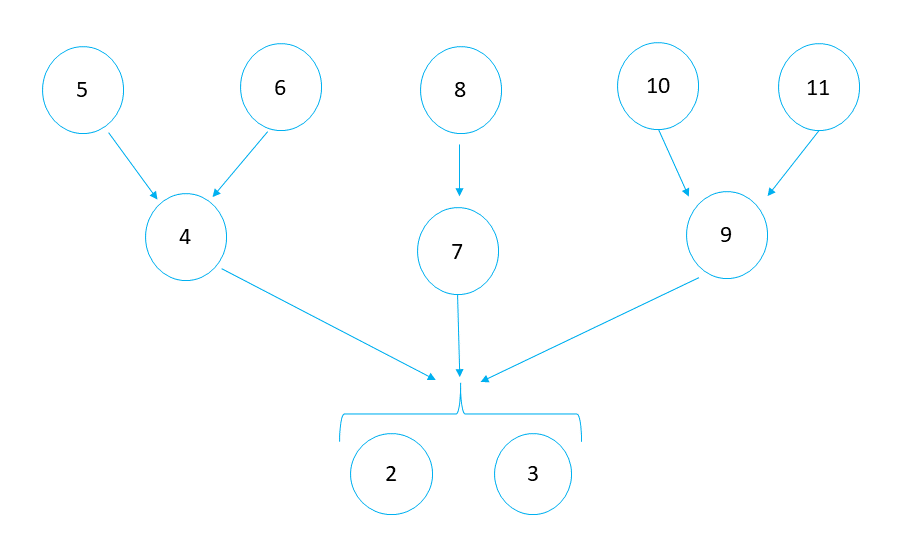
Example:
(1) The president may have their faults, but
(2) they are an outstanding leader and
(3) we should re-elect them.
(4) Their foreign policy has brought about respite from violence in various war torn regions as
(5) They sent in troops to protect refugees in Rwanda and
(6) They negotiated an armistice between two middle eastern countries.
(7) Their economic policy has also been largely successful in that
(8) a potential recession has been avoided for now.
(9) They are also a great moral leader as
(10) Theirs is a model family and
(11) They demonstrate true integrity daily.
Notice how 1 isn’t actually part of the argument: it just introduces the topic but isn’t a premise or conclusion. 2 and 3 are both conclusions (notice the “and”, which often links premises to premises and conclusions to conclusion) because neither is a premise/evidence for the other and both are implied by the rest of the argument (4, 7, and 9).
Why did we go with independent support for all of the top-most premises? Try to reason through it on your own.
Lesson 4.3: Argument Layers
Introduction to Terminology
Let’s introduce some new terminology so we can have a common language with which to talk about arguments:
A “level” or “layer” of an argument map is one horizontal row of a carefully drawn argument map. Notice how the previous argument map above is drawn so that even though there’s a lot going on in the argument, we can see 3 distinct layers or horizontal rows?
A Main Conclusion is the final conclusion of the argument. It doesn’t serve as a premise/support for any other proposition in the complex argument. It’s always in the bottom-most layer (using the convention adopted in this course).
A Main Premise is one among the set of premises directly supporting the main conclusion. It’s always in the layer that’s the second from the bottom (using the convention adopted in this course).
A Sub-Inference is an inference from a premise to another premise. The conclusion of a sub-inference is never in the bottom-most layer.
A sub-premise is a premise in a sub-inference.
A sub-conclusion is a conclusion in a sub-inference. (Note that a sub- conclusion is always a premise itself, and that it is usually one of the main premises unless the argument gets really complex).
3-layer Argument
So here it is, the anatomy of a typical 3-layer argument diagram:
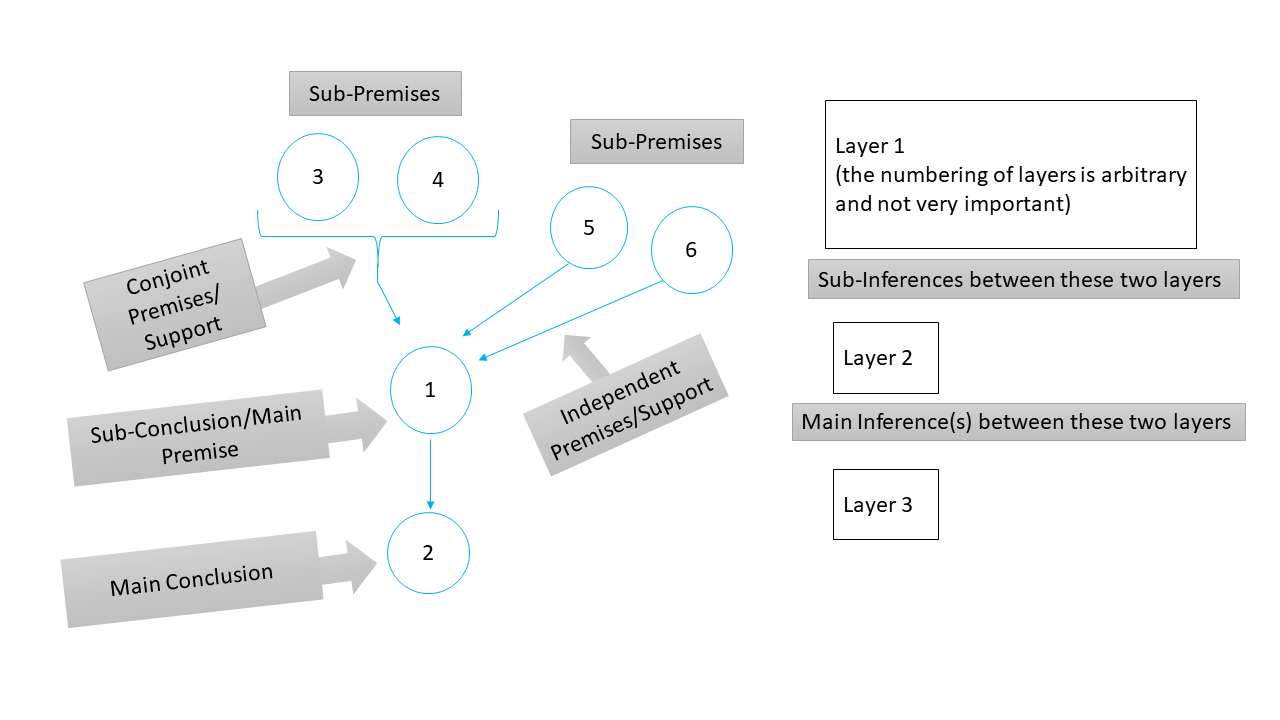
Argument diagram of anatomy of a typical three-layer argument demonstrating layer 1 sub-premise 3, 4, 5, and 6; layer 2 inference 1; and layer 3 conclusion 2.
Lesson 4.4: Negation Test
Examples
Let’s walk through a few examples of arguments that need mapping:
She's the best girlfriend ever. She bought me a
new backpack for my birthday, she's never late
for a date, and she always treats me with care.
First, we need to identify each proposition—that is, each claim that can be true or false independently of the other claims. This is a bit interpretive, so sometimes there aren’t hard and fast rules that produce one particular right answer, but generally we can all come up with the same propositions:
(1) She's the best girlfriend ever. (2) She bought me a
new backpack for my birthday, (3) she's never late for
a date, and (4) she always treats me with care.
What a nice young person! Next, we need to decide what the conclusion is and which propositions are premises. A good test that often helps is to read all the premises and then say “therefore…” and then read what you think is the conclusion. It should make sense as an inference if you do this properly. For instance, this is clearly not so good:
She’s the best girlfriend ever, she bought me a new
backpack, and she always treats me with care,
therefore she’s never late for a date.
What?
This one makes a lot more sense:
She bought me a new backpack, she’s never late for a
date, and she always treats me with care, therefore
She's the best girlfriend ever.
It seems like the three premises are evidence for the claim that she is the best girlfriend ever. The thing we’re being asked to believe as a result of this reasoning is that she’s the best girlfriend ever. So that is the conclusion of the inference.
Next Step
Now we’ve already basically ruled out that 2, 3, and 4 have any inferential relationship between them. They all seem to give us reasons for believing the conclusion directly. Furthermore, none of them seems to give us reason for believing any other. Maybe 4 could be the conclusion of 2, but that’s a real stretch. So based on all of this, we can reasonably conclude that 2, 3, and 4 are all on the same level and are all main premises for the conclusion.
Next, we need to decide if these are conjoint or independent premises. What do you think?
How do we decide? Using the negation test. If negating or saying the opposite of one premise doesn’t make the inference fall apart, then the premises are not conjoint—they’re independent. Let’s try it here:
She bought me a new backpack, she’s sometimes
late for a date, and she always treats me with
care, therefore she’s the best girlfriend ever.
I mean, it is a bit weird, but it’s not nonsense. Sure, she’s sometimes late for a date, but the inference still makes sense.
She hasn’t bought me a new backpack, but she’s
never late for a date, and she always treats me
with care, therefore she’s the best girlfriend ever.
Again, it’s strange, but not nonsensical. We wonder why the backpack thing is brought up in the first place, but we don’t immediately think “oh, well, she can’t be the best girlfriend ever if she hasn’t bought you a backpack!” Instead, we just think, “she’s clearly an excellent partner, backpack or none.”
Next Step Continued
The last one is a bit stranger:
She bought me a new backpack, she’s never
late for a date, but she doesn’t always treat
me with care, therefore she’s the best
girlfriend ever.
Interesting…the case is definitely pretty weak for her being the best girlfriend ever at this point, but the inference hasn’t utterly fallen apart. An opposite conclusion doesn’t now follow, we just have a weaker reason for accepting the conclusion than we had before. This test reveals how strong a piece of evidence proposition 4 was for the conclusion in the original argument, but it doesn’t tell us that 4 is conjoint—the argument didn’t fall apart.
With all of this in mind, the premises appear to be independent reasons from one another for accepting the conclusion that she is the best girlfriend ever. So the argument map looks like so:
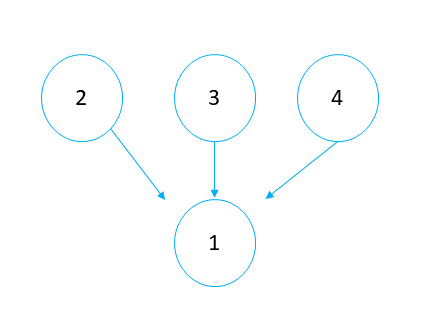
Another Example
How about another example? This time I’ve skipped right to numbered propositions:
(1) Winston Churchill was the best Prime Minister in British history. (2) He protected people by playing a lead role in winning WWII, and (3) that feat was among the greatest victories for a British Prime Minister. (4) He defended the United Kingdom from the Soviet Union, and (5) he introduced "Old Age Pensions'' to help aging British citizens. (6) Anyone who could help aging British citizens must be a great Prime Minister.
Before we ever get to the question of whether or not this is a good argument, or what’s wrong with it if anything, or whether or not the conclusion is true, we must understand the argument. In particular we must understand the structure of the argument. This argument is complex, so what’s going on here?
What’s the conclusion? It’s probably somewhat obvious here. There’s one claim that seems like the kind of claim someone might have as a thesis statement, or might defend in an Oxford-style debate. There’s one claim that seems to unify the rest of the propositions: everything is meant to justify or defend the claim that Churchill was the best Prime Minister in British history.
With a longer argument like this, sometimes it is best to simply work sentence-by- sentence. 2 and 3 are part of the same sentence. The “and '' tells us that there probably is no inferential link between 2 and 3. “and'' is usually not interchangeable with “therefore”. When we read the content of 2 and 3, furthermore, 3 makes reference to 2. Often when a premise makes reference to another premise we can conclude that they are conjoint premises. Not always, mind you, and often that means that one is a subpremise for the other. Nevertheless, in this case the reference to “that feat” is 3 times 3 to 2 conjointly.
Negative Test
We can run the negative test to be sure we’re correct here:
(1) Winston Churchill was the best Prime Minister in British history. (2) He protected people by playing a lead role in winning WWII, and (3) that feat was not among the greatest victories for a British Prime Minister.
Now I’m unclear why we should think he’s the best Prime Minister in British history if the reason we’re being given is that this feat was not a great victory. Not convincing. If anything, it seems to suggest that he was a fine, but unremarkable leader.
(1) Winston Churchill was one of the best Prime Ministers in British history. (2) He did not protect people by playing a lead role in winning World War II, and (3) that feat would have been among the greatest accomplishments of a British Prime Minister.
No. He's not protecting people does not make him the best British Prime Minister.
So, these two premises are conjoint. What about 4? It’s part of the same sentence as 5, but the topics are so wildly different that it’s hard to see how they could be conjoint premises. Instead, it seems safe to assume they’re independent and that they’re independent from 2 and 3 for the same reason. They do, however, appear to be premises for the main conclusion (1) and so appear to belong on the second level with the other main premises 2 and 3.
This is one way you know you’re dealing with
conjoint premises: if one premise explains how the
Another premise supports the conclusion.
The last proposition, though, seems to essentially be about the same topic as 5 and furthermore seems to be the reason 5 supports the conclusion. This is one way you know you’re dealing with conjoint premises: if one premise explains how the other premise supports the conclusion. So 6 and 5 appear to be conjoint. If you ran the negative test, you’d soon learn that the negated inferences make no sense.
As a result, the whole argument map, which is a bit strange looking, looks like this:
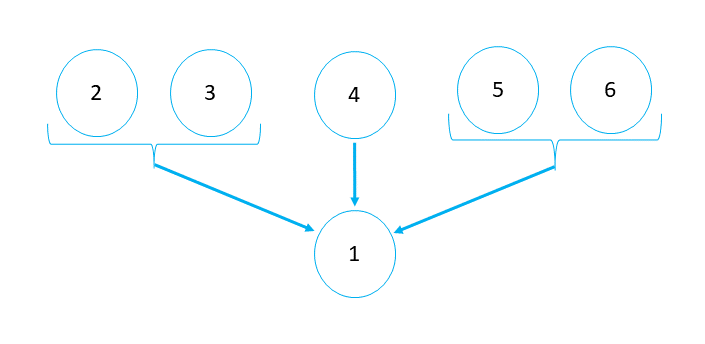
Key Terms
Main Conclusion: Final conclusion of the argument
Main Premise: One among the set of premises that directly support the main conclusion
Sub-inference: An inference from a premise to another premise
Sub-premise: A premise in a sub-inference
Sub-conclusion: A conclusion in a sub-inference
Lesson 5.1: Hidden Assumptions
Identifying Hidden Assumptions
We need to be able to identify (and then to incorporate into our argument maps) assumptions that are part of the argument but are not explicitly stated. These are called Hidden Premises or Missing Assumptions. These are cases where an argument in fact relies on a claim that it doesn’t state as a premise. There is a claim that must be true if the inference is to make sense, but isn’t explicitly claimed to be true by the argument as it is written or spoken.
It’s a bit tricky, but it might be one of the most important and practical skills you’ll learn in this class. How do we figure out when an argument has one or more hidden premises and how do we identify what those premises are?
Check out this argument:
Flowers smell nice
???
Therefore: Let’s plant some flowers
We can’t quite get from “smelling nice” to “things we’ll plant” without an assumption which links these two ideas. Notice how flowers are in both the premise and the conclusion, so we don’t need to link the topic of flowers together with the topic of flowers.
Abstractly, if A is related to B, and C is related to B, then what we need is something linking A and C so that we can bridge the gap between A and B being associated with one another to C and B being associated with one another.
Less abstractly, if we have three topics: flowers, smelling nice, and things to plant; then we need something linking smelling nice and things to plant so that we know the fact that flowers smell nice is a compelling reason to think that flowers are the kind of thing we should be planting. We know that flowers smell nice and we’re trying to get to know which flowers should be planted. Any idea what the hidden link might be?
The hidden assumption is something like “we should plant things that smell nice.” Can you see how that completes the inference? Check out some more examples and see if you can figure out what is going on in each example: why do we need the extra premise for the inference to work?
These wildfires are out of control! So global warming is real.
The hidden assumption is something like “global warming is the best explanation for an increase in wildfires.”
We should believe only what is reasonable, so we should reject theism.
The hidden assumption is something like “belief in theism is unreasonable.”
No one believes the Earth is flat anymore, so it’s a silly belief.
The hidden assumption here is something like “any belief that no one currently holds is a silly belief.”
Step-by-Step Process
Here’s a step-by-step process for identifying hidden assumptions:
A step-by-step process:
First, identify the inference or sub-inference with the hidden assumption.
Which one is “incomplete”?
Then, look at the premises of the inference and identify the “terms” or topics discussed in each premise.
Each premise is usually a claim which links two topics together.
Then, ask how we can link the terms that aren’t yet linked.
This requires a bit of imagination and instinct, but you can do it!
Finally, write the assumption that links the unlinked terms.
Now that you’ve identified a hidden assumption or more, perform the following two steps:Check to be sure your argument now works.
Does the argument now have a link between each topic?
Is there a path from the topics in the premises to the
topics in the conclusion?
Perform the “negative test” on your assumption.
If you negate your hidden assumption, you should end up
with an argument that makes no sense. If the argument
with the negated premise makes sense, then you haven’t
identified a hidden assumption (i.e. the argument was fine
without your assumption).
Step-by-Step in Action
Let’s take a look at how this works with some real arguments.
I think we should invade North Korea. Look, the Kim
Jong dynasty is simply never going to give up on their
goal of being a nuclear power.
Okay, this inference is really “fast” meaning it skates over a few hidden assumptions and so doesn’t seem to work all by itself. It’s like it rushes straight to the finish line without actually running the course. Let’s break it down step by step.
Step 1
There’s only one apparent premise and one apparent conclusion, so identifying the inference in question is easy.
Step 2
The “terms” or topics of this inference are:
We should invade
North Korea
Kim Jong dynasty
Nuclear Arms
Step 3
How do we connect these topics? First, we need to connect “North Korea” with the “Kim Jong dynasty”. Then we’ll need to connect “being a nuclear power” with “we should invade.”
Step 4
Let’s try these assumptions and see how the argument works out:
The Kim Jong dynasty is never going to give up on their goal of being a nuclear power.
The Kim Jong dynasty is going to lead North Korea for the foreseeable future.
Any country that aspires to be a nuclear power is one we should invade.
Therefore, we should invade North Korea.
This inference is more complete and connects the topics together more completely, but it rests on one very shaky premise. Can you identify which one?
Yes, that’s right. Premise 3 is pretty shaky. What if Argentina decided it wanted to be a Nuclear Power? Should we invade them? I would hope not.
Exercise the Principle of Charity
So, we have a choice. Either decide that the argument is weak and reject it out of hand, or we can exercise the Principle of Charity to try to interpret the argument to be as plausible as possible. We should always interpret arguments—especially the ones we’re skeptical of or disagree with—to be as rational and plausible as possible.
With that in mind, let’s change this argument up a bit so that it makes a bit more sense. We might not agree with the argument in the end, but at least we will have understood the argument in the best possible light. We will have seen what the most plausible argument for that conclusion on the basis of similar premises is.
If we ignore premise 3, the weak premise, and try to replace it with a few premises which make more specific and believable claims, we’ll be in a better spot. We’ll need to tie together some new topics. Premise 3 was supposed to make a link between “aspires to be a nuclear power” and “we should invade.” There’s a bit of conceptual “distance” between these ideas, though, so we shouldn’t just posit a principle like premise 3 above which directly links them. That would be too easy a principle to reject. Instead, we’ll travel the distance between these ideas in a few steps rather than a giant leap.
Steps Continued
How about we connect “aspires to be a nuclear power” to “they’re dangerous”? Then we can get from “they’re dangerous” to “we should invade.” That sounds more plausible, right?
The Kim Jong dynasty is never going to give up on their goal of being a nuclear power.
The Kim Jong dynasty is going to lead North Korea for the foreseeable future.
North Korea under Kim Jong rule would be an immediate existential danger to its neighbors and the rest of the world if they ever became a nuclear power.
If we invade North Korea, then we prevent the danger.
Therefore, we should invade North Korea.
Now the argument seems to hang together a bit more clearly. We have a clear path from the Kim Jong dynasty through to a nuclear North Korea, to the danger that poses and therefore a motivation for invading, all the way to the claim that we should invade. It’s still shaky reasoning, but it’s approaching the strongest version of the original argument.
There’s still technically something missing. Between 4 and 5 we’ve missed a premise. In order to get from an “is” claim to an “ought” claim, often you’ll need a general normative principle. That is, we need a general rule which allows us to move from a simple statement of supposed fact (premise 4) to a prescription for what we should do (the conclusion, #5). This one will do:
4a. If we can prevent immediate existential danger to whole countries then we must/should act so as to prevent that danger.
That actually seems pretty plausible, right? So, in this case the missing premise wasn’t so shaky (you might disagree, though).
We can then perform the negative test on our hidden assumptions and figure out if the argument falls apart without them. If we deny 4a, then we can’t get from 4 to 5.
Lesson 5.2: Mapping Hidden Assumptions
Mapping
Mapping Hidden Assumptions is relatively simple.
A hidden assumption will always offer conjoint support for its conclusion/sub-conclusion.
Think about it: if hidden assumptions are things that must
be true for an inference to work, and conjoint premises are
premises that must all be true for the inference to work,
then it makes sense that any hidden premise will offer
conjoint support.

The only difference will be that we’ll use dotted circles instead of a complete line circle:
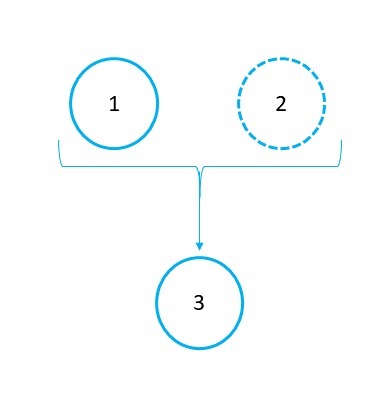
A few complete examples:
There is smoke.
Hidden Assumption: (Wherever there is smoke, there is fire.)
Therefore, there is fire.
The inference from 1 to 3 makes some sense because we have added a premise that links the presence of smoke with the presence of fire.
Mapping Example
(1) We’ll never stop climate change, (2) Hidden Assumption: Climate change will intensify fires and storms, so (3) we’re going to have many more fires and storms. (4) Our current system can’t handle even basic disasters. Furthermore, (5) state disaster relief funds are insufficient without help from the Federal Emergency Management Agency’s(FEMA). So, (6) we need to enhance funding for FEMA.
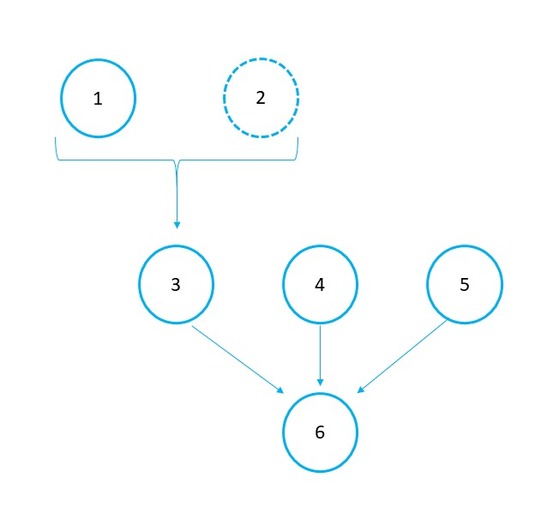
The inference from 1 to 3 makes little sense if it’s not true that climate change is connected to fires and storms, so we need premise 2 to make that connection. 3, 4, and 5 are independent because each by itself makes sense as a premise for 6.
Lesson 6.1: Beginning to Evaluate Arguments
Evaluation Process
We often use argument mapping to understand an argument before we do any evaluation of those arguments as good or bad.
But the process of identifying hidden assumptions is in itself a sort of evaluative process: we must identify the need in the argument for another claim to be true—we have to declare that an argument is incomplete and therefore faulty before we can talk about the argument needing an extra premise.
We’ve already done a bit of evaluating arguments in identifying hidden premises. These tools we use when identifying hidden assumptions will help us in evaluating an argument as a good or bad argument. Let’s explore how helpful these tools are.
Recall the central idea in the process of identifying hidden assumptions is the idea that a good, complete argument has a series of topics or terms linked together in the right way.
Informal Idea
Let’s look at how this informal idea can help us determine whether we’ve got a good or bad argument. Here’s an example to consider:
If you don’t want to own a firearm, you don’t have to own one.
[Implied conclusion: Owning a firearm should be legal].
This argument needs a tune up—not because it is wrong-headed or because its conclusion is wrong, but because it’s unclear what the actual argument is: what are the premises and how do they support the conclusion?
First, try to interpret the argument in a way that makes the process of identifying topics easier through both a premise and conclusion. This process is already a bit evaluative in that we are interpreting the argument charitably: we’re trying to understand the premise and conclusion without changing its essential content. Maybe something like:
The right to own a firearm is not a mandate to own a firearm, so there’s no reason to oppose it.
Maintaining the right to bear arms does not mean requiring (mandating) anyone to own a firearm. This is already starting to look like a more complete argument.
Identify the Topics
The next step is to identify the topics being discussed:
a. Firearm ownership rights
b. Firearm ownership mandates
c. Reason to oppose things
Once we’ve identified these terms, we can think about the argument in terms of a series of propositions which connect them together.
1. Firearm ownership rights laws are not firearm ownership mandates
[Links (a) to (b)]
2. So, there is no reason to oppose firearm ownership rights
[Links (c) to (a)]
We’ve got some of the tools now to recognize there’s a missing premise here. Can you find it?
There’s no link between Reasons to oppose things and Firearm ownership mandates, so the inference has a gap in it.
Right! Good work. We’ve linked a to b, and a to c, but not b to c. This is why the argument feels incomplete. What, then, might our hidden premise be? We need to link “Firearm ownership mandates” with “reason to oppose things.” Any ideas?
Yeah. Why not something like “There’s no reason to oppose firearm ownership mandates.”
Well…not quite. That’s a pretty clearly false statement right? Lots of people do not want to own firearms, so it makes little sense to say there’s no reason to oppose mandating everyone to own them, right?
Oh…yeah. What about “If something isn’t a mandate, then there’s no reason to oppose it.”
Now we’re talking! That’s a really general claim: it applies to everything (or at least every public policy or law) that isn’t a mandate. So here’s our complete argument:
1. Firearm ownership rights laws aren’t firearm ownership mandates
[Links (a) to (b)]
1a. If something isn’t a mandate, then there’s no
reason to oppose it [Links (b) to (c)]
2. So, there’s no reason to oppose firearm ownership
rights [Links (c) to (a)]
This process is tricky and interpretive. But it is an incredibly valuable skill in all aspects of life: when is an inference making an implicit assumption? People make implicit assumptions all the time.
Example
The goal in this section was to start to evaluate arguments using some of the tools you have learned. Here’s how this might go:
The first claim in this argument is that 1. Firearm ownership rights aren’t firearm ownership mandates. This is clearly true. No law or policy securing the right to bear arms would require people to have firearms. So there’s no problem with the first claim.
The second (hidden) claim in the argument is that 1a. If something isn’t a mandate, then there’s no reason to oppose it. This is very broad. It seems easy to come up with a counterexample. In this case, a counterexample would be something that isn’t a mandate, but which we would have reason to oppose. Can you think of a possible law that doesn’t put a requirement on citizens, but nevertheless is a law we would want to oppose?
A law allowing murder is an example. A piece of legislation requesting strongly considering nuking the moon is another. This seems like a bad principle: one shouldn’t be opposed to something that doesn’t bring a mandate with it.
This hidden premise completes the argument fairly directly and charitably, but also reveals that the argument is open to serious objections.