Pharmacology - lecture 18 - Toxicology
Learning Objectives
Students should be able to:
Describe three important principles of toxicology.
Explain terms: dose, dose-response, LD50, and therapeutic index.
Distinguish between acute and chronic effects, and organ-specific and systemic effects.
Identify common sources of toxins and toxicants.
Explain toxic effects from alcohol, botulinum toxin, paracetamol, aspirin, thalidomide, and grapefruit juice.
List branches of toxicology and examples of toxicants and their mechanisms.
Describe the science of safety testing.
Definition of Poison
Paracelsus: "All substances are poisons; the right dose differentiates a poison from a remedy."
Concept: "The dose makes the poison" emphasizes the role of dosage in toxicity.
Poison: drugs that are likely to cause ill effects at doses likely to be encountered
Principles of Toxicology
Toxicant effects are proportional to exposure/dose.
Variability in sensitivity occurs between and within species.
Different mechanisms mediate acute and chronic toxic effects.
Understanding LD50
LD50 (Lethal Dose 50) is the quantity of a substance that can kill 50% of a test population.
Variability based on route of administration and species differences.
Dose-Response Relationships
Understanding efficacy and effectiveness illustrated with dose-response curves.
Key thresholds: LD50, ED50 (Effective Dose 50), TD30 (Toxic Dose 30).
Therapeutic Index
The ratio indicating the margin of safety between effective and toxic doses.
A larger TI indicates greater safety.
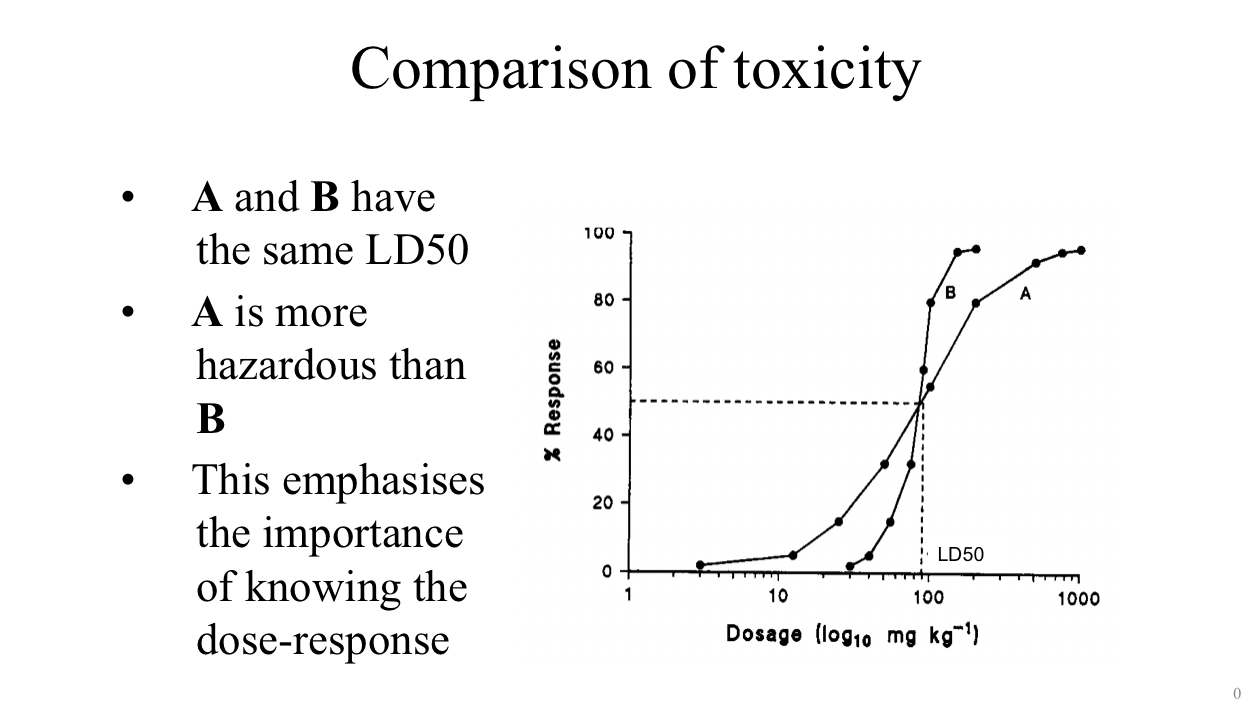
Toxicity Comparison
Drugs A and B may share an LD50 but differ in hazard level due to their dose-response profile.
Drug Disposition Dynamics
Importance of ADME (Absorption, Distribution, Metabolism, Excretion) phases in drug efficacy and toxicity.
Types of Toxic Substances
Examples of toxins:
Drugs: Paracetamol, Aspirin, Thalidomide.
Industrial Chemicals: Lead, asbestos.
Food Additives: Artificial sweeteners, botulinum toxin.
Pesticides and Natural Products: DDT, plant toxins.
Household Products: CO, alcohol.
Environmental Pollutants: Ozone, tobacco smoke.
Distinction between toxins (natural origin) and toxicants (man-made).
Alcohol Toxicity
Acute Effects: CNS depression, impaired motor functions, vomiting.
Chronic Effects: Liver cirrhosis, various cancers, brain damage.
Benefits of low-level consumption for cardiovascular health.
Botulinum Toxin
Produced by Clostridium botulinum, highly toxic, a soil bacterium that thrives in low acid, low sugar, low oxygen, environment.
Blocks neuromuscular transmission through decreased release of acetylcholine.
Symptoms: blurred vision, swallowing difficulties, can lead to paralysis.
Therapeutic uses include muscle spasm treatments and cosmetic applications.
Risks highlighted by recent case of botulism in food products.
Paracetamol Metabolism and Toxicity
Metabolized mainly by sulfate and glucuronic acid conjugation.
Minor metabolism by oxidation followed by conjugation with glutathione.
Overdose leads to liver damage via toxic metabolite formation.
Saturation of conjugation pathway so more oxidative metabolism and depletion of glutathione.
Leads to hepatic necrosis and death.
Alcohol can potentiate the liver damage by inducing levels of cytochrome P450 enzymes which increases toxic metabolic activation of paracetamol.
Antidote: N-acetylcysteine; efficacy decreases after 10-12 hours.
Aspirin Toxicity and Mechanism
Metabolized to salicylic acid then conjugated with glucuronic acid ot glycine, impacting mitochondrial function.
Leads to hyperventilation, increase in blood pH, then correction by elimination of sodium bicarbonate into the urine.
Overdose may cause metabolic acidosis and brain damage.
Lack of ATP to brain and heart may prove fatal.
Antidote: Bicarbonate infusion.
Thalidomide Diversity
Initially an anti-sickness remedy, later linked to severe birth defects.
Importance of chirality (enantiomer effects) in toxicity.
New therapeutic applications discovered for various conditions.
Grapefruit Juice Interaction
Contains furanocoumarins that inhibit cytochrome P450 3A4, affecting various drugs.
Branches of Toxicology
Types of Toxicology:
Clinical, Forensic, Industrial, Environmental, Ecotoxicology, Regulatory, Genetic.
Clinical Toxicology
Focuses on diagnosis and treatment of poisoning cases, including drug overdoses and adverse reactions.
Forensic Toxicology
Examines poisons like arsenic, mercury, and cyanide in legal contexts.
Industrial/Occupational Toxicology
Identifies industrial diseases and their causes (e.g. asbestos, cadmium).
Environmental Toxicology
Studies pollution effects on ecosystems and human health.
Ecotoxicology
Examines chemical pollutants on non-human species and ecosystems.
Vulture Crisis and Diclofenac
Diclofenac's toxicity to vultures led to population declines and ecological consequences.
Captive breeding programs initiated to prevent extinction.
Genetic Toxicology
Evaluates mutagenicity and carcinogenicity metrics.
Major mutagenicity endpoints:
Gene mutations (point mutation or deletions/insertions)
Clastogenicity (structural chromosome changes)
Aneuploidy (numerical chromosome aberrations)
Major carcinogenicity endpoint: tumour formation
Regulatory Toxicology
Assesses safety of chemicals based on testing methodologies and ethical considerations.
Emphasizes risk vs. benefit analysis.