Topic 8: Sustainability
8.1 Sustainable development
Sustainable Development is concerned with satisfying human needs for resources now and in the future without compromising the carrying capacity of the planet and emphasizes the balance between economic growth, environmental protection, and social equity.
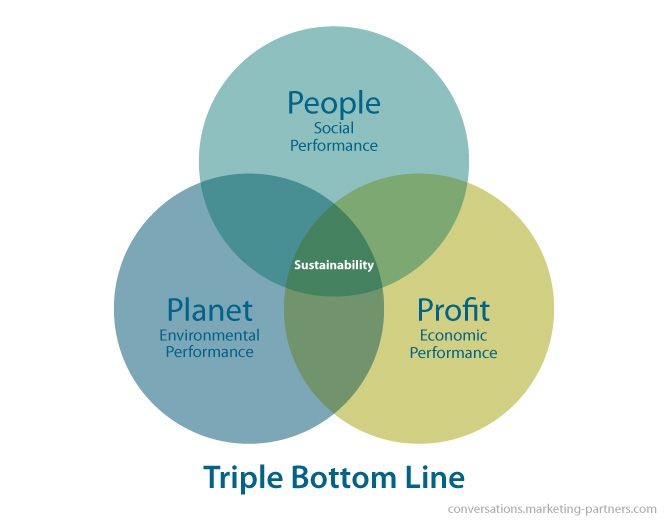
Triple Bottom Line Sustainability:
Expanded spectrum of values and criteria for measuring organizational success: economic development, environmental development, and social development.
Decoupling
Disconnecting two trends so that one trend no longer depends on the other.
In the context of sustainable development, disconnecting economic growth and environmental impact so that one no longer depends on the other.
Resource decoupling
Getting more efficiency from the resources we use, so that we can spread the use of our finite resources out over a longer time frame.
Impact decoupling
Using processes that leave a smaller footprint on the ecosystem, so that our building and manufacturing do not harm the ecosystem. We need a healthy ecosystem for our own survival.
Sustainability Reporting
A company report that focuses on four aspects of performance: Economic, Environmental, Social and Governance.
Benefits of sustainability reporting for governments, manufacturers and consumers
Consumers
potential cheaper products or services
potential for more innovative products or services
builds trust in that organization
information can assure the consumer that it is globally and nationally employing sustainable practises and strategies
Product Stewardship
Everyone involved in making, selling, buying or handling electronic equipment takes responsibility for minimising environmental impact of the equipment at all stages in the life cycle.
Designers may need to respond to consumer pressure as more consumers become aware of resource issues and product labelling.
Examples:)
Organic foods
GMO foods
Green cotton
Forest Stewardship
Bio-plastics
The use of international and national laws to promote sustainable development
International and national laws encourage companies to focus on something other than shareholder value and financial performance, which include:
Transparency corporate sustainability
Transparent sustainability assurance
Whether businesses, public services, national resources and the economy have the means to continue in the years ahead at a micro and macro level.
Adopting a sustainable corporate strategy that has the support of shareholders/stakeholders can be difficult to achieve.
1992 - Rio Earth Summit | 1997 - The Kyoto Protocol | 2009 - Copenhagen Accord |
An international agreement that called for industrialized nations to significantly reduce their greenhouse gas emissions | ||
|
| Global warming → limited to below 2 Celsius degrees |
2015 - Paris Climate Change Conference / Agreement |
|
8.2 Sustainable consumption
/
8.3 Sustainable design
8.4 Sustainable innovation
Sustainable innovation : cooperation between different stakeholders
(e.g. government, manufacturing.)
It is the broadest approach going beyond technical solutions.
This approach is based on a socio-technical systems intervention rather than just considering product improvement.
Complexity and timescale of sustainable innovation
Sustainability is difficult to maintain because conditions/criteria can change significantly.
Two examples include:
Sustainable innovation requires a time-consuming, expensive [radical change].
Which makes manufacturers less willing to consider sustainable innovation.
Sustainable innovation is a hugely complex concept that requires a long time for implementation (typically 20–40 years) depending on the nature of the innovation.
Top-down strategies
Top-down sustainability encompasses system-level changes driven by policy and operational directives. (= is controlled by the government.)
These approaches have the potential to create widespread and immediate change when applied effectively.
Management of resources, finances (controlling bank rates, etc) and so on.
Top-down strategies provides targets and measures for sustainability.
Pro/con | Advantages | Disadvantages |
Points |
|
|
Examples | California has changed the auto industry by passing stricter fuel-economy standards that manufacturers must meet in order to sell vehicles in the state.
|
Bottom-up strategies
Bottom-up approaches attempt to influence policy through behaviour.
The appeal of any bottom-up approach is that individual actions can have a massive impact when adopted by large numbers of people, and the barrier to entry is low.
An individual behaviour change—say, biking to work—may have a limited impact, but has great potential if adopted by many.
The key to [effectively activating the potential of a bottom-up approach] lies in communicating both [the goals of behavioural changes] + [the best strategies for implementing these changes to have maximum impact]
Strategies implemented from the ‘bottom’ such as regional or local (city or town) level.
Designers involved with bottom-up strategies are usually enthusiasts for the project and willing to make a commitment even though it may not be cost-effective to do so.
Students are expected to be able to identify examples of bottom-up strategies and evaluate the advantages and disadvantages for consumers/users.
Pro/cons | Advantages | Disadvantages |
Points |
|
|
Examples | These include local initiatives like Planting Tree Campaigns | Autofeiertag in Germany |
Government intervention in innovation
There are various strategies that governments use to promote knowledge exchange and technology transfer.
Government intervention includes:
Regulation
Education
Taxes
Subsidies.
Macro-energy sustainability
Macro energy sustainability: Focus on how a nation utilizes energy in a sustainable manner.
(macro = large goal setting)
Macro-sustainability is the area of sustainable development that focuses on how a nation, region or the entire world would establish large scale behaviors for sustainability.
How macro energy sustainability can be influenced through:
International treaties and energy policies
e.g. Earth Summit 1992, Kyoto Protocol 1997, World Summit on Sustainable Development 2002, Copenhagen Accord 2009
Instruments for change and disincentives
National systems changing policy when government leadership changes
E.g. the Kyoto Treaty would fall into this category. Kyoto Protocol on the reduction of greenhouse gases. In order for it to be successful all governments need to agree, for a while Australia and USA did not so many countries followed suit.
Micro-energy sustainability
Micro energy sustainability: Focus on local initiatives
(micro = small goal setting)
Micro-sustainability is the area of sustainable development that focuses on how individuals, organisations and businesses decide [what activities they should engage in] and [how/where to allocate their resources.]
Jesse Stallone (2009)
Micro energy sustainability can be influenced by the role of the government:
Raising awareness (Education)
Changing attitudes
Promotion of individual and business action towards energy sustainability.
E.g. Local governments installing Combined Heat and Power (CHP) or solar powered roof tiles.