Fatty Acid and Triacylglycerol Synthesis
Comparison of Fatty Acid Synthesis and Oxidation
General Principle: Fatty acid synthesis is not a simple reversal of fatty acid degradation (oxidation). Although the underlying chemistry is similar, synthesis involves a completely new set of enzymic processes.
Location and Substrates:
Synthesis: Occurs primarily in the cytosol. It utilizes an Acyl Carrier Protein (ACP) as the carrier for the growing fatty acid chain. It is catalyzed by a multi-enzyme complex and requires NADPH as the electron donor.
Oxidation: Occurs in the mitochondria. It utilizes Coenzyme A (CoA) as the carrier. It involves separate enzymes rather than a complex and produces NADH and FADH2.
Acetyl CoA Carboxylase: The Committed Step
Reaction Chemistry: The conversion of acetyl CoA to malonyl CoA is the committed and regulated step of fatty acid synthesis. This reaction is irreversible and driven by ATP hydrolysis.
Process
So carbon dioxide reacts with water to form carbonic acid
that is ionised into a hydrogen ion and a bicarbonate ion
the bicarbonate ion binds with acetyl-co enzyme A
forming malonyl CoA
this is done with acetyl CoA carboxylase
this is powered by ATP
Acetyl CoA carboxylase
this is the committed step
it is near the start
as if it was near the end then the intermediate products will build up
irreversible
driven by ATP
Cofactor: The enzyme requires Biotin (Vitamin B7), which serves as a carrier for the carboxyl group ().
Activation Mechanism: The enzyme is activated by polymerization. When active, individual subunits assemble into long filaments.
Process
Biological reaction:
Enzymatic step:
The Four-Step Catalytic Cycle
now we have malonyl CoA it can react with Acyl Carrier Protein (ACP)
the malonyl group transfers to the Acyl Carrier Protein (ACP).
giving malonyl - Acyl carrier protein and co enzyme
the acetyl group also binds to the Acyl carrier protein
giving acetyl - acyl carrier protein and co enzyme
the Acetyl-ACP (2C)and malonyl-ACP(3C) (then react together
forming acetoacetyl-ACP (4C) releasing a Carbon dioxide enzyme
this is reduced by NADPH
Preparation for Chain Growth: Before synthesis begins, acetyl and malonyl groups must be transferred to the Acyl Carrier Protein (ACP).
The Four-Step Catalytic Cycle:
Condensation: Acetyl-ACP and malonyl-ACP condense to form acetoacetyl-ACP. This step is accompanied by the release of .
Reduction: The oxo group is reduced to a hydroxyl group using NADPH to form D-3-hydroxybutyryl ACP.
Dehydration: A molecule of is removed to form a double bond, resulting in crotonyl ACP. - this is a double bond
Reduction: The double bond is reduced using NADPH to form butyryl ACP (a 4-carbon chain).
Cycle Repetition: The resulting butyryl-ACP then condenses with another malonyl-ACP to continue the elongation process.
this carriers on until there are 16 carbons
so you build up the fatly acid chain 2 carbons at a time
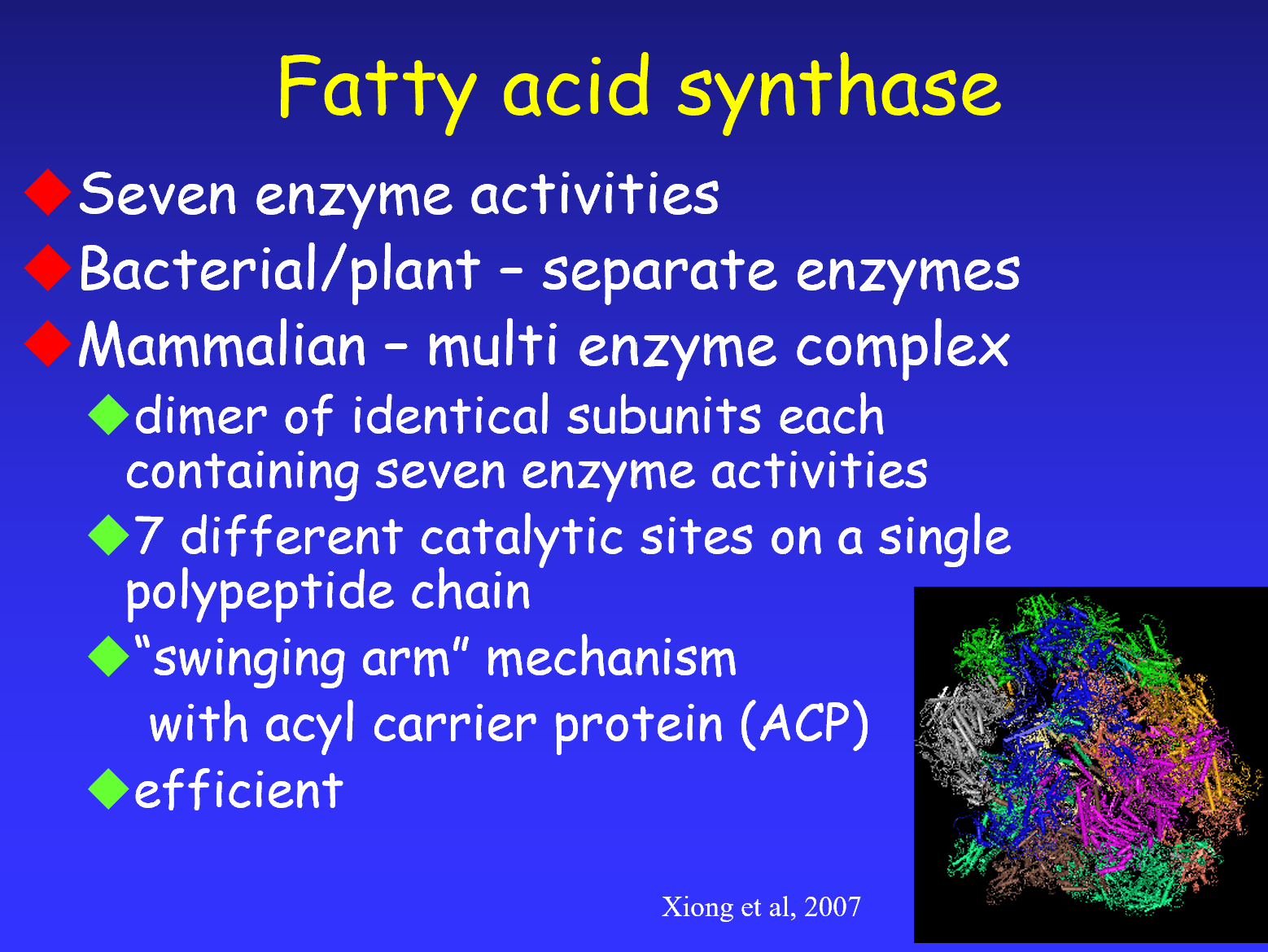
Fatty acid synthase
Enzyme Structure:
Bacterial/Plant FAS:
Composed of separate, individual enzymes.
Mammalian FAS:
A multi-enzyme complex existing as a dimer of two identical subunits. Each individual polypeptide chain contains seven different catalytic sites.
The "Swinging Arm":
The complex utilizes a 4'-phosphopantetheine prosthetic group as a "swinging arm." This arm carries the growing fatty acid chain and swings it from one active site to the next on the same enzyme molecule, ensuring metabolic efficiency.
Dimer of identical subunits
The mammalian enzyme is made of 2 identical parts joined together (called a dimer).
Each part can do all 7 steps.
👉 Think: two identical machines working side by side.
7 catalytic sites on one chain
Each subunit has 7 “active sites” (places where reactions happen).
They are all on the same long protein chain.
👉 Like one machine with 7 different workstations.
5. “Swinging arm” mechanism (ACP)
There’s a part called ACP (acyl carrier protein).
It acts like a flexible arm that carries the growing fatty acid from one site to another.
👉 Think: a robotic arm moving the product
Stoichiometry and Substrate Transport
Palmitate Synthesis (): To synthesize one molecule of palmitate (), the system requires:
Acetyl CoA units (1 used directly as the primer, 7 converted to malonyl CoA).
ATP (for the formation of 7 malonyl CoA molecules).
NADPH (2 for each addition of a 2-carbon unit).
Acetyl - CoA.
Process Before
you eat some glucose
it is then converted into pyruvate in the cytosol
it is then taken to the mitochondria
it is then converted into acetyl CoA
this needs to be converted into fatty acids for storage in the adipose tissue
as triglyceride
How is Acetyl CoA transferred out of the mitochondria
it needs to get into the cytosol but there are no carrier proteins
it is carried by the citrate shuttle
this also makes NADPH from NADH
high ratio of NADPH to NADP in the cytosol
The Citrate Shuttle:
Acetyl CoA is produced in the mitochondria but synthesis occurs in the cytosol.
Since the mitochondrial membrane is impermeable to acetyl CoA, it is transported as citrate
Inside Mitochondria: .
In Cytosol: Citrate is cleaved by citrate lyase to recover Acetyl CoA and Oxaloacetate.
NADPH Generation: The return of oxaloacetate to the mitochondria (via malate and pyruvate) involves malic enzyme, which reduces to .
The cytosolic ratio of is approximately , which strongly favors fatty acid synthesis.
Plant-Specific Localization: In photosynthetic cells, fatty acid synthesis occurs in the chloroplasts instead of the cytosol because the light reactions of photosynthesis produce the necessary NADPH directly within the chloroplast.
Control and Regulation of Fatty Acid Synthesis
Metabolic Conditions: Synthesis is high when carbohydrate levels are high and fatty acid levels are low.
Hormonal Regulation:
Insulin: Stimulates glucose uptake in adipose tissue via GLUT4. In response to glucose abundance, insulin stimulates acetyl CoA carboxylase (ACC), promoting fatty acid synthesis from glucose-derived acetyl CoA.
Glucagon/Adrenaline: Inhibit synthesis by signaling a need for fuel mobilization.
Allosteric and Covalent Regulation of Acetyl CoA Carboxylase (ACC):
Citrate: High levels signal high energy and building block availability; citrate promotes the polymerization (activation) of ACC.
Palmitoyl CoA: The end-product of synthesis; it prevents polymerization, thereby inhibiting ACC (negative feedback).
Phosphorylation: ACC is inhibited by phosphorylation carried out by AMP-activated protein kinase (AMPK).
When energy is low (high AMP), synthesis is shut down.
Elongation and Desaturation
Chain Length Limitation: Fatty acid synthase stops synthesis at palmitic acid ().
Elongation: Occurs on the cytosolic face of the endoplasmic reticulum (ER). This system adds two-carbon units from malonyl CoA to the carboxyl ends of existing fatty acids (e.g., converting palmitic acid to stearic acid ).
Desaturation: Carried out by fatty acyl CoA desaturases in the ER.
Example: .
Conversion: Stearic acid () to oleic acid (), introducing a double bond between and .
Essential Fatty Acids: Mammals can only introduce double bonds up to the position. Consequently, linoleic acid () and -linolenic acid () are essential and must be obtained from the diet.
Arachidonic Acid (): This is synthesized from linoleic acid and serves as the precursor for prostaglandins and leukotrienes.
Triacylglycerol (TAG) and Phospholipid Synthesis
TAG Synthesis Pathway: Occurs in the endoplasmic reticulum of the liver and adipose tissue.
Glycerol 3-phosphate Formation: Derived from dihydroxyacetone phosphate (DHAP) via glycerol 3-phosphate dehydrogenase using NADH.
Acylation: Two fatty acyl CoA units are added to glycerol 3-phosphate to form phosphatidic acid (via 1-acyl-sn-glycerol-3-phosphate).
Dephosphorylation: Phosphatidic acid phosphatase removes the phosphate group to produce 1,2-diacylglycerol (DAG).
Final Acylation: An acyltransferase adds a third fatty acyl group to form triacylglycerol.
TAG Transport: The liver does not store TAG; it packages it into Very Low Density Lipoprotein (VLDL) for transport to other tissues.
Regulation of TAG: Driven by high insulin, low glucagon/adrenaline (anabolic state), and glucose metabolism providing glycerol units.
Phospholipid Synthesis: Phosphatidylcholine is a major cellular phospholipid.
Reaction sequence: