ENTREPRENEURSHIP
LESSON 1 FACTORS TO CONSIDER IN STARTING A BUSINESS
starting a business is a positive decision on the part of the entrepreneur to exploit entrepreneurial opportunities which are important and a worth-while endeavor.
An entrepreneur has several ways to start a new venture. The most frequently used forms of entrepreneurs are start-up, buying an existing business, and franchising
A start-up enterprise is a company which is recently formed, where the founder establishes a completely new business from scratch.
Buying an existing business is acquiring either the shares of an existing company or all of the assets of an existing enterprise.
Franchising is when the “owner of the company that already has a successful product or service, licenses its trademark, trade name, and methods of doing a business to others in exchange for an initial franchise free and royalty payments.”
There are many important factors to consider before an entrepreneur can actually begin the enterprise. These are the following:
FOCUS AND ATTENTION
It means that there should be a clear and documented vision-mission and strategies to begin with. Start right by “beginning with the end in mind.”
SOURCES OF CAPITAL
There are different sources of capital that can be used depending on the needs to start the venture. These can be from personal funds, family and friends, a retirement account, banks/financial institutions, a government loan, and/or the stock market
GOOD NETWORK
Building good relationships and working with other people could help start the business. Formal networks like associations and professional groups, as well as informal networks like childhood friends, family members, and former classmates, can be drivers to build confidence and direction, providers of information that are not readily accessible to others, suppliers of raw materials, and serve as mentors/coaches.
LEGAL REQUIREMENTS
It is very important to know the laws and regulations that govern the type of business that will be opened to avoid major problems that can arise if legal requirements are overlooked.
Examples are the copyright and patent laws, environment and sanitation regulations of the municipality and labor laws.
There are also businesses with restrictions which might give you difficulties in operation, like mining and quarrying.
DEGREE OF RISK
Consider the degree of risk related to a specific business opportunity. A business is said to be risky when the probability or chances of failure is high. It means the odds are great in many aspects against starting the business like limited market, stiff competition, high cost of financing the business, and few supply of needed labor.
RESEARCH AND DEVELOPMENT
There should be a strong research and development that should be undertaken. The government should provide adequate support to investors, scientists and engineers and their new technologies to commercialize their Research and Development products.
PERSONAL COMPETENCIES
The personal competencies like creativity, opportunity seeking, selfconfidence, persistence, commitment, and risk-taking , as well as technical background and related experiences needed to run the particular business, are necessary to start running the business.
AVAILABILITY OF RESOURCES
Resources pertain to raw materials, human resources, and machineries/equipment.
Specifically, the raw materials that are indigenous to the community and available in certain quantities, like clay, sand, abaca, and other natural fiber. Knowing where and how entrepreneurs get their materials and where they source them is vital.
Local people’s localized skills that may be tapped from and developed the commercial purposes.
In Laguna for example, the availability of a group of people who are skilled in wood craft making.
Modern machineries/equipment, even locally manufactured, might be useful in upgrading or improving a traditional production system or starting a new business altogether.
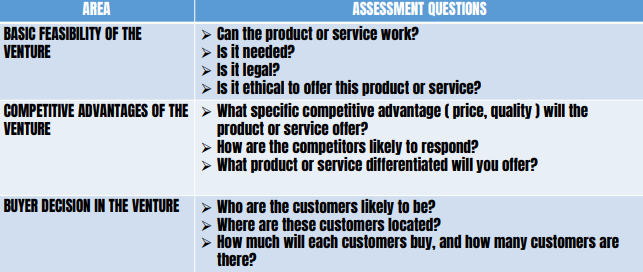
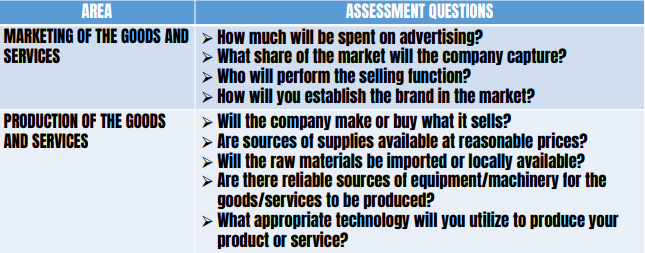
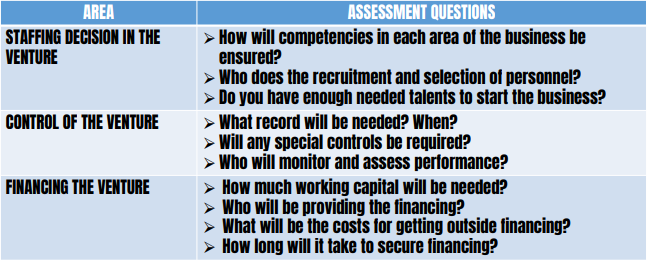
THE TABLE BELOW SHOWS A CHECKLIST THAT AN ENTREPRENEUR SHOULD CONSIDER IN THE ASSESSMENT OF A NEW VENTURE
LESSON 2 TYPES OF BUSINESS AVAILABLE TO ENTREPRENEURS
In general, entrepreneurs can identify more ideas and opportunities from the types of businesses available to them in the community and the country at large. There are a number of ways to classify enterprises which they can choose from:
TYPES OF BUSINESS ACCORDING TO SIZE:
The size of the enterprise is based on its total assets or number of employees who work for it. The Department of Trade and Industry, through the Bureau of Small and Medium Enterprise Development (BSMED), categorized them as micro, cottage, small, medium, and large enterprises for purposes of rationalizing assistance and incentives to these business enterprises.
Micro-Enterprise
It has an asset size not exceeding Php 50,000. It is usually a home-based enterprise, operating in makeshift or temporary quarters. The two owner heads the enterprise and employs from one to not more than 10 people to help him/her. Examples : Self-employed vending food like taho, puto, or fishballs; those selling in public market; and those having sari-sari or rolling stores
Cottage Enterpise
It has an asset of Php 250,000 but not exceeding Php 500,000. It is a home based business which is often managed and operated by the members of the family. Examples : Subcontractors of footwear like shoes and slippers; and food manufacturers of peanut butter/coco jam or pastillas, as well as decorative products like vases candles and lanterns.
Small Enterprise
It has an asset of Php 500,000 but not exceeding Php 2.5 million. It is owned by an individual or group and has enough resources to continue operating. It employs from 10 to 20 people. Examples : Groceries, bakeshops, beauty salons, medical/dental clinics, toy makers jeepney manufacturers, and travel/tour agencies.
Medium Enterprise
It has an asset of Php 5 million to less than Php 20 million and employs 1000 or more workers. It is owned by a single individual, business partners, or a corporation. It employs more than 20 to 100 people. These workers are more skilled and possess technical expertise to run the business with machines/equipment and utilize various quality controls to make the products. Examples : Fine dining restaurants with branches, computer importer-dealers, garment manufacturers, human resource providers, and private educational institution.
Large Enterprise
It has an asset of Php 20 million or more. It is often owned and managed by a corporation. It is large in scope of operation and number of products or services that it offers to the market. It employs 100 or more workers who are hired on the basis of their expertise. Its Board of Directors is responsible for its governance and it has a Chief Operating Officer to oversee the implementation of the directives of the Board. Examples : Big fast food chains, large department stores, big bookstores, family-owned commercial banks and insurance companies.
TYPES OF BUSINESS ACCORDING TO OWNERSHIP
There are four (4) forms of business, based on ownership, namely: single proprietorship, partnership, corporation, and cooperative. Most of our businesses are in the form of single proprietorship. This form dominates the retailing, agriculture and service industries.
SINGLE PROPRIETORSHIP
owned as usually managed by one person
ADVANTAGE
easy to setup
decision-making left entirely to owner
easy to dissolve
retention of all profits
more flexibility
tax incentives and less government regulation