Drugs Affecting the Sympathetic Nervous System – Part 1
Drugs Affecting the Sympathetic Nervous System – Part 1
Dr. Dibesh Thapa
Life Sciences & Medicine
Fundamentals of Pharmacology (4BBY1040)
Pharmacology & Therapeutics
School of Bioscience Education
Learning Objectives
Describe the physiological importance of the sympathetic nervous system (SNS), including the role of the adrenal medulla.
Describe the process of chemical synaptic transmission at synapses where noradrenaline (norepinephrine) is the neurotransmitter and give examples of how drugs can affect this process.
Understand the pharmacology:
List clinical uses of drugs that alter chemical synaptic transmission within the sympathetic nervous system and provide a rationale for the effects they produce.
Example: Why would an adrenergic receptor antagonist be expected to decrease heart rate?
Explain what is meant by the term “indirectly acting sympathomimetic amines” and give two examples of such drugs.
Explain why patients being treated with monoamine oxidase inhibitors (MAOIs) should avoid eating cheese.
Overview of the Nervous System
Categories of Nervous System:
Central Nervous System
Peripheral Nervous System
Autonomic Nervous System
Sympathetic Nervous System
Parasympathetic Nervous System
Somatic Nervous System
Enteric Nervous System
Role of the Sympathetic Nervous System (SNS)
Response Preparation: The SNS prepares the body for scenarios related to fear, flight, or fright.
Physiological Responses Include:
Increased Heart Rate and Force:
Effects: More blood pumped to essential organs.
Blood Vessels:
Some vessels dilate while others constrict; blood is redirected to skeletal muscles, reducing blood flow to gastrointestinal areas.
constriction of systemic vessels, dilation of blood vessels that supply blood to your skeletal muscle
Constriction of the systemic vasculature leads to increased blood pressure.
Airways (Lungs):
Increased airflow to lungs improves oxygenation of blood.
bronchodilation, increase breathing capacity
Pupils (Eyes):
Dilation occurs to enhance distant vision and focus on escape.
Overall reduction of resources directed to less urgent needs such as saliva production or digestion.
Homeostatic Role: The SNS also regulates key body functions independently of immediate threat responses, contributing to homeostasis.
Anatomy of the Sympathetic Nervous System
SNS Components:
Efferent nerves exit the spinal cord from thoracic and lumbar regions.
Pre-ganglionic fibers are shorter than post-ganglionic fibers.
Ganglia run in a chain along both sides of the spine.
Neurotransmitters involved:
Acetylcholine (ACh) and Noradrenaline (Norepinephrine).
Innervation of Sweat Glands: ACh is released instead of noradrenaline.
post-ganglionic noradrenergic transmission
coming onto tissue
swellings - varicosities - synaptic place, release neurotransmitter (NA) to produce effect on the blood vessel present in post-synaptic neurons
Chemical Synaptic Transmission
General Description: Drugs can modify chemical synaptic transmission by affecting various processes.
Pre-synaptic mechanisms:
Synthesis, storage, release of neurotransmitters.
Post-synaptic mechanisms:
Receptor activation, signal termination.
ca+ increase in nerve cell = exocytosis
NA is taken back into the nerve terminal to stop signalling by norepinephrine transporter (NET)
NA is synthesised inside synaptic vesicle and stored that are released by the process of exocytosis
Noradrenaline (Norepinephrine) Synthesis and Release
Synthesis Process:
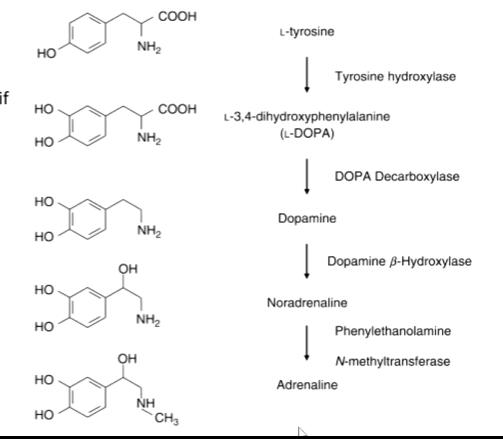
Starting Point: Tyrosine → DOPA by enzyme Tyrosine Hydroxylase (rate-limiting step).
Conversion of DOPA to dopamine in the cytoplasm (slow step) and then dopamine to noradrenaline in synaptic vesicles.
Use of Carbidopa: Inhibits DOPA decarboxylase, used with L-DOPA in Parkinson’s treatment.
At adrenal medulla: Noradrenaline is converted to adrenaline by PNMT.
Adrenaline Release:
During stimulation, approximately 95% adrenaline and 5% noradrenaline is released into the bloodstream.
adrenaline produced in adrenal glands
Storage of Noradrenaline:
Stored in synaptic vesicles, which release noradrenaline via exocytosis triggered by calcium influx during action potential.
dopamine or recycled noradrenaline are taken up into synaptic vesicles by a transporter protein
Vesicular Monoamine Transporter (VMAT): Responsible for taking up dopamine and recycled noradrenaline.
Effects of Reserpine: Inhibits VMAT, depleting vesicular stores of noradrenaline.
Release Mechanism:
exocytosis triggered by increased intracellular calcium via voltage-gated calcium channels.
After release, noradrenaline either activates target receptors or binds to presynaptic α2-adrenoreceptors for negative feedback to inhibit further release, blocks calcium entry by inhibiting the voltage gated calium channels which inhibits any further release of noradrenaline. prevents excessive release of noradrenaline
Drug Guanethidine inhibits noradrenaline release via a complex mechanism.
Termination of Noradrenaline Signaling
Uptake Mechanisms:
About 75% of noradrenaline is recycled (Uptake-1 via NET), and remaining 25% is handled via Uptake-2 (Extraneuronal Monoamine Transporter, EMT).
Inside the varicosity, noradrenaline can either be repackaged (via VMAT) or metabolized by Monoamine Oxidase (MAO).
Sympathomimetics
Categories:
Direct Sympathomimetics: Activating adrenoceptors directly (e.g. phenylephrine). directly bind to arenorepectors and mimic the physiological effects of these receptors
Indirect Sympathomimetics: Increasing noradrenaline levels without directly activating receptors (e.g. amphetamine, cocaine, tyramine, ephedrine).
NET Inhibitors:
removes neurotransmitters from synapses
prolong the lifetine of the neurotransmitter in the synapse, increasing its effects
Cocaine inhibits NET, increasing noradrenaline concentration in the synapse.
Fluoxetine (Prozac): A Selective Serotonin Reuptake Inhibitor (SSRI) that inhibits serotonin uptake in the brain.
MAO Inhibitors and Dietary Restrictions
MAOIs in Treatment: Used for depression but require dietary restrictions (e.g., avoiding cheese).
Causes of Hypertensive Crisis:
Tyramine, when accumulated due to MAO inhibition, enters sympathetic neurons, displaces noradrenaline from vesicles, leading to increased blood pressure.
Revisiting Key Concepts and Applications
Adrenoceptors: At least nine types exist (α1A, α1B, α1D, etc.), primarily G-protein coupled receptors (GPCRs).
Receptor Mechanisms:
Hormonal influences and neurotransmitter interactions to modulate bodily responses.
Quick Revision Points
What neurotransmitter is released in the sympathetic ganglion? (ACh, NA, 5-HT, Adrenaline)
True/False: SNS increases heart rate.
True/False: SNS has long pre-ganglionic and short post-ganglionic fibers.
What is the effect of clonidine (α2 adrenoceptor agonist) on noradrenaline release?
How many adrenoceptor types are there?
True/False: Tyramine is sympathomimetic.
True/False: Amphetamine acts on adrenoceptors to activate the SNS.
True/False: MAO terminates SNS transmission.
Conclusion
Review of the role of the SNS, the process of noradrenaline transmission, and the implications of pharmacological interventions.Students should be familiar with the physiological responses and associated drugs, as well as dietary precautions when using MAO inhibitors.