Environmental Sustainability Final
Module 5.1 – Ecological Economics and Consumption: Wall to Wall, Cradle to Cradle
Core Message: Humans have a high impact on Earth because of how we use resources.
- Humans focus on short-term gains
- Humans often focus on one issue instead of seeing the interconnected whole.
- Humans would be wise to use nature as a model.
Case Study: Ray Anderson’s Epiphany in Ecological Economics
- Carpet is made of:
- Natural fibers (wool, cotton, sisal)
- Synthetic fibers
- Environmental consequences of making synthetic carpets – air and water pollution, using petroleum products, generating waste
- Customers asked about Interface Carpet’s environmental actions. This led to a total rethinking and retooling of the company’s manufacturing processes and energy use.
Key concept #1: What are ecosystem services, and why are they important to ecosystems and human populations? Life on Earth depends on ecosystem services provided by nature. Recognizing the value of these services may motivate us to protect them.
- Economics – the social science that deals with producing, distributing, and consuming goods and services.
- Economics is not just about money; it is also about the environmental resources we depend on
- Sustainable – capable of being continued indefinitely.
- Ecosystem services – essential ecological processes that make life on Earth possible
- Oxygen production by green plants
- Water purification
- Pollination
- Ecosystem systems provide cultural benefits, human provisions such as food production, and ecosystem regulations such as pest control or air filtering.
Key concept #2: What is an ecological footprint? Human impact can be measured in terms of our ecological footprint, and the amount of land needed to support our lifestyle.
- Ecological footprint: the land area needed for providence the resources for, and to assimilate the waste of, a person or population
- Quantifying our impact on the environment
- When we degrade ecosystems we threaten our future
- Using nature as a model, businesses can lessen their impact and still make choices that support a viable industrial economy.
Key concept #3: What does the IPAT equation tell us about our impact and the potential to reduce that impact? The impact of a population generally increases as its size, affluence, and use of technology increase. However, the right technology can reduce resource use and pollution generation, thus helping to decrease impact.
- IPAT model – a measure of human impact: I = P * A * T
- I = impact
- P = population
- A = affluence
- T = technology
- As P and A increase, so does I
- Although T usually increases impact, sometimes they can decrease environmental impact.
Interface Carpet: Re-entry 2.0
- Old or unused carpet is typically discarded
- Interface developed:
- Technologies to recycle old carpets
- Technologies that allow one square of carpet to be replaced
- Goal: be a restorative enterprise with a positive environmental impact.
Key concept #4: What are natural capital and natural interest, and how can they be sustainably used? If we harvest resources only at or below the rate at which they are produced, that is, take only the natural interest, we will leave behind enough natural capital to replace what we took.
- Natural capital – the wealth of resources on Earth; includes the natural resources we consume as well as the natural systems that produce these resources
- Natural interest – readily produced resources that we could use and still leave enough natural capital behind to replace what we took.
The Epiphany of Ray Anderson:
- Ray Anderson came to realize that if we take more than is replaced, natural capital will shrink and therefore produce less the next year.
- By taking 50% more resources than is sustainable, we are taking resources away from the future: intergenerational tyranny
- By 2017, Interface Carpet had cut the amount of energy it derived from fossil fuels by 88% and reduced its total energy use by 45%.
Key concept #5: What is true cost accounting, and why should we employ it? When the price of a product does not reflect the social and environmental external costs, those costs are paid by others, rather than being passed on to the consumer. Internalizing these external costs better reflects the true cost of a product.
- True cost accounting – what does it take to produce a product or service?
Internal vs. External Cost –
Internal costs – a cost that is accounted for when a product or service is evaluated for pricing.
Examples: raw materials, manufacturing costs, labor, taxes
External costs – a cost associated with a product or service that is not taken into account when a price is assigned to that product or service, but rather is passed on to a third party who does not benefit from the transaction. Examples: Nutrient cycles, health costs associated with manufacturing
Key concept #6: What are the main differences between the assumptions and economic models of environmental versus mainstream economics? Mainstream economics is criticized because it makes some assumptions about resource availability and value that are inconsistent with the way nature operates. Transitioning from linear economic models to circular systems that depend on renewable resources and see waste as a useful input can help address these shortcomings.
- Environmental economics – a new theory of economics that considers the long-term impact of our choices on people and the environment.
- Environmental economists argue that traditional models will fail because they are based on false assumptions.
- Natural and human resources are infinite. Water, fossil fuels, soil are all finite.
- Discounting future value – giving more weight to short-term benefits and costs than to long-term ones.
- Linear economic system – a production model that is one-way inputs are used to manufacture a product, and waste is discarded. This is an unsustainable model!
- Circular economic system – a production system in which the product is returned to the resource stream when consumers are finished with it or are disposed of in such a way that nature can decompose it. Ex: Interface’s ReEntry 2.0 program recycles old carpet tiles.
- Cradle to cradle – refers to the management of a resource that considers the impact of its use at every point, from raw material extraction to final disposal or recycling
- Service economy – a business model whose focus is on leasing and caring for a product in the customer’s possession rather than on selling the product itself (i.e., selling the service that the product provides)
- Example: interface leases its carpet tiles and does regular maintenance.
- Take back program – a program that allows a consumer, once they are finished with a product, to return it to the manufacturer that made it
- Green business – doing business in a way that is good for people and the environment
- Example: interface outcompeted other carpet manufacturers in a $20 billion deal because of its genuine sustainability practices.
*Misconception: models of production typically follow a linear sequence, a “take, make, dispose” approach.
Assumptions of mainstream economics:
- Natural and human resources are infinite or can be found if needed
- Economic growth will go on forever. Since there are inherent limits to what Earth can provide, unlimited economic growth is not possible
- Something that benefits or harms us today is more important than might do so tomorrow.
Key concept #7: how can consumers make better choices that reduce their overall impact? Transparency in how a business operates will allow consumers to make better choices and level the playing field for businesses that are trying to operate more sustainably. Finding ways to consume less is also an important green choice
- Ecolabeling – providing information about how a product is made and where it comes from; allows consumers to make more sustainable choices and support sustainable products and the businesses that produce them,
- Greenwashing – claiming environmental benefits about a product when the benefits of a product when the benefits are minor or nonexistent.
- Fairtrade – a certification program whose products are made in ways that are environmentally sustainable and socially beneficial including fair wages and good working conditions,
Green consumerism:
- Ecolabels: Look for transparency in labeling to identify sustainable options, such as certified organic or 100% post-consumer recycled content.
- Greenwashing: Beware of claims with no verification of accuracy or environmental relevance.
- Fair Trade: Support fair trade products made with methods that support sustainable practices and social justice.
- Share programs: Don’t buy when you can rent or borrow a product.
- Green Businesses: Support businesses that use sustainable methods and resources. Be willing to pay more for goods and services whose price represents their true cost.
- Consumption: Lower your consumption of goods and services by purchasing high-quality products that are durable and will last a long time. Try to limit your overall purchases.
Summary:
- Although Interface has come a long way since 1994, it is still working hard to achieve its sustainability goals.
- By June 2018, all Interface products were made with 100% plant-based or recycled materials—and their business continues to grow.
- Changing the way we do business to give consumers the ability to choose sustainably produced goods and services is not going to be easy, but it is necessary.
- Economics must account for, and work to protect, the environmental resources we depend on.
- Consumers can decrease their impact by consuming less and opting for sustainable or low-impact choices whenever possible.
Module 5.3 – Managing Solid Waste Microplastics
Core Message: Human waste…
- Maybe unrecognized by us, but profoundly affects the environment
- Accumulates unless reused or recycled
- Can be toxic to other living organisms
- Our actions must change to address these issues.
Case Study: Microplastics are not ubiquitous on Earth
- The U.S. Niagara conducted one of the first surveys of plastic pollution in Lake Superior
- 30,000 plastic particles per km^2
- Particles embedded with hazardous chemicals, such as flame retardants
- Found everywhere: remote waters, remote air, and inside living organisms, including humans.
Key concept #1: What types of solid waste do we produce and why do we say waste is a human invention? Solid waste can be said to be unique to human societies because in nature there is no “waste”: the discarded matter of one organism becomes a resource for another.
- Solid waste: any material that humans discard
- Natural ecosystems have a circular pathway, whereas human ecosystems tend to handle matter linearly.
- Law of Conservation of Matter: matter cannot be created or destroyed, only change forms.
- Biodegradable: capable of being broken down by living organisms
- Nondegradable: incapable of being broken down under normal conditions.
- Plastics were specifically engineered NOT to break down.
Key concept #2: What is Municipal Solid Waste (MSW) and what are the types and proportions of waste in the U.S. MSW stream? Household trash contains a variety of items, much of it food or packaging waste. Though this municipal solid waste is a small part of the total waste produced, volumes are still significant and worth efforts aimed at reducing the trash we produce.
- Municipal solid waste (MSW): everyday garbage or trash (solid waste) produced by individuals or small businesses.
- Urban dwellers produce most of the world’s municipal trash.
- As wealth increases, so does the amount of waste, except for plastic
- In 2015, each American produced about 4.5 lbs of solid waste per day.
Key concept #3: What problems are caused by the improper management of solid waste? Uncollected and mismanaged solid waste contributes to a variety of environmental problems (ex: flooding, air and water pollution), which can contribute to environmental damage and health problems for humans and other species.
Disposal Methods:
- As much as half of the world’s population, 3.5 billion people, do not have access to any form of waste management
- Discarded plastics are often eaten by other organisms.
- Plastics and other wastes reappear in gyres, areas where strong currents encircle weak currents. This leads to an accumulation of garbage.
Plastics break down but they don't biodegrade:
- Sunlight, salt water, wind, and wave action break plastics into smaller and smaller pieces.
- In the North Atlantic Gyre, > 100,000 pieces of plastic per km^2
Key concept #4: Compare the design, advantages, and disadvantages of open dumps and sanitary landfills. While better than open dumps because they bury trash in a way that reduces air and water pollution, sanitary landfills reduce decomposition rates of trash and produce methane, a powerful greenhouse gas.
- Resource Conservation and Recovery Act (RCRA): the federal law that regulates the management of solid and hazardous waste
- Implemented in 1979; EPA provides rules, and the states manage implementation.
- Open dumps: places where trash, both hazardous and non hazardous is simply piled up. This was banned in the U.S. by the RCRA
- Leachate: Water that carries dissolved substances (often contaminated) that can percolate through the soil. Can contaminate soil and groundwater.
- Sanitary landfills: disposal sites that seal in trash at the top and bottom to prevent its release into the atmosphere; the sites are lined on the bottom, and trash is dumped in and covered with soil daily.
- Pros: prevents many problems of open dumps
- Cons: prevents rapid decomposition of materials and produces large amounts of methane gas. Ex: newspapers are readable after decades
Key concept #5: What are the pros and cons of waste incinerators? Incinerators can reduce the volume of trash tremendously and generate electricity in the process, but they produce air pollution, and the ash is hazardous due to the presence of chemicals in the trash.
- Incinerators: facilities that burn trash at high temperatures
- Pros: reduces trash volume by about 80-90% and Heat produced during incineration can be converted into steam energy or electricity
- Cons: releases toxic substances into the air, polluting air and water & producing toxic ash which must be disposed of in a separate, specially designed landfill.
Key concept #6: What are some common household hazardous wastes, and how should individuals deal with this waste? Some municipal solid waste is considered hazardous and must be properly managed (recycled or disposed of) to reduce health risks and environmental contamination.
- Hazardous waste: waste that is toxic, flammable, corrosive, explosive, or radioactive
- Many household products are hazardous, including paints, batteries, and fluorescent light bulbs.
- E-waste: unwanted computers and other electronic devices such as discarded televisions and cell phones
- Contains significant amounts of precious and rare earth metals as well as toxic chemicals
- Mining for these metals is environmentally damaging.
Key concept #7: What is composting and how can it help us in our quest to deal with solid waste? Composting organic trash is a waste disposal method that mimics nature. It allows waste to decompose quickly and produces a mulch-like product that can be used to return nutrients to the soil.
- Composting: allowing waste to biologically decompose in the presence of oxygen and water, producing a soil-like mulch
- Small or large scale
- The time frame for municipal-scale composting is several days. The time frame for small-scale composting is dependent on the temperature, amount of moisture, and the number and variety of composting organisms at work.
- Large scale takes only a few days. Both can produce a soil-like mulch which enhances soil nutrients.
Key concept #8: What are the four R’s of waste reduction? Consumers can reduce their generation of waste by using less, reducing or recycling what is used, and “closing the loop” by purchasing recycled products.
- Refuse: choose not to use or buy a product if you can do without it
- Reduce: Make choices that allow you to use less of a resource by, for instance, purchasing durable goods that will last or can be repaired.
- Reuse: Use a product more than once for its original purpose or for another purpose
- Recycle: return items for reprocessing into new products. Not all plastics can be recycled. Some plastics can be recycled into other products, such as decking – turning the plastic industry into a closed-loop system.
Summary:
- We all need to be accountable for the waste we produce and the profound effects it has on the environment.
- To become more sustainable, we must make an effort to generate less trash.
- Steps must be taken to implement proper waste disposal methods in developing countries and to reconfigure the plastics industry to follow a circular production path.
- If we do not reduce our dependence on plastic and improve our disposal methods, by 2050, there will be more plastic bits in the ocean than fish.
Module 8.1 – Feeding the World Banking on Seeds
Core Message:
- We produce enough food to feed the world’s population, but ~820 million people go hungry.
- Industrial agriculture and the Green Revolution helped fight hunger
- Genetically modified crops can increase productivity
- It will take a combination of agricultural and socioeconomic reforms to solve world hunger.
Case Study: The Millennium Seed Bank
- Millennium Seed Bank–a global organization that stores seeds from around the world.
- Includes the wild relatives of today’s food plants
- Provides a backup for the future.
Key concept #1: How prevalent is hunger and what are its causes? Although we currently grow enough food to feed everyone, nearly a billion people are undernourished due to poverty, war, environmental degradation, and inadequate food distribution or preservation.
- Food security: having physical, social, and economic access to sufficient safe and nutritious food.
- Food waste: A lot of food is wasted (1.3 billion tons/year – ⅓ of food grown for humans). In developed nations, food is wasted later in the production chain. In developing nations, it happens earlier in the production chain.
- Food desert: a locale where access to affordable, fresh, and nutritious food is limited or nonexistent. In 2018, 37 million Americans lacked food security, including college students!
Key concept #2: What is malnutrition, and what problems can it cause? Malnutrition can result from undernutrition or overnutrition, both of which can lead to serious health problems.
- Malnutrition: a state of poor health that results from an inappropriate caloric intake (too many or few calories) or deficiency in one or more nutrients
- Can serve as a prelude to many diseases. Ex: blindness as a result of a vitamin A deficiency
- Undernourishment: when a person does not have enough to eat.
- Overnutrition: the consumption of too many calories
- Considered a form of malnutrition
- It affects approximately 1.5 billion people around the world
- Increases susceptibility to diseases like heart disease and type II diabetes
- A problem of both the wealthy and poor
- Cheaper foods can be high in calories but deficient in essential nutrients
Key concept #3: What were the intent, scope, and outcome of the green revolution? The Green Revolution helped address world hunger in the mid-20th century by producing high-yielding crop varieties grown with chemical fertilizers and pesticides.
- Green Revolution: a plant-breeding program in the mid-1900s that dramatically increased crop yields and paved the way for mechanized large-scale agriculture.
- Began in the late 1960s
- The global population was soaring but food production was plummeting, especially in India and China
- In addition to enhanced technologies, new high-yield plants were introduced.
Key concept #4: What is industrial agriculture and what are the pros and cons of farming this way? Modern industrial agriculture produced huge amounts of food but led to ecological and social problems and reduced crop genetic diversity.
- Industrial agriculture: farming methods that rely on technology, synthetic chemical inputs, and economies of scale to increase productivity and profits
- Monoculture: farming method in which a single variety of one crop is planted, typically in rows over huge swaths of land, with large inputs of fertilizer, pesticides, and water. Usually, a genetically uniform crop (monoculture) is planted.
- Genetic diversity: the heritable variation among individuals of a single population or within the species as a whole.
The Unintended Consequences of Industrial Farming:
- Loss of soil fertility
- Depleted water supplies
- Salinization of soil
- Water pollution
- Evolution of pesticide resistance in insects
- Toxic chemical exposure
- Increases dependence on fossil fuels
- Reduction in small-scale farming
Monocultures and the Loss of Genetic Diversity:
- Monocultures have led to a loss in genetic diversity. Consequences:
- Crops are more vulnerable to pesticide-resistant pests
- Loss of crop resilience due to a loss of genetic diversity
- Without genetic diversity, crops face big threats from climate change.
- Changing temperatures and the length of growing seasons
- Destruction from unseasonable floods and droughts that are destroying crops and diminishing yields worldwide.
- Example: coffee productivity declining as much as 50% in some areas.
Trade-offs of Industrial Agriculture:
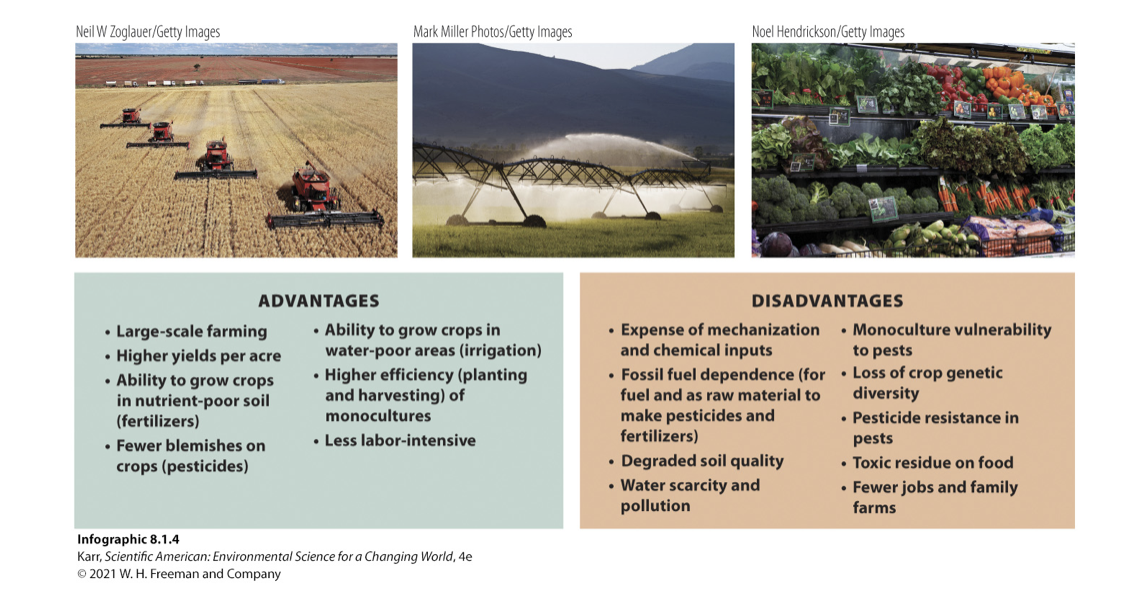
Key concept #5: What are the trade-offs of fertilizer and pesticide use in agriculture? The application of synthetic fertilizers and pesticides contributes to the high productivity of industrial agriculture, but their use comes with trade-offs.
- Fertilizer: a natural or synthetic mixture of nutrients that is added to soil to boost plant growth.
- Pesticide: a natural or synthetic chemical that kills or repels plant or other animal pests.
- Pesticide resistance: the ability of a pest to withstand exposure to a given pesticide; the result of natural selection favoring the survivors of the original population that was exposed to the pesticide.
Key concept #6: How can genetic engineering be used in agriculture, and what are its trade-offs? Genetically engineering crops (or animals) to contain useful traits such as faster growth or an expanded growing range may increase food supplies but comes with environmental, economic, and ethical concerns.
- Genetically modified organism (GMO): an organism whose genetic information is modified to give it desirable characteristics such as pest or drought resistance.
- Transgenic organism: an organism that contains genes from another species
- Intragenic organism: an organism whose own DNA has been edited
- Cisgenic organism: an organism that received DNA from a close relative, DNA that could have been acquired via traditional breeding.
GMOs in America’s Processed Foods:
- GMOs are in more than 75% of U.S. processed food – 85-90% of our corn, soybeans, and cotton are GMOs
- HT crops: crops with a herbicide-tolerant gene added to their genome.
- Enables crops to withstand huge doses of herbicides, chemicals that kill plants
- Most commonly used in conjunction with Roundup, a product of Monsanto
- BT crops: crops that contain a gene from Bacillus thuringiensis. A naturally occurring bacterium that produces a toxin that kills some insect pests.
- Both the HT and BT genes are found in some crops
Key concept #7: What are food self-sufficiency and food sovereignty and why are they important? Concerns about genetically engineered foods include health and environmental effects, and the worry that the use of patented GMOs could give a few large corporations unprecedented control over global agriculture.
- Food self-sufficiency: the ability of an individual or nation to grow enough food to feed its people
- Food sovereignty: the ability of an individual or nation to control its food system.
- Principles of food sovereignty:
- Focus on healthy and culturally appropriate food
- Value food providers’ right to live and work with dignity
- Favor less environmentally damaging farming methods
- Promote local control of land sees, and other needed agricultural resources.
- Principles of food sovereignty:
- Cash crops: food and fiber crops are grown to sell for profit rather than for use by local families or communities. Ex: growing cotton, coffee, or chocolate
Summary:
- We grow enough food to feed everyone on Earth, but we need to solve socioeconomic problems so that everyone has access to food.
- Farming solutions need to be specific to the area and promote local control.
- Different challenges require different farming methods.
- Whatever methods are pursued, they must also protect the natural environment to protect future productivity.
- All methods must be made available to all people, not just an empowered few.
Module 8.2 – Sustainable Agriculture Raising Crops
Core Message:
- Food security for all people requires a sustainable food system.
- Two goals:
- Grow crops without degrading the ecosystem that supports that growth
- Change consumer purchasing practices to support sustainable
Case study: Using Ancient Methods for Modern Farming
- A Vermont Famer, Erik Andrus, realizes that the location of his farm is good for growing rice.
- He uses an ancient Japanese method of integrating growing rice and dicks
- This is profitable for the farmer, provides grain and protein, and provides ecosystem services.
Key concept #1: What is sustainable agriculture? The goal of sustainable agriculture is to raise food without damaging the environment or future productivity while operating ethically concerning animals, workers, and local communities.
- Sustainable agriculture: farming methods that can be used indefinitely because they do not deplete resources, such as soil and water, faster than they are replaced.
- The goal is to mimic the traits of a sustainable ecosystem:
- Use renewable energy and local resources for inputs
- Rely on biodiversity to trap energy, deal with wastes, and control pests.
- Sustainable agriculture should also be economically viable and socially ethical
- The goal is to mimic the traits of a sustainable ecosystem:
- Organic agriculture: farming that does not use synthetic fertilizer pesticides, GMOs, or other chemical additives like hormones (for animal rearing).
- Organically grown food may be more nutritious than conventionally grown food – but whether there is an accompanying health benefit is unknown.
- Higher profit margin because consumers will pay more.
(there is speculation that it is more nutritious and tastes better than non-organic foods)
Key concept #2: What is the importance of fertile soil, and how does land use affect it? Fertile soil is a diverse ecosystem that is dependent on a wide variety of biotic and abiotic factors. It provides many important ecosystem services; unfortunately, soil is lost much more quickly than it forms in many places.
- Soil: a complex ecosystem of mineral and organic material, including living organisms such as bacteria, invertebrates, and fungi, that supports the growth of plants and is, in turn, affected by those plants.
- Soil is key for plant growth – and plants are key for other living organisms.
- Mutualisms – both organisms benefit from their relationship.
- Soil aggregates: clumps of soil produced as organic matter decomposes are beneficial for soil bacteria
- Soil is key for plant growth – and plants are key for other living organisms.
- Soil Erosion: the process in which soil is moved from one location to another, most often by wind or water.
- Soil forms slowly – 500-1,000 years to form 1 inch of soil.
- Erosion can remove in days what it took centuries to form.
- Soil formation: Native grasses can have deep roots. This way, they can access deep sources of water. They also hold soil in place better than shallow-rooted plants (such as wheat)
- Soil can vary from place to place
- Soil horizons
- The best soil for plants has even proportions of large, medium, and small soil particles.
O - organic, leaf litter/grass clippings (one of the most important layers)
A - topsoil, broken down plant and animal material (one of the most important layers)
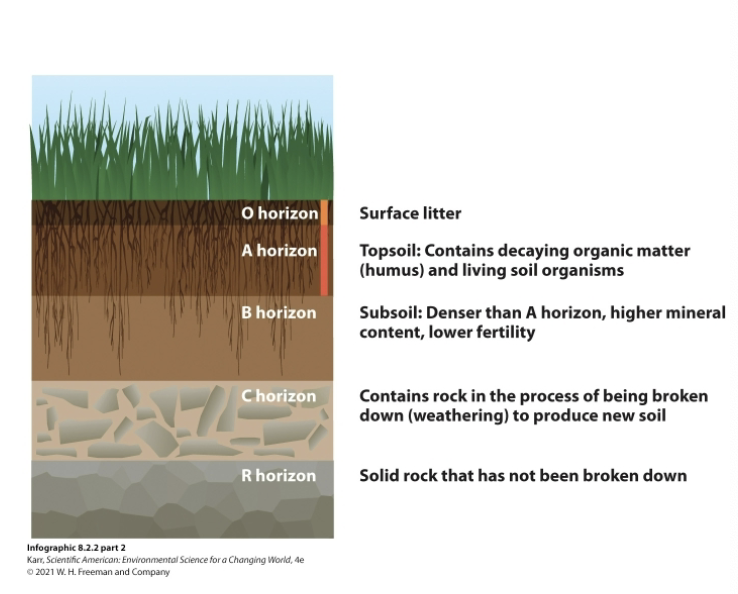 B - subsoil, denser and more minerals/clay/sand (where plant roots stop)
Key concept #3: What is agroecology and what are its benefits? Modeling a farm after an ecosystem (agroecology) to include a variety of plants and animals can boost productivity and protect or even enhance the local environment.
- Agroecology: a scientific field that considers the area’s knowledge and favors agricultural methods that protect the environment and meet the needs of local people.
- Example: when raising ducks, fish, and rice crops together, Japanese rice farmer Furuno discovered he could produce more rice than with the old industrial system.
- Polyculture: a farming method in which a mix of different species are grown together in one area. Before industrial farming, small farms were largely polycultures.
Key concept #4: How can pests be managed in a way that minimizes environmental damage? Integrated pest management techniques can often effectively control pests while minimizing or eliminating the use of chemical pesticides.
- Integrated Pest Management (IPM): the use of a variety of methods to control a pest population, to minimize or eliminate the use of chemical toxins. For example, incest sticky traps are IPM because insects are attracted to blue and yellow.
- Steps of integrated pest management:
- Identify true pests – not all bugs and weeds are pests, some can be beneficial
- Set an action threshold and monitor pests – identify population size because some smaller sizes are manageable
- Develop an action plan – excluding, discouraging, or killing the pests while minimizing the use of chemicals.
- Cultural – how you arrange plants in the space like using barriers
- Mechanical – using nets or traps
- Biological – using natural predators to kill pests
- Chemical – applying chemicals
- Steps of integrated pest management:
Key concept #5: How can traditional farming methods contribute to sustainable agriculture? Sustainable agriculture draws on various traditional farming methods that can protect or improve soil and reduce pest problems.
- Annual crops: crops that grow, produce seeds, and die in a single year and must be replanted each season.
- Perennial crops: crops that do not die at the end of the growing season but live for several years, which means they can be harvested annually without replanting.
- Example: perennial wheat roots vs. annual wheat roots
- Using traditional methods to mimic nature!!
Key concept #6: What role does the consumer play in helping build a sustainable food system? Consumer choices can support sustainable agriculture. Buying locally grown, organic food is the best option for reducing the carbon footprint of that food.
- Food miles: the distance a food travels from its site of production to the consumer
- Carbon footprint: the amount of carbon released into the atmosphere by a person, a company, a nation, or an activity.
- Buying locally grown items supports local economies and provides fresher food to consumers.
Key concept #7: What are the trade-offs of sustainable agriculture, and how might they be addressed? Sustainable agriculture comes with trade-offs, but many feel that the disadvantages are less problematic than those of modern industrial agriculture, especially in the long term.
Can sustainable agriculture feed the world?
- A 2010 report by the International Livestock Research Institute concluded that mixed polyculture farms hold the most promise for intensifying food production worldwide.
- A combination of methods targeted at the local community will probably work best.
Summary:
- Polycultures that integrate multiple species are a viable method for sustainable farming.
- Relying on indigenous knowledge can match the farm to the local community.
- Sustainable farming has to feed the people and maintain or improve the health of the land.
- Mimicking natural ecosystems is beneficial to both people and land.
- Essay: The importance of sustainable foods is to reduce the amount of pesticides used on our food
- Essay Pros and cons of sustainable agriculture