Memory
🧠 DETAILED MULTI-PARAGRAPH SUMMARY
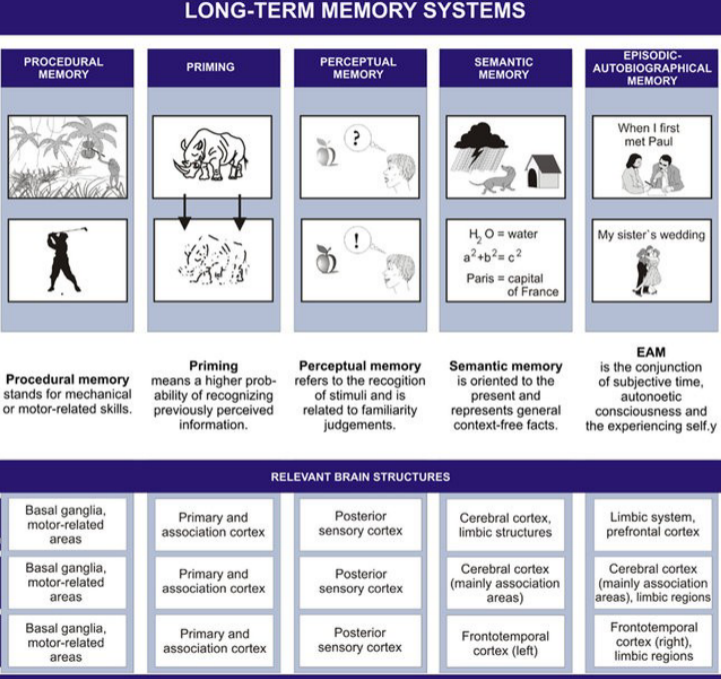
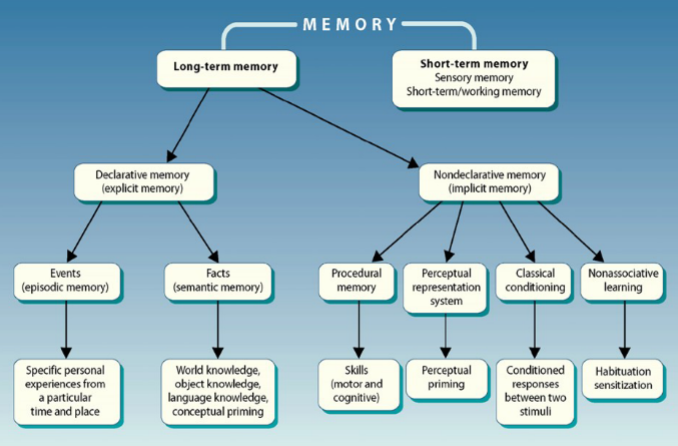
Memory is a complex, multi-stage process that allows organisms to acquire, store, retain, and retrieve information. It is broadly divided into short-term (working) memory and long-term memory (LTM). Short-term memory temporarily holds small amounts of information, while working memory actively manipulates this information for tasks like reasoning or calculations. Long-term memory, in contrast, has a vast capacity and duration, storing information over extended periods. Long-term memory is further divided into declarative (explicit) memory—comprising episodic (events) and semantic (facts) memory—and procedural (implicit) memory, which involves skills and habits.
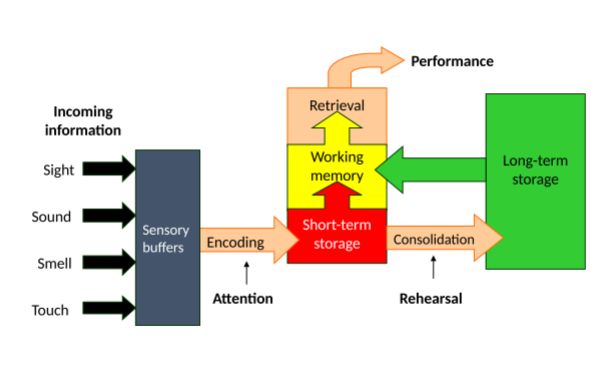
Memory formation begins with sensory input, which is briefly held in sensory buffers. For this information to progress, attention acts as a gatekeeper, allowing encoding into short-term memory. Without attention, information is rapidly lost. Through rehearsal, information in short-term memory can undergo consolidation, transforming into long-term memory. This process involves both cellular consolidation (hours; synaptic changes) and systems consolidation (days to years; reorganisation between brain regions). Importantly, consolidation requires gene expression and protein synthesis, indicating that learning physically alters the brain.
The hippocampus, part of the limbic system, plays a critical role in memory formation—particularly episodic and spatial memory—but is not the site of long-term storage. Instead, it acts as a temporary processor, transferring memories to the neocortex, where they are stored long-term. Evidence from patient Henry Molaison (H.M.), who underwent bilateral hippocampal removal, demonstrated severe inability to form new memories while retaining older ones, highlighting the hippocampus’s role in memory consolidation. Additionally, studies of London taxi drivers show increased hippocampal volume due to extensive spatial navigation, emphasising brain plasticity.
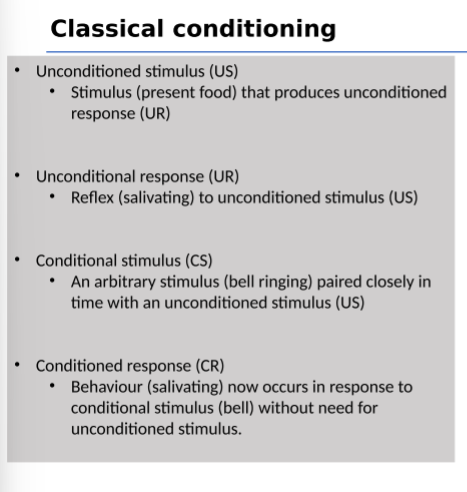
Animal models have been crucial in understanding memory. The Morris water maze demonstrates spatial learning in rodents, relying on hippocampal “place cells.” Classical conditioning, such as Pavlov’s dog experiment, shows associative learning between stimuli. Fear conditioning models involve pairing a context with an aversive stimulus, leading to a freezing response upon re-exposure. This process involves the amygdala (fear processing), hippocampus, and frontal cortex.
At the molecular level, memory formation depends on synaptic plasticity, particularly long-term potentiation (LTP) and long-term depression (LTD). LTP strengthens synaptic connections when neurons fire together, largely mediated by glutamate receptors (NMDA and AMPA) and calcium signalling. This leads to increased receptor density, enhanced neurotransmitter release, and even new synapse formation. Conversely, LTD weakens synapses by reducing receptor availability, ensuring that unused connections are pruned. The balance between LTP and LTD is essential for efficient learning and memory storage.
📌 BULLET POINT SUMMARY
🔹 Types of Memory
Short-term memory: temporary storage
Working memory: manipulation of information
Long-term memory:
Declarative (explicit):
Episodic (events)
Semantic (facts)
Procedural (implicit): skills
🔹 Memory Formation
Sensory input → Attention → Encoding → Short-term memory
Rehearsal → Consolidation → Long-term memory
Requires gene expression and protein synthesis
🔹 Consolidation
Cellular: synaptic changes (hours)
Systems: hippocampus → cortex (days–years)
🔹 Brain Regions
Hippocampus: memory formation, spatial memory
Amygdala: fear and emotional memory
Cortex: long-term storage
Frontal cortex: attention and learning
🔹 Key Evidence
Patient H.M.: hippocampus essential for new memories
Taxi drivers: increased hippocampal volume
Rodent models: spatial learning and conditioning
🔹 Learning Paradigms
Classical conditioning: CS + US → CR
Fear conditioning: freezing response to context
🔹 Molecular Mechanisms
LTP:
Strengthens synapses
NMDA receptor activation → Ca²⁺ influx
LTD:
Weakens synapses
Removes unused connections
🧩 FILL-IN-THE-BLANK SUMMARY
Section 1: Memory Types
Long-term memory is divided into _declarative______ and __procedural_______ memory.
Episodic memory refers to _personal_______ experiences.
Procedural memory involves _motor skills______.
Section 2: Memory Formation
__attention_____ acts as the gatekeeper of memory.
The process of converting information into memory is called _encoding_____.
Stabilising memory over time is called _consolidation________.
Section 3: Brain Regions
The __rehersal ______ is critical for memory consolidation.
The __amgydala________ is important for fear-based learning.
Long-term memories are primarily stored in the __neocortex_______.
Section 4: Animal Models
The morris water_ _maze______ is used to study spatial memory in rodents.
Freezing behavior is used in __fear______ conditioning.
Section 5: Molecular Mechanisms
LTP strengthens __synpatic______ connections.
___NMDA_____ receptors allow calcium influx.
LTD causes ___weakening_______ of synaptic strength.
✅ ANSWERS (Fill in the blanks)
declarative, procedural
personal
skills/actions
attention
encoding
consolidation
hippocampus
amygdala
cortex (neocortex)
Morris water maze
fear
synaptic
NMDA
reduction
📝 40 MULTIPLE CHOICE QUESTIONS (MCQs)
Questions
Memory is defined as:
A. Reflex action
B. Storage only
C. Acquisition, storage, and retrieval
D. Motor responseWhich is explicit memory?
A. Procedural
B. Declarative
C. Reflex
D. MotorEpisodic memory stores:
A. Skills
B. Facts
C. Personal events
D. ReflexesSemantic memory stores:
A. Emotions
B. Facts
C. Skills
D. ReflexesProcedural memory is:
A. Conscious
B. Emotional
C. Unconscious skills
D. SensoryShort-term memory duration is:
A. Long
B. Infinite
C. Brief
D. PermanentWorking memory:
A. Stores permanently
B. Manipulates information
C. Is unconscious
D. Is reflexiveAttention is required for:
A. Storage
B. Encoding
C. Retrieval
D. ReflexConsolidation converts:
A. LTM to STM
B. STM to LTM
C. Reflex to memory
D. Emotion to memoryCellular consolidation occurs over:
A. Seconds
B. Hours
C. Years
D. MinutesSystems consolidation involves:
A. Spinal cord
B. Cortex and hippocampus
C. Cerebellum only
D. BrainstemThe hippocampus:
A. Stores memory
B. Forms memory
C. Controls reflexes
D. Controls breathingH.M. showed:
A. Memory is irrelevant
B. Hippocampus is crucial
C. Cortex is useless
D. Reflexes dominateAmygdala is involved in:
A. Vision
B. Fear
C. Movement
D. HearingTaxi driver studies show:
A. Reduced hippocampus
B. Increased hippocampus
C. No change
D. Brain damageMorris water maze tests:
A. Fear
B. Spatial memory
C. Reflex
D. EmotionClassical conditioning involves:
A. Reflex only
B. Association
C. Movement
D. VisionUS stands for:
A. Unknown stimulus
B. Unconditioned stimulus
C. Unique stimulus
D. Universal signalCR is:
A. Natural response
B. Learned response
C. Reflex
D. MotorFear conditioning measures:
A. Movement
B. Freezing
C. Eating
D. JumpingLTP causes:
A. Weakening
B. Strengthening
C. Loss
D. DeathLTD causes:
A. Strengthening
B. Weakening
C. Growth
D. ExcitationGlutamate is:
A. Inhibitory
B. Excitatory
C. Neutral
D. HormoneNMDA receptors allow:
A. Sodium only
B. Calcium
C. Potassium
D. ChlorideLTP requires:
A. Low activity
B. High activity
C. No activity
D. ReflexLTD removes:
A. Neurons
B. Receptors
C. DNA
D. GenesPlace cells are in:
A. Amygdala
B. Hippocampus
C. Cortex
D. BrainstemWorking memory interacts with:
A. Reflexes
B. LTM
C. Emotions
D. HormonesMemory trace is called:
A. Reflex
B. Engram
C. Signal
D. PulseGene expression is needed for:
A. Reflex
B. Learning
C. Vision
D. HearingSleep helps:
A. Forgetting
B. Consolidation
C. Reflex
D. MovementAmygdala enhances:
A. Weak memory
B. Fear memory
C. Motor skills
D. VisionProcedural memory example:
A. Birthday
B. Cycling
C. Name
D. FactSemantic memory example:
A. Riding bike
B. Capital city
C. Fear
D. ReflexEpisodic memory example:
A. Fact
B. Skill
C. Personal event
D. ReflexNMDA knockout leads to:
A. Better learning
B. Impaired learning
C. No change
D. ReflexLTP depends on:
A. Dopamine
B. Calcium
C. Oxygen
D. GlucoseLTD prevents:
A. Learning
B. Overload
C. Reflex
D. SleepCortex stores:
A. STM
B. LTM
C. Reflex
D. EmotionHippocampus damage affects:
A. Old memories only
B. New memories
C. Reflex
D. Movement
✅ MCQ ANSWERS
C
B
C
B
C
C
B
B
B
B
B
B
B
B
B
B
B
B
B
B
B
B
B
B
B
B
B
B
B
B
B
B
B
B
C
B
B
B
B
B