Gluconeogenesis
Production of Glucose from Non-Hexose Precursors
Occurs primarily in the liver and proximal tubules of the kidneys.
Importance of gluconeogenesis in maintaining blood glucose levels, so as not to solely rely on liver glycogen stores.
Liver glycogen lasts 12-24 hrs when fasting and resting
After 22 hr fasting, ~64% of glc in circulation was from gluconeogenesis
After 46 hr fasting, ~90% of glc in circulation was from gluconeogenesis
Gluconeogenesis
Definition: Gluconeogenesis is essentially a reversal of glycolysis, with three key enzymatic steps differing from glycolysis.
**Key Enzymatic Steps:
Hexokinase vs. Glucose-6-phosphatase:
In glycolysis, hexokinase converts glucose to glucose-6-phosphate. In gluconeogenesis, glucose-6-phosphatase converts glucose-6-phosphate to glucose.
Phosphofructokinase-1 vs. Fructose-1,6-bisphosphatase:
Phosphofructokinase-1 in glycolysis is replaced by fructose-1,6-bisphosphatase in gluconeogenesis to convert fructose-1,6-bisphosphate to fructose-6-phosphate.
Pyruvate Kinase vs. Pyruvate Carboxylase and PEP Carboxykinase:
The pyruvate kinase reaction in glycolysis is reversed by the actions of pyruvate carboxylase and phosphoenolpyruvate (PEP) carboxykinase.
May involve an intermediary conversion to malate by malate dehydrogenase.
Enzymatic Reactions in Glycolysis and Gluconeogenesis
A complex interrelationship exists between glycolysis and gluconeogenesis, where different enzymes catalyze opposing reactions:
Key Reactants & Products:
Glucose in glycolysis is converted to glucose-6-phosphate through hexokinase (ATP is consumed).
In gluconeogenesis, glucose-6-phosphate is converted back to glucose using glucose-6-phosphatase.
Fructose-6-phosphate converts to fructose-1,6-bisphosphate via phosphofructokinase in glycolysis, while the reverse happens using fructose-1,6-bisphosphatase in gluconeogenesis.
Convert Glyceraldehyde-3-phosphate (G3P) to 1,3-bisphosphoglycerate, then to 3-phosphoglycerate, and so forth, until reaching glucose again.
Acetyl-CoA: A crucial substrate in gluconeogenesis that provides the necessary acetyl groups for glucose synthesis, although it cannot be converted back to glucose directly.
Substrates for Gluconeogenesis
Lactate:
Produced during anaerobic glycolysis, converting pyruvate to lactate via lactate dehydrogenase (LDH), which requires NADH and yields NAD+.
Lactate is released by muscles or red blood cells into the bloodstream, and converted back to glucose in the liver, which is then transported back to muscles.
Alanine:
Produced from the breakdown of proteins or during the transamination of amino acids, alanine can also be converted to pyruvate through alanine aminotransferase (ALT) in the liver, providing a substrate for gluconeogenesis.
All amino acids except 2, leucine and lysine - can be used for gluconeogenesis, as they can be converted into intermediates that enter the gluconeogenic pathway.
They’re purely ketogenic, meaning they can be used to make ketones
Glycerol:
Derived from lipolysis in adipose tissue, serves as a gluconeogenic substrate.
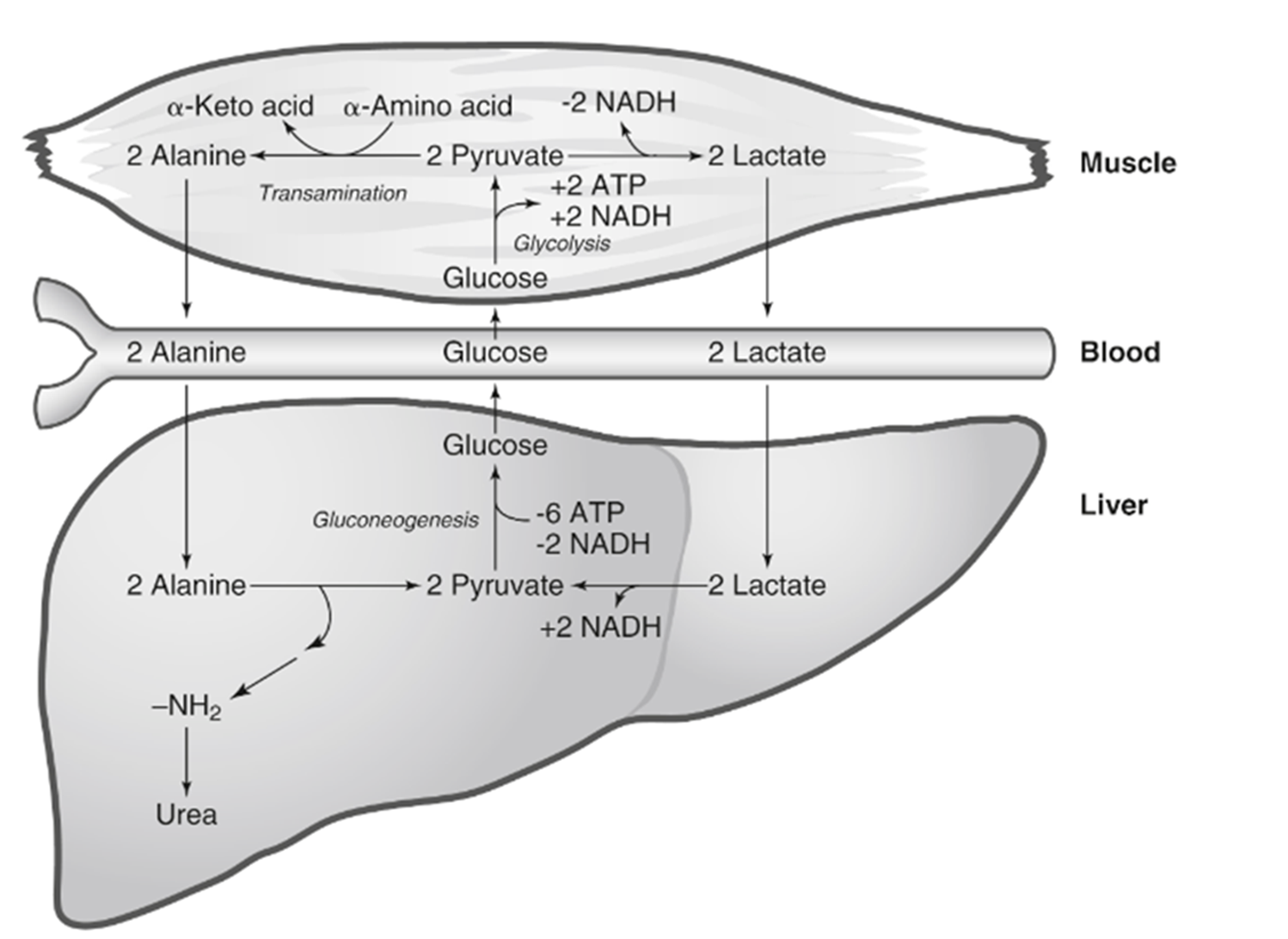
Directional Flow in Metabolism
Flow of gluconeogenic substrates during prolonged fasting:
Sources: Glycerol and fatty acids from adipose, amino acids from protein degradation, and lactate released by red blood cells.
Conversion to glucose occurs mainly in the liver and proximal renal tubules.
Regulation of Pyruvate Kinase
Pyruvate kinase is regulated differently in the liver versus other glycolytic tissues:
Inactive under certain conditions, such as the presence of ATP, acetyl-CoA, and long-chain fatty acids.
Active when ADP is present, indicating a requirement for energy production.
Regulation of Gluconeogenesis
Influenced by various hormones:
Glucagon: Increases gluconeogenesis, particularly in the liver.
Insulin: Acts oppositely to glucagon, inhibiting gluconeogenesis and stimulating glycolysis.
Glc-6-P → Fruc-6-P with PFK-1 (activated with F2,6BP)→ Fruc 1,6 BP
Bypassed in gluconeogenesis
Cortisol (Glucocorticoid): Promotes gluconeogenesis.
In gluconeogenesis, Fruc 1,6 BP with FBPase-1 (inhibited by FBPase-1)→ Fruc-6-P → Glc-6-P
Thyroid hormones and several transcription factors like CREB, FoxO1, etc.
Enzyme that makes F2,6BP is phosphofructokinase-2 (PFK-2) (6PF-2K), which regulates the levels of fructose 2,6-bisphosphate
Enzyme that makes F2,6BP into Fruc-1-P is fructose bisphosphatase-2 (FBPase-2) [F2,6-Pase]
It removes a phosphate group, converting fructose 2,6-bisphosphate into fructose 6-phosphate
Increased F2,6BP = increased stimulation of glycolysis and inhibition of gluconeogenesis, facilitating the conversion of glucose to pyruvate.
Decreased F2,6BP = decreased stimulation of glycolysis and increased gluconeogenesis, promoting the generation of glucose from non-carbohydrate sources.
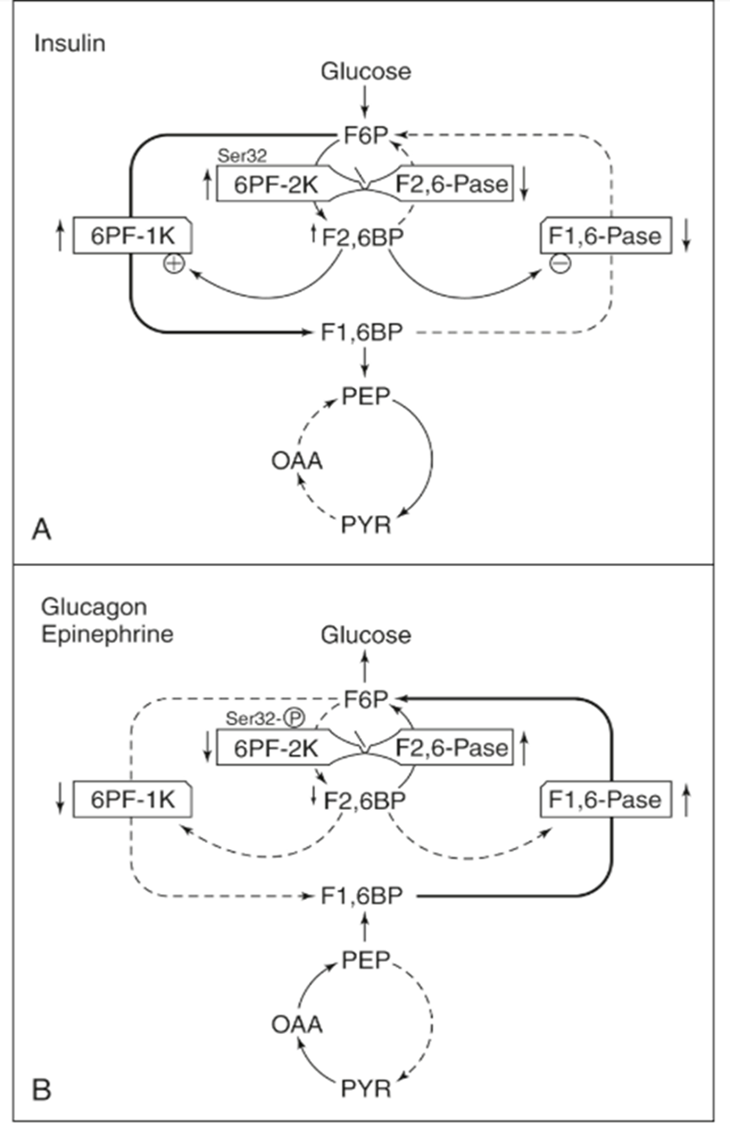
Protein Kinase A is activated by glucagon or epinephrine
Low glucose, glucagon epinephrine activates protein kinase a, which in turn catalyzes the phosphorylation of key enzymes involved in gluconeogenesis, enhancing the liver's ability to synthesize glucose.
Phosphate is added to biphasic regulation of fructose-1,6-bisphosphate, thereby promoting the conversion of pyruvate to phosphoenolpyruvate.
Thyroid-stimulating hormone
also plays a role in metabolic regulation, influencing gluconeogenesis through its effect on basal metabolic rate and aiding in the overall homeostasis of blood glucose levels.
Thyroid Hormone
increases the rate of gluconeogenesis by stimulating the expression of key enzymes, such as phosphoenolpyruvate carboxykinase (PEPCK) and glucose-6-phosphatase, which are crucial for glucose production.
CREB, FoxO1, CREBH, C/EBPs, NRS
transcription factors also modulate gluconeogenesis by regulating the expression of these enzymes, thereby impacting glucose metabolism under various physiological conditions.
Glucose Production Data
Study data from Ahlborg et al. (1974) presents glucose production during rest and exercise:
Overall Glucose Production (mmol/min):
Rest: 0.82
During exercise (40 min): 1.86
Post-exercise (240 min): 1.46
Uptake of Glucogenic Nutrients:
Lactate: 0.13, 0.23, 0.29 mmol/min
Pyruvate: 0.01, 0.02, 0.03 mmol/min
Glycerol: 0.02, 0.10, 0.21 mmol/min
Amino Acids: 0.05, 0.09, 0.12 mmol/min
Percent contribution to overall glucose production varies, peaking at 45% in prolonged fasting conditions.
Energy cost of gluconeogenesis?