PS201 - T1W6 - The Dark Side of Psychology
Slides 7–9: Personality Disorder Framework (DSM-5)
Key claims / arguments
Definition of Psychopathology → “…The study of psychological and behavioural dysfunction occurring in mental disorder or in social disorganisation (or such dysfunction per se).”
Extreme individual differences can impair functioning across relationships, work, and self-regulation
Personality pathology reflects enduring maladaptive patterns
Dysfunctional traits can undermine conventional definitions of success
Key theories / models
DSM-5 personality disorder framework
Personality disorders represents a last pattern of behaviour i the individual → this is separated from an individuals culture as cultural differences can play a role in the contextualisation of lasting patterns of behaviour. Also factoring in the internal experience of the individual.
They impact on:
Affect
Cognition
Impulse control
Interpersonal Relationships
The 4 Ds (diagnostic for Personality Disorders):
Duration → Pattern of behaviour needs to be lasting (onset is seen in adolescence/early adulthood)
Diffuse contexts → exppect to see the impact of PD (Personality Disorder) in a variation of contexts.
Distress/disability → Some form of impairment from PD
Differential diagnosis → Should be no differential diagnosis meaning no other potential reason why the individual is exhibiting such behaviour aside from the PD. All avenues should be examined before diagnosing PD
Cluster model (A, B, C) - (Done in the format of DSM 4 Revised, with clusters. DSM 5 has a format that does not include clusters)
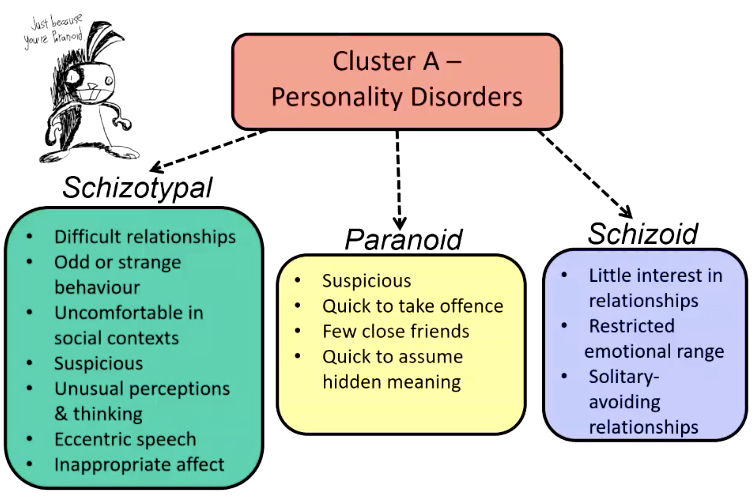
Cluster A:
Withdrawn/emotionally cold/Suspicious of thos around you/Irrational behaviour and thoughts
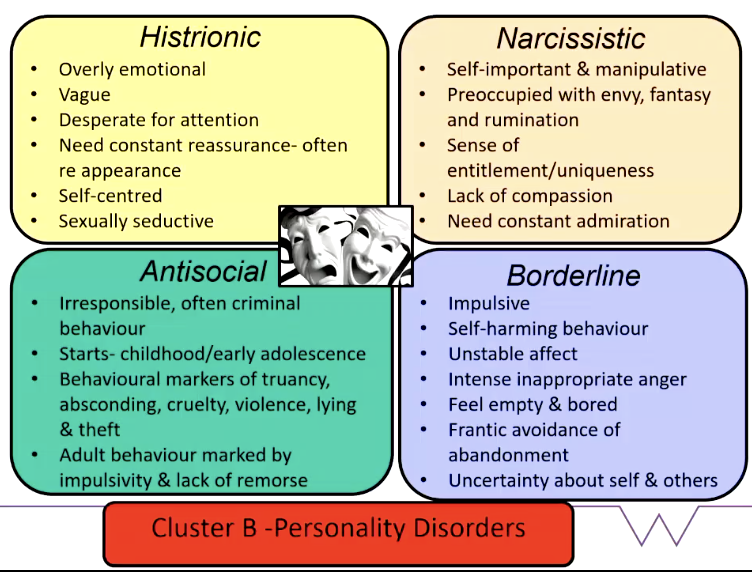
Cluster B:
Theatrical/ emotional/ attention-seeking/ shallow
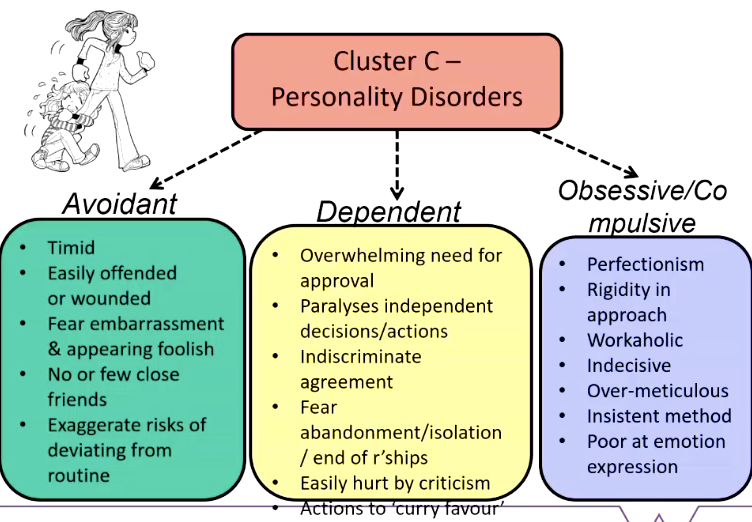
Cluster C:
Anxious/ tense/ over-controlled
Key studies
American Psychiatric Association (2013)
Defined personality disorders as enduring, maladaptive patterns affecting cognition, affect, impulse control, and relationships.
One-line essay use
Useful for defining limits of success, showing when individual differences become maladaptive rather than advantageous.
Slides 10–12: Personality Disorder Clusters & Functioning
Key claims / arguments
Different clusters impair success in different domains
Interpersonal dysfunction is a central feature of many disorders
Rigid personality styles reduce adaptability
Key theories / models
Cluster A: social withdrawal, suspicion
Cluster B: impulsivity, emotional instability, manipulation
Cluster C: anxiety, perfectionism, dependency
Key studies
DSM-5 (APA, 2013)
Cluster-based classification of personality disorders.
One-line essay use
Can be used to argue that extreme individual differences often undermine long-term success, especially relational and occupational stability.
Slides 14–20: Personality Types – The Authoritarian Personality
Key claims / arguments
Some personality types are linked to rigid cognition and dominance-based behaviour
Authoritarian traits may promote control and leadership, but impair empathy and flexibility
Personality types reflect socio-historical influences
Key theories / models
Authoritarian Personality Type
Psychoanalytic roots (strict superego, weak ego)
Social learning reinterpretations
Adordno et al., (1950) - Are some individuals more susceptible to extremist ideology? How does this then explain subsequent poor/abhorrent/socially unacceptable behaviour?
Components
Obedience to authority
Belief in own authority - believing oneself has authority to those below them
Rigid oppressive treatment to subordinates
Strict adherence to rules
Hostility/aggression towards the ‘different other’ (different from them)
favoured conventionalism and conventional norms - everyone should act in the same way as the majority
Cynical view of human nature
Opposition to subjective/intraceptive tendencies → opposition to anything that is seen as softer
Incredible levels of superstition
Exaggerated moral stance → “do as i say not as i do”, informs and rigidly regulates the behaviours of other people to standards they themselves do not follow.
Key studies
Adorno et al. (1950) - Identified authoritarianism as a personality type associated with obedience, aggression, and rigidity.
Four self-report questionnaire measures
Followed with follow up interviews - in depth
Self-report questionnaires themselves involved questions regarding anti-semitism - AS (Anti-Semitism) Scale e.g. It’s wrong for Jews and Gentiles to intermarry.”
Ethnocentric Scale - included questions regarding favouring one ethnic group over others
PEC (Politico-Economic Conservatism) Scale - the idea that those who work hard will always achieve what they deserve, regardless of any other factors
F-scale (Potential for Fascism scale) - “No insult to our honour should ever go unpunished.”
Fromm (1941, 1942, 1944) - Highlighted role of early socialisation.
Role of early experience
Parent-child relationship
Parent attitudes directed towards the child
If the attitude of the parent towards the child is poor, resentment may build in the child
Psychoanalytic roots
strict superego and weak ego → because of the poor parental attitudes towards the child, the superego has now developed to be more overbearing than the Id and imposes itself on the ego, meaning that the superego often punishes the ego more than normal. Leading to insecurity
Protection from the desires of the Id
Insecurity arises from the conflict between the ego and superego
Can lead to projective defence mechanism - saying that something is about someone else/punishing someone harshly for something when really it is about oneself.
Central Neurotic Trait - idea that the individual does not feel control in ones own world so then feeling the need to control other people
Rokeach (1960) - Reframed authoritarianism as dogmatism (cognitive rigidity).
Changed the potential for Fascism → Dogmatism
Rejected the idea that it came from a psychoanalytic intrapersonal approach, and instead reflected what he called a cognitive style - the way in which we interact with the information that comes to us from the outside world.
Idea behind his work was that once you have a set of information that sets your mindset, it will be very difficult to intergrate any new, contradictory information, and will likely reject it
Altemeyer (1981) - Viewed that the orginal proposed idea of authoritarianism was too broad, and instead adopted a social learning theory approach. Reduced authoritarianism to three factors:
Authoritarian Submission → submit to those who are perceived to have more power
Authoritarian Aggression → imposing aggressive behaviour on those perceived below you in hierarchy.
Authoritarian Conventionalism → standard views. The idea of what is viewed as the most average set of behaviour within a country, and that all people should follow that.
One-line essay use
Useful for evaluating whether rigid personality types can succeed in hierarchical environments (e.g. authority, leadership) while failing socially.
Slides 22–25: Introduction to the Dark Triad
Key claims / arguments
Some socially aversive traits may confer competitive advantages
“Dark” traits can be adaptive in certain contexts - represents social malevolence, putting themselves first, and emotional coldness.
Characterised by things just stated with the addition of duplicity
Aggression.
Success may be achieved through exploitation rather than cooperation
Key theories / models
Dark Triad
Narcissism
Machiavellianism
Psychopathy
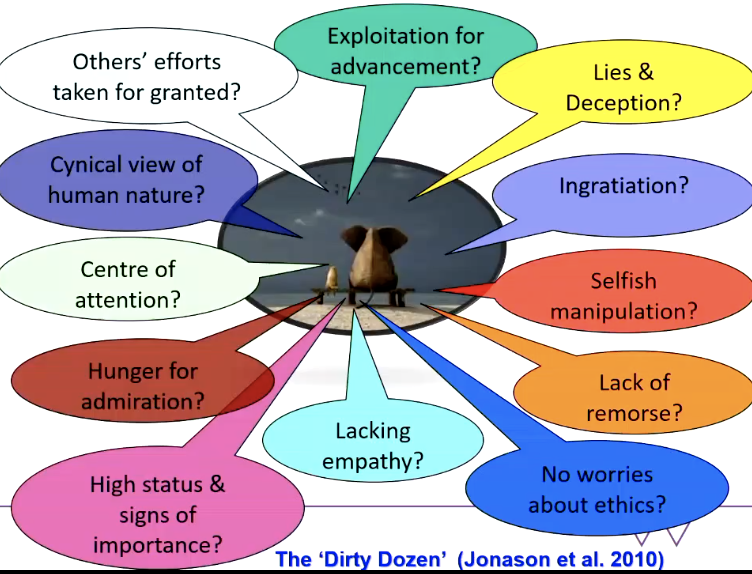
Dirty Dozen scale
Key studies
Hoskey et al. (1998a,b); Paulus & Williams (2002); Jakobwitz et al. (2006) - Identified clustering of three malevolent personality traits.
Found that Narcissism, psychopathy and, Machiavellianism seem to cluster together. When you find high rates of one, there is likely to be high rates of the others also.
Jonason et al. (2010) - Developed the Dirty Dozen measure.
One-line essay use
Central for challenging the assumption that success requires prosocial traits.
Slides 25–27: Why Do Dark Triad Individuals Succeed?
Key claims / arguments
Dark traits are often studied in organisational contexts → can show links between the individual and organisations (characteristics of the individual can be transferred the organisation, making a narcissistic organisation).
Those individuals that are identified as being Dark Triadic aren’t necessarily the ‘bad guys’ within society. E.g. James Bond → kills without remorse, uses women, cheats, lies, attention always on him and yet the movies are celebrated.
Traits such as fearlessness, manipulation, and emotional coldness can promote advancement
Success depends on context, not morality
Key theories / models
Subclinical psychopathy
Continuum model of dark traits
Key studies
Jonason et al. (2010)
Found Dark Triad traits associated with workplace success.James (2013)
Estimated prevalence of psychopathy in general and prison populations.
One-line essay use
Strong for employment-focused essays, showing how individual differences can promote success in competitive environments.
Slides 27–28: Psychopathy
Key claims / arguments
Psychopaths show emotional detachment and stress immunity
Low anxiety and lack of empathy facilitate manipulation
Social cognition may be intact or enhanced → superficial charm to get others to do as they please.
Key theories / models
Clinical vs subclinical psychopathy → It has been found that psychopathy overlaps with machiavellianism, can be argued that psychopathy is the clinical version and machiavellianism is the sub-clinical version.
May also be the case that it is on a continuum with machiavellianism on one end and psychopathy on the other.
Psychopathy as instrumental social strategy
Key studies
James (2013) - Estimated ~1% prevalence in general population.
Neuroscience evidence (implied)
Reduced empathy linked to neural circuitry differences.
One-line essay use
Useful for explaining why lack of emotional reactivity can facilitate high-pressure success.
Slides 28–30: Narcissism
Key claims / arguments
Narcissism involves inflated self-esteem and status-seeking
Narcissists often perform well in short-term social and competitive contexts and are extroverted
Exhibit attention-seeking behaviour, and ‘stealing credit for things others have done → one of many ways they may attempt to chase status
Shows obvious involvement of self-deception and impulsive behaviour
Long-term relationship success is impaired
Key theories / models
Healthy vs maladaptive narcissism
Self-enhancement model
Key studies
Raskin, Robert & Hall (1979)
Developed the Narcissistic Personality Inventory (NPI).Twenge et al. (2008) - Reported increases in narcissism among US students.
Meta analysis of 85 studies ranging from 1979 to 2006
Used NPI (Narcissistic Personality Inventory)
Found increases in NPI scores
15% of US students were narcissistic in 1979, now 24% of 2006
Twenge (2010) - Showed narcissists rated as likeable initially and successful in brief tasks.
Narcissistic behaviour may be an extension of child like egocentrism → perceiving oneself as the centre of the universe as a child then changes to positive self regard as you grow up, and they tend to have more realistic confidence in their abilities as opposed to having imposter syndrome.
Is being Narcisstistic healthy?
Narcissistic people have higher rates of life satisfaction
They are said to be very likeable when you first meet them
They perform well socially, but fail in long term relationships
The key difference may therefore be empathy
One-line essay use
Ideal for evaluating short-term vs long-term success, especially in leadership and social influence.
Slides 31–33: Machiavellianism
Key claims / arguments
Definition - Someone who seizes and holds power via their own manipulation of others → cunning behaviour.
What they want to happen is what SHOULD happen in their eyes
Machiavellian individuals use strategic manipulation
While being influential and manipulative themselves, they are resistant to attempts at being influenced by others
Have the ability to convince others into their own agendas whilst keeping their true intentions concealed
Prefer fluid environments in order to be flexible in their method of manipulation to achieve their goal.
Exploitative and suspicious of others
They are socially skilled but emotionally detached
May represent the most adaptive dark trait
Key theories / models
Machiavellianism as strategic exploitation
Fluid adaptation to social environments
Key studies
Christie et al. (1970); Nelson et al. (1991); Fehr et al. (1992)
Defined Machiavellian traits.Goleman (2007) - Suggested moderate deviousness may be adaptive.
Meaning that the Machiavellian will be more succesful within society because they posses a factual connection with reality that neither the narcissist nor the psychopath posses. Meaning that they will be able to manipulate people, but not to the point that they will lose the favour of those around them.
“displaying just enough deviousness to get the lion’s share without getting booted out of the group”.
One-line essay use
Strong for arguing that some individual differences optimise success without triggering social rejection.