MOD 1
CH 1
What makes a psychological scientist:
act as empiricist in their investigation
test theories, revise based on results
Prioritize objectivity and fairness
empirical approach to applied and basic research
make their work public through journals for peer review and discussion
Applied research: done with a practical problem in mind, researchers conduct their work in a local, real-world context. Also, help identify certain people more fit for a particular job
ex: testing the school district's new language teaching method to see if it’s working better than the past one
Basic research: enhances the general body of knowledge, the opposite of applied research. looking broader, and the results may be used later on and applied to real-world issues
ex: studying the brain and its functions
research producer:
research consumer:
empiricists:
do not base conclusions on intuition, casual observation of their own or others' experiences
also referred to as the empirical method or empirical research
uses evidence as the basis of a conclusion
aim to be systematic and rigorous, and to make their work public
empirical evidence
collected using quantitative or qualitative methods
quantitative: turns findings into numbers, uses statistics to estimate how many or strongly certain variables are related. More prevalent is psychological
qualitative: creates descriptions that are not simplified into numbers. Aims to capture the complexity through interviews, focus groups, or participant observations
. They practice reflexivity: self-consciously considering how their research can be effective for sensitive studies or marginalized groups, because it seeks and values multiple perspectives
—
The Theory-Data Cycle
scientists collect data to test, revise, and update theories
theory—>hypothesis—>data—>results—>revise/update if needed
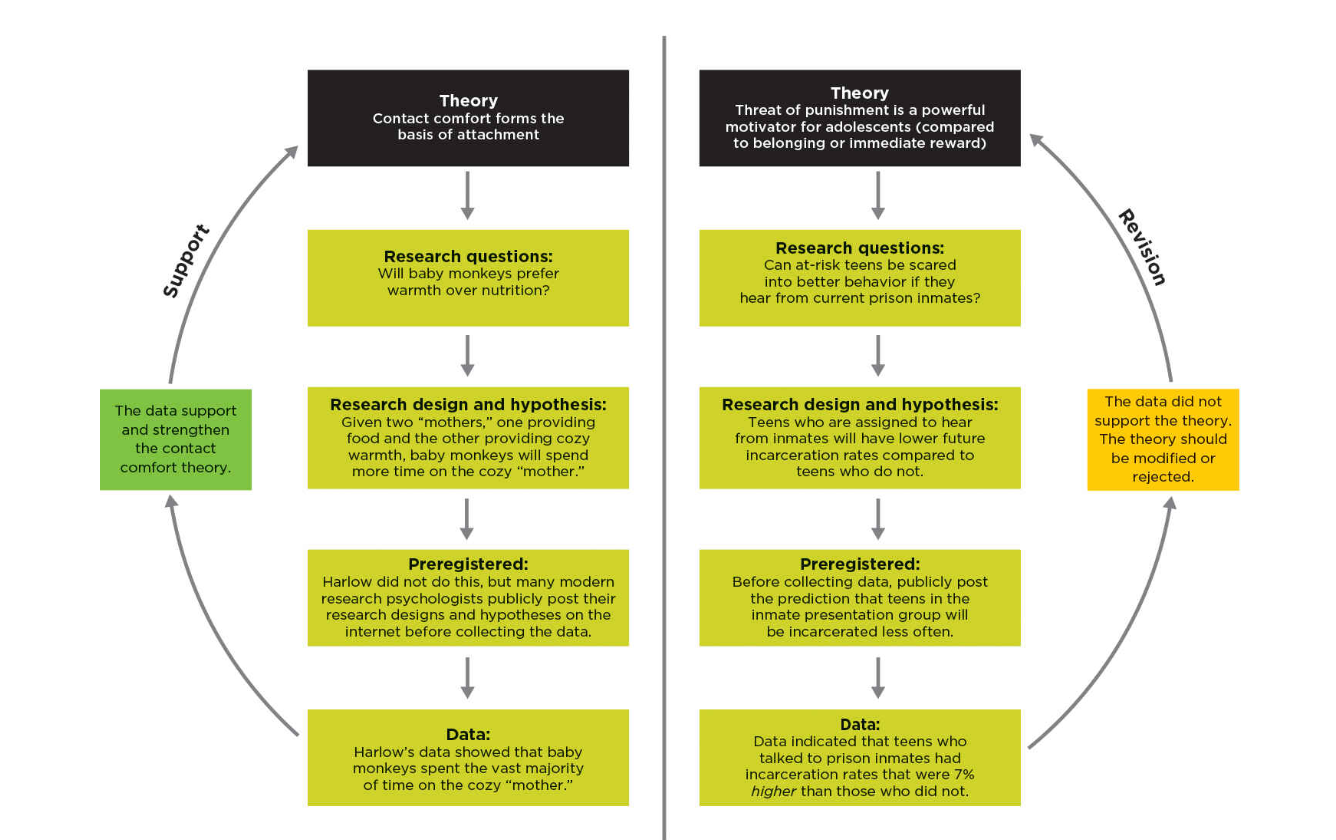
studies DONT PROVE theories, ‘proved’ is not used in science, instead use ‘supports’ or ‘is consistent with’
—
Scientist social norms based on Sociologist Robert Merton
universalism: scientific claims are evaluated according to their merit, independent of the researcher’s credentials or reputation; the same preestablished criteria apply to all scientists and researchers
interpretation: even a student can do science, you don’t need an advanced degree or research position
communality: scientific knowledge is created by a community, and its findings belong to the community
interpretation: scientist should transparently and freely share their results with the public and peers
disinterestedness: scientists strive to discover the truth, whatever it is; they should not be swayed by conviction, politics, idealism, or profit
interpretation: view it strictly objectively, no personal feeling should affect the hypothesis or be affected by whether the hypothesis was supported or not. Your own beliefs should not cause a bias in your research interpretation
organized skepticism: scientists question everything, including their own theories, widely accepted ideas, and ancient wisdom
Should not accept anything at face value, always ask for evidence
VOCAB
empiricism: the use of evidence as the basis for conclusions (empirical method, empirical research)
quantitative method: a way to collect empirical data by converting it into numbers for future statistical analysis
qualitative method: a way to collect empirical data by creating rich, in-depth descriptions of a phenomenon or group of people. often done via interviews or extended observations
reflexivity: a process where researchers reflect on their own values/beliefs/biases/experiences and how they might shape the topics they study and the interpretations they make
theory: a statement or set of statements that describes general principles about the variables related to one another
hypothesis: a statement of the specific result the researcher expects to observe from a particular study if the theory is accurate. (prediction)
data: (plural, singular: datum) a set of abservations representing the values of some variable, collected from one or more research studies
preregistered: a term referring to a study in which, before collecting any data, the researcher has stated publicly what the study’s outcome is expected to be.
replication: The process of conducting a study again to test whether the result is consistent
weight of the evidence: A conclusion drawn from reviewing scientific literature and considering the proportion of studies that is consistent with a theory
falsifiability: A feature of a scientific theory, in which it is possible to collect data that will indicate that the theory is wrong
self-correcting: A process in which scientists make their research available for peer review, replication, and critique, to identify and correct errors in the research.
applied research: Research whose goal is to find a solution to a particular real-world problem
basic research: Research whose goal is to enhance the general body of knowledge, without regard for direct application to practical problems
journalism: new and commentary published or broadcast in the popular media and produced for a general audience
journal: a monthly or quarterly periodical containing peer-reviewed articles on a specific academic discipline or subdiscipline written for a scholarly audience. (scientific journal)
universalism: One of Merton’s four scientific norms, stating that scientific claims are evaluated according to their merit, independent of the researcher’s credentials or reputation. The same preestablished criteria apply to all scientists and all research. See also communality, disinterestedness, and organized skepticism.
communality: One of Merton’s four scientific norms, stating that a community creates scientific knowledge, and its findings belong to the community. See also disinterestedness, organized skepticism, universalism.
disinterestedness: One of Merton’s four scientific norms, stating that scientists strive to discover the truth, whatever it is; conviction, idealism, politics, or profit do not sway them. See also communality, organized skepticism, and universalism.
organized skepticism: One of Merton’s four scientific norms, stating that scientists question everything, including their own theories, widely accepted ideas, and “ancient wisdom.” See also communality, disinterestedness, universalism.
QUESTIONS
What happens to a theory when the data do not support the theory’s hypotheses? What might a scientist say and do if the data fail to support the theory? p11-12
Why can’t theories be proved in science? p.16 n table1.1
Merton proposed four norms that people in the scientific community strive to follow. How many can you name without looking back? p13-15
Describe at least two ways journalists might distort (intentionally or not) the science they attempt to publicize. -By selecting poor studies to report on, overstating results of studies, or by getting the details wrong.
Which of the following jobs most likely involves producer-of-research skills rather than consumer-of-research skills?
police officer
university professor
physician
journalist
As a true empiricist, one should
base one’s conclusions on direct observations
strive to prove all theories with research
be sure that one’s research can be applied in a real-world setting
discuss one’s ideas in a public setting, such as on social media.
A statement, or set of statements, that describes general principles about how variables relate to one another is a(n)
prediction
hypothesis
empirical observation
theory
Why is publication an important part of the research process?
Publication enables practitioners to use the research in applied settings
When a study is published, other scientists can verify or challenge it, making science self-correcting
Journalists can make the knowledge available to the general public
Publication is the first step of the theory-data cycle
Which of the following research questions best illustrates an example of basic research?
Has our company’s new marketing campaign led to an increase in sales?
How satisfied are our patients with the sensitivity of the nursing staff?
Does wearing kinesio-tape reduce joint pain in figure skaters?
Can 2-month-old human infants tell the difference between four objects and six objects?