lab exam 2
Diffusion and Osmosis Notes
Definition of Diffusion
Diffusion is the spontaneous tendency of a substance to move down its concentration gradient from a more concentrated to a less concentrated area.
Molecules or atoms move randomly in all directions due to kinetic energy, bouncing off other molecules.
Highly concentrated molecules gradually spread out and away from that area.
Confusion with Advection
Diffusion should not be confused with advection, which is the bulk movement of whole volumes of a liquid or gas.
An example commonly illustrated in classrooms is the opening of a perfume bottle; however, the scent spreading is due to advection caused by air currents, not diffusion.
In diffusion, individual molecules move in various directions, while in advection, most molecules move collectively in one direction.
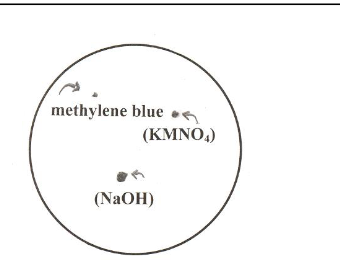
Special Case: Osmosis
Osmosis is the diffusion of water across a selectively permeable barrier that allows water to pass but restricts certain solutes.
If a solute's concentration is higher on one side of the membrane, the solute molecules will be surrounded by a hydration shell, preventing the water in that shell from crossing.
More "free" water is available on the side with lower solute concentration, allowing it to diffuse from high free water (low solute) to low free water (high solute).
Most water molecules cross cell membranes through protein channels called aquaporins, rather than through phospholipids.
Understanding Osmolarity
Osmolarity measures the total quantity of dissolved solutes in a solution.
Formula: Osmolarity = (total moles of solute) / (liters of solution).
Example: A solution with 1 mol/L glucose (1 M) and 1 mol/L fructose has an osmolarity of 2 Osm/L. A 1 mol/L NaCl solution also has an osmolarity of 2 Osm/L, as it produces Na+ and Cl- ions.
Terms in Comparison of Solutions
Hyperosmotic: A solution with a higher osmolarity.
Hypoosmotic: A solution with a lower osmolarity.
Isosmotic: Solutions with the same osmolarity.
Water flows by osmosis from hypoosmotic to hyperosmotic solutions.
Understanding Tonicity
Tonicity relates to osmolarity and impacts cell volume:
Hypotonic: A solution that makes a cell swell.
Hypertonic: A solution that causes a cell to shrink.
Isotonic: A solution that does not affect cell size.
Tonicity and osmolarity are often used interchangeably but are defined differently.
Linear Regression Notes
Definition: Linear regression is a linear approach to modeling the relationship between dependent and independent variables.
Nature of the Model: It is a linear model that assumes a linear relationship between the input variables (x) and the single output variable (y).
Calculation of y: More specifically, y can be calculated from a linear combination of the input variables (x).
Purpose: The purpose of linear regression is to determine the equation of the line (y = mx + b) that best fits a set of data.
Prediction Capability: Knowing the line equation allows prediction of the x value if the y value is known, and vice versa
Cellular Respiration in Living Organisms
Process: The stored energy of carbohydrates is released through cellular respiration, a catabolic process.
Oxygen-Dependent Pathway: The equation for aerobic respiration is:
C6H12O6 + 6 O2 → 6 CO2 + 6 H2O + Energy
Anaerobic Pathway: Certain unicellular fungi (yeasts) can produce energy without oxygen through fermentation:
C6H12O6 → 2 CH3CH2OH + 2 CO2 + Energy
Applications: Yeasts are crucial for producing bread, beer, wine, and industrial ethanol.
Alcoholic Fermentation Study
Purpose: Monitoring carbon dioxide production from different yeast strains at various temperatures and with different carbohydrate substrates.
Statistical Analysis: Use a t-test to analyze class data.
Statistical Analysis with a t-test
Definition: A t-test compares two sets of randomly collected measurements to determine if they are significantly different.
Examples:
Measuring tail length of male and female raccoons to see if averages differ.
Comparing sleep duration between cadets and non-cadets.
Measurement Type: Measurements in a t-test are considered numerical data.
Difference Between Data Types
Numerical Data: Data collected that allows for calculating averages (e.g., tail length, sleep duration).
Nominal Data: Counts of observations within categories, analyzed with a chi-square test (e.g., catching equal numbers of male and female opossums).
Test Selection: If you can take measurements and calculate averages, you are dealing with numerical
Photosynthesis Notes
Importance of PhotosynthesisPhotosynthesis is the most crucial process sustaining living systems on Earth, converting radiant energy (from the sun) to chemical energy. This process is carried out by plants, protists, and cyanobacteria, producing carbohydrates and oxygen. The net chemical equation for photosynthesis is the reverse of aerobic cellular respiration:
6CO2 + 6H2O + LIGHT → C6H12O6 + 6O2
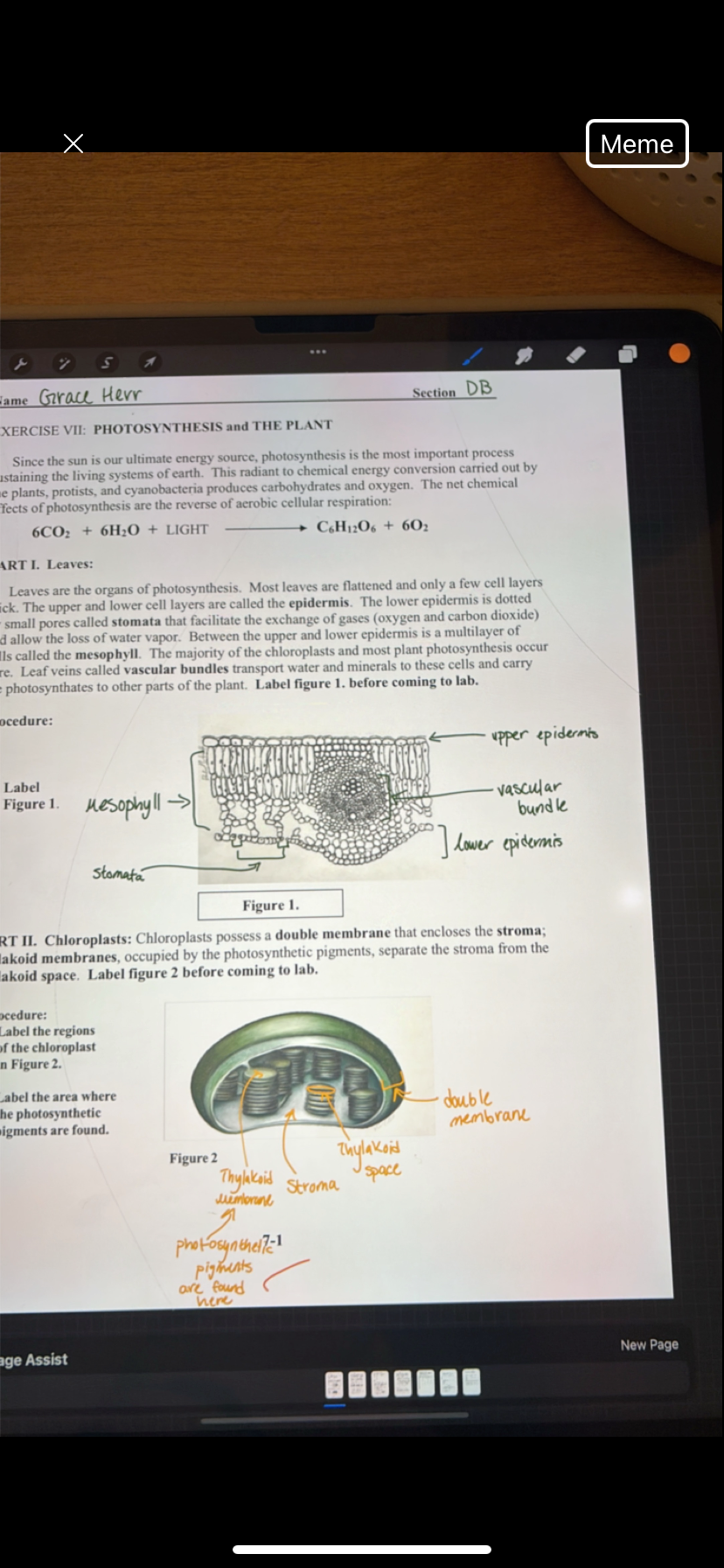
PART I: LeavesLeaves are the primary organs of photosynthesis and are typically flattened, consisting of only a few cell layers.
Epidermis: The outer upper and lower cell layers of leaves.
Stomata: Small pores located in the lower epidermis, facilitating gas exchange (oxygen and carbon dioxide) and allowing water vapor loss.
Mesophyll: A multilayer of cells between the upper and lower epidermis where the majority of chloroplasts and plant photosynthesis occur.
Vascular Bundles: Leaf veins that transport water and minerals to mesophyll cells and distribute photosynthates to other plant parts.
ChloroplastsChloroplasts have a double membrane enclosing the stroma, which is separated from the thylakoid space by thylakoid membranes that contain photosynthetic pigments.
Nature of LightUnderstanding light properties is crucial to studying photosynthesis.
Color Reflection: The color we see in an object results from the specific wavelength of light reflected by that object. For instance, a red blouse reflects red light, while absorbing all other colors in the visible spectrum.
Plant Pigments and Light Absorption: Plant pigments determine which wavelengths of visible light are absorbed, impacting their effectiveness in driving photosynthesis. If a pigment cannot absorb a certain wavelength, that portion cannot be utilized in photosynthesis.
Plant PigmentsPlant leaves contain pigments that absorb various wavelengths of light, converting radiant energy into chemical bonds. Key pigments include:
Chlorophyll a
Accessory Pigments: Chlorophyll b, xanthophylls, and carotenoidsThe absorbed wavelengths form the absorption spectrum for each pigment.
Experiments on Pigment Absorption
Paper Chromatography: A technique utilized to separate mixtures of substances, allowing for the isolation of photosynthetic pigments.
Spectrophotometry: This method measures how much light a pigment absorbs. White light from a spectrophotometer is split into specific wavelengths (340 - 950 nm). Light not absorbed by the sample (contained in a test tube or cuvette) generates an electric current indicated on a meter.
Scales: The meter provides two readings, transmittance, and absorbance. Absorbance will be used to construct absorption spectra for both chlorophyll a and accessory pigments isolated on chromatograms.
Cell Division Cycle Notes
Overview of the Cell Division Cycle
The cell division cycle is the fundamental means by which all eukaryotic organisms reproduce and by which multicellular organisms grow and replace cells that are lost.
During the cell cycle, cells replicate their contents and divide in two.
Phases of the Cell Cycle
The cell cycle alternates between two main phases:
M-phase (Mitosis): Includes nuclear and cytoplasmic divisions.
Interphase: Involves replication of chromosomes and preparation for cell division.
M-phase Subphases
M-phase can be further divided into four subphases:
Prophase: Chromosomes condense and become visible.
Metaphase: Chromosomes align at the cell's equatorial plane.
Anaphase: Sister chromatids are pulled apart to opposite poles of the cell.
Telophase: Nuclear membranes reform around each set of separated chromosomes.
Interphase
Between one M-phase and the next is interphase, which consists of three subphases:
G1 phase: Cell growth and normal metabolic roles; organelle synthesis begins.
S phase: DNA synthesis and chromosome duplication occur.
G2 phase: Continued growth and preparation for mitosis; protein synthesis and organellogenesis take place.
Mitosis in Onion Root Cells
In plants, particularly in the roots and branches, growth only occurs at their tips due to a high rate of cell division in these areas.
New cells produced push the tip forward, while older cells are left behind to elongate and differentiate into specific cell types.
Meiosis
In sexually reproducing organisms, meiosis is a type of cell division that produces specialized reproductive cells (gametes or spores).
Each gamete contains one-half of the normal complement of chromosomes.
Meiosis consists of two nuclear divisions: Meiosis I and Meiosis II.
Importance of Meiosis
Meiosis is significant for the following reasons:
It allows organisms to produce offspring that are similar but not identical to each other or their parents.
It maintains a constant chromosome number from generation to generation.
Mitosis vs Meiosis
Definition:
Mitosis: A type of cell division resulting in two genetically identical diploid cells, used for growth and repair.
Meiosis: A type of cell division that produces four genetically unique haploid gametes, involved in sexual reproduction.
Phases:
Mitosis has one round of division: Prophase, Metaphase, Anaphase, and Telophase.
Meiosis has two rounds of division: Meiosis I (including Prophase I, Metaphase I, Anaphase I, Telophase I) and Meiosis II (Prophase II, Metaphase II, Anaphase II, Telophase II).
Chromosome Number:
Mitosis: Chromosome number remains the same (diploid).
Meiosis: Chromosome number is halved (haploid).
Genetic Variation:
Mitosis: Produces genetically identical cells (no variation).
Meiosis: Introduces genetic variation through crossing over and independent assortment during the formation of gametes.
Purpose:
Mitosis: Growth, repair, and asexual reproduction.
Meiosis: Production of gametes for sexual reproduction and ensuring genetic diversity