Week 9 - Magnetic forces and fields
22.3 Magnetic Fields and Magnetic Field Lines
Since magnetic forces act at a distance, we define a magnetic field to represent magnetic forces.
The pictorial representation of magnetic field lines is very useful in visualising the strength and direction of the magnetic field. As shown below the direction of magnetic field lines is defined to be the direction in which the north end of a compass needle points.
The magnetic field is traditionally called the B-field.
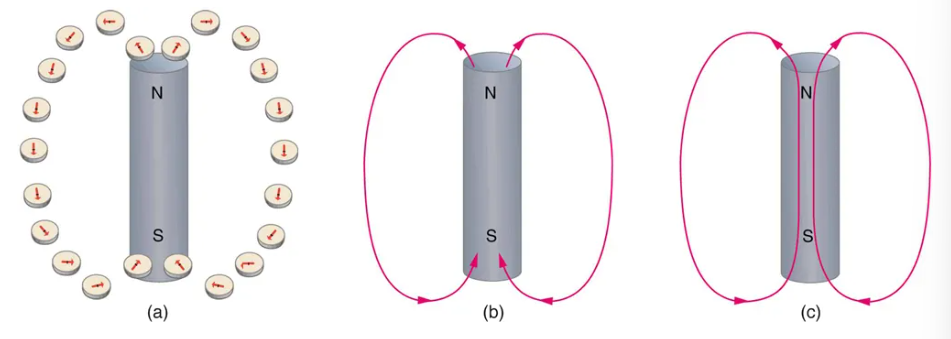
Small compasses used to test a magnetic field will not disturb it. (This is analogous to the way we tested electric fields with a small test charge. In both cases, the fields represent only the object creating them and not the probe testing them.)
The figure below shows how the magnetic field appears for a current loop and a long straight wire, as could be explored with small compasses.
A small compass placed in these fields will align itself parallel to the field line at its location, with its north pole pointing in the direction of B. Note the symbols used for field into and out of paper
The properties of magnetic field lines can be summarised by these rules:
The direction of the magnetic field is tangent to the field line at any point in space. A small compass will point in the direction of the field line.
The strength of the field is proportional to the closeness of the lines. It is exactly proportional to the number of lines per unit area perpendicular to the lines (called areal density)
Magnetic field lines can never cross, meaning that the field is unique at any point in space
Magnetic field lines are continuous, forming closed loops without beginning or end. They go from the north pole to the south pole.
22.4 Magnetic Field Strength: Force on a Moving Charge in a Magnetic Field
Magnetic fields exert forces on moving charges, and so they exert forces on other magnets, all of which have moving charges.
Right Hand Rule 1
The magnetic force on a moving charge is one of the most fundamental known. Magnetic force is as important as the electrostatic or Coulomb force.
Yet the magnetic force is more complex, in both the number of factors that affects it and in its direction, than the relatively simple Coulomb force. The magnitude of the magnetic force F on a charge q moving at a speed v in a magnetic field of strength B is given by
F = qvBsin
where is the angle between the directions of v and B. This force is often called the Lorentz force.
This is how we define the magnetic field strength B in terms of the force on a charged particle moving in a magnetic field. The SI unit for magnetic field strength B is called the tesla (T).
The direction of the magnetic force F is perpendicular to the plane formed by v and B as determined by the right hand rule 1.
Right hand rule states that to determine the direction of the magnetic force on a positive moving charge, you point the thumb of the right hand in the direction of v, the fingers in the direction of B, and a perpendicular to the palm points in the direction of F.
22.5 Force on a Moving Charge in a Magnetic Field: Examples and Applications
Magnetic force can cause a charged particle to move in a circular or spiral path.
The curved paths of charged particles in magnetic fields are the basis of a number of phenomena and can even be used analytically, such as in mass spectrometer.
So does the magnetic force cause circular motion?
Magnetic force is always perpendicular to velocity, so that it does no work on the charged particle.
The particle’s kinetic energy and speed thus remain constant. The direction of motion is affected but not the speed. This is typical of uniform circular motion.
The simplest case occurs when a charged particle moves perpendicular to a uniform B-field, such as shown below.
Because the magnetic force F supplies the centripetal force Fc we have
qvB =
r is the radius of curvature of the path of a charged particle with mass m and charge q, moving at a speed v perpendicular to a magnetic field of strength B.
If the velocity is not perpendicular to the magnetic field, then v is the component of the velocity perpendicular to the field. The component of the velocity parallel to the field is unaffected since the magnetic force is zero for motion parallel to the field. This produces a spiral motion rather than a circular one.
The figure below shows how electrons not moving perpendicular to magnetic field lines follow the field lines. The component of velocity parallel to the lines is unaffected and so the charges spiral along the field lines. If field strength increases in the direction of motion, the field will exert a force to slow the charges, forming a kind of magnetic mirror.
22.7 Magnetic Force on a Current - Carrying Conductor
Because charges ordinarily cannot escape a conductor, the magnetic force on charges moving in a conductor is transmitted to the conductor itself.
We can derive an expression for the magnetic force on a current by taking a sum of the magnetic forces on individual charges.
F = qvdBsin
F = (nqAvd)lBsin=IlBsin
where I (is current) and l (is length)
A strong magnetic field is applied across a tube and a current is passed through the fluid at right angles to the field, resulting in a force on the fluid parallel to the tube axis as shown.
Magnetohydrodynamics (MHD) is useful because it can move liquids without mechanical moving parts, making it suitable for hot or chemically reactive substances like liquid sodium in nuclear reactors. It has also been explored for artificial heart pumps and quiet propulsion systems in nuclear submarines. MHD submarine propulsion could reduce noise compared to propellers, improving stealth capabilities. However, strong magnetic fields can damage cell membranes in medical applications, and current MHD systems are still heavy and inefficient. More technological development is needed before widespread practical use.
22.8 Torque on a Current Loop: Motors and Meters
Motors are the most common application of magnetic force on current-carrying wires.
Motors have loops of wire in a magnetic field. When current is passed through the loops, the magnetic field exerts torque on the loops, which rotates a shaft.
Electrical energy is converted to mechanical work in the process.