10/10
Chapter 30: Intro to Animals
Cookie monster sea sponge
What defines an animal?
Multicellular eukaryotes lacking cell walls but with an extensive extracellular matrix
Heterotrophs
Move under their own power at some point in their life cycle
Have neurons and muscle cells (except sponges)
Most animals, neurons connect to each other and some neurons connect to muscle cells
Animals are the only multicellular heterotrophs that ingest their food first before they digest it
Sponges
Most basal lineage of living animals
Sponges and choanoflagellates are both sessile filter feeders.
30-35 phyla of animals
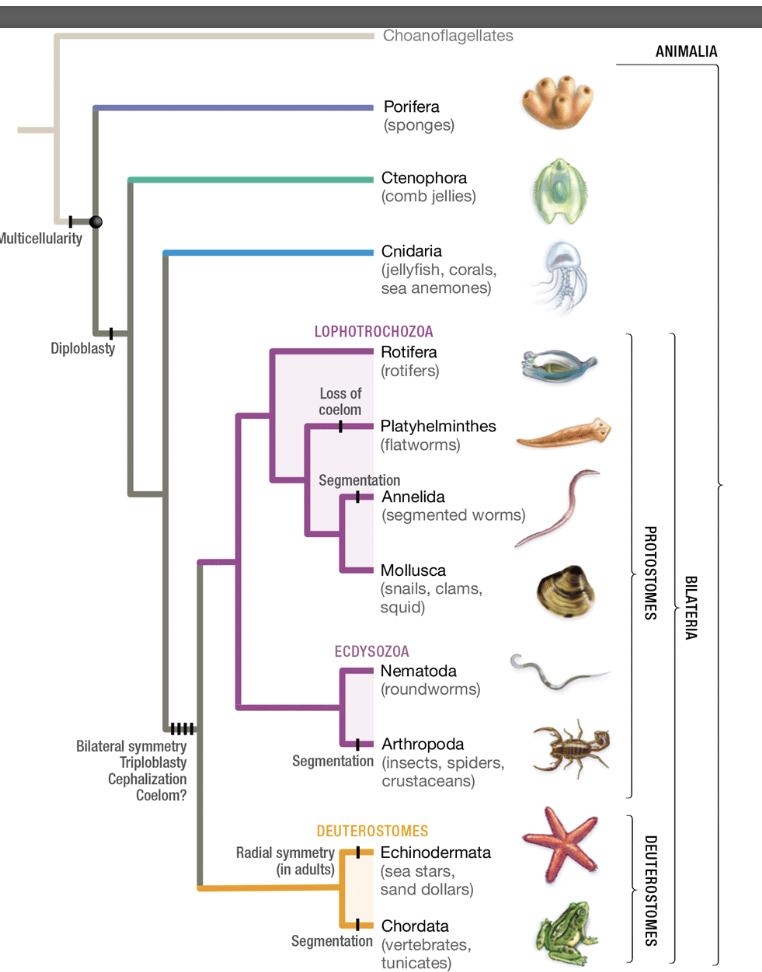
Animals are a monophyletic group
Important Traits of Animals
The origin of tissues (specialized groups of cells)
Choanoflagelllates - no tissues, just colonies of identical cells
Sponges - some have epithelium (surface tissues)
Diploblasts (comb jellies, jellyfish, sea anenome, coral) - tissues from 2 embryonic germ layers (ectoderm, endoderm)
Triploblasts (every other animal) tissues from 3 embryonic germ layers
The origin of bilateral symmetry and cephalization/the nervous system
Did not evolve all at once during the Cambrian explosion. Some corals and anemones (around before the Cambrian) are bilaterally symmetrical.
Bilateral animals have a nervous system along an axis (like a spinal column)
Bilateral animals have concentrated nerves and receptors at the most important places rather than evenly dispersed like in radial animals
The origin of the body cavity (coelom)
Triploblasts have a fluid filled sac called the coelom that allows us to specialize, makes us squishy, gives us room to grow
Triploblasts have a tube-within-a-tube body plan
Ectoderm on the outside (skin), endoderm on the inside (guts), mesoderm in between (organs)
Three types of coelom body plans:
Coelomates have an enclosed coelom completely lined with mesodermal tissue
Acoelomates have no enclosed coelom. All they got is guts. Ex. flatworm
Pseudocoelomates have an eclosed coelom that’s only partially lined with mesodermal tissue
Embryonic origin of the anus
Protostomes: embryonic development of the mouth before the anus
So many protostomes, so some of them don’t follow this rule
Deuterostomes: embryonic development of the anus before the mouth