Unit 3: Analysing the Marketing Environment
Unit Learning Outcomes
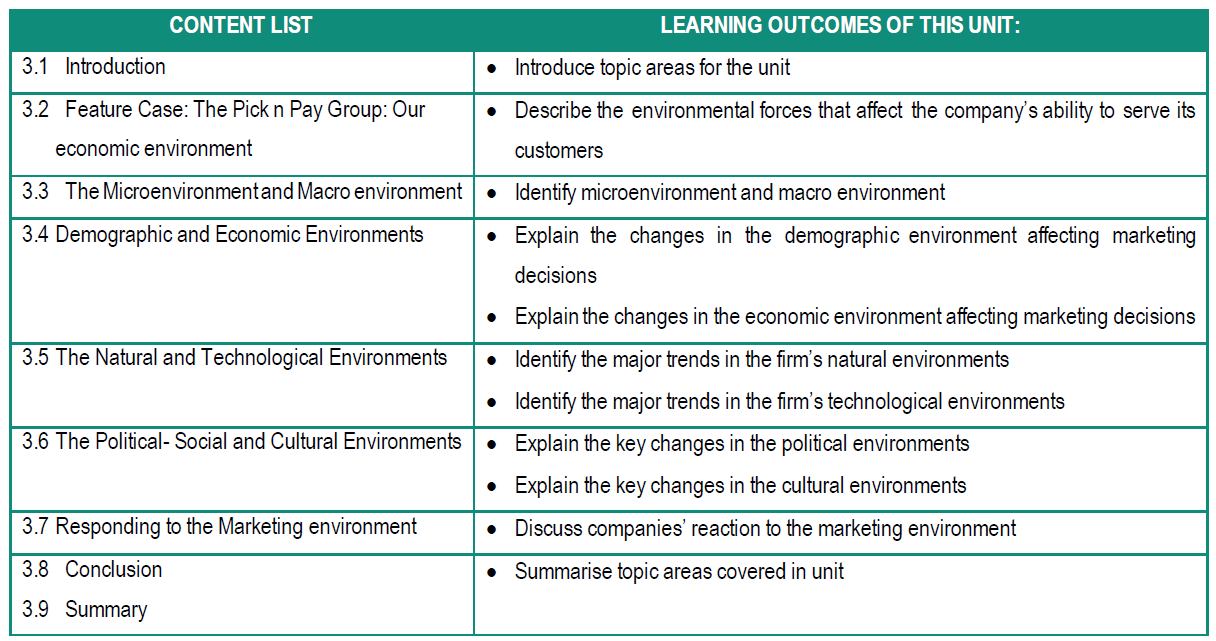
 | Prescribed and Recommended Textbooks/Readings Prescribed Reading(s)
Recommended Reading(s)
|
3.1 Introduction
The previous two units introduced you to the basic concepts of marketing and the importance of company-wide strategic planning in the marketing process to attain long-term company growth and survival. For a company to develop an effective marketing strategy, it must first understand the environment in which the company operates. Political, economic, social, technological, and demographic are the major environmental forces affecting company marketing opportunities and exposure to potential threats and affecting how the company engages customers and builds customer relationships. Hence, it is important that companies constantly assess factors that influence and shape the marketing environment, and then craft sophisticated strategies that adequately address the impact of complex and changing environment. In addition, companies that employ creative strategies understand the market environment better and they often anticipate market changes and its potential impact. The section is the feature case on The Pick n Pay Group. Since there has been growth in the lower to middle-income market segments, The Pick n Pay Group found a niche in this group.
3.2 Feature Case: The Pick n Pay Group: Our economic environment
 | CASE STUDY The Pick n Pay Group is a South African grocery retail company. In this country the retail market environment is diverse and complex. It comprises formal and informal retail operators where widespread disparities in income and geography are noticeable. It is in this environment that the Pick n Pay Group has a renowned history of more than 50 years. The company benefits from broad-appeal across all socio-economic groups and strong brand loyalty in the grocery retail market. In the South African market segment, Pick n Pay has a share of approximately 9% of the total market, and 15% of the formal market from a turnover of R77.8 billion. A tough economic climate and constrained consumer spending characterised the 2018 financial year in South Africa. In 2017, the South African retail environment experienced a real gross domestic product (GDP) growth of 0.9% and, unemployment of 27%, food inflation of 5.9%, and retail sales growth of 4.8% year on year. Political uncertainty, growing budget deficit and increasing food prices continued. Due to awareness of this environment, retail consumers exercised caution in spending and have become more value driven.
The Group has a footprint in southern Africa – in Botswana, Lesotho, Namibia, Swaziland, Zambia and Zimbabwe. It is planning further expansion opportunities in Ghana and Nigeria. Although the Group’s foreign operations are performing well, there are difficult trading conditions in some of these markets. Pick n Pay branded operations are fighting economic impacts, import restrictions, poor stock availability and political uncertainties. The Group remains confident and optimistic regardless of the challenges facing South Africa and beyond. The political and economic outlook promises opportunities, higher sales, improved efficiency and profit growth. Local investment and job creation remain a strategic priority for the Group |
 | Think Point What microenvironmental and macroenvironmental forces affect The Pick n Pay Group in the current markets and the potential and future market opportunities? How are these forces affecting the way Pick n Pay wants to serve their customers? |
|
3.3 The Microenvironment and Macroenvironment
The case of the Pick n Pay Group shows you how the company carefully and continuously analyses the marketing environments in which they have operations. The company’s ability to analyse their marketing environments contributes to its continuous profitability and profit growth opportunities because whatever is happening helps the company to adopt models relevant to a given marketing environment. This section should help you to define marketing environments. You need to differentiate between a company’s micro and macro marketing environments.
 | LEARNING OUTCOMES |
The marketing environment is made up of microenvironment and macroenvironment (Kotler and Armstrong, 2018:92). Marketing environments are ever changing and consists of factors and forces outside marketing activities. Successful companies in serving customers continuously assess and manage the complex and ever-changing marketing environments. The complex and changing marketing environment affect the marketing strategies and eventually the company’s ability to build and maintain successful relationships with target customers. Successful companies find themselves driving changes in the environment by deploying effective market research and making sense of the collected information. A competitive advantage is gained through carefully studying of the market environment. Companies develop insights about the marketing environment. This is called market intelligence (Kotler and Armstrong, 2018:92). This research on the environment results into companies developing and adopting marketing strategies relevant to the addressing of the new marketplace challenges and to also capitalise on new identified opportunities.
3.3.1 Microenvironment
The microenvironments are all the actors close to the company that influence positively or negatively on its ability to create value for and relationships with customers (Kotler and Armstrong, 2018:92). For marketing to be successful, it requires building and fostering relationships with other company departments, suppliers, marketing intermediaries, competitors, various publics, and customers, which combine to make up the company’s value delivery network (Kotler and Armstrong, 2018:92).
3.3.2 Macroenvironment
The macroenvironment consists of broader forces and issues that directly and indirectly affect the company actors in the microenvironment (Kotler and Armstrong, 2018:96). For marketing to be successful, it requires building and fostering assessments and management of demographic, economic, natural, technology, political, and cultural forces that present growth opportunities and threats.
STUDENT TIP: The environmental factors affect the company’s marketing strategies and ability to serve target customers. |
| Think Point Think about expanding opportunities in new market segments. Do you think The Pick n Pay Group expanding to new opportunities into Ghana and Nigeria will guarantee them success? How do you argue your position when you compare The Pick n Pay Group expanding to new opportunities with The Group’s current performance in Southern African market segments? |
|
3.4 Demographic and Economic Environments
There are threats and opportunities posed by the demographic and economic environment to the company’s marketing strategies. You should be able to examine demographic trend of the changing age structure in the population. You need to examine the threats and opportunities posed by the economic environment.
| LEARNING OUTCOMES |
3.4.1 Demographic Environment
Changes in demographics means changes in the markets, and eventually changes in the marketing strategies (Kotler and Armstrong, 2018:97). Demographics are important for marketers. The demographic environment consists of population size, age, gender, race, ethnicity, family structure, status, locations, occupation, income, and other factors determining the attractiveness of a given market. Successful marketers analyse and constantly keep an eye on the demographic trends in their markets, and understand that changes in age and family structures, geographic shifts, educational characteristics, and population diversity may mean opportunities and/or threats.
3.4.2 Economic Environment
Changes in the economic environment present companies both opportunities and threats (Kotler and Armstrong, 2018:103). The economic environment refers to economic factors that affect consumer purchasing power and spending patterns (Kotler and Armstrong, 2018:103). Marketers need to analyse the changes in economic factors and their influence in the marketplace and people’s buying power, buying decisions and consumer spending and buying behaviour. For example, when the economy is in recession people tend to be cautious on where and how they spend their money.
Economic forecasting has enabled marketers to understand the economic variables affecting consumer behaviour and then to tailor marketing strategies to customers seeking greater value between product quality and fair price (Kotler and Armstrong, 2018:104).
STUDENT TIP: Company marketing decisions are affected by the changes in the demographics and economic environments. |
3.5 The Natural and Technological Environments
Every company’s marketing strategy is vulnerable to changes in the natural and technological environment. You should be able to identify actors, forces shaping a company’s marketing planning, and marketing activities. You need to recognize current digital forces shaping a company’s marketing strategies.
| LEARNING OUTCOMES |
3.5.1 Natural Environment
Modern companies that are informed and aware of the events in the marketplace develop environmentally sustainable marketing strategies (Kotler and Armstrong, 2018:104). Such companies show regard for the natural environment. The natural environment refers to “the physical environment and natural resources that are needed as inputs by marketers or that are affected by marketing activities” (Kotler and Armstrong, 2018:104). Many company operations are affected by natural environmental factors such as weather and/or climate, pollution challenges, global warming, and resource depletion. Marketers and companies are therefore increasingly developing environmentally sustainable marketing strategies to create a sustainable world economy because segments of consumers are showing interest in sustainability. Tailored marketing strategies help the company to address the environmental challenges such as the global warming and pollution to compete better.
3.5.2 Technological Environment
The technological environment consists of innovative capabilities allowing companies to become more effective and efficient in their operations as well to expand their markets (Kotler and Armstrong, 2018:106). Given the digital and technological advancement across industries and business globally, marketers are presented with both opportunities and threats.
Marketers therefore need to assess the forces of digital platforms and devices in creating efficiency and effectiveness. Pro-active marketers are improving their use of technology to enhance customer value by offering a more personalised product experience to attain competitive advantage. Marketers need to assess how these forces have the potential to affect efficiency and effectiveness.
STUDENT TIP: Natural and technological environment creates new product and marketing opportunities and challenges for the company |
3.6 The Political- Social and Cultural Environments
Socio-political uncertainties in different market segments force the company to rethink its marketing strategies and marketing models. You should be able to classify regulations forcing marketers and their companies to be socially responsible. You need to identify cultural factors shaping the customer thinking and why is it important for marketers to understand and be aware of cultural factors.
| LEARNING OUTCOMES |
3.6.1 Political environment
The political environment consists of laws and legislations, government agencies, and pressure groups that influence and/or limit various companies and individuals in each society (Kotler and Armstrong, 2018:108). Laws and legislations play an important role in controlling and guiding how companies operate for the good of society. Marketers across the globe fight laws and regulations affecting marketing activity by trying to understand their implications to the competition, consumers, and society in segment markets.
3.6.2 Cultural environment
The cultural environment consists of institutions and other forces that affect a society’s basic values, perceptions, preferences, and behaviours (Kotler and Armstrong, 2018:111). Cultures have a strong influence on people’s attitudes and behaviour toward accepting products offered them. Where marketers have their operations, they need to assess and understand the influences of cultural characteristics, values and shifts in the marketing decisions, and then craft the marketing strategies with clear appreciative of culture in market segments.
STUDENT TIP: Political and cultural environment involve change in new technology-enabled communication, limited trust of institutions, increased patriotism, greater appreciation of nature, and search for spiritualism and meaningful values. |
3.7 Responding to the Marketing environment
A company should be able to respond to the consumer behaviours in different marketing environments, and the environmental factors towards the business environment. You should be able to determine when the company’s marketing management should take a proactive or reactive approach to the marketing environment.
| LEARNING OUTCOMES The company’s response philosophy determines how the company engages and views the environment. |
3.7.1 Reactive philosophy
This is when a company understands the marketing environment as an uncontrollable element to which it must react to and adapt (Kottler and Armstrong, 2018:114). Marketing environment is accepted passively and not changed. A reactive philosophy toward marketing environment is seen when a company is more cautious and seeks to avoid threats at all costs but looks out for opportunities the environment provides (Kotler and Armstrong, 2018:115). Put simpler, marketing decisions and strategies are tied up by the current marketing environment.
3.7.2 Proactive philosophy
This is when companies come up with strategies to change the environment (Kotler and Armstrong, 2018:114). Companies adopting a more proactive philosophy towards the marketing environment drive public opinion and the changing the forces in the environment (Kotler and Armstrong, 2018:114). As a result, proactive companies can capitalise on the resulting opportunities. However, marketing management in any company is not always about controlling environmental forces, but, it involves taking proactive steps where possible (Kotler and Armstrong, 2018:115).
STUDENT TIP: Companies respond to the marketing environment using either a proactive philosophy or a reactive philosophy. In view of creating value for customers, companies are urged to respond proactively. |
 | ACTIVITY Study the Pick n Pay Group case at the beginning of the unit. Make a compelling argument by discussing the company’s best possible response philosophy towards the marketing environments. In your discussion demonstrate how this philosophy is working, or is not working, for the company’s operations in each market segment. Submit Your Answer View Correct Answer |
3.8 Conclusion
This unit highlighted the significance of understanding the marketplace and marketing environment. Marketing environment consists of the microenvironment and macroenvironment affecting the marketing managers’ and companies’ marketing decisions and strategies. The company’s ability to develop effective marketing strategy largely depends on the understanding of the environment in which it operates. Consequently, market environment often influences the company to assess and manage market segments by putting in place the relevant strategies to engage with customers and to build customer relationships. Companies capitalise on identified opportunities when they use more proactive approach as opposed to a reactive approach toward marketing environment. The leading companies that are ahead of the competition design and use proactive strategies to help the company better engage the customers and build profitable partnerships.
3.9 Summary
At the beginning of the unit, the Pick n Pay Group case showed you the importance for marketers and marketing managers to understand the marketing environment. The unit examined and explained how the companies assess and anticipate implications of the changing marketing environments. It demonstrated the importance of companies’ ability to analyse the micro and macro environments to better understand the marketplace and the consumers. The overall objective achieved is that companies constantly lookout for and manage the marketing environments to take advantage of opportunities and to avoid threats. It was also described that the marketing environment consists of all the actors and forces influencing the company’s ability to transact business effectively within its target market.