Lesson 4: Efficiency & the production process (Firms)
Productivity; refers to the quantity of goods and services the economy can produce with a give namount of inputs (such as capital and labour, factors of production).
High productivity within the economy leads to:
lower inflation (lower prices) and higher wages
the ability to produce more goods with exisiting resources → more wants are able to be satified→ improved standards of living
HOW??
advancements in technology (capital)
increased traiing for labour workers (labour)
Economies of Scale
… decreasing per unit cost of production (the cost to produce one output) as the quanitity produced increases.
Why does this happen? Economies of scale occurs when a business is able to increase productivity and produce more output units wiht the same units of input. This leads to the cost being spread over more units and therefore a decreased per unit cost of production.
Diseconomies of Scale (internal)
… increasing cost per unit of production when output is increased for a sustained period of time
Why does this happen? Internal diseconomies of scale occurs when a firm becomes too big. As a business grows communication can become inefficient, time can be spent poorly, and it can become to hard to account fo rthe work of all labour (not all workers may be working correctly). This means that the numbr of output that a business is producing becomes too much and inturn the cost per unit of production increases.
Technical Optimum; the most efficient level of production for any firm. Occuts when the average cost of production are at their lowest possible level.
Internal Economies of Scale refers to when a business is performing below the techinical optimum, the cost saving advantages that result form a firm expanding its scale of operation.
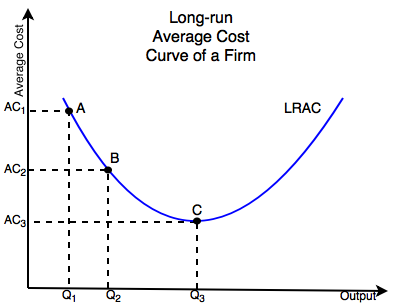
A-C captures economies of scale.
The upturn after C captures internal diseconomies of scale.
C is the technical optimum.
So, how can a business achieve Economies of Scale?
The specialisation of labour.
workers are assigned specific takes within a specific process → there is an increase i noutput per unit (productivity), which reduces the average cost of production.
Specialisation of Capital
as production quantity increases, firms can afford to invest in expensive, specialist capital machinery → results in a lower cost of production
Volume Purchasing Discounts
as produciton quantity increases, more raw materials are purchased → the business amy now get discounts for purchasing in large volumes form their supplier which therefore reduces the average cost of production.