Module 3 Friday p1: Introduction to the Cell
Cell Overview
Cells are the basic unit of structure and function in organisms.
Most cells are microscopic and require a microscope for visualization.
Light microscopes are commonly used.
Electron microscopes are needed for detailed views and smaller cells.
Analogy: Comparing a cell to a city helps understand its functions.
Organelles are like businesses performing work for the cell.
Plasma membrane interacts with the environment and controls entry/exit of substances.
Types of Cells
Two main categories:
Prokaryotic
Domains: Bacteria and Archaea
These are single-celled organisms
Bacteria are found everywhere (skin, gut, soil, etc.)
Archaea thrive in extreme environments like deep sea vents.
Eukaryotic
Make up organisms like humans, plants, and fungi.
More complex than prokaryotic cells.
Basic Cellular Features for all cells
Plasma membrane (cell membrane):
Barrier controlling what enters and exits the cell.
Cytosol:
Runny, gelatin-like mixture in the cell.
Cytoplasm:
Refers to the space within the cell.
Cytosol is the fluid within that space.
Genetic Information:
DNA in the form of genes.
Genes instruct the cell to produce proteins.
Ribosomes:
Responsible for protein synthesis.
Prokaryotic Cells
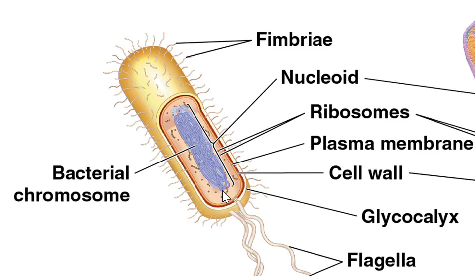
Basic cell type, including bacteria.
Lack a nucleus.
DNA resides in a region, not a membrane-bound nucleus.
Lack membrane-bound organelles.
Contain cytoplasm where cellular components float.
Contain ribosomes for protein synthesis.
Plasma membrane present.
Most also contain a cell wall.
Some have flagella for movement and fimbriae for attachment.
Eukaryotic Cells
More complex than prokaryotic cells.
DNA is contained within a nucleus.
The nucleus has a membrane around it.
Contain organelles with membranes.
Cytoplasm is the region between the plasma membrane and the nucleus.
Eukaryotic cells are usually larger than prokaryotic cells.
Plasma membrane is a selectively permeable barrier.
Cell Size Limits
Cells are small due to surface area to volume ratio.
Surface Area:
The amount of area on the outside of the cell
Volume:
The space inside the cell
A large cell would have a volume too big for its surface area to manage.
Multiple smaller cells increase the surface area for diffusion.
Diffusion is more efficient in smaller cells.
Eukaryotic Cells - Compartmentalization
Eukaryotic cells contain membrane-bound organelles.
Organelles compartmentalize functions.
Both plant and animal cells have similar organelles.
Biological membranes surround organelles and the plasma membrane.