World War II
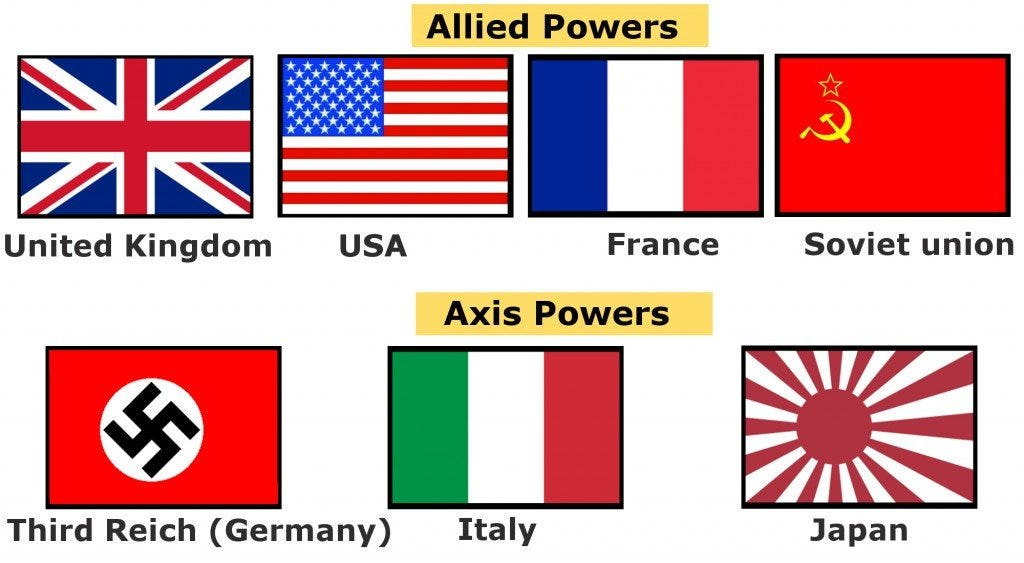
Causes:
Adolf Hitler violated the treaty of Versailles:
- Built a new Air Force
- Began a military draft
Effects of WWI:
- Instability allowed for the rise of Dictators
- Appeasement, European leaders wanted to avoid another global conflict so they would agree to Hitlers demands
Dictators
The effects of World War I and the global Great Depression that followed led to the rise
of dictators.
Japan: Their economy was harmed since they did not have raw materials and had to import them. The United States and the Soviet Union had raised their tariffs due to the Great Depression. The Japanese were also worried about the Soviet’s influence on China, so they decided to invade by staging an incident. This incident, known as “Rape of Nanking”, gave power to the military and made Tōjō the prime minister.
Italy: Benito Mussolini gained power in Italy by convincing voters that by giving the government strong power, voters would allow him to fix the nation's social and political problems.
USSR: The leader of the Communist, Vladimir Lenin, died, giving the power to Stalin. Stalin
began a massive effort to industrialize his country using Five-Year Plans, however, industrial wages fell sharply. Family farms were collectivized, dissenters faced harsh punishment, and millions died in camps or from starvation.
Germany: Hitler was a nationalist who hated the Allies after WWI. He was the leader of the Nazi Party, which called for Germany to expand its territory and to reject the terms of the Treaty of Versailles.
Nazi POV
- The party held very negative views of the Jewish people and used Jews as political scapegoats for Germany’s problems. He thought that Germans were the master race. He thought that Germans should enslave all other people from Eastern Europe.
- He also blamed the Jews for many of the world’s problems, especially for Germany’s defeat in World War I. The Nazis gained support from desperate German voters during Germany’s economic depression, and Hitler got to power.
Building up to war
- Hitler took actions that directly defied the Treaty of Versailles, such as building a new air force and beginning a military draft. Other countries thought that they could negotiate in order to avoid war.
- Hitler wanted to unite all German-speaking countries, and was willing to do so by force. Britain and France practice appeasement. They believed that if they gave Hitler what he wanted, they could avoid war.
- Hitler kept demanding and wanted more territory, specifically Poland. Britain and France realized that appeasement was not working anymore and that war was inevitable. Germany invaded Poland and wanted to negotiate with the Soviets to not do it alone. Germany and the Soviets had a nonaggression pact that called for dividing Poland between each other.
War Begins
- The Germans used a new type of warfare called blitzkrieg, or “lightning war.” This strategy focused on offensive speed. They had engines and communication technologies. Tanks, combined with waves of aircraft and paratroopers, were used to break through and encircle enemy positions. The Germans defeated the Polish.
- Then, the Germans proceeded to attack France. Many soldiers were going to die and suddenly the Germans stopped fighting. This caused a delay that allowed them to evacuate. This became known as the “Miracle at Dunkirk.” France surrendered and became Nazi-occupied territory.
Formation of the Axis
- The Spanish Civil War was the first clash between the forces of fascism and western democracy. It also aligned Germany, Japan, and Italy which became known as the Axis Powers.
U.S. Acts on Neutrality
- After WWI, the U.S. wanted to stay neutral. The U.S. passed laws to make sure that they maintained neutrality, such as the Neutrality Act, which made it illegal for Americans to sell arms and loan to any countries that were at war. They established that countries had to pay in cash and that each country had to send their ship to avoid repeating the Lusitania mistake again; this became known as the “cash-and-carry.”
- President Roosevelt sought to support Britain once World War II had officially begun. The Lend-Lease Act allowed America to supply Britain and the Soviet Union with arms and other supplies. By this point, the Soviet Union had been invaded by Hitler and Roosevelt justified the act to whomever was fighting the Nazi.
- German submarines sank the supplies the Americans were providing. As a solution, he declared the western Atlantic neutral and had the navy patrol it, helping the British by revealing German submarine locations. Germany and the U.S. tensions grew as Germany attacked American ships that were surveying the waters.
- Despite Roosevelt’s support for the British and French, many Americans believed that fighting another war overseas was against the nation’s interests.
Arguments for neutrality:
- Some Americans admired Hitler and favored the growth of Germany and Italy in territory and power.
- Some businessmen wanted to continue trading with Germany and Japan.
- Americans who viewed entering World War I as a mistake did not want to repeat the error.
The Holocaust
- It was a genocide from groups that they considered inferior. They prosecuted anyone who would oppose them, people with disabilities, people with different sexual orientations, and Slavic people (Indo-European)
Nuremberg Laws
- The Jews had been deprived of many of their established rights. The Nuremberg Laws took away their citizenship and banned marriage between Jews and other Germans, banned them from voting or holding public office, and made sure that Jews with “german-sounding” names were changed to “Jewish names” and marked their passports with a J.
- The Jews remained jobless and had no source of income since they were banned and had lost that right.
Kristallnacht
- It was also known as the “night of broken glass” (because broken glass littered the streets).
- There was a young Jewish boy who killed a German diplomat because he was mad since Polish Jews had been deported from Germany to Poland.
- Hitler used this event as propaganda against the Jews. (propaganda chief Joseph Goebbels)
- Nazi storm troopers destroyed Jewish property.
- Roving bands of Nazis destroyed business and synagogues. 90 Jews were dead or badly injured.
- The Gestapo (Nazi secret police) arrested any Jewish men.
Trying to escape
- The Nazi persecution escalated quickly against the Jews
- Many wanted to flee to the United States, however, they couldn’t get a visa so they were trapped with the Nazi regime.
- Nazi restrictions: Germany limited the money Jews could take with them, making it hard to meet US financial requirements for entry.
- US immigration laws: Existing quotas restricted immigration and there were no exceptions for refugees. Officials also assumed Jewish immigrants would be a burden due to lack of wealth.
- Anti-Semitism: Some Americans didn't want Jewish immigrants.
- International reluctance: Many countries, including the US, were unwilling to raise immigration quotas to accept more Jewish refugees.
- There was a boat called SS St. Louis
- Nearly 1,000 Jewish refugees hoping to reach the United States sailed to Cuba with invalid landing permits.
- Cuba denied them entry, and the US refused to accept them.
- The U.S. denied entry because even though many members of Congress wanted to allow more refugees from Europe into the United States, public opinion was against it.
- Laws restricted immigration. President Roosevelt did not allow more refugees in, partly because of prejudice against Jews.
- The ship was forced to return to Europe, where some refugees were accepted by other countries. Tragically, many of these countries would later be overtaken by the Nazis.
The Final Solution
- At first, they would shoot people and pile them up in mass graves. They would also pile them in trucks and then throw gas at them.
- These methods had seemed insufficient and slow for the Nazi.
- Nazi leaders gathered at the Wannsee Conference to figure out how to get rid of all the Jews.
- In this conference they came up with the idea of concentration camps. The individuals would work until they died of exhaustion, malnutrition or disease.
- Many others would be sent to extermination camps (which were mostly attached to the concentration camps) to be executed in gas chambers.
- Extermination camps were not really in Germany. (Poland) Also, because Poland had a lot of Jewish people.
Reasons behind the Holocaust
- Post-WWI Germany: Germans felt wronged and looked for scapegoats for their suffering, making them vulnerable to manipulation.
- Economic Woes: Germany's crippled economy after WWI fueled discontent and desperation.
- Hitler's Power: Hitler's absolute control and the weak German democratic tradition allowed his hateful ideology to flourish.
- Suppression of Dissent: The secret police silenced opposition and discouraged people from speaking up against injustices.
- Longstanding Antisemitism: Centuries of prejudice against Jews in Europe provided a foundation for Nazi persecution.
The Nuremberg Trials
- The trials aimed to hold Nazi leaders accountable for their atrocities and set a precedent for international justice.
- Established by the Allied Powers (US, Britain, France, Soviet Union)
- Held in Nuremberg, Germany
- Tried high-ranking Germans
- Case #9 of the Subsequent Nuremberg Proceedings aimed to specifically address the Holocaust. It focused on punishing the Einsatzgruppen, a Nazi death squad
Marginalized communities during war
- The U.S. started to build their army during peacetime (after France surrendered) (first time American history)
- Many bases were either built or expanded
- African Americans, Latinos, Native Americans, Jewish Americans, and Japanese Americans were segregated in the military.
- The U.S. military was segregated. There were special units for A.A.
- President Roosevelt banned discrimination based on race among government defense contractors, but he didn't officially integrate the armed forces.
- Japanese Americans were barred from enlisting in the military for a period of time, but eventually they could.
- Hispanic Americans served in the armed forces despite racial hostility against them.
- Native American men served as “code talkers”, relaying critical information and orders over field radios as spoken messages coded in their own language.
- This expanded the role of African Americans within the armed forces.
- Women also joined the armed forces in non combat roles.
- They served as nurses and pilots during the war.
Atlantic Charter:
- August 1941: Roosevelt and Churchill met and created the Atlantic Charter.
- The Atlantic Charter promised a world after the war with democracy, free trade, and nonaggression.
- Roosevelt hinted he wanted an excuse to fight Germany.
- In early September, a German U-boat shot at an American ship.
- Roosevelt said American ships could shoot at German U-boats without waiting for them to shoot first.
- The Germans got angrier and attacked two American ships the next month.
- One ship, the Reuben James, sank, killing over 100 sailors.
North Africa
- President Roosevelt and Prime Minister Chruchill agreed on the strategy of not attacking Germany directly, but instead attacking the territories on the borders of Germany.
- Roosevelt decided to attack Northern Africa to give the troops experience and help the British fight the Germans in Egypt.
What happened
- British forces defeated the German "Afrika Korps" at El Alamein.
- British troops secured the Suez Canal and forced Erwin Rommel to retreat.
- American forces led by General Eisenhower invaded North Africa.
- American troops were defeated by the Germans at the Battle of Kasserine Pass.
- Eisenhower replaced the general defeated at Kasserine Pass with General George Patton.
- British and American forces pushed the Germans back, forcing their surrender in North Africa.
Submarines
- German submarines kept attacking American cargo ships and oil tankers.
- The attacks caused citizens on the East Coast to dim their lights, gas and oil shortages, and construction of the nation's first long-distance pipeline.
- This also led to the creation of a convoy system in which the ships were escorted by warships.
- The Americans and the British built more ships and they began to use new technology to locate the submarines.
- Hitler thought that the way to defeat the Soviets was by cutting off their supply by attacking the city of Stalingrad.
- The Soviet Union won, however, many soldiers and civilians died during the battle.
Casablanca
- Roosevelt and Churchill met again to step up the bombing of Germany.
- Its purpose was to destroy Germany's military, industrial, and economic system and to undermine the morale of the German people.
- The bombing caused a severe oil shortage, wrecked the railroad system, and destroyed so many aircraft factories that Germany’s air force could not replace its losses.
- The Allies also agreed to attack the island of Sicily, which Churchill called the “soft underbelly” of Europe.
- The attack created a crisis within the Italian government.
- Mussolini was arrested and a new Italian government was put into place.
- This new government wanted to surrender.
- Germany intervened and put Mussolini back into power.
Tehran
- Roosevelt, Stalin, and Churchill met.
- The leaders agreed that they would attack Germany.
- They decided that they would divide Germany after the war.
- Accepted the idea of an organization of international peacekeeping.
D-Day
- Operation Overlord was the codename for the invasion of France.
- They had to choose their location wisely. They chose to land on Normandy.
- The Allies had to be able to surprise the Germans to ensure the operation's success.
- The locations had to meet several requirements for the landings to go smoothly.
- The beaches had to be within range of fighter planes based in England, near a good network of roads and paths, and had to be firm and flat.
- General Eisenhower was in charge of the operation.
- The weather conditions necessary were:
Paratroopers would need clear skies and moonlight to see where to land.
High waves would be dangerous for the landing craft.
Planes wouldn't be able to fly in a storm.
- There were only a few days of each month to begin the invasion.
- The invasion date came to be known as d-day.
- It was a success but just the beginning.
War Ends in Europe
- While the American and British were fighting to liberate France, the Soviets were attacking the Germans as well.
- The Germans had been driven out of Russia and across Poland.
- They were attacking from the East and the West
- The end was near, and Hitler knew this.
- He committed suicide.
- Germany accepted unconditional surrender
- The next day as considered V-E (Victory in Europe)
Context
- Japan had desires for territorial expansion, access to resources, and the establishment of a Japanese-controlled sphere of influence in the region.
- US was aiding China in the second Sino-Japanese war
Pearl Harbor
- Britain left their colonial possessions vulnerable to a Japanese attack.
- To prevent Japanese aggression, the U.S. restricted the sale of many raw materials that they needed.
- Angrily, the Japanese became part of the Axis.
- The Japanese still attacked British territory.
- The U.S. reduced shipments to Japan and sent troops to reinforce the Philippines.
- They also decided to attack Pearl Harbor and the Philippines
- The Japanese and the U.S. tried to negotiate, but it didn’t work.
- American intelligence had decoded a message that said that Japan was preparing for war, but it was interpreted wrongly.
- The Japanese attacked the harbor as a surprise
- The day later, the U.S. declared war on Japan.
- Germany and Italy then declared war on the U.S.
- Pearl Harbor was a preventative strike to stop the US getting involved in their business in South East Asia,
- They hoped to buy time to increase their naval power.
- They wanted to stop the US capabilities to mobilize in the Pacific
- Weaken morale in America.
The Pacific
- A few hours after attacking Pearl Harbor, the Japanese attacked the Philippines
- The American General, MacArthur, then retreated to the Bataan Peninsula.
The Doolittle Raid
- A plan involved using an aircraft carrier to launch B-25 bombers within striking distance.
- The surprise attack on Tokyo, though causing minimal damage, showed the vulnerability of Japan and lifted American morale.
- The Japanese, however, were mad because the raid could’ve killed their emperor which was considered a “god”
- It convinced the Japanese that they had to change their strategy
- They decided to cut American supplies to Australia by capturing the coast of New Guinea
- The commander also wanted to attack Midway Island
- He believed that attacking Midway would lure the American naval force into battle and enable his ships to destroy it.
- The American naval force had to be destroyed to protect Tokyo from bombing.
- The attack on New Guinea would happen, but only three aircraft carriers were assigned to the mission.
- All of the other carriers were ordered to assault Midway.
The Navajo Code Talker
- The Navajo language was unwritten and unknown to most, making it an unbreakable code.
- Navajo code talkers were highly effective. They could transmit messages in minutes, compared to the hours needed with code machines. Their role was crucial in battles like Iwo Jima, where they relayed critical messages during intense fighting.
Island Hopping in the Pacific
- The plan involved a coordinated effort. Nimitz would capture islands closer to Japan, while MacArthur aimed to retake the Philippines.
- The central Pacific islands, mostly coral reefs, posed a problem for landing troops, causing high casualties.
- The vehicle nicknamed "Alligator" was a lifesaver. Originally designed for civilian use, it allowed troops to cross reefs safely, reducing casualties significantly.
- The goal was to establish airbases for the B-29 Superfortress, a long-range bomber capable of attacking mainland Japan. After capturing Saipan, Tinian, and Guam, B-29s began bombing Japan by late 1944.
Taking back the Philippines
- MacArthur's troops fought their way through the southwest Pacific, capturing islands and strategically surrounding the main Japanese base.
- A massive US force invaded Leyte in the Philippines in October 1944. MacArthur famously waded ashore and declared his return.
- The Japanese launched a multi-pronged attack to stop the invasion. This massive naval battle involved kamikaze attacks by Japanese pilots deliberately crashing planes into US ships. Despite initial success, the Japanese commander withdrew, fearing more US forces.
- The fight to retake the Philippines was long and bloody. It took until March 1945 to capture Manila, which was left in ruins. The Japanese continued fighting until the war's end in August 1945.
Bombing Japan
- LeMay's strategy aimed to break Japanese morale and cripple their industry through widespread firebombing.
- However, it resulted in the deaths of a massive number of civilians, raising ethical questions about the tactic.
- The bombings ultimately contributed to Japan's surrender, but the human cost remains a subject of debate.
Using the Atomic Bomb
- The Manhattan Project was the top-secret program, led by General Groves, aimed to build an atomic bomb.
- Key breakthroughs included creating the world's first nuclear reactor in 1942 and assembling a team of scientists led by J. Robert Oppenheimer.
- The first atomic bomb was successfully detonated in New Mexico in July 1945.
- Even before the test, there were disagreements about using the bomb.
- Some officials, like Admiral Leahy, argued against civilian casualties and favored alternative methods to force Japan's surrender.
- Others, like Secretary of War Stimson, proposed a warning to Japan.
- President Truman, however, prioritized saving American lives through a swift end to the war and authorized the bomb's use.
- Despite warnings, Japan didn't surrender. Hiroshima and Nagasaki were hit with atomic bombs in August 1945, resulting in devastating civilian casualties.
- The bombs, combined with the Soviet Union's entry into the war, finally forced Japan to surrender, ending World War II on August 15th, 1945 (V-J Day).
Putting the Enemy on Trial
- The International Military Tribunal for the Far East (IMTFE) was established in 1946 through an agreement between the US, Soviet Union, and Britain.
- The Tokyo trials aimed to punish Japanese leadership.
- The IMTFE tried 27 Japanese officials, including both civilian and military leaders.
- All defendants were found guilty, receiving sentences ranging from imprisonment to death.
Important Battles
Battle of the Bulge
- Hitler wanted to cut off the supplies of the Allies through Belgium.
- The battle resulted in more than 100,000 German casualties.
- The battle left the Germans without resources to defend Germany.
Bataan Peninsula
- There were terrible conditions, with the lack of food supplies and diseases.
- The nurses worked in very bad conditions.
- The defenders of the island finally surrendered
- Prisoners of war were forced to march in these terrible conditions to a prison camp. This would be called the Bataan Death March
- The Japanese had taken over the Philippines.
Battle of the Coral Sea
- The American codebreakers in Hawaii had cracked the Japanese naval code.
- Both sides launched heavy airstrikes in early May. Despite losing the Lexington and damage to the Yorktown, American attacks achieved two victories:
- They stopped the Japanese from landing on New Guinea.
- They secured the American supply lines to Australia.
Battle of Midway
- After the Battle of the Coral Sea, the Americans ordered ships to ambush the Japanese navy at Midway Island in the Pacific.
- The Battle of Midway forced Japan into defensive mode and turned the course of the war in the Pacific.
- The Battle of Midway was a turning point in the war.
- The Japanese navy lost four large ships—the heart of its baby.
- The United States had stopped the Japanese advance.
Battle of Iwo Jima
- A battle in February and March 1945 in which U.S. forces took Iwo Jima, a small but strategically important island off the Japanese coast.
- The island had difficult terrain - a volcano, rocky cliffs, caves, and volcanic ash. The Japanese had heavily fortified it with bunkers and tunnels.
- Iwo Jima's capture was crucial for the US to cripple Japan's mainland with B-29 bombers.
- However, the island's geography and Japanese defenses made the battle incredibly bloody.
- The Marines fought with exceptional bravery but suffered horrific losses to secure victory.
Battle of Okinawa
- As Japan showed no signs of surrender in 1945, the US needed a base close to mainland Japan to prepare for a potential invasion. Okinawa, just 350 miles away, was chosen.
- The last large-scale battle in the Pacific, in which U.S. forces invaded the Japanese home island of Okinawa.
- The battle was very bloody, killing at least 100,000 Japanese soldiers and 80,000 to 100,000 Japanese civilians.
- Capturing Okinawa convinced some Japanese leaders to seek peace. However, the key issue was the fate of Emperor Hirohito.
- Many Americans wanted him removed from power, while Japanese leaders insisted he remain.