Bio Lab Midterm
Unit 1:
Metric units are a system of measurement used in many countries around the world. They provide a standardized way to express length, mass, volume, and other quantities. Here is a table showcasing some commonly used metric units:
Metric Unit | Value |
|---|---|
Kilo(K) | 10³ |
meter (m) | 10^0 |
Centi(C) | 10^-2 |
Millimeter (mm) | 10^-3 |
Micrometer(Mm) | 10^-6 |
Nanometer(nm) | 10^-9 |
Example 250 Km to Cm (larger to smaller) → add the exponents (3 + 2) → add the 5 zeros
25,000,000
Example (smaller to larger)
250 cm to Km (smaller to larger) → add the exponents (3 + 2) → change decimal point 5 times 250.0 → 0.00250
B. Explain the concept of temperature and the capability of converting from oC to both Fahrenheit and Kelvin
Temperature represents the degree of hotness or coldness in a body or environment, indicating the molecular activity and somatic sensation of heat. It is measured in Fahrenheit (°F), Celsius (°C), or Kelvin (K), quantifying the average kinetic energy of particles, with 0°C as the freezing point and 100°C as the boiling point of water at standard atmospheric pressure.
Celsius (°C) to Fahrenheit (°F):
(°C× 9/5) + 32
Fahrenheit (°F) to Celsius (°C):
(°F − 32) * 5/9
Kelvin (K) to Celsius (°C):
K−273.15
Celsius (°C) to Kelvin (K):
K+273.15
Unit 2:
A. You should be able to describe the basic steps of the scientific method
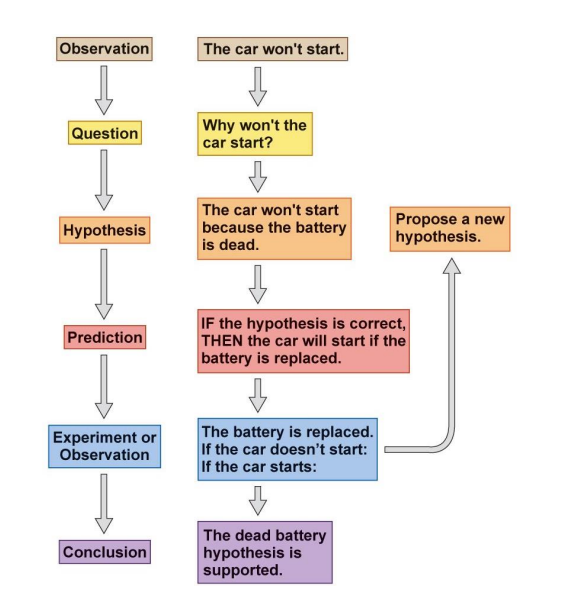
1. Observation:
- Description: The scientific process begins with observation, where scientists notice and question phenomena in the natural world.
- Example: Observing that plants in a particular area are growing taller than plants in another area.
2. Question:
- Description: Scientists form a specific question based on the observed phenomena, expressing their curiosity.
- Example: Why are plants in Area A growing taller than plants in Area B?
3. Hypothesis:
- Description: Scientists formulate a hypothesis, a testable explanation for the observed phenomenon, often involving an educated guess.
- Example: If plants receive more sunlight, they will grow taller.
4. Prediction:
- Description: Scientists make predictions about the outcome of experiments if the hypothesis is correct, specifying expected results.
- Example: If the hypothesis is correct (plants grow taller with more sunlight), then providing additional sunlight to plants in Area B will result in increased height.
5. Experiment or Observation:
- Description: Scientists design and conduct experiments or make observations to test the hypothesis and gather data.
- Example: Providing additional sunlight to plants in Area B and measuring their growth over a specific period.
- Additional Step: If the experiment doesn't work and the hypothesis is not supported:
6. Conclusion:
- Description: Scientists draw conclusions based on the analysis of the data collected during the experiment or observation.
- Example: If plants in Area B exposed to additional sunlight grow significantly taller than those without, the initial hypothesis is supported. If there's no significant difference and a new hypothesis is proposed, it should be tested in subsequent experiments to reach a valid conclusion.
B. Describe a typical biology research experiment
Research Question: How does varying light intensity affect the photosynthetic rate in spinach leaves?
Hypothesis: If spinach leaves are exposed to different light intensities, then the photosynthetic rate will be higher under moderate to high light intensity due to increased energy availability for photosynthesis.
Experimental Design:
1. Variables:
- Independent Variable: Light intensity (low, moderate, high).
- Dependent Variable: Photosynthetic rate of spinach leaves (measured by oxygen production or carbon dioxide consumption).
- Controlled Variables: Temperature, humidity, water supply, duration of exposure, and spinach leaf age.
2. Experimental Groups:
- Group A (Low Light Intensity): Spinach leaves exposed to low light intensity (e.g., 100 lux).
- Group B (Moderate Light Intensity): Spinach leaves exposed to moderate light intensity (e.g., 1000 lux).
- Group C (High Light Intensity): Spinach leaves exposed to high light intensity (e.g., 5000 lux).
3. Setup:
- Place spinach leaves in separate chambers with controlled light sources, ensuring the specified light intensity for each group.
- Provide adequate water supply to all plants.
- Maintain consistent temperature and humidity levels for all groups.
4. Experiment:
- Expose spinach leaves in each group to the designated light intensity for a specific duration (e.g., 6 hours).
- Measure the photosynthetic rate by monitoring oxygen production or carbon dioxide consumption using appropriate sensors and equipment.
5. Data Collection:
- Record the amount of oxygen produced or carbon dioxide consumed by the spinach leaves in each group.
- Measure and record the light intensity using a light meter.
- Repeat the experiment multiple times to ensure consistency and reliability of the results.
6. Data Analysis:
- Analyze the photosynthetic rates of spinach leaves under different light intensities.
- Compare the rates of oxygen production or carbon dioxide consumption among the experimental groups.
- Examine the relationship between light intensity and photosynthetic rate.
7. Conclusion:
- If Results Support Hypothesis:
- If spinach leaves show higher photosynthetic rates under moderate to high light intensity compared to low light intensity, the hypothesis is supported.
- Conclude that light intensity significantly affects the photosynthetic rate in spinach leaves, with optimal rates occurring under moderate to high light conditions.
- If Results Contradict Hypothesis:
- If there's no significant difference in photosynthetic rates among the light intensity groups, reconsider the hypothesis and explore other factors that might influence photosynthesis.
- Propose new hypotheses, such as investigating the role of other environmental factors or plant adaptations in photosynthetic processes.
8. Future Research:
- Explore the impact of different wavelengths of light (colors) on photosynthetic rates.
- Investigate the long-term effects of varying light intensities on plant growth, development, and overall productivity.
By following the scientific method, researchers can systematically investigate the relationship between light intensity and photosynthetic rates in spinach leaves, contributing valuable knowledge to the field of biology and plant physiology.
Unit 3:
A. Recognize and give the function of the parts of a compound microscope
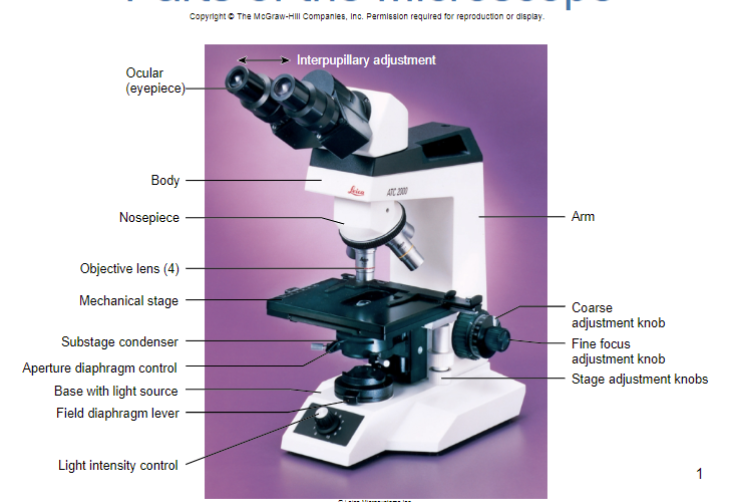
B. be able to calculate the total magnification (i.e. Ocular lens X objective lens = total magnification
Total Magnification=Ocular Lens Magnification×Objective Lens Magnification
Total Magnification=Ocular Lens Magnification×Objective Lens Magnification
For example, if the ocular lens magnification is 10x and the objective lens magnification is 40x, the total magnification would be 10x×40x=400x.
UNIT4:
Unit 4 Study Guide: Understanding the Composition of Living Organisms and
A. Elements in Living Organisms:
Living organisms are composed of several essential elements. Knowing these elements and their symbols is fundamental to understanding the building blocks of life:
1. Oxygen (O): Essential for respiration and energy production.
2. Nitrogen (N): Found in proteins and nucleic acids, vital for growth and reproduction.
3. Carbon (C): Basis of organic molecules; forms the backbone of all life.
4. Hydrogen (H): Commonly found in water and organic compounds, crucial for chemical reactions and energy transfer.
B. Macromolecules:
Macromolecules are large, complex molecules essential for life processes. There are four main types:
1. Proteins: Examples include enzymes (catalysts), antibodies (immune defense), hemoglobin (oxygen transport), and collagen (structural protein).
2. Carbohydrates: Examples include glucose (energy storage), starch (plant energy storage), glycogen (animal energy storage), and cellulose (plant cell walls).
3. Lipids: Examples include triglycerides (energy storage), phospholipids (cell membrane structure), steroids (hormones), and waxes (protective coatings).
4. Nucleic Acids: Examples include DNA (genetic information storage), RNA (protein synthesis), messenger RNA (mRNA), and transfer RNA (tRNA).
C. Organic vs. Inorganic Molecules:
Organic Molecules:
- Contain Carbon-Hydrogen (C-H) bonds.
- Often large and complex.
- Found in living organisms.
- Examples include carbohydrates, proteins, lipids, and nucleic acids.
Inorganic Molecules:
- Lack Carbon-Hydrogen (C-H) bonds.
- Simpler in structure compared to organic molecules.
- Can be found in living organisms and non-living matter.
- Examples include water (H2O), salts (NaCl), minerals, and gases like oxygen (O2) and carbon dioxide (CO2).
D. Detection of Starch, Glucose, and Lipids:
1. Starch:
- Detection: Use iodine solution. Starch turns blue-black in the presence of iodine.
2. Glucose:
- Detection: Utilize Benedict's solution and heat. Glucose in the presence of Benedict's solution turns from blue to orange-red upon heating.
3. Lipids:
- Detection: Use the paper bag test or Sudan III stain. Lipids leave a translucent spot on paper or turn red-orange in the presence of Sudan III stain.
UNIT4UNIT4