First Aid
Preserve: Life
Protect: Unconcius
Prevent - Further injury or illness
Promote - recovery
▪Whenever we come across a First Aid situation/scenario, we need to follow a specific Action Plan. The acronym to remember is: DRSABCDEF
▪Danger - Yourself, bystanderand patient
▪Response - COWS acronym (Can you hear me, can you see me, wiggle your toes, squeeze my hand) - no response send for help
▪Send for help/send for defibrillator - Call 000 and provide the operator with number of patients, age(s), condition, what happened, specific location, first aid treatment given, your name and mobile.
▪Airways - You can check the airways by placing one hand on the patient’s forehead and opening their mouth using the pistol grip (thumb across chin and index finger along jaw) with your other hand.
Be sure NOT to tilt the patient’s head
back during this stage as this may
cause blockages to fall further down
the airway.
▪If there is foreign material in the airways: Roll the patient onto their side and clear the airway.
▪If there is no foreign material found: Leave the patient in the position found, and open the airway by tilting the head back with a chin lift.
Recovery position:
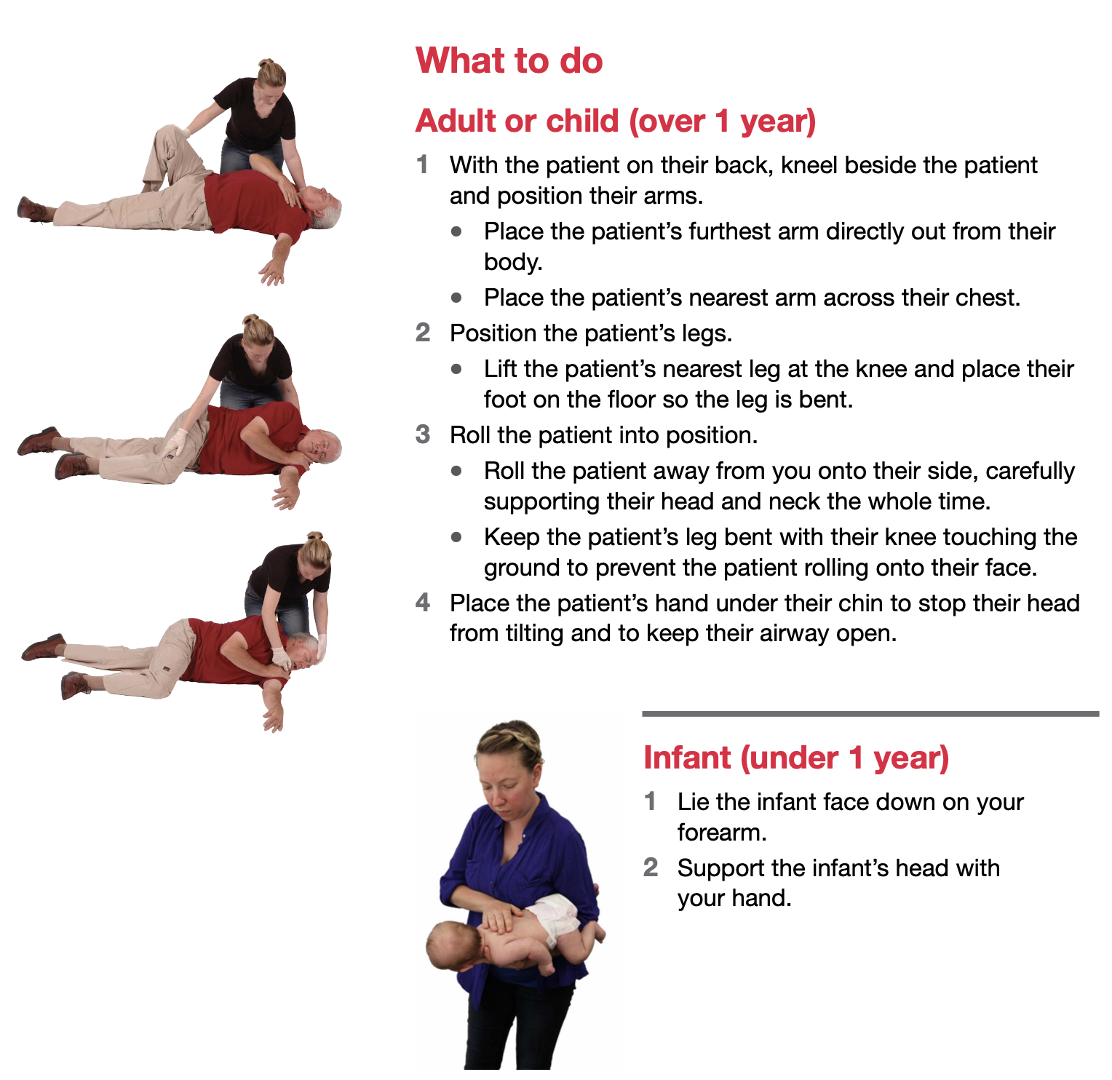
▪Breathing - look, listen and feel for breathing, if no breathing start CPR.
▪CPR/Compressions = = Cardiopulmonary Resuscitation - try to achieve ▪Try to achieve 5 sets of 30:2 in about 2 minutes (or 100–120 compressions/minute).
CPR SUMMARY TABLE
| ||
| ADULTS & CHILDREN (1-8YRS) | INFANTS (0-1YRS) |
Head Tilt |
Full | Neutral |
Hand Placement |
Centre of Chest |
Centre of Chest |
Ratio | 30:2 | 30:2 |
Compressions per Min | 100-120 | |
Compression Depth |
1/3 of Chest
| |
Technique |
2 hands (dependant strength and size) | 2 fingers |
Breaths |
Full |
Cheek Puff |
▪Defibrillator - Do not use the defib if the patient is:
▪Conscious
▪Breathing
▪Has a detectable pulse or other signs of circulation
▪Wet/lying in water
▪Is in contact with any other conductible surface (i.e. a metal ute tray)
Before using:
▪Dry the patient
▪Shave any hair where the shock pads will be attached
▪Make sure the area is clear (especially from dangers and bystanders)
▪Make sure no one is in contact with the patient when a shock is being given
▪Extra Bleeding - Signs/Symptoms:
▪Excess blood on/coming from skin surface
(Arteries = blood will be spurting, Veins = blood will be oozing, Capillaries = blood will be spotting on skin surface)
▪Faintness/dizziness/confusion
▪Pale skin
▪Nausea
▪Loss of consciousness
Direct pressure, Elevation, Bulky bandage, Indirect pressure
▪Fractures
•Greenstick – A small, slender crack in the bone. Generallyoccurs in children.
•Hairline/stress – The most common form is a stress fracture.
•Closed (simple) – The broken bone has not pierced the skin.
•Open (compound) – The broken bone pierces the skin.
•Complicated – structures surround the fracture are injured. Possible damage to the veins, arteries/nerves or to the lining of the bone.
Nose bleed:
▪1 Ask the patient to breathe through their mouth and
not to blow their nose. Encourage the patient to spit out blood rather than swallow it.
▪2 Help the patient to sit down with their head slightly forward.
▪3 Pinch the soft part of the patient’s nostrils, just below the bridge of the nose, for at least 10 minutes.
▪4 Loosen any tight clothing around the patient’s neck.
▪5 If bleeding persists, seek medical aid.
Placing a cold pack on the patient’s neck and forehead might help the bleed. A cold pack is unlikely to cause any harm.
Asthama
Step 1: Sit the person upright
•Be calm and reassuring.
•Do not leave them alone.
Step 2: Give 4 separate puffs of blue/grey reliever puffer
•Shake the puffer.
•Put 1 puff into the spacer.
•Get the person to take 4 breaths from the spacer.
•Repeat until 4 puffs have been taken. (If you don’t have a spacer, give 1 puff as they take 1 slow, deep breath and hold breath for as long as comfortable. Repeat until all puffs are taken.)
•Remember: Shake, 1 puff, 4 breaths.
Step 3: Wait 4 minutes
•If there is no improvement, give 4 more separate puffs of blue/grey reliever, as with Step 2.
Step 4: If breathing does not return to normal, call triple zero (000) for an ambulance
•Tell the operator that someone is having an asthma emergency.
•Keep giving the person 4 separate puffs, taking 4 breaths for each puff, every 4 minutes until emergency assistance arrives.
Snake Bite treatment
▪1. Follow DRSABCD.
▪2. Call 000 for an ambulance.
▪3. Lie patient down, tell them to keep still. Reassure them.
▪4. If bite is on a limb, apply elasticised roller bandage over the bite site asap.
▪5. Apply second elasticised bandage, starting just above fingers or toes and moving upwards on the bitten limb as far as can be reached. Apply the bandage firmly - you should be able to slide a finger between the bandage and skin.
▪6. Immobilise the bandaged limb with splints.
▪7. Place a cross on the bite site (if known) and write down the time of the bite and when the bandage was applied with a pen, or photograph it.
▪8. Stay with patient until medical aid arrives