Habit 2: Begin with the end in mind
Habit 2: Begin With the End in Mind is about having a vision and a meaning to your life.
If you practice Habit 2, you do everything with a purpose.
If you’re highly effective, you identify the meaningful goals and dreams you want to pursue in life.
Your compelling why for being in college and Habit 2 go hand in hand. After all, if you don’t know where you want to go, how will you get there?
Highly effective students = a compelling why + solid academic skills + effective life skills
See, do, get
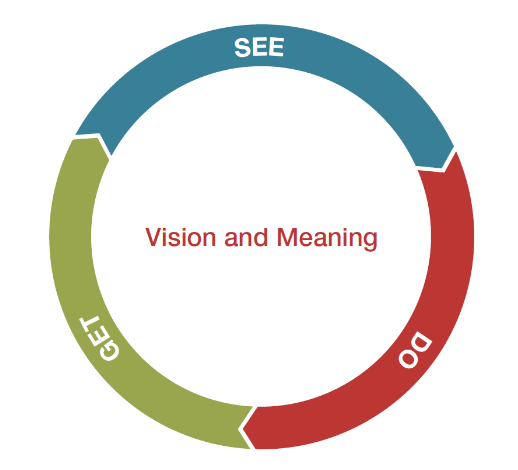
See
Know that the mental creation precedes the physical creation.
Believe they can make a meaningful difference.
Do
Discover what matters most.
Write a personal mission statement.
Set meaningful, realistic goals.
Map out a graduation plan.
Get
A greater sense of meaning and purpose
A feeling of greater self-worth
Accomplished goals
Criteria for deciding what is or is not important
See: Paradigms
Habit 2: Begin With the End in Mind is based on two paradigms.
Everything is created twice: first mentally, then physically
Just as you wouldn’t start building a house without a blueprint, it makes no sense for you to go around every day without a plan for your life.
If you don’t have a plan, you become part of someone else’s plan.
Whether you take a traditional route or attend college in a nontraditional way, having a plan from the beginning can save a lot of time and money.
I can make a meaningful contribution in the world around me
Waking up each morning with a reason for why you do your daily activities.
Whether your life directly impacts a billion people or a single person is not what really matters—the size of the contribution doesn’t count.
What does count is your belief in yourself; that your life is of worth and what you do is important.
Do
Discover what matters most to you
Along the way, certain meaningful and enjoyable experiences stick in their memory like superglue.
Over time, those memories grow into a unique bundle of experiences, and from it they eventually “detect” the things that matter most to them and how they want to spend their life.
Think: How are you unique? What has energized you in the past?
Vocation does not mean a goal that I pursue. It means a calling that I hear. Before I can tell my life what I want to do with it, I must listen to my life telling me who I am.
Write a personal mission statement.
Direct you in all of your choices and inspires you to be your best self.
A personal mission statement is the “big picture” of you at your best.
Set meaningful, realistic goals
The next step is to turn your mission statement into reality.
Setting meaningful, realistic goals can help you do that.
While they should be realistic, your goals shouldn’t be low. Set them high enough that they excite and motivate you.
These are the five simple tips that work:
Narrow your goals down from many to only one or two.
“Which of my goals must be achieved, or nothing else I achieve will really matter much?” This kind of goal is called a Wildly Important Goal®, or a WIG®.
A WIG is different from a Pretty Important Goal, or PIG. PIGs are not unimportant, but never let your PIGs get in the way of your WIGs.
Write your goals a “From X to Y by When” format.
Identify the few key activities you’ll need to do to achieve the goal.
Track your goal. Keep score.
Account every week to yourself or a partner around how well you’re doing on the goal.
Explore your career options
In your first year of college, your life is beginning again.
You have a chance to Begin With the End in Mind by deciding on a career path.
Of course, the ideal is to find a career that will help you fulfill your mission in life and your long-term WIGs.
There are three ways to look at work: as a job, a career, or a calling.
A job is something you do as an assigned task and in an assigned amount of time.
A career is a job with opportunities for advancement and personal growth, usually in a certain field like law, engineering, or media.
A calling is a career attached to a meaningful purpose.
What education and pay level do you need to achieve your aspirations and life-satisfaction level?
Choosing a career is easier if you know about all the opportunities out there and what types of careers will best suit you.
Think about your answers to these four questions:
Talent: What are you really good at?
involves doing what you do best.
Passion: What do you love doing?
refers to what you like doing most. It’s where your heart is.
Need: What does the world need that you can get paid to do?
is the reality check.
Conscience: What do you feel you should do?
is the feeling that something “ought” to be done.
Where the four questions overlap represents your career “sweet spot”
What is your sweet spot? You have unique qualities no one else has. So you need to find the best match for your uniqueness and the career options that are out there.
If you want to live in the sweet spot, it won’t happen by accident. You’ll need to Be Proactive about it.
Map out a graduation plan
Finishing your degree on time or early requires planning.
Having a plan early on can help you take advantage of your college years and also save a lot of time and money later.
Exploring a career.
Talk to people about your ideas and interests
Take an aptitude test
Explore three careers that match aptitudes identified by the test.
What are the education requirements for that career, dream job, or calling?
What skills would you need to develop?
What types of organizations offer opportunities in that field?
What is the typical compensation?
Draft your professional development path.
Begin college with your portfolio or résumé in mind.
What will set you apart from all the other job applicants, other than your grades?
Start building a genuine portfolio now.
Get
If you do Begin With the End in Mind, you save time and money—and more important, you’ll get more life satisfaction and the contentment that comes from living the life you want.
Students who Begin With the End in Mind get better test scores, better grades, and better jobs upon graduation.
Having a clear vision of what you want to do in college and in life is important, but it’s even more important to have a clear vision of who you want to be.
You cannot have a feeling of worth if you are not doing things of worth.
The happiest and most effective people I know are those who use their talents to make a positive difference in others’ lives.
What you get out of life depends on your particular “ends in mind” and how aggressively you go after them.