Dependency Theory
What is it?
A theory in international relations and global politics.
Emerged in the 1960s-1970s in Central and South America.
It was a response to the question:
“Why are so many countries still poor and not developing?”
Traditional view:
Poor countries are poor because:
They have bad economic policies.
Their governments are authoritarian or corrupt.
Dependency Theory’s view:
The international system itself is exploitative.
It is designed to prevent poorer countries from developing.
Rich countries dominate and benefit at the expense of poorer countries.
4 Different States (in the World Economy)
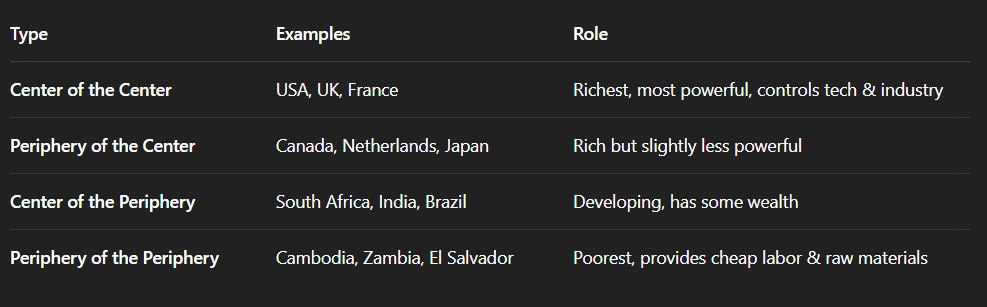
3 Arguments in Dependency Theory
International Division of Labor
Rich (core) countries: Focus on technology, research, capital-intensive industries.
Poorer (periphery) countries: Focus on agriculture, raw materials, cheap labor.
All poor countries’ economies are designed to serve richer ones.
“All roads lead to Rome” → everything benefits the wealthiest.Class Distinction
Every country has:
A small, rich elite class (the powerful, ruling group).
A large working/mass class (the poor majority).
Rich elites across countries cooperate with each other to:
Stay in power
Protect their own wealth
Keep the global system the same
Global Capitalism
Everything exists within a larger global system of capitalism.
What is capitalism?
An economic system where:
Most businesses, industries, and resources are owned by private individuals or companies (not the government).
The goal is to make profit.
Trade, finance, production, and labor are organized to maximize private profit.
Think of it as:
“The people with money invest, produce, and sell to get even more money.”Capitalism connects economies all around the world.
Rich, powerful countries (called core countries) have:
Big industries
Advanced technology
Major banks and multinational corporations
These core countries:
Control global trade rules
Set international prices
Lend money to poor countries (with conditions)
Dominated by:
The wealthy elites control the system.
Liberal economic theories (like free trade and finance systems)
→ favors rich/core countries.Multinational corporations and banks
→ tools used by the rich in core countries.→ examples: Apple, Nestle, Shell
Global institutions like:
World Bank
International Monetary Fund (IMF)
→ serve the interests of the rich/core countries.→ they lend money to developing countries, but in return, they ask for policy changes that favor open markets (which benefits rich countries more).
Education systems and global media
→ shaped to support powerful countries and elites.→ globally, schools and universities tend to teach ideas that support capitalist thinking — like free trade and open markets as the "right" way to develop.
→ movies, news, and online platforms often spread ideas, lifestyles, and consumer habits that align with rich countries’ interests.
Result:
The whole system serves the wealthy.
It prevents developing countries from truly developing.
It maintains global inequality.
Underdevelopment
Dependency theorists say:
The system creates underdevelopment.
Poor countries aren’t just “left behind” — the system actively keeps them poor to serve rich countries’ interests.
Underdevelopment refers to the condition where certain countries have lower levels of development compared to others, often due to unequal trade relations or capital investment that hinders their progress and leads to economic disparities on a global scale.
Though not as famous today, the dependency theory still explains:
Why global poverty and inequality exist.
Why some countries stay poor despite following “good” policies.
The same patterns Dependency Theory described in the 1960s-70s are still seen in the world today.