Chapter 6~ The Federal Judiciary
Federal Judiciary- Constitution & Federalist 78
The Federal Judiciary refers to the broad judicial network in our government. This includes not just the Supreme Court, but also the system of Federal Courts.
The Supreme Court is established in Article III of the Constitution. It is the last branch described and the shortest. This article:
- Gives the Supreme Court original & appellate jurisdiction
- Defines the Supreme Court as the supreme law of the land
- Requires chief justice
- Gives judges lifetime tenure as long as they have “good behavior”
- Describes how judges are appointed by the president and confirmed by the Senate
- Lays no requirements for being a Supreme Court justice
- Designates the power to create lower courts to Congress
Though the branch is seemingly weak, Antifederalists feared it would go rogue and trample on the rights of people with their rulings. In the foundational document Federalist 78, Alexander Hamilton argued that this was not the case for two main reasons:
- Judges were isolated from politics due to their lifelong tenure
- The Supreme Court has no powers of the purse & sword (cannot finance or enforce)
Hamilton described the branch as essential to check and balance the other two, but not with enough power to be tyrannous as Antifederalist feared. In the document, he also declared that the Supreme Court has the power to “declare legislative acts void”. This formed the basis of judicial review.
John Marshall & Judicial Review
John Marshall was the first Chief Justice of the Supreme Court and had the most influence in shaping its role in the government.
Though it is describe in more detail in the Supreme Court cases notes, Marbury v Madison was a key case that first exercised judicial review.
In response to losing the election of 1800, Federalists passed the Judiciary Act of 1801. The act shrunk the number of federal judges and reorganized the lower courts. This opened up 16 new positions that the federalists tried to take advantage of. Unfortunately, many judges did not get their commissions to serve in these positions.
One of the judges, William Marbury, protested the Supreme Court. In response, it denied his commission and exercised judicial review to declare the Judiciary Act of 1801 unconstitutional.
Federal Judiciary- Structure
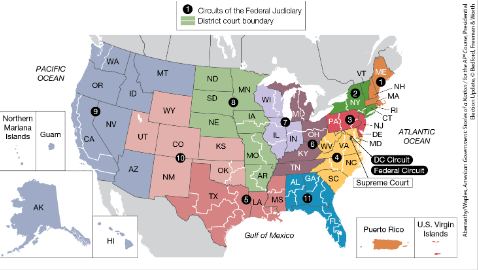
Though the Constitution did not describe the number of justices, the number has remained at nine since 1869. The Supreme Court cannot create lower courts, so most of the structure of the federal judiciary was done with Congress’s Judiciary Act of 1789. It established 13 Federal Appeals Courts and 94 Federal District Courts below the Supreme Court. The president elects judges to all levels in the federal court system, and they are all confirmed by the Senate.
Federal Appeals Courts have appellate jurisdiction. That means they are only allowed to evaluate cases that have already been ruled on. They cannot introduce new evidence, only uphold or overturn existing decisions.
Federal District Courts are below appeals courts, decide cases for a specific region of the US, and have original jurisdiction. This means they can hear new cases and gather evidence. Most cases in the federal level are done by district courts, and rarely make it to the Supreme Court.
States have also created their own system of courts similar to the federal level. Most cases in the U.S are resolved in the state court system. As for the structure, many states have one Supreme Court, and then appeals courts, special courts, and trial courts.
Special courts are courts designed to hear about cases involving a specific issue, like traffic violations or marriage. Trial courts have original jurisdiction, and hear new cases.
State judges are elected by people. However, there has been an increasing worry that huge donations from anonymous sources (called dark money) have influenced these elections. One example of this is Caperton v Massey Coal.
Caperton v Massey Coal
The head of Massey Coal Don Blankenship influenced West Virginia election for Supreme Court of Appeals justice by donating 3 million to the candidate Brent Benjamin.
By donating this money, Blakenship hoped to help Benjamin win to in return overturn a ruling that gave 50 million to Hugh Caperton of Harmon Mining due to them being put out of business by Massey Coal.
Benjamin won with 53% votes and ruled in favor of Blankenship in 2007
Caperton tried to appeal to have Benjamin recuse himself due to obvious bias, but he refused. When heard by the Supreme Court, they demanded Brent Benjamin be recused due to a debt of gratitude. His earlier refusal had violated the 14th amendment and the Caperton case was reversed.
Federal Judiciary- Handling Cases
There are two kinds of cases in the judicial system. Criminal and civil cases.
Criminal cases are cases where there has been potential harm to the community or to society. In these cases, the defendant has to be proven guilty beyond a reasonable doubt. They must be convicted unanimously by a jury.
Civil cases are cases where a group or individual believes they have been wronged by another. These cases involved private rights and decided by a judge or jury.
The Supreme Court gets thousands of cases a year, but only hears a few, and most are appellate cases. There is a very long process before this happens.
Supreme Court Case Approval
- Litigant has to appeal to have their court case heard.
- Supreme Court justices determine which cases are of enough importance to go on the discussion list
- Looking at the discussion list, 4 out of 9 judges have to issue a writ of certiorari to add a case to the docket
- Supreme Court cases hears cases from the docket. For each case, parties get 30 minutes to answer questions from the judges
- Interest groups and other outside parties can issue amicus curaie which are historical, legal, or economic arguments to sway the decision
- After hearing a case, judges consult in a judicial conference. 5 out of the 9 judges are required to make a decision.
When making the decision the Supreme Court can do a variety of things.
- Stare decisis: Rely on existing precedent
- Remand: Send the case back down to lower courts
- Make a new decision
When making a new decision, justices have to write the majority opinion, and then dissenting opinion. Dissenting opinion serves no purpose other than to possibly be used if the case were re-argued. There are also concurring opinions that can be written if justices agree or disagree on something but for a different reason.
There are also different ideas on how much the Courts should rely on making new decisions or using stare decisis:
Judicial Activism
Judicial activism argues that the Supreme Court should use judicial review to make bold new policy and shift public opinion. It should protect the rights of minorities and fix other branches mistakes.
Critics argue that judges are not policy experts and should not overturn legislation written by elected bodies. In other words, don’t undo what representatives elected by people have done. Critics also argue that the Supreme Court should not weaponize it’s rulings to try to undermine other branches of government. Fortunately, the other branches can ignore the Supreme Court.
Though judicial activism may seem dangerous, it has its uses. Judicial activism was key in influencing the civil rights movement and the movement for marriage equality.
Judicial Restraint
Judicial restraint argues that the Supreme Court should defer to the other two branches, and rely on set precedents. Overturning laws is undemocratic and should be a last resort.
Federal Judiciary- Interactions With Government
The judiciary, like all branches of government, are subject to a variety of checks and balances.
Executive
- The president nominates all Supreme Court and federal judges
- The Supreme Court can rule actions of the president unconstitutional
Legislative
- Congress can create lower courts
- The Senate confirms all nominations to the federal courts and Supreme Court
- Senate can filibuster to block nominations
- Congress cannot control the budget of justices
- Supreme Court can use judicial review to overturn Congressional laws
Though the Constitution does not declare any qualifications to serve on the Court, nominees must be very experienced to be confirmed by the Senate. Over time, these nominations have gotten increasingly more intense and divisive since judges can have a lifelong affect on policy.