T6- LOCATION STRATEGIES
Content Introduction to Location Strategy
Importance: Location decisions significantly affect a company’s long-term success.
Impact on Costs: Determines fixed (e.g., rent) and variable costs (e.g., labor).
Long-Term Commitment: Hard to change; needs careful consideration.
Strategic Options: 1) Expand existing sites, 2) Maintain and add new sites, 3) Close and relocate.
Complex Globalization: Market economies, communication, transport, and labor costs complicate decisions.
Geographic Information Systems (GIS): Location analysis tools help us understand populations and combine maps with other information like demographics.
Key Success Factors (KSF) and Evaluation Methods
KSF Identification: Political risks, culture, market, labor, resources, and costs.
Evaluation Methods: Methods like factor-rating, cost-volume analysis, GIS-based methods.
Service Considerations: Analyze purchasing power, local demographics, competition, and the physical environment.
Service Location Decision: Look at strategic alignment regarding outsourced services.
Strategic Importance of Location
Critical Decision: Affects organizational success; essential long-term choice.
Cost Influence: Locations impact fixed costs (land/rent) and variable costs (labor/transport).
Relocation Challenges: Expensive and disruptive to change locations; careful investment needed.
Factors Affecting Location Decisions
Globalization Complexity: Factors influencing location include economies, communication, transportation, and labor costs.
Key Success Factors (KSF): Political risks, culture, market demands, and labor costs.
Country Level Decisions: Consider political stability, labor conditions, and supply complexity.
Labor Productivity: Measures the output per hour of labor; higher productivity indicates efficiency, affecting costs and competitiveness
Exchange Rates & Currency Risks: The value of one currency against another; currency risks arise from fluctuations affecting prices and profits in international transactions
Costs: Includes fixed costs (e.g., rent) that remain constant and variable costs (e.g., labor) that change with production; crucial for pricing and profitability.
Political & Cultural Values: Political values relate to stability and regulations impacting business operations, while cultural values influence consumer behavior and interactions.
Proximity to Markets: Closeness to customers reduces transportation costs and enhances responsiveness to market demands.
Proximity to Suppliers: Nearby suppliers lower transportation costs and improve delivery times, enhancing operational efficiency.
Proximity to Competitors: Geographic closeness to competitors increases rivalry but can also offer clustering benefits such as shared resources and innovation.
KSF Decision Levels
Country Level: Political climate, market location, economic factors.
Regional Level: Corporate desires, regional attraction, and labor availability.
Site Level: Site size, proximity to services, zoning restrictions.
Methods for Evaluating Location Alternatives
Factor-Rating Method
Steps:
1) List relevant factors
2) Assign weights
3) Rate locations
4) Multiply and sum scores
Purpose: Determine optimal location based on weighted evaluations.
Locational Cost-Volume Analysis: Economic comparison of location alternatives
Steps:
1) find fixed and variable costs for each location
2) plot costs for each location based on production volume
3) select location with lowest total cost for exp. production volume
Center-of-Gravity Method: Find optimal distribution center by minimizing transportation costs. (Plot locations, calculate x/y coordinates for cost-efficiency.)
GIS Transportation Model: Assesses the most efficient paths and routes to minimize transportation costs while satisfying supply and demand requirements.
Service Location Strategies: Maximize operational benefits through strategic location decisions.
Purchasing Power: Assess the spending capacity of potential customers by analyzing local income, spending patterns, and demographics.
Service Compatibility & brand image with customer’s area demographics: Ensure the service and brand align with local demographics, considering age, education, lifestyle, and cultural values.
Competition in the area: Evaluate the quantity and intensity of competition, identifying direct and indirect competitors along with their strengths, weaknesses, and market share.
Quality of Competition: Analyze not only the number of competitors but also their service standards, reputation, customer base, and profitability.
Uniqueness of Location: Identify unique factors that differentiate the company's location from competitors, including visibility, access, environment, and history.
Physical Qualities: Assess the physical features of facilities, such as size, design, layout, lighting, parking, and security, as well as the presence of complementary
Operational Policies: The company's hours of operation, pricing, service quality, and customer service must align with the location and target market, ensuring attractiveness to potential customers and meeting their expectations.
Quality of Management: Effective management is critical for success, particularly in service industries, as it impacts service quality, customer satisfaction, employee motivation, and business profitability.
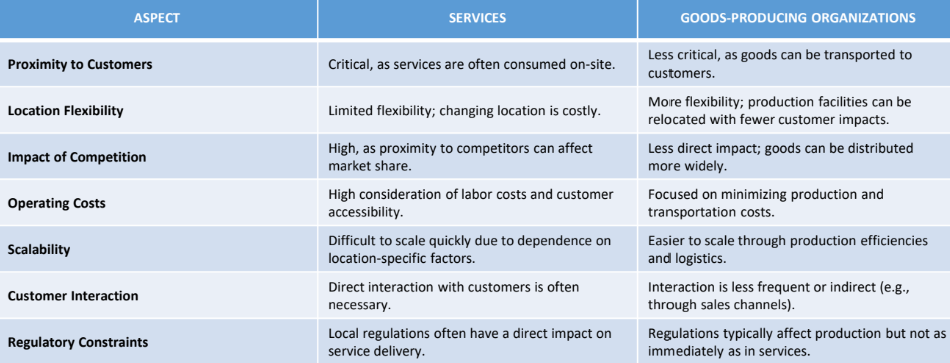
Global Service Models
Offshoring: Moving tasks abroad for cost efficiency.
Onshoring: Outsourcing within the same country (e.g., US to another state).
Reshoring: Returning outsourced work back to the home country
Nearshoring: Collaborating with nearby countries for efficiency.
Outsourcing: Hiring third parties to perform tasks traditionally done in-house
Insourcing: A company internalizes services or processes that it previously outsourced
Strategic Alliances: Agreements between 2+ companies to combine resources, strengths, & capabilities in order to achieve shared objectives
Service Level Agreements (SLAs)
Definition: SLAs describe the expected level of service and compliance metrics.
Components: Performance indicators, availability requirements, penalties for non-compliance.
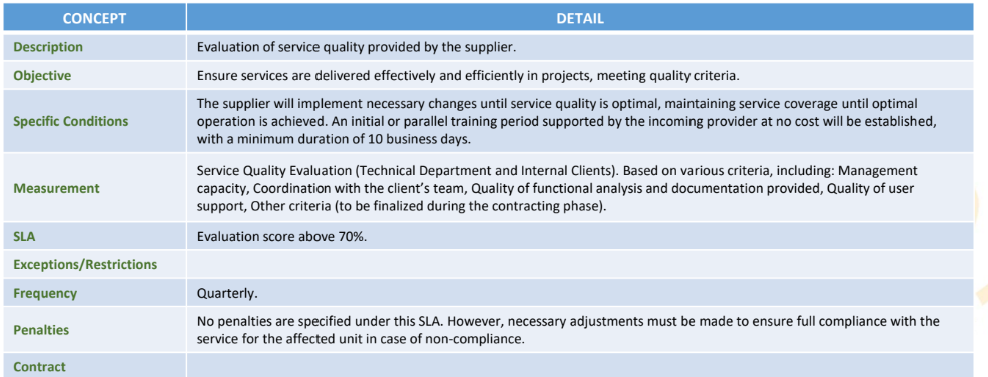
Customer-Based SLA: Customizes service levels for a specific client.
Example: A bank has SLAs for different departments, prioritizing online banking support over internal support.
Service-Based SLA: Sets a uniform service standard for all clients.
Example: A cloud provider guarantees 99.9% uptime for all customers.
Multi-Level SLA: Used in large organizations with various service tiers.
Example: A telecom company has distinct SLAs for retail, corporate, and government clients.
Geographic Information Systems (GIS)
Description: Technology that integrates spatial data for location analysis.
Functions: Data visualization, urban planning, service optimization.
Future Growth: Increasing relevance due to sustainability and analytical needs.
Benefits of GIS:
Informed decision-making: Combines art and science to evaluate impacts on various areas.
Problem-solving: Provides more information for addressing issues, especially in marginalized communities.
Data visualization: Enhances understanding of complex data through visual representations, such as maps.
Anticipated planning: Enables proactive problem-solving and effective solution planning.