Comprehensive Study Guide to Visual Culture, Image Systems, and Art Markets
Conceptualizations of Copies, Originals, and Forgeries
Legal and Market Ambiguities in Art Authentication
The boundary separating an original artwork from a copy or restoration is frequently undefined in legal and market contexts.
In a legal dispute involving Christie's sale of a painting by Egon Schiele, a judicial ruling ordered the auction house to reimburse the buyer because the work was repainted, deeming it no longer an authentic Schiele. The court established no clear metric on whether a repainted work would yield a different verdict.
Conversely, Barnett Newman's Who Is Afraid of Red, Yellow and Blue? was repainted following extensive vandalism and continues to hang in the Stedelijk Museum in Amsterdam under the artist's name.
The classification of vintage photography exhibits similar threshold ambiguities:
In the photographic output of Man Ray, questions arise regarding whether prints remain "vintage" if developed years after the initial shot, printed by assistants (such as Lee Miller) under or without supervision, or produced post-relationship using original negatives.
In printmaking (lithographs and engravings), authenticity definitions fluctuate based on signature and production:
A print is conventionally considered authentic if drawn on stone or engraved on copper by the artist, printed in their atelier, and signed.
Ambiguities occur when verified, atelier-printed works lack signatures, when artists employ professional engravers to translate drawings onto copper plates, or when artists merely sign blank sheets or third-party reproductions, as practiced by Salvador Dalí.
Accepted Posthumous and Workshop Reproductions
Institutional authorization frequently validates posthumous physical replicas as authentic works:
The Rodin Museum in Paris possesses legal authority to cast up to 8 bronze copies of plaster molds left in Auguste Rodin's atelier at his death, selling these posthumous casts as genuine Rodins.
The Fondation Arp in Rolandseck reproduces sculptures by Jean Arp under official sanction.
Jewelry designed by Duke Fulco di Verdura 50 years ago continues to be produced and marketed as original Verdura pieces.
Printmaking markets trade posthumous print editions under the label of "later states" under the creator's name.
Unsigned, mechanically produced posters by major artists achieve fine-art status; the Musée d'Ixelles in Brussels holds and exhibits the complete collection of Henri de Toulouse-Lautrec's commercial posters.
Taxonomic Distinctions: Forgeries vs. Copies vs. Reproductions
Fakes and Forgeries: Defined specifically by the underlying intent to deceive. Forgeries deny the aesthetic superiority of the original while claiming its market price.
Forgers systematically exploit gaps in art history or artist catalogues raisonnés (which emerged in the 19th century to definitive boundaries around artist oeuvres).
Han van Meegeren forged Vermeer's Disciples at Emmaus by studying art historical literature to mimic Caravaggio's compositional style, exploiting scholarly hypotheses that Vermeer had traveled to Italy.
Historical copy traditions complicate forgery classifications: Roman sculptors between and produced thousands of archaizing copies of 6th-century B.C. Greek marbles. Thomas Hoving identifies these as systematic copies, whereas Rudolf Arnheim argues that such Roman renditions provide valuable visual access to lost Greek originals.
Copies: Executed to replicate the original artwork as closely as possible within a given medium, incorporating artistic mediation and creative interpretation (e.g., Vincent van Gogh's painted interpretations of Jean-François Millet's compositions).
Reproductions: Executed through technical mechanisms (including photography and digital scanning) to capture the visual surface of a work with minimal artistic interpretation, though mechanical reproductions remain subject to visual unfaithfulness (e.g., lighting variations in photographs of Leonardo da Vinci's Mona Lisa).
Historical Evolution of Copying Practices and Market Valuations
Antiquity and Renaissance: Copying served as an essential method for mastering artistic technique and honoring original creators.
Pieter Bruegel the Elder completed 45 original paintings, which spurred widespread replication; distinct versions of Winter Landscape with Birdtrap exist. His son, Pieter Brueghel the Younger, produced dozens of copies of Returning from the Country Fair and versions of St. John the Baptist Preaching.
Inventories compiled upon El Greco's death documented 5 to 6 varying-sized versions of his major compositions produced within his workshop.
Workshop Systems: Rembrandt van Rijn established a workshop model structured around life-drawing sessions where pupils copied models and master works. Hyacinthe Rigaud operated a structured portrait atelier where client prices scaled directly with canvas dimensions and the proportion of direct retouching executed by the master (as recorded by the Duc de Saint-Simon).
Self-Copying and Historical Replicas:
Peter Paul Rubens copied Leonardo, Michelangelo, Andrea Mantegna, and Raphael; Eugène Delacroix and Édouard Manet executed hundreds of master copies (Manet completed copies after sources; Van Gogh produced copies).
Jean-Auguste-Dominique Ingres painted versions of Paolo and Francesca to refine the composition.
Jean-Léon Gérôme produced massive automated self-copies of his academic paintings, provoking satire from Émile Zola.
Andy Warhol serialized iconic imagery (Marilyn, Mao, Mona Lisa) via screenprinting, asserting that mass duplication enhanced iconic status.
Market Dynamics: Economic historical analyses by Neil De Marchi and Hans J. Van Miegroet demonstrate that in 17th-century Netherlandish art markets, original paintings commanded at most the price of high-quality workshop copies. Historical Dutch estate inventories in Amsterdam () analyzed by John Michael Montias reveal that copies constituted to of all landscapes and still lifes owned by collectors.
Decline of the Copy Market: The status of copies degraded during the late 18th and 19th centuries due to the rise of public museums, Johann Joachim Winckelmann's historical identification of Roman marble copies, the Romantic paradigm of individual genius, and the invention of photography. The failure of Charles Blanc's Musée des Copies in Paris (opened in 1873 and dismantled after 9 months by Philippe de Chennevières) marked this shift.
Philosophical Shifts and the Re-Evaluation of Originality
Contemporary art historians and philosophers challenge the absolute primacy of the original:
Roger Caillois and Theodor Adorno reassessed the creative validity of replica production.
Nelson Goodman argues that aesthetic value derives from quality rather than priority, asserting that an exceptional copy of Pieter Lastman by Rembrandt surpasses an inferior Lastman original.
John W. Meiland posits that an exact visual copy conveys the identical aesthetic vision and world-presentation as the original work.
The Otsuka Museum of Art in Naruto, Japan, exhibits over full-scale, authorized ceramic panel reproductions of Western masterpieces (including the Sistine Chapel ceiling and Pompeian murals) produced via photographic slides burnt onto enameled tiles.
Visual Culture and Global Image Systems
The Evolution of Planetary Perception: Blue Marble (1972 vs. 2012)
Blue Marble (1972): Photographed on December 7, 1972, by Apollo 17 astronaut Jack Schmitt. It depicts a fully illuminated, spherical Earth with the sun directly behind the spacecraft.
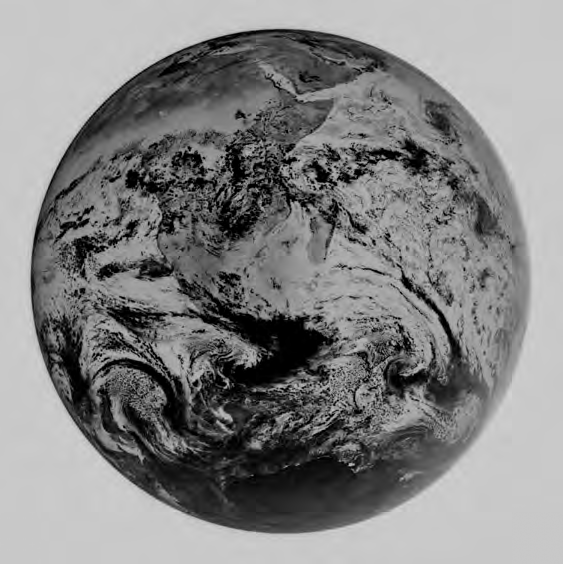
- It became the most reproduced photograph in human history, functioning as a cultural symbol for environmentalism, planetary unity, and global justice (described by Robert Poole as a "photographic manifesto for global justice").
Aki Hoshide Space Selfie (2012): Taken in December 2012 (cataloged as ISS032-E-025258), Japanese astronaut Aki Hoshide inverted the planetary perspective by framing himself.
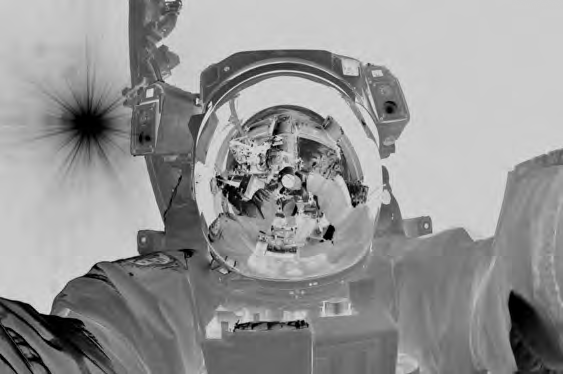
- His facial identity is obscured by his helmet visor, reflecting the International Space Station and the Earth below, mirroring the individualized yet networked nature of contemporary screen culture.
Blue Marble Composite (2012): Produced by NASA/NOAA using satellite data collected at an orbital altitude of .

- Because a complete hemispheric view requires an observation distance exceeding , NASA created a digital mosaic through tiled rendering, color-correcting and centering the image on North America.
The Four Global Thresholds of the Contemporary World
1. Urbanization: Passed the global urban threshold in 2008. In Brazil, urban demographics shifted from in 1960 to in 1972, reaching ( people) today.
2. Youth Demographic: Passed the majority global threshold in 2011, with of the global population under .
In Brazil, are .
In India, are .
In South Africa, () are .
In Niger, of its citizens are ; sub-Saharan Africa averages under .
3. Internet Connectivity: global internet penetration reached by 2015 (a growth since 2000). of connected users reside in Asia.
Active internet users expanded to in 2014, with projections estimating users.
Global mobility inequality persists alongside digital connectivity: a United Kingdom passport grants visa-free access to , whereas an Iranian passport permits entry to .
4. Atmospheric Climate Shift: In 2013, atmospheric carbon dioxide concentrations exceeded for the first time since the Pliocene epoch ().
The Digital Image Commons and Media Acceleration Statistics
Image upload volumes illustrate the scale of visual production:
of video are uploaded to YouTube every minute.
of video are consumed monthly on YouTube ( per person on Earth).
Annual photographic capture expanded from images in 1930 (film) to in 1980, in 2012 (digital transition), and in 2014.
The global photographic archive comprised images in 2011, expanding by in 2014 alone.
Over photographs are posted to Facebook every minute, alongside tens of thousands uploaded to Instagram.
Digital Computation vs. Analog Photography
Digital images differ fundamentally from analog photographs: they are not direct optical light-traces, but computed outputs of numeric code generated by digital sensor sampling (Wendy Hui Kyong Chun: "it computes").
Media operations simulate legacy analog physics (such as synthesized mechanical camera shutter clicks or digital filter algorithms mimicking Polaroid and black-and-white film stocks).
Reverse-image searching and digital forensic tools allow immediate verification of image manipulation (e.g., the 2013 exposure of college football player Manti Te'o's fabricated online identity within 24 hours).
The Seven Core Principles of Visual Culture Analysis
All media function as social media through which individuals represent themselves to others.
Vision operates as a multisensory feedback loop integrated across the entire body, rather than an isolated ocular function.
Visualizing represents a technological practice historically tied to airborne military oversight and battlefield management.
Human bodies function as operational nodes and extensions of electronic data networks.
Visual processing occurs on mobile digital screens.
Perception involves a simultaneous combination of conscious seeing and culturally habituated selective un-seeing (learning not to see).
Visual culture constitutes an active, performative framework for producing political and social transformation.
Media History, Time Representation, and Visualizing Power
Deep Time, Fossils, and Industrial Acceleration
Geological science in the 18th and 19th centuries established the concept of "deep time," displacing biblical chronology () with multi-million-year planetary timescales.
Georges Cuvier's 1808 identification of fossil strata demonstrated past species extinctions, laying the groundwork for Charles Darwin's On the Origin of Species (1859).
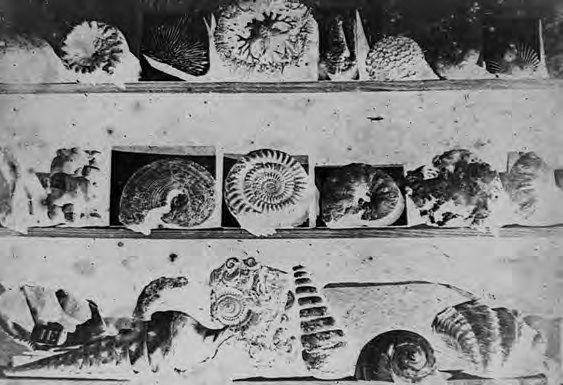
Louis Daguerre's 1839 photographic capture of fossil shells (Untitled [Shells and Fossils]) juxtaposed the immediate exposure time of the camera shutter against geological epochs.
Standardized Time, Railway Infrastructure, and Visual Expression
Industrialization necessitated the replacement of solar-based local time with standardized railway time networks, initiated by the Great Western Railway in England in 1840.
J. M. W. Turner depicted this mechanical speed shift in his 1844 canvas Rain, Steam and Speed – The Great Western Railway.

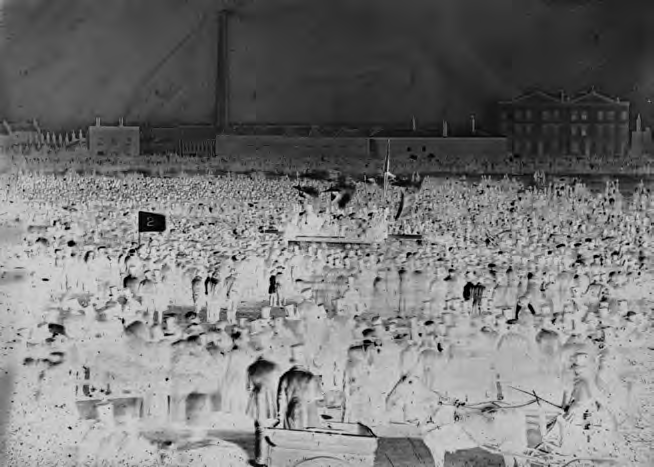
William Kilburn recorded the 1848 Chartist rally at Kennington Common, London, via daguerreotype, documenting political demands ( petition signatures for universal male suffrage) through early photojournalistic practice.
Christian Marclay's 2010 video installation The Clock compiled a 24-hour real-time montage of cinema clips featuring clocks and time indicators, reflecting the time-stamped nature of modern video media.
Visualizing Battlefields and Airborne Technologies
The operational term visualizing historically denotes the strategic abstraction of space for military oversight.
Early battlefield visualization originated in command strategy, expanding to airborne platforms: hot-air balloons, reconnaissance aircraft, orbital satellites, and unmanned aerial vehicles (drones).
Airborne visualization transforms geographic territory into remote target grids mediated by screen interfaces.
The Dual Dynamics of Looking: Appearance, Performance, and Invisibility
The concept of looking incorporates two distinct dimensions:
How one appears: The self-fashioning of identity governed by social frameworks (gender, class, nationality, religion) and digital platforms (e.g., selfies).
How one performs sight: The active deployment of ocular and technological tools to construct meaning, navigate environments, and exercise authority.
Nicholas Mirzoeff's "Right to Look": Asserts that looking is an active exchange that establishes social dominance, mutual recognition, or solidarity, operating as a site of political negotiation against institutional regulation.
The Politics of Invisibility and Erasure:
Bahraini Anti-Government Protests (May 4, 2012, Barbar village): Protesters carried symbolic coffins bearing photographs of victims killed in government crackdowns; female casualties were represented by standardized hijab graphics rather than personal facial portraits, adhering to local religious conventions while marking political presence.
Ken Gonzales-Day's Searching for California Hang Trees (2007–12): The LightJet print Nightfall I (, aluminum mount) depicts a leafless tree against a night sky, marking the unrecorded historic lynching of over 350 young Mexican men in California (). The empty tree visualizes historical erasure and absence.
Visuality, Power Dynamics, and Institutional Spaces
Visuality describes the historical and institutional structures that govern what can be seen, who is permitted to look, and how authority is visually enforced.
Institutional spatial design enforces visual power hierarchies:
Traditional classrooms align student gaze toward an instructor positioned as the authoritative source of knowledge.
Windowless government facilities, panoptic surveillance architectures, and restricted military zones control access to enforce state power.
Theoretical Foundations of Visual Studies and Cultural Analysis
The Intellectual Evolution of Cultural Studies
Cultural studies developed in the mid-1960s in Great Britain as an interdisciplinary framework to examine how human subjects are constructed through social practices.
Raymond Williams: Proposed in 1958 that "culture is ordinary," defining it as a "whole way of life of a social group or whole society." Culture operates through ordinary classificatory systems (popular music, print, cuisine, sport) rather than exclusively through fine art.
Matthew Arnold: Defined culture in the 19th century as "the best which has been thought and said," establishing an elitist paradigm of timeless aesthetic perfection.
Stuart Hall: Formulated representation theory, arguing that cultural participants actively produce meaning by constructing symbolic codes, deploying objects, and interpreting visual signs.
High vs. Low Culture, Enculturation, and Taste Dynamics
Pierre Bourdieu: Demonstrated that aesthetic "taste" is not an innate inclination but an acquired set of cultural preferences inculcated through class-based training and social enculturation.
Classificatory hierarchies historical divided "high culture" (opera, fine art painting, classical composition) from "low culture" (television, comic books, commercial illustrations).
Digital network convergence and prosumer practices have largely rendered the rigid distinction between high and low culture obsolete.
Media Convergence, Prosumer Practices, and Visual Remediation
Contemporary media networks combine previously distinct channels of communication (television, print journalism, personal photography, scientific data) onto unified digital screen interfaces.
Prosumer Culture: Erases the boundary separating media producers from media consumers, enabling users to create, remix, and distribute visual content globally.
Cross-Domain Remediation Example: Ian Moore, a UK technical support consultant for Lego, designed a custom Lego MRI suite model for the Royal Berkshire Hospital in Reading to alleviate pediatric anxiety before scans. The project integrated medical imaging, toy design, patient care, and global corporate branding via social media dissemination.