Eye and Vision - Pupillary Reflex Test
The size of each pupil is adjusted by muscles in the iris based on light intensity and object distance.
The adjustment of the pupil due to light intensity is called the pupillary light reflex (also called the photopuplillary reflex).
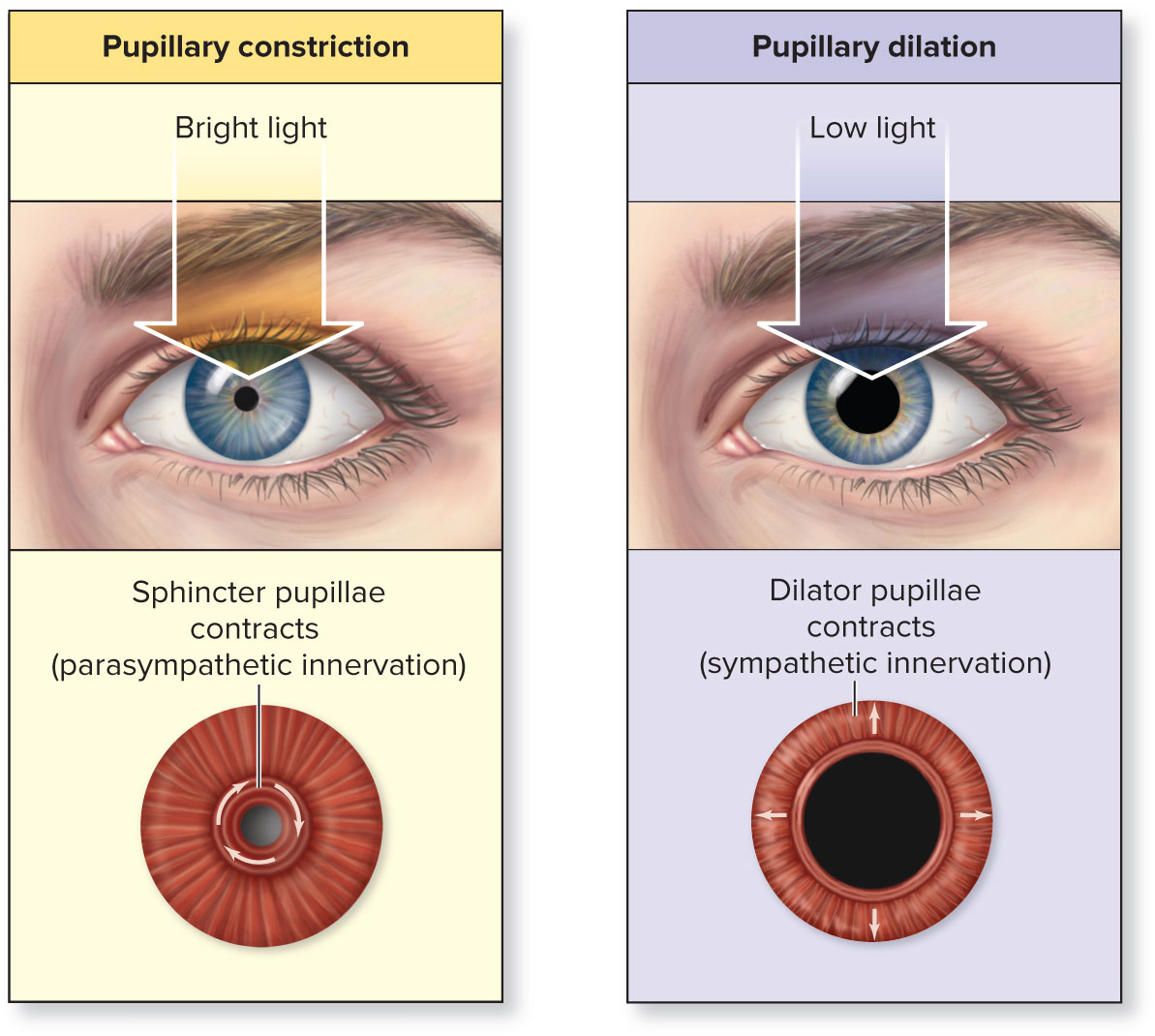
When relatively bright light enters one or both eyes, both pupils will constrict (get smaller) together. This is a parasympathetic reflex of the autonomic nervous system (ANS) that is controlled by the sphincter pupillae muscle of the iris.
When relatively dim light enters one or both eyes, both pupils will dilate (get larger) together. This is a sympathetic reflex of the ANS that is controlled by the dilator pupillae muscle of the iris.
The two muscles of the iris are innervated by the oculomotor nerve (cranial nerve III).
Pupil constriction is also one of three mechanisms for focusing light on the retina when viewing objects closer than 20 feet away. Accommodation of the lens and convergence of the eyeballs are the other two mechanisms. These are both covered in separate simulations.
When viewing a near object, both pupils will constrict to reduce the amount of light entering the eyes. This makes the field of view more focused on the fovea centralis, which is the most sensitive and acute area of the retina.
In the pupillary light reflex, both pupils constrict simultaneously when exposed to bright light and dilate in low-light level situations.
Both pupils also constrict simultaneously when an object is moved closer to the eyes.