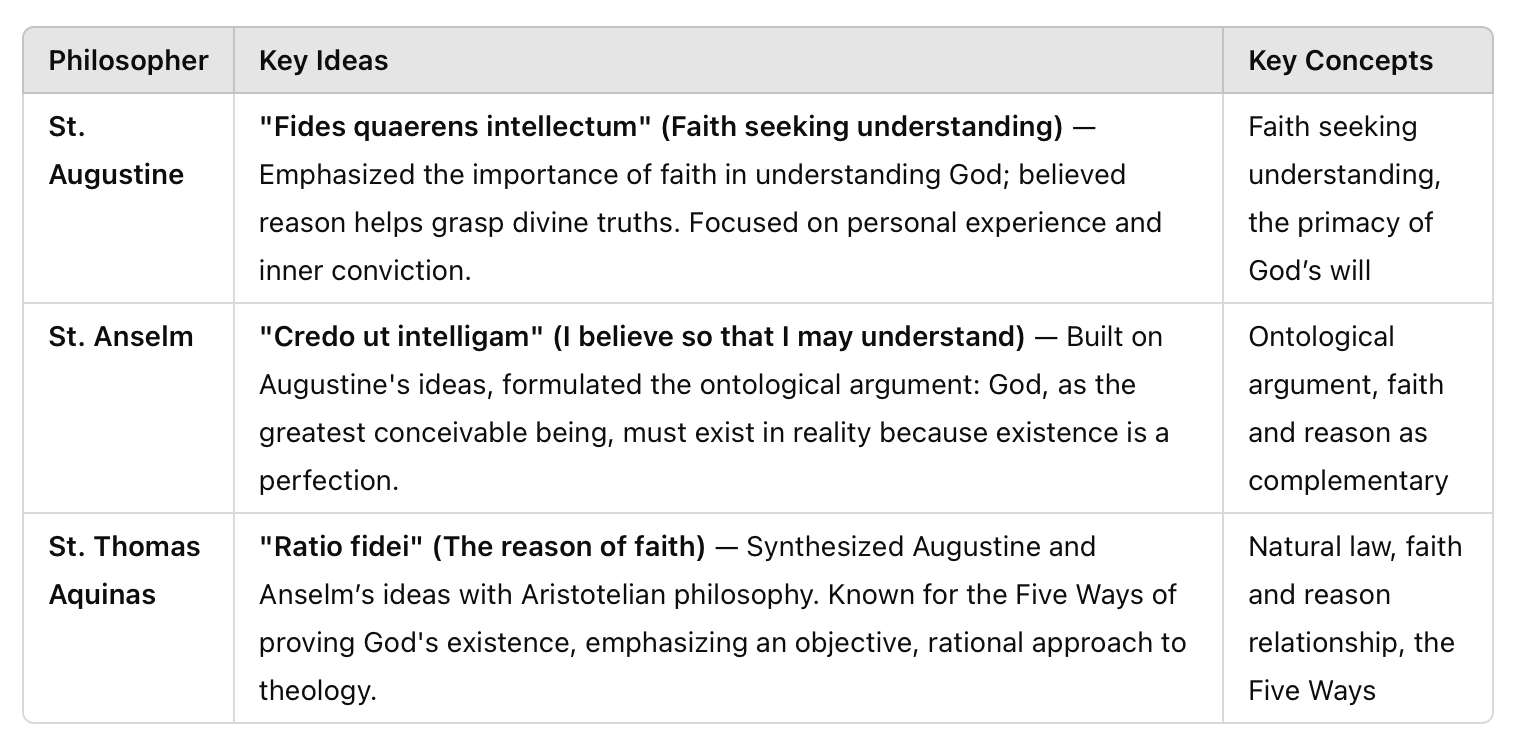
St Aquinas
Summary of Summa Theologiae
Structure of Summa Theologiae
Three main parts:
Part One: Presence of God in creation.
Part Two: Presence of God by grace in the souls of the just.
Part Three: Presence of God in Christ and the Church.
Core theme: Extended meditation on the presence of God.
The Existence of God
Key Question: Does God exist?
Faith: One way to know God’s existence is through faith based on the Bible.
Natural Knowledge:
St. Paul (Romans 1:20) indicates that God's existence is known through the beauty and goodness of the natural world.
Ancient philosophers, who never read the Bible, also argued for God's existence.
Aquinas teaches that natural reason provides knowledge of God.
Development of Knowledge of God
Spectrum of Understanding:
Knowledge of God is common and confused; not always explicit or clear.
Development depends on individual interest, cultural circumstances, and intellectual gifts.
Obstacles:
Factors such as cultural circumstances can hinder the full development of natural knowledge of God.
Philosophical Arguments:
Some individuals may cultivate robust philosophical proofs for God's existence after extensive reflection and study.
Aquinas's Five Ways
Basic Principle: Knowledge of God's existence is inferred from our experiences in nature by seeking an ultimate explanation.
Analogies:
E.g., Inferring a fire from smoke; witnessing symptoms infers an underlying infection.
The Five Ways
First Way:
Observes motion/change in nature; concludes the necessity of a first unmoved mover.
Second Way:
Examines cause and effect; deduces the necessity of a first uncaused cause.
Third Way:
Considers contingent beings; concludes there must be a source of existence that cannot not exist.
Fourth Way:
Inspects degrees of perfection in beings; leads to the conclusion of a perfect being as the source.
Fifth Way:
Observes that unintelligent beings act towards ends; deduces a higher intelligence directing them.
Meditation on Presence: The arguments lead to meditations on how God moves, causes, and directs all things.