X-rays
About X-rays
X-rays were discovered on research of cathode rays. ==It was noticed that there are negatively charged particles going from cathode to anode end and invisible radiation being emitted at certain voltage, these are called X-rays.==
It was also observed that some materials absorb x-rays better than others. They applied it in 1896 to view a broken arm.
Physical properties
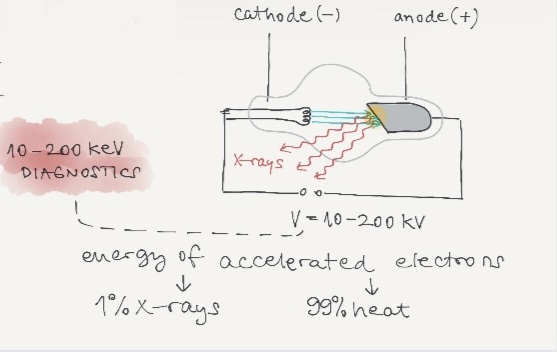
X-rays are electromagnetic waves made of photons with energy >124eV and wavelengths <10nm. ==In diagnostics we use energy of 10-200keV.==
Components and functions of X-ray tube
X-ray tube is a special cathode ray tube, containing a heated cathode and a block of metal as the anode. A voltage (10-200kV) is connected between them, negatively charged electrons leaving the cathode are accelerated to the anode and at the point where electrons collide with the anode x-rays are emitted. 1% of the energy of accelerated electrons is converted into x-rays and 99% is lost in form of heat, a block of metal with high melting point(e.g: tungsten) is used as the anode to dissipate this heat.
In modern x-ray tubes a rotating anode is used so as to change position where electrons collide with the anode and reduce heat affecting each side.i
==*If we accelerate electrons at 10-200kV then they will have energy of 10-200keV.==
Radiation
Characteristic radiation
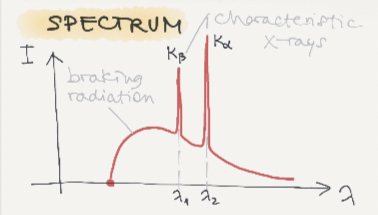
This occurs at higher voltage. The spectrum of intensity against wavelength is plotted, at this higher voltage there is still braking radiation but at some point sharp peaks appear and overlap with the braking radiation. The peaks appear at certain wavelengths.
Properties
- Line spectrum; appear at given wavelengths.
- The wavelengths depend on the anode material, position of wavelength will change based on material.
- The wavelengths do not depend on the voltage.
Mechanism
Atoms inside the anode are hit by electrons coming from the cathode but these electrons can also hit electrons around the atom and kicks it out of the nucleus. This creates a vacancy on the shell(K shell) so electron from another shell(L shell) can jump into that shell but due to the energy difference the energy is emitted in form of x-ray photon.
hf = EL - EK
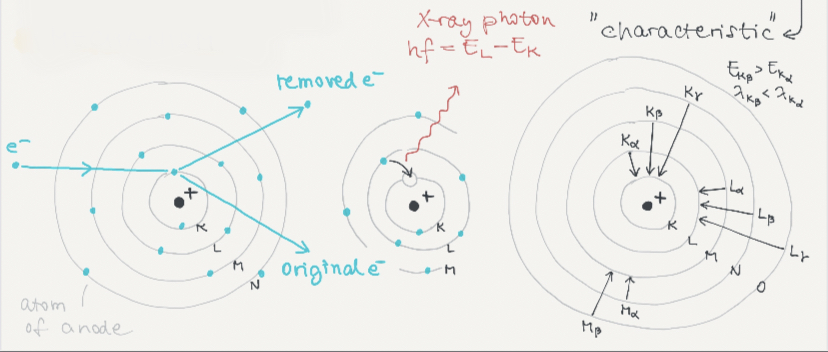
Different jumps are possible, if an electron is jumping to K shell from;
a. L shell that transition is K alpha
b. M shell it is K beta
c. N shell it is K gamma
Basically if it is one shell difference it is alpha, two shell difference is beta etc. Energy required to move by beta is greater so has smaller wavelength.
Braking radiation
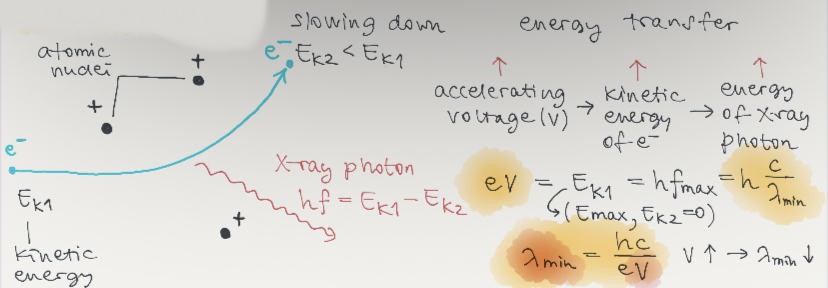
When electrons slowing down and an x-ray is created. The spectrum is studied showing composition of radiation(colours shown) at certain wavelengths, here a graph is plotted of intensity against wavelength and it shows the intensity distribution for each wavelength.
Properties
- Continuous spectrum; has high range of wavelength.
- Increase in voltage means lower minimum wavelength.
- Increase in voltage leads to increase in power of radiation(can be seen in the area below the curve).
- Minimum wavelength is independent on anode material, only depends on voltage.
Mechanism
Electrons in space are moving then collide with the atomic nuclei, the electrons path is deflected and slowed down due to the nuclei so it loses kinetic energy, the energy lost is emitted as x-ray
photon. When accelerating voltage(V) gives electron high speed it collides with the anode then it’s kinetic energy is converted into x-ray.
==eV = Ek1 = hfmax. = hc/wavelength min.==
When Ek1 is converted to an x-ray photon, the max. energy of photon in form of x-ray is when electron loses all its energy to the photon.