Bio Notes
It works in five main processes:
Ingestion
Digestion
Absorption
Assimilation
Egestion
1⃣ Ingestion
✅ Meaning:
Ingestion is the process of taking food into the body.
🦷 What happens:
Food enters through the mouth
Teeth chew the food (mechanical digestion / mastication)
Tongue mixes food with saliva
Saliva contains amylase enzyme, which starts digestion of starch
📍 Organ involved: Mouth
2⃣ Digestion
✅ Meaning:
Digestion is the process of breaking large, complex food molecules into simple, soluble substances.
🔬 Types of digestion:
(a) Mechanical digestion
Chewing by teeth
Churning of food in the stomach
(b) Chemical digestion
Enzymes break food chemically
🧪 Examples:
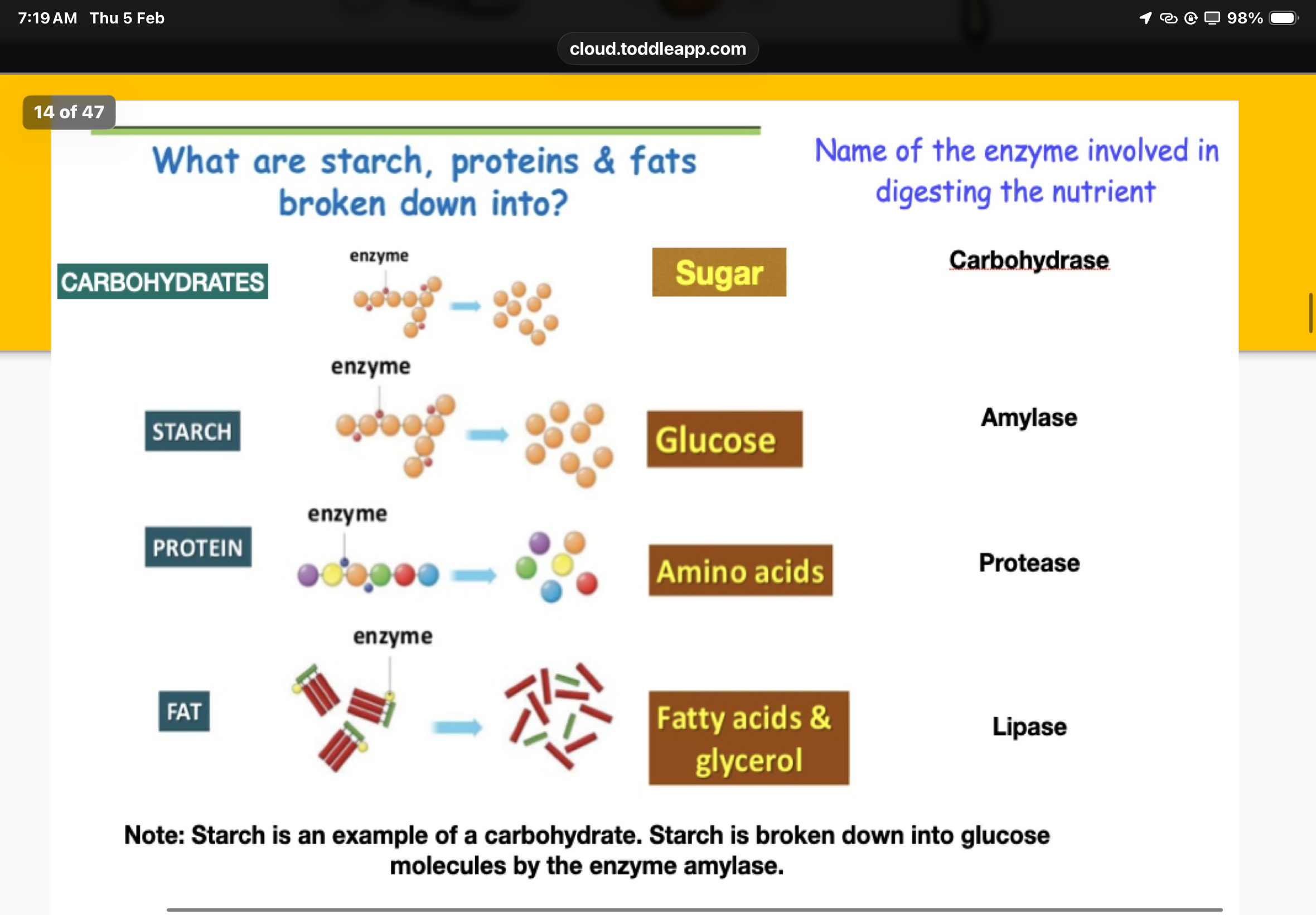
Amylase → starch → sugar
Pepsin → proteins → peptides
Lipase → fats → fatty acids + glycerol
📍 Organs involved:
Mouth
Stomach
Small intestine
3⃣ Absorption
✅ Meaning:
Absorption is the process by which digested food passes into the blood.
🩸 Where it occurs:
Small intestine
🔍 How:
The inner wall has tiny finger-like structures called villi
Villi increase surface area
Nutrients enter:
Blood capillaries (glucose, amino acids)
Lacteals (fatty acids and glycerol)
📍 Result:
Nutrients are now in the bloodstream
4⃣ Assimilation
✅ Meaning:
Assimilation is the process of using absorbed nutrients by body cells.
🧠 What happens:
Glucose → used for energy (respiration)
Amino acids → build muscles and tissues
Excess glucose → stored as glycogen in liver
Fats → stored under the skin
📍 Occurs in:
All body cells
Mainly regulated by the liver
5⃣ Egestion
✅ Meaning:
Egestion is the removal of undigested and unabsorbed food from the body.
🚫 Important:
Egestion ≠ excretion
Egestion removes solid waste
Excretion removes metabolic waste (urine, sweat)
🧻 Process:
Undigested food enters large intestine
Water is absorbed
Waste is stored in rectum
Removed through anus as faeces
📍 Organs involved:
Large intestine
Rectum
Anus
Respiratory system ——> (1) = Nasal cavity - Air rich in oxygen enters the mouth through the nasal cavity.
2 - Pharynx —- Contains lining of mucus which traps dirt/ dust particles inside it and pushes it back to the mouth to be swallowed or thrown out.
3 - Larynx - Contains Goblet cells which contains a thin lining in the eosophagus and protects it.
4 - Trachea - It carries air from the nose and mouth to the bronchi.
It is kept open by C-shaped rings of cartilage so it doesn’t collapse.
It helps filter air using mucus and tiny hairs (cilia) that trap dust and germs.
5 - Bronchi — They carry air from the trachea (windpipe) into the lungs.
Inside the lungs, the bronchi branch into smaller tubes called bronchioles.
They help distribute air evenly throughout both lungs.
6 - Bronchioles — They branch off from the bronchi.
They carry air deeper into the lungs.
They control airflow by expanding and contracting (using smooth muscles).
They lead air to the alveoli, where gas exchange happens.
Alveoli —- They are the site of gas exchange.
Oxygen passes from the alveoli into the blood.
Carbon dioxide passes from the blood into the alveoli to be breathed out.
They have very thin walls and many capillaries, which makes gas exchange fast and efficient.
Capillaries ———> They surround the alveoli in the lungs.
They allow exchange of gases:
Oxygen from the alveoli passes into the blood.
Carbon dioxide from the blood passes into the alveoli to be exhaled.
Their walls are very thin (just one cell thick) to make this exchange easy.
Glucose (from food) + Oxygen (from breathing) → Energy (ATP) + Carbon dioxide + Water.
The chemical equation: C6H12O6+6O2→6CO2+6H2O+energy(ATP)
It happens in the mitochondria of cells (often called the “powerhouse” of the cell).
The energy (ATP) produced is used for all activities of the cell, like movement, growth, and repair.
DIGESTIVE SYSTEM – DETAILED NOTES
1. Mouth (Buccal Cavity)
Ingestion
Digestion begins in the mouth.
Food is taken in and prepared for swallowing.
Chewing (Mastication) – Physical Digestion
Teeth cut, tear, and grind food into smaller pieces.
This is physical digestion because:
The food’s size changes
Its chemical nature stays the same
Chewing increases the surface area of food, making digestion easier later.
Role of Saliva – Chemical Digestion
Saliva is released by salivary glands.
Saliva contains:
Salivary amylase (enzyme)
→ Breaks starch into maltose (simple sugar)Water
→ Softens foodMucus
→ Makes food slippery and easy to swallow
✔ This is chemical digestion because enzymes change food chemically.
Bolus Formation
Chewed food mixed with saliva forms a soft ball called a bolus.
The bolus is swallowed into the oesophagus.
2. Oesophagus (Food Pipe)
The oesophagus connects the mouth to the stomach.
Food moves by peristalsis:
Wave-like muscle contractions
Push food downward
No digestion occurs here.
3. Epiglottis – Preventing Food from Entering the Windpipe
The epiglottis is a flap-like structure.
It is located at the entrance of the trachea (windpipe).
What happens during swallowing?
When you swallow:
The epiglottis closes over the trachea
This prevents food from entering the windpipe
Food is safely directed into the oesophagus.
✔ If food enters the windpipe, it causes choking.
4. Stomach
The stomach is a muscular sac that stores and digests food.
Churning – Physical Digestion
Strong muscles contract and relax
Food is mixed and crushed
Food becomes a semi-liquid called chyme
This is physical digestion.
Chemical Digestion in the Stomach
The stomach releases gastric juice, which contains:
Hydrochloric acid (HCl)
Kills harmful bacteria
Provides acidic medium for enzymes
Pepsin (enzyme)
Breaks proteins into smaller peptides
✔ Proteins are mainly digested here.
5. Small Intestine
The small intestine is the main site of digestion and absorption.
It has three parts:
A. Duodenum
First and shortest part
Receives:
Bile from liver
Pancreatic juice from pancreas
Functions:
Bile emulsifies fats (breaks large fat droplets into smaller ones)
Pancreatic enzymes digest:
Carbohydrates
Proteins
Fats
✔ Major chemical digestion happens here.
B. Jejunum
Middle part of small intestine
Digestion continues here
Nutrients are broken into simple soluble forms
Examples:
Glucose
Amino acids
Fatty acids and glycerol
C. Ileum
Last and longest part
Absorption of nutrients happens here
Inner lining has villi:
Finger-like projections
Increase surface area
Villi absorb:
Glucose → into blood
Amino acids → into blood
Fatty acids → into lymph
6. Summary Table
Part | Process | Type of Digestion |
|---|---|---|
Mouth | Chewing + salivary amylase | Physical + Chemical |
Oesophagus | Peristalsis | None |
Stomach | Churning + pepsin | Physical + Chemical |
Duodenum | Enzymes + bile | Chemical |
Jejunum | Digestion continues | Chemical |
Ileum | Absorption | None |
Key Exam Words to Use
Mastication
Peristalsis
Chyme
Enzymes
Emulsification
Villi
Absorption
trachea is covered in c - shaped Cartilaginous rings that protect the trachea lining.
the capillaries contain Deoxygenated blood/ impure blood until the alveoli gives air rich in oxygento the blood cells in the capillaries.
The amount of breathes a person does in a minute is called breathing rate.
A person breathes 12–20 times per minute
Nutrient | Where digestion starts | Enzyme(s) involved | Broken down into |
|---|
Carbohydrates (starch) | Mouth | Amylase (salivary & pancreatic) | Simple sugars (glucose) |
Proteins | Stomach | Pepsin, then Trypsin (small intestine) | Amino acids |
Fats (lipids) | Small intestine | Lipase (with help of bile) | Fatty acids + glycerol |
Sugars (disaccharides) | Small intestine | Maltase, Sucrase, Lactase | Glucose / fructose / galactose |
Oxygen debt is the extra oxygen needed after exercise to remove lactic acid.
circulatory system — Circulatory system is a body system that allows transportation/transfers nutrients such as oxygen and other important substances such as amino acids (protien) glucose (starch) through the blood. The main parts of the circulatory system is - 1= The heart
2 = The blood and blood vessels.
there are 2 parts of the part——> the left and right side.