History unit 3
The Crimean War
TIMELINE: 1853 – 1856
When did the war start and who declared the war on the Russian Empire?
Why did the Ottoman Empire declare the war on the Russian Empire?
a) There were many reasons, but first of all, Nicholas I was legally the protector of the Christians in the Ottoman Empire, and Napoleon III, the Emperor of the French wanted this position. It was unacceptable and Nicholas sent his army against him;
b) Austria was on good terms with Russia, but it was concerned with Russia’s growing influence in the Balkans, especially with its links with Slavic and Orthodox populations;
c) France wanted to increase its international prestige;
d) Britain didn’t want the Ottomans to lose, and for Russia to gain too much
e) Prussia opted for neutrality
Why did Britain & France give Russia the ultimatum? Because they were concerned about Russian victory and they told Russia to withdraw its forces to avoid the Anglo-French intervention.
What was the Russian response? Russia refused to do that so as a result, Britain and France declared war on Russia.
The most important battles of the Crimean War:
a) the Battle of Alma – where the Russians were pushed back by the Anglo-French forces
b) the Battle of Balaclava
- Who continued the war after the death of Nicholas I? Alexander II.
- When did Sevastopol fall? It fell in 1855.
- When did the peace treaty take place? In early 1856 and what were its conclusions?
a) Russia was no longer the protector of the Christians within the Ottoman Empire;
<<b) the Black Sea was to remain demilitarized<<
c) The Crimean War marked a turning point for the Russian Empire. The war weakened the Imperial Russian Army, drained the treasury and undermined Russia's influence in Europe. Russia would take decades to recover. The humiliation forced Russia's educated elites to identify the Empire's problems and to recognize the need for fundamental reforms. They saw rapid modernization of the country as its only way to recover the status of European power. The war thus became a catalyst for reforms of Russia's social institutions, including the abolition of serfdom and overhauls in the justice system, local self-government, education, and in military service.
In a nutshell:
Causes of the war:
- Russian expansion in the Balkans, which were part of the Ottoman Empire
- Gaining by Russia had free access to the Straits of the Bosporus and the Dardanelles, which linked the Mediterranean and the Black Seas
- The desire of Russia to erase from the maps the Ottoman Empire
- Support given by Russia to the Balkan nations that were under Turkish rule.
- Support the idea of Pan-Slavism, according to which all Slavs should unite under the Russian protectorate. To achieve the goals, Tsar Nicholas I demanded the only right to protect the holy places of Christians in Palestine, The Tsar also wanted to protect all believers of the Eastern Orthodox Church within the Ottoman Empire. Turkey rejected these demands and declared war on Russia.
The Course of the Crimean War:
Great Britain, France, Austria and the Kingdom of Sardinia came out in favour of Turkey, joining the anti-Russian camp. It was the first international conflict since the Napoleonic wars.
The British and French forces landed on Crimea and captured the Crimean Peninsula.
The siege and capture of Sebastopol in 1855 was the turning point of the war and led to the failure and defeat of Russia. The defeat of Russia was also sealed because of the sudden death of the Tsar, Nicholas I. His successor, Alexander II didn’t want to continue the war.
The end of the war:
1856 – signing the Peace Treaty in Paris. By virtue of the Paris Peace Treaty:
The Black Sea became the demilitarized region, which meant that warships were not allowed to be there;
==Serbia, Moldavia & Wallachia== gained autonomy
The defeat of Russia in the Crimean war prevented the Ottoman Empire from the fall & strengthened the position of Great Britain and France in this region.
The Crimean War weakened the Holy Alliance.
The defeat of Russia weakened its position as well as revealed backwardness of Russia. Consequently, Alexander II, the Tsar of Russia was forced to conduct a series of reforms. The period of the reforms was called the Post - Sebastopol Thaw or the Sebastopol Spring.
Unification of Italy
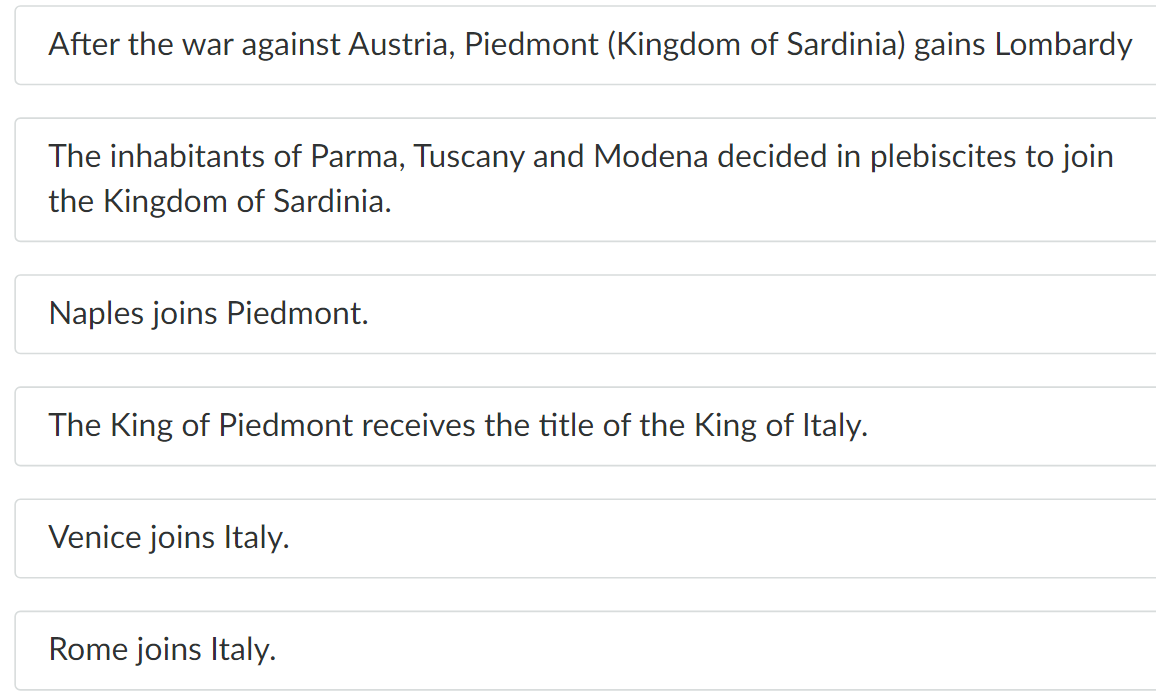
The movement of unification of Italy was started by the Kingdom of Sardinia. The first stage was to include Piedmont after winning the war with Austria in 1859. After an uprising against the authorities broke out in the Kingdom of Both Sicily, it was supported by “red shirts” led by Giuseppe Garibaldi. As a result, this country was also incorporated into Italy undergoing the process of unification. In 1862, the Kingdom of Italy was proclaimed. In 1866, after Austria lost the war with Prussia, ==Venice== was incorporated into Italy. In 1870, Italians entered the Papal States. They occupied Rome and severely limited premises of the Church.
Camillo Cavour was an Italian count, politician and statesman. In 1852 he became a Prime Minister and Minister of Foreign Affairs of the Kingdom of Sardinia.
He was aware of the economic differences between the poor south and the rich north of Italy, therefore he assumed the need to create a loose federation of Italian countries.
skillfully conducted diplomacy, providing Piedmont with military and diplomatic support from Napoleon III. The Emperor of France was the first of Europe's monarchs to advocate the right of nations to be politically „self‑determined”, that is to gain their own independence.
However, he did not support Piedmont voluntarily. He hoped to acquire lands for France: Savoy and Nice. He gained them thanks to the defeat of Austria in 1859. Sardinia received then Lombardy, which was handed over to it by the winning France.
Later, Napoleon did not want to be a protector of Risorgimento(19th-century movement for Italian unification that culminated in the establishment of the Kingdom of Italy in 1861) anymore, but the reunification process continued. In 1860, revolutions broke out against the Austrian princes – the absolute rulers of Parma, Tuscany and Modena. After their downfall, due to plebiscites, residents of these countries decided to join the Kingdom of Sardinia.
Giuseppe Garibaldi
He set off from a small port in the north‑west of Italy to the Kingdom of Both Sicily with a group of trained and armed Italian volunteers, embarked on two steamships. This expedition was called the “==Expedition== of the Thousand”. Their weapons and equipment were the donations collected all over Italy, as well as sent from abroad. Garibaldi conquered Sicily and then headed for Naples, crushing the army of the Kingdom of Both Sicily and overthrowing the House of Bourbon.
‘==only a revolution can create Italy, diplomacy will never do it'.==
Garibaldi and his volunteers declared that they are acting on behalf of the King of Piedmont, but for Victor Emmanuel and Prime Minister Cavour, the political action of the Italian democrats was as beneficial as worrying. The success of the expedition made Garibaldi the actual ruler of southern Italy. He chose obedience to Victor Emmanuel II.
New Political Ideologies
In 19th century Europe, democratization progressed systematically, led by Britain, which had abolished religious discrimination and promoted free speech. The country was characterized by a diverse and open society, including political refugees from Poland. The political reforms of the 1800s expanded the electorate, and labor unions and associations were established. The Labour Party was formed in 1900 and won parliamentary seats, resulting in improved labor laws. Meanwhile, republicanism emerged as an alternative to monarchies, with the US presidential system serving as an example. Republicanism gained traction in Switzerland, France, and Portugal, but parliamentary systems remained dominant in Europe.
Social democracy
Although the main goal of social democracy was socialist revolution and nationalization of the means of production, its supporters also became involved in democratic politics. There were protests and strikes organised by the labourers. Social democratic parties were established in many European countries, as well as in Japan, the United States, Australia, and South American countries.
Eduard Bernstern- ideologue of German Social Democracy, preacher of Marxist ideas in the labour movement
The Gernan Social Democratic party was formed in 1869.
the Social Democratic Party of Russia in 1898
The Labour Party was formed in 1900 in the UK
Postulates:
- equality and social justice
- extension of universal suffrage
- fight for social rights within the parliamentary system
→ they rejected a social revolution, they believed it would cause more evil than good
- criticism of communism
Christian democracy (also called Chadecja)
The Christian social movement was based on the social teachings of the Church initiated by Pope Leo XIII. In 1891, the pope issued the encyclical Rerum novarum, in which he sharply criticized communist and liberal ideas associated with the French Revolution, which were seen as the most dangerous for social order. He propagated social solidarity and cooperation among different groups for the common good. He also emphasized the need to respect human dignity and called on governments and factory owners to improve working conditions for workers and condemn their exploitation.
Postulates:
- criticism of socialism, communism and liberalism
- respecting human dignity
- implementation of the idea of social justice
- social solidarity
- improvement of working conditions
- corporatism- cooperation of employers and employees of different/various branches
Nationalism
Postulates:
- the nation is of the highest value and most important form of communication
- national solidarity- placing the nation and its
interests as priority
- desire to create a national state in which the interests of its people will be realised
- development of education, culture of a national character and preservation of traditions
Modern nationalism, which emerged from the increasing importance of national identity in Europe. Nationalists believed that states should have a national character, and that national identity was the most important element of an individual's identity. Nationalism took on various forms, and some proponents established hierarchies among nations, claiming that some were superior to others. Nationalism also gave rise to racism and anti-Semitism, as nationalists viewed minorities as incompatible with their vision of a unified nation. There was also a Jewish nationalism movement called Zionism, which advocated for the creation of a Jewish state in Palestine and criticized assimilation.
Anarchism
Piotr Kropotki and Michaił Bakumi
Postulates:
- abolition of the state, religion, property
- breaking with tradition and religion
- organizing voluntary communities within which free individuals function
Women's empowerment movement
Postulates:
- access to education, especially higher education,
- changes in family law (such as inheritance),
- economic equality,
- voting rights for women.
Particularly in traditional societies where women were limited to roles such as motherhood and homemaking, they began to demand access to education, changes in family law, economic equality, and voting rights. Women gained access to higher education first, and many new professions became available to them. The suffragette movement was particularly vocal in demanding voting rights for women, which were gradually granted in various countries around the world.
First female professor Marie Skłodowska Curie at Sorbonne University, France
\n