Knowledge Organization
Definition (#f7aeae)
Important (#edcae9)
Extra (#fffe9d)
Declarative knowledge:
Knowledge of facts, concepts, and principles.
It is the theoretical knowledge of the world.
It can be learned relatively quickly and is easily modified.
Procedural knowledge:
Knowledge of how to do something, carry out a process, or perform a skill.
Acquired through practice and involves the practical application of knowledge to achieve a goal.
Concept:
The fundamental unit of symbolic knowledge, or knowledge of correspondence between symbols and their meaning.
Category:
A concept with members.
Ex: Bird is a concept, but it’s also a category having robin and hawk as members.
Types of categories:
Natural: Groupings that occur naturally in the world.
Artificial: Invented by humans to serve particular purposes or functions.
Feature-based categories: There are 3 features to be considered a member.
Prototype theory:
Similarity to an averaged model of the category.
Prototype: An abstract average of all the objects in the category we previously have encountered.
Crucial for prototypes are characteristic features, ideal representation of the category.
Combining Feature-Based and Prototype Theories:
A full theory of categorization can combine both defining and characteristic features so that each category has both a prototype and a core.
Core: The defining features something must have to be considered an example of a category.
Ex:
Concept of a robber.
The core requires that someone labeled as a robber be a person who takes things from others without permission.
The prototype, however, tends to identify particular people as more likely to be robbers.
Collin’s & Quillian’s Network Model:
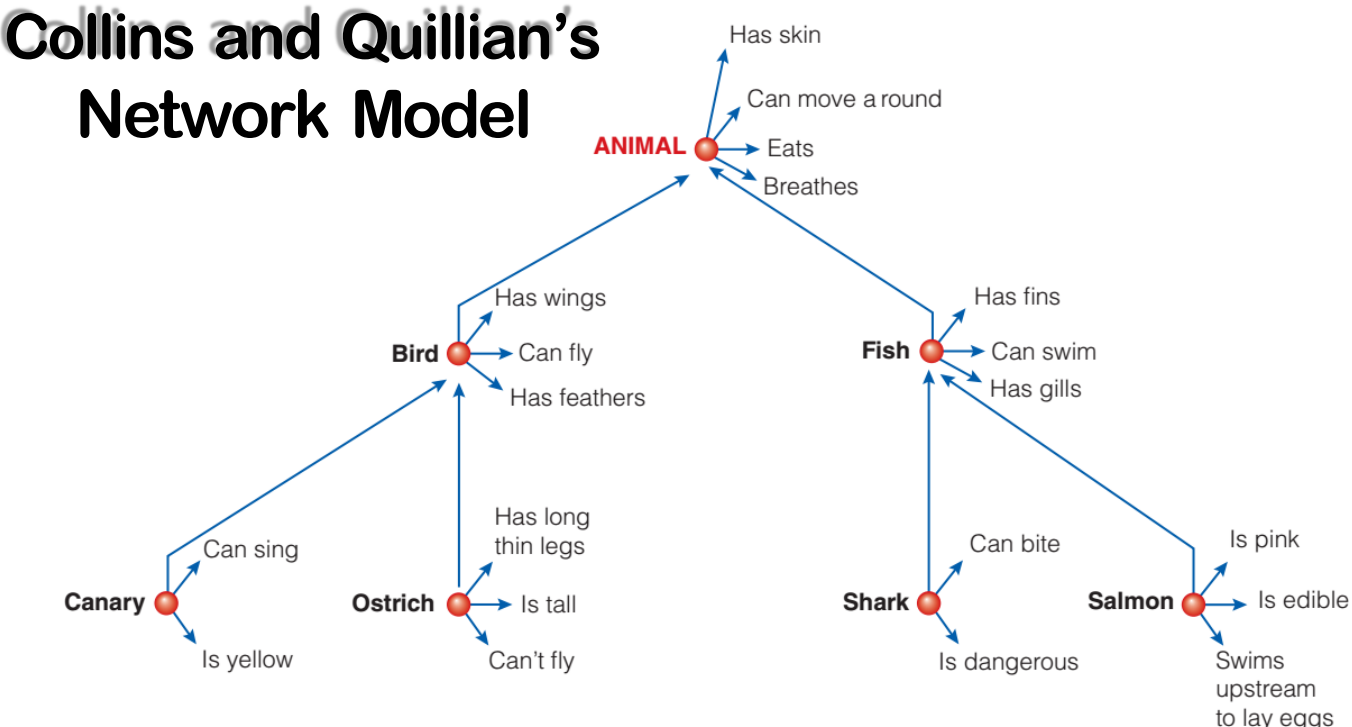
Semantic network: A web of elements of meaning (nodes) in which the elements are connected with each other through links.
Organized knowledge representation takes the form of a hierarchical tree diagram.
The elements are called nodes; typically concepts.
The connections between the nodes are labeled relationships.
They might indicate category membership, attributes, or some other semantic relationship.
A network provides a means for organizing concepts.
The labeled relationships form links that enable the individual to connect the various nodes in a meaningful way.
Within a hierarchy, we can efficiently store information that applies to all members of a category at the highest possible level in the hierarchy.
We don’t have to repeat the information at all of the lower levels in the hierarchy.
The system allows for maximally efficient capacity use with a minimum of redundancy.
Comparing semantic features:
Knowledge is organized based on a comparison of semantic features, rather than on a strict hierarchy of concepts.
It differs from the feature-based theory in a key way:
Features of different concepts are compared directly, rather than serving as the basis for forming a category.
Ex:
Categorization of different mammals.
In feature-based theory, each mammal would be described by its own set of defining features (Rabbit defined by its fur, long ears, hopping).
Schematic representations:
One main approach to understanding how concepts are related in the mind is through schemas.
Schema: A mental framework for organizing knowledge.
They are similar to semantic networks, except that schemas often are more task-oriented.
It creates a meaningful structure of related concepts.
Characteristics of schemas:
Schemas can include other schemas.
Ex: A schema for animals includes a schema for cows.
Schemas encompass typical, general facts that can vary slightly from one specific instance to another.
Ex: Although the schema for mammals includes a general fact that mammals typically have fur, it allows for humans, who are less hairy.
Schemas can vary in their degree of abstraction.
Ex: A schema for justice is more abstract than a schema for apple.
Scripts:
Contains information about the particular order in which things occur.
Scripts are much less flexible than schemas.
Scripts include default values for the actors, the props, the setting, and the sequence of events expected to occur.
These values taken together compose an overview of an event.
Features of a script:
Props: Tables, a menu, food, a check, and money.
Roles to be played: Customer, a waiter, a cook, a cashier, and an owner.
Opening conditions for the script: The customer is hungry, and he/she has money.
Scenes: Entering, ordering, eating, and exiting.
A set of results: The customer has less money; the owner has more money; the customer is no longer hungry.
Procedural knowledge:
Procedural knowledge representation is acquired by practicing the implementation of a procedure.
Not a result of reading, hearing, or acquiring information from explicit instructions.
Once a mental representation of non-declarative knowledge is constructed (proceduralization is complete) that knowledge is implicit.
Hard to make explicit by trying to put it in words.
Practice often decreases explicit access to that knowledge.
As your explicit access to non-declarative knowledge decreases, your speed and ease of gaining implicit access to that knowledge increases.
Most non-declarative knowledge can be retrieved for use much more quickly than declarative knowledge can be retrieved.
Non-declarative memory:
Knowledge has been described as either declarative or procedural.
One can expand the traditional distinction between declarative and procedural knowledge to suggest that non-declarative knowledge may encompass a broader range of mental representations than just procedural knowledge.
In addition to declarative knowledge, we mentally represent the following forms of non-declarative knowledge:
Perceptual, motor, and cognitive skills (procedural knowledge).
Simple associative knowledge (classical and operant conditioning).
Simple non-associative knowledge (habituation and sensitization).
Priming.
All of these non-declarative forms of knowledge are usually implicit.
Parallel processing:
Parallel processing is multiple operations go on all at once.
The human brain seems to handle many operations and to process information from many sources simultaneously—in parallel.
It seems necessary that we are able to process information in parallel:
A computer responds to an input within nanoseconds, but an individual neuron may take up to 3 milliseconds to fire in response to a stimulus.
Serial processing in the human brain would be far too slow to manage the amount of information the brain handles.
Ex:
We can recognize complex visual stimulus within about 300 milliseconds.
If we processed the stimulus serially, only a few hundred neurons would have had time to respond, which is not enough for perception.
The distribution of parallel processes better explains the speed and accuracy of human information processing.
Parallel distributed processing (PDP) models (connectionist models):
We handle very large numbers of cognitive operations at once through a network distributed across incalculable numbers of locations in the brain.
Network: The mental structure within which parallel processing is believed to occur.
In connectionist networks, all forms of knowledge are represented within the network structure.
Each node is connected to many other nodes.
These interconnected patterns of nodes enable the individual to meaningfully organize the knowledge contained in the connections among the various nodes.
In many network models, each node represents a concept.
In the PDP model, the network is made up of neuron-like units.
They don’t actually represent concepts, propositions, or any other type of information.
The pattern of connections represents the knowledge, not the specific units.
The same idea governs our use of language.
Individual letters (or sounds) of a word are relatively uninformative, but the pattern of letters (or sounds) is informative.
No single unit is very informative, but the pattern of interconnections among units is highly informative.