working with woods
BOX JOINTS
box joints are used to join to pieces of wood at 90°, these increase strength and different joints may be chosen for aesthetics, suitability and time efficiency
finger (comb) joint - often used for boxes, these are strong due to the increased surface area as the fingers pack together. these when cut accurately are very aesthetically pleasing and can be produced using a router jig, they can even be laser cut for increased efficiency and accuracy
dovetail joint - very aesthetically pleasing and strong these fingers are harder to cut but can be marked out with a jig, the shape also increases directional strength and so will hold a joint better
half lap (halving) - when joining to pieces of wood they can be overlapped and glues, this makes a simple and quick join, however it is not very strong, the corners can be reinforced with dowels, but even without create a good square corner, stopping diagonal distortion
dowel joint - these can be used for frame joining and are easy machined, the holes have to be accurate for a good fit and can be used as a knockdown fitting. it is cost effective and easy to make and glue
mitre joint - when two pieces of wood are cut at 45° and stuck together with glue, creating a clean finish that often needs to be reinforced with screws
FRAME JOINTS
housing joint - when a channel is cut into wood and the other piece is slotted in, this is often done for shelves and can be used for moving parts that need to slide past each other, they are also easy as only one piece of wood needs to be machined
mortise and tenon - these are time consuming joints that require both a mortising machine and a tenon saw, this created a join with high shear strength that can be used to carry large weights, these can be glued or using aesthetic wedges. the wood can be wasted using CNC for higher efficiency in flat-pack furniture production
dowel joint
SCREWS
most screws are made from mild steel plated with a non-corrosive metal such as brass, zinc or chrome. the heads can have a countersunk angle to make sure they spot flush and are unobtrusive. a domed head can be used for aesthetics
screws are quick to install and can be used for joining different woods
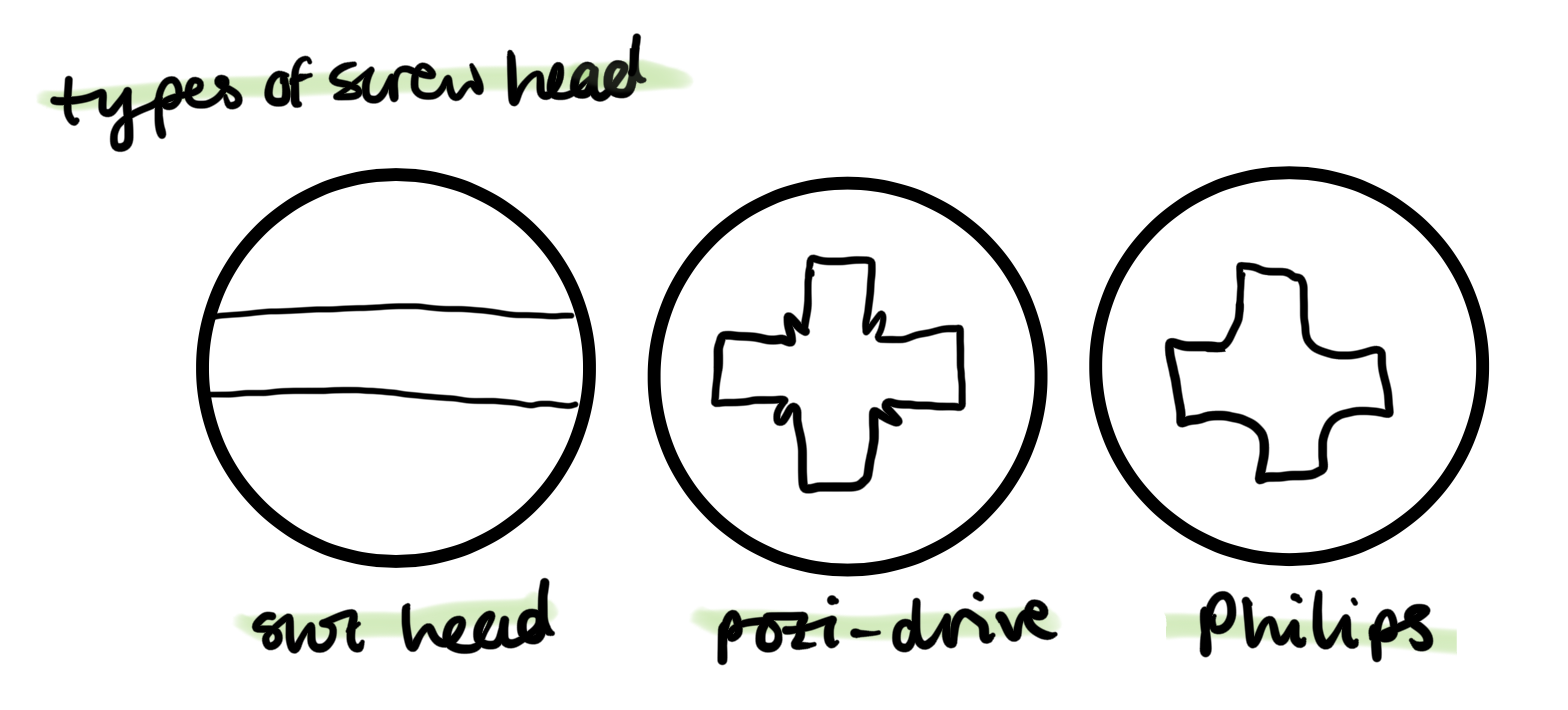
there are three different heads used; Philips, slot head and pozi-drive, these are easy to access and source. when working with screws you must use to avoid damaging the screw
 self-tapping screws do not need a pilot hole, whereas normal screws do. clearance and pilot holes are used to reduce splitting and ease screwing when joining. pilot holes make it easier for screws to drill and are better for stronger/tighter grained wood
COMPONENTS
nuts and bolts are both temporary and permanent fixings. they can be combined with washers for moving parts, their heads can be countersunk to increase aesthetics and can be used in large weight baring products
coach bolts are larger bolts but with a square protrusion to make a strong permanent fixing , these fixings require a pre-drilled hole. the square prevents spinning and is self locking, these cannot be undone. this makes it suitable for external use
KNOCK DOWN FITTINGS
knock-down fittings are used for collapsible furniture and flat-pack production, these are used for timbers and different materials, these can be fitted with easy access tools and glue free dowels are used for stability
knock-down fitting make furniture easier to transport and cheaper to produce as less work is needed. also wood can be separated for recycle, however knock down fittings are not as durable as joints such as finger joints
modesty block - pre-made blocks that fit on the inside of joints used for modular furniture. they are easy to instal but not very strong or durable, they can also be customised for aesthetics to blend in
cam fitting - these require pre drilled holes that have to be very accurate, they are often manufactured by CNC but can be assembled with a screwdriver for ease of customers, these are used in laminated board products eg. cabinets
barrel nut and bolt - these are used for large pieces of furniture, such as beds and tables, these require Allen keys for accurate 90° angles. these have a high sheer strength and can hold high loads
TRADITIONAL vs MODERN FABRICATION
woods with different colours of grains can be used for a contrasting pattern and to highlight a joint. also, well made joints that fit well are impressive
modern fabrication can utilise pilot and clearance holes for efficiency and mass manufacture can utilise CNC machining. screws are quick for reliable joints - such as hinges or for decoration. products need to be made very accurately to be easily assembled at home, CNC and CAM can make sure high volume production is consistent for easy use
traditional design by hand takes time and as a result a cleaner aesthetic and minimalism formed this meant bulk production was more suitable than bespoke products
an example of mass production is IKEA established in 1943 it automated production and developed new techniques for joining for easy cheap products, creating and effective business plan