Making Informed Financial Decisions
Financial Products (7.1)
Financial Products are contracts that consumers enter into with financial service providers to manage their money, whether saving, investing or taking out a loan.
FSPs - firms that operate in the financial industry e.g. banks, credit unions, insurance companies
Savings
the proportion of our income we choose not to spend
to pay back debt
children’s education
home improvement
new car
Where to save?
commercial banks e.g. BOI
the Credit Union
An Post
As European residents, Irish citizens can also shop around for banks/ financial providers in other EU countries.
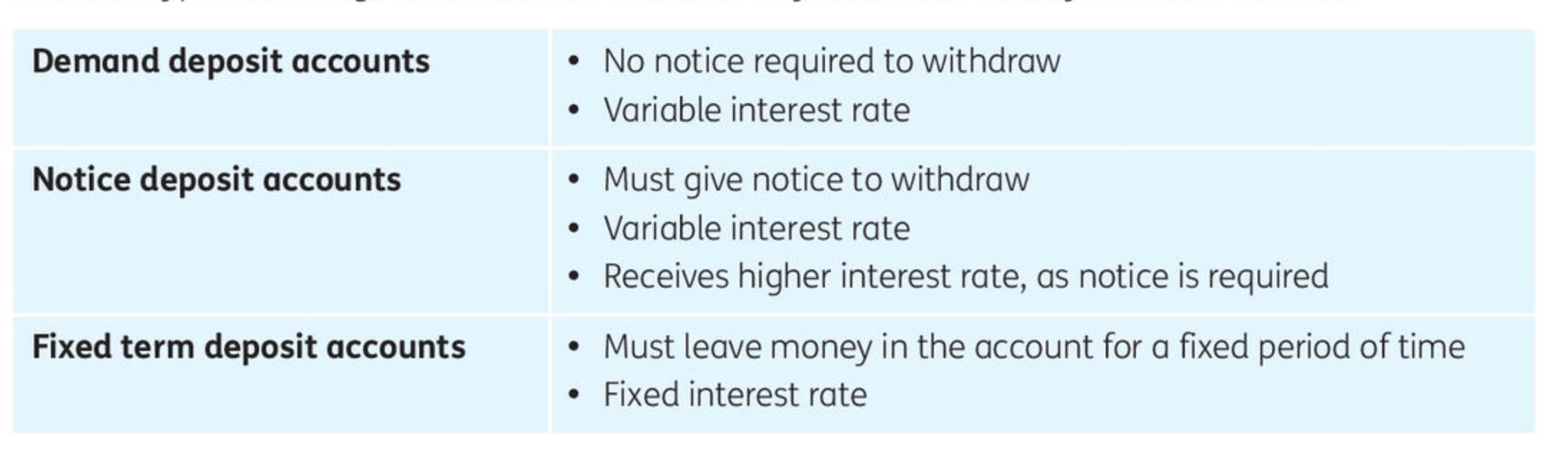
Types of saving accounts
Interest is the reward for saving or the cost of borrowing.
Interest rates can be:
Fixed - stay the same for a set period of time
Variable - change over time based on market conditions
Investments
Investments are assets or ventures that money is put into, with the goal of earning a profit
Types of investments
Shares/Stocks - Represent ownership in a company
Advantage - Potential for good returns and to diversify risk in investing in different sectors or countries
Disadvantage - Share prices can fall, holding shares in one company is very high risk
Bonds - Loans given to businesses or the government.
In return, the issuer:
pays interest
repays the original value at an agreed date
Advantage - Regular income in the form of interest payments.
Disadvantage - Money isn’t accessible for a specific time
Property - money invested in commercial or residential property. Earn money through rental income/ property appreciation.
Advantage - Potential for long-term growth
Disadvantage - High minimum investment
Cryptocurrency - digital or virtual currencies (i.e. bitcoin). Bought and held in an investment in hope that their value will increase.
Pension/Retirement planning
Pension and retirement planning combines strategic long-term savings with a variety of investments to build a strong pension plan.
Ensures financial stability and manages risk
It’s important to strart planning early to make sure they have enough resources to support their retirement.
Borrowing
Types of finance
Overdraft (short term) - Bank gives current account holder permission to withdraw more money than they have in their account, up to an agreed limit
Used for bills e.g. phone and internet
Only pay interest on amount used
Credit Cards (short term) - allow an individual to buy goods and services up to a certain limit
Used for concert tickets, online purchases
When the balance is paid within an agreed period of time (interest-free period), no interest is charged.
Holder pays stamp duty, annual government tax
Trade Credit (short-term finance) - Credit for 30 days when you buy an item; you don’t have to buy up front
Businesses use it so they can have some leeway to sell products and then pay the supplier
Personal Loan (medium term) - type of unsecured loan provided by banks, used for personal expenses, monthly payments.
Used for car or home improvement for example.
Leasing/Renting (medium term) - individual signs a lease to use an asset for a set period in exchange for regular payment. e.g. property rental, car, computer equipment.
Immediate use of the item
No large deposit or collateral
Lesee never owns the item
Item reposessed if payments arent made
Hire purchase - paying for an item in installments with interest. e.g. car, laptop, tv.
Immediate use of the item
Customer doesn’t own the item until the final installment is paid.
High interest
Personal Contract Plan (PCP) - car financing option. low monthly payments and a final payment based on the guaranteed minimum future value(GMFV). Choose to keep, enter into a new contract or return the car.
Lower monthly payments than traditional car loans.
Monthly repayments and fina baloon are set at the start
Customer doesn’t own the car until final payment is made.
Exceeding mileage limit can incurr extra charges.
Mortgage (long-term) - Long-term loan to buy property.
Can be offered up to 35 years.
Repaid monthly with interest
property deed is collateral
Types:
Fixed rate - Monthly payments fixed for a set period.
Variable rate - interest rate set by lender and can change at any time.
Tracker: Interest rate follows the rate of the ECB(European Central Bank)
Allows for purchase of a home without paying the full price upfront
Offers potential financial gains as property prices may increase.
Collateral must be provided
Interest over life of the loan can be significant
Long-term loan - Loan with repayment period over 5 years. for home extension/improvements
Allows for borrowing a large sum of money
If variable rate of interest and rate increases, repayment increases.
Factors to consider when choosing a source of finance
Purpose - Matching principal dictates that the source of finance should match the time frame of the item being bought
Cost - APR(Annual percentage rate) is the yearly cost of borrowing, shown as a percent. Includes interest payable and any other fees
Collateral - valuable item given to the lender as a repayment guarantee, which lender takes if the borrower defaults(fails to make agreed payments)