1c. Specialisation and trade
Why do countries trade?
To sell excess production and gain export revenue (an injection into the circular flow of income)
To gain access to goods and services that are not produced or are expensive to produce in their home country e.g. bananas
Increased competition promotes forces domestic producers to be efficient and improve quality
To gain economies of scale from specialising (see next section)
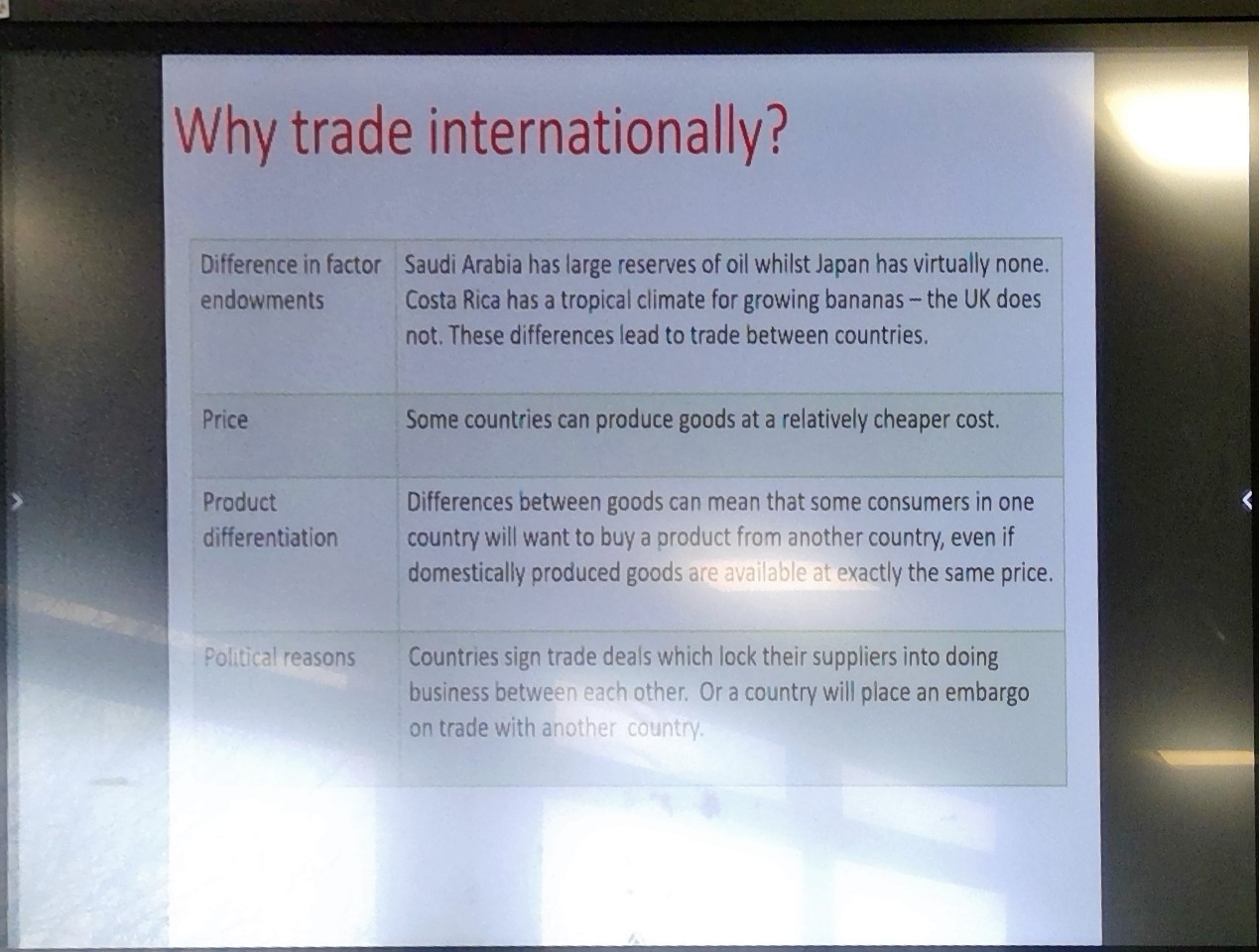
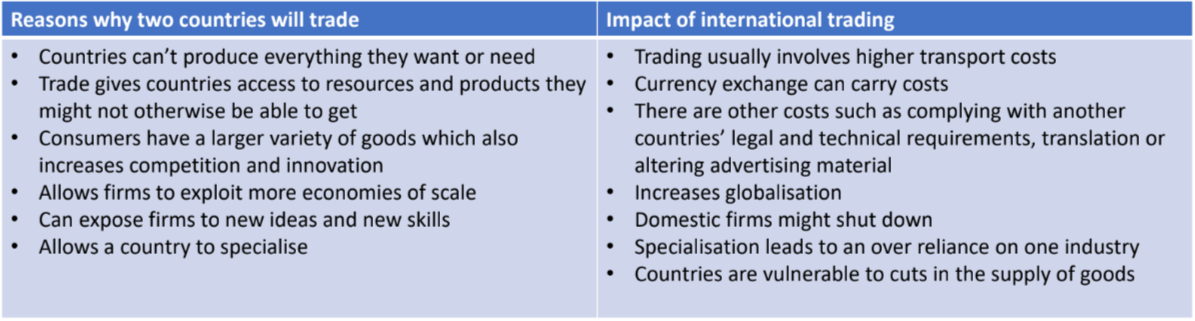
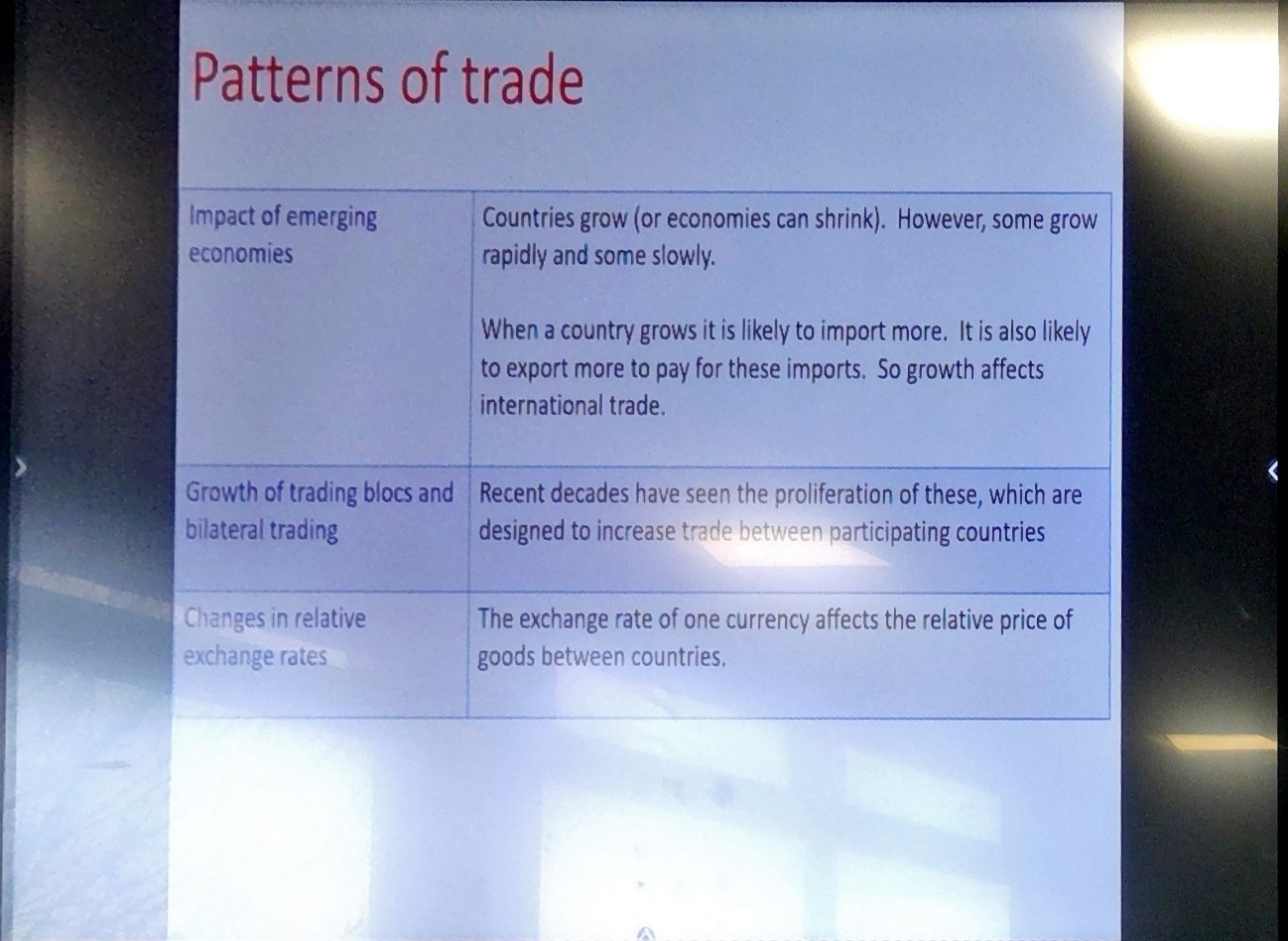
Why do countries trade?
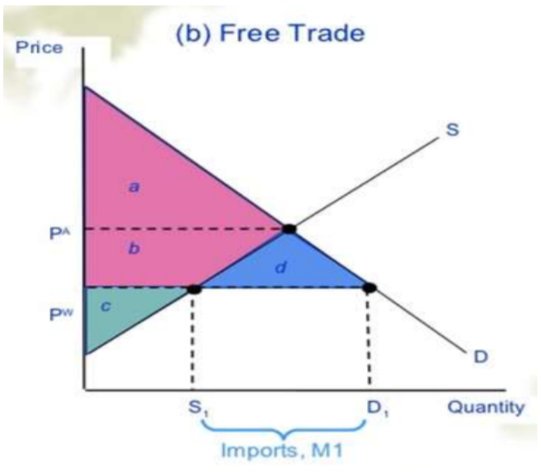
Without international trade the domestic market is in equilibrium at PA
Once international trade is possible, consumers can now purchase goods at the world price of PW
At PW consumers demand D1 but domestic suppliers are only willing to produce S1. Therefore M1 products are imported from abroad.
Consumer surplus has grown from triangle a to triangle abd
Domestic producer surplus has fallen from triangle bc to triangle c
The gains from trade are triangle d (area b switched from producer to consumer surplus but area d is newly created)
Absolute advantage
Let us imagine that there are only two countries in the world: France and Spain. They can only produce two products: cheese and olives. The below table shows what happens if they devote their entire workforce to just producing one of the goods.
Blocks of cheese | Jars of olives | |
|---|---|---|
France | 2000 | 400 |
Spain | 400 | 2000 |
If Spain decided to split its workers equally between the two products how many of each product would they produce?
Cheese = 200 Products Olives = 1000 Products Total= 1200 Products
The opportunity cost for Spain of making one block of cheese is 5 jars of olives
The opportunity cost for Spain of making one jar of olives is 0.2 blocks of cheese
The opportunity cost for France of making one block of cheese is 0.2 jars of olives
The opportunity cost for France of making one jar of olives is 5 blocks of cheese
It is clear from the above that France has an absolute advantage in producing cheese and Spain has an absolute advantage in producing olives. This can be seen in the way they have a lower opportunity cost of production for their speciality i.e. Spain only has to give up 0.2 blocks of cheese to make one jar of olives whereas France has to give up 5 blocks of cheese.
If France and Spain then trade half their output on a 1:1 basis how many products will Spain have?
Cheese = 1000 Products
Olives = 1000 Products
Total= 2000 Products
By trading Spain have gained 800 extra products compared to domestic production
Comparative advantage
Cars | Mobile phones | |
|---|---|---|
UK | 100 | 150 |
Japan | 800 | 200 |
The opportunity cost for UK of making one car is 1.5 mobile phones
The opportunity cost for UK of making one mobile phone is 0.67 cars
The opportunity cost for Japan of making one car is 0.25 mobile phones
The opportunity cost for Japan of making one mobile phone is 4 cars
Therefore, we can say that the UK has a comparative advantage in mobile phones and Japan has a comparative advantage in producing cars as the opportunity cost is lower. For each mobile phone the UK makes it gives up 0.67 cars, whereas in Japan, for each mobile phone they must give up 4 phones.
According to the principle of comparative advantage, each country should specialise in producing the products in which it has a lower opportunity cost. If neither country specialises and devotes half their efforts to each product then there will be the following output:
Cars | Mobile phones | |
|---|---|---|
UK | 50 | 75 |
Japan | 400 | 100 |
Total | 450 | 175 |
If the UK specialises in mobile phones they will produce 150. Japan decides to partially specialise and still produce 50 mobile phones. Producing 50 mobile phones takes up 25% of Japan’s capacity (their maximum mobile phone production is 200) meaning they can produce 600 cars with their remaining capacity (800 x 0.75 = 600). This gives the following output:
Cars | Mobile phones | |
|---|---|---|
UK | 0 | 150 |
Japan | 600 | 200 |
Total | 600 | 150 |
We can see that world production is now up by 150 cars and 25 mobile phones.
If the two countries agree to trade at a rate of exchange of 2 cars for one mobile phone and the UK exports 60 mobile phones to Japan and receives 120 cars in return the post-trade position will be as follows.
Cars | Mobile phones | |
|---|---|---|
UK | 120 | 90 |
Japan | 480 | 110 |
The UK now has the 15 extra mobile phones and 70 more cars whereas Japan has 80 extra cars and 10 extra mobile phones when compared to a time they were not specialising and then trading.
Comparative advantage and PPFs
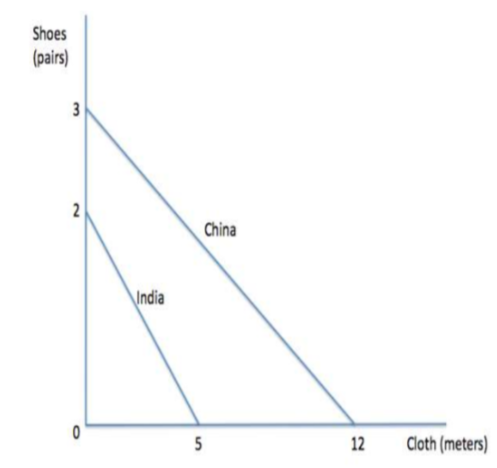
From the above diagram we can see China has an absolute advantage over India
The opportunity cost for China of making one pair of shoes is 4 cloth meters
The opportunity cost for China of making one cloth meter is 0.25 pairs of shoes
The opportunity cost for India of making one pair of shoes is 2.5 cloth meters
The opportunity cost for India of making one cloth meter is 0.4 pairs of shoes
Therefore, China should produce cloth and India should produce shoes
Trade will not be beneficial if the opportunity cost of productions the same for both countries
How countries gain a comparative advantage
Availability of Raw Materials
Counties like Saudi Arabia have an advantage in oil production as it is easily available
Climate
Coconuts grow easily in the Caribbean
Investment in R&D
High levels of technology is places like Germany lower their costs of production
Demographics i.e. availability and cost of labour
China has a large population so has cheap labour
Higher labour productivity
Countries like USA which have high productivity will be more efficient
Criticisms of comparative advantage
The assumptions are unrealistic, however they do give a rough explanation of why trade works.
The theory does not explain who will benefit the most from trade. For political reasons the actual trade may not be fair e.g. 50 cows for 1 PC
Countries may be at different levels of development and infant industries may need time to grow (e.g. South Korea)
Countries that specialise in agriculture are unlikely to benefit from technological progress as much as countries which specialise in manufacturing
Countries may be trapped selling primary products which have volatile prices (e.g. wheat) and are possibly finite (e.g. oil)
It ignores external costs
It assumes there are constant returns to scale
Complete specialisation can cause structural unemployment
Does not take into account relative prices or exchange rates
It changes over time
Many countries strive for food security
It is very simplistic
Analysing specialisation
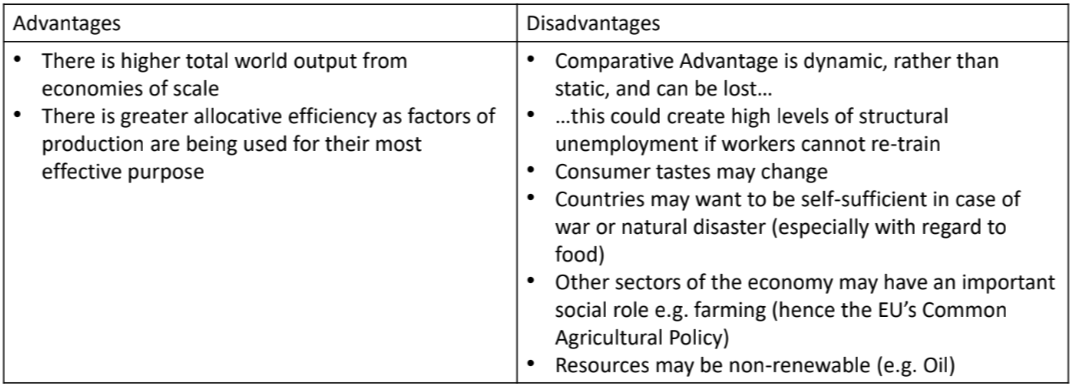
Comparative advantage is good at explaining why countries rich in raw materials or with lots of agricultural land will specialise in these commodities.
It also provides a good explanation of why first and third world countries trade.
Preference similarity theory suggests that consumers don't just import manufactured goods because they are relatively cheaper but because they want more choice than the domestic market offers.
Domestic manufacturers are better at understanding the needs of their consumers though and therefore do have an advantage. This can limit the extent to which foreign firms can enter a market.