Unit 4
Production and inventories
the start of unit 4 is on paper notes
Just in time inventory control
system when no inventories are held by business: raw materials delivered when needed and finished goods transported to customer immediately.
Need to have fast and reliable supplier to deliver on time in good quality.
Need to have flexible capital and workforce to switch among products quickly
Kaizen ( continuous improvement)
approach which gives employees opportunity to make suggestions about how to improve quality or productivity
workers do the tasks everyday → might know better how to improve productivity than managers e.g by repositioning machines in cells by function to cut walking time
Methods of production
Job
Where a single product is made at a time. products are made to order.
examples - tailored dress, customised cake,
Advantages
more suitable for personal services or one off products
the product meets the exact requirements of the customer
the workers often have more varied jobs ( don’t do just one task)
more varied work increases motivation - giving greater job satisfaction
it is flexible and often used for high quality goods and services meaning that a higher price can be charged
Disadvantages
skilled labour is often used and therefore increases costs
cost is higher because its usually labour intensive
production takes a long time
products are specially made to order so any mistake can be expensive to fix
materials have to be specially purchased leading to higher costs.
Batch
a quantity of one product is made and then a quantity of another product is made.
e.g a bakery making a batch of bread and then a batch of croissants
advantages
it is a flexible way of working - you can quickly change from one product to another
it give variety to workers jobs - increases motivation
allows more variety of products - which allows more customer choice
production may not be effected to great extent if machinery brakes down.
disadvantages
it can be expensive as semi finished products will need moving about to the next production stage
machineries have to be reset between production batches which means there is a delay in production and output is lost
warehouse space will be needed for inventories of raw materials, components and finished batch of goods which increases costs.
Flow
large quantities of a product is produced continuously. (mass production)
advantages
high output of a standardised product
cost of making each item is low which means price is alos lower
disadvantages
if machinery braked down it will effect the production greatly
technology vs production methods
use of computers in production → aid traditional methods
computer aided design (CAD)
allow to show design and test features (e.g safety) → changes can be made quickly → no need to rebuild prototype → cut costs.
Examples - 3D design on computers, 3D printers, Special computer software.
Computer aided manufacturing and computer Integrated manufacturing
computers contol machinery in production
examples - car manufacturing, internet banking, ATM,
Advantages
Businesses
reduce cost and time to design products
reduce cost of production
improves quality and reduces waste
Consumers
lower prices
better quality goods
products with more features
employees
makes repetitive tasks for employees easier
work is generally easier
new job opportunities for workers in technology
Disadvantages
Businesses
can be very expensive
training employees on how to use new technology might be needed
risk of need to change technologies often in rapidly changing environment
consumers
products can be out of date quickly
faullty product can be expensive to repair
employees
technology reduces need for employees → less qualified = likely to get redundant
smaller workforce → lower chance of promotion
work can be made less interesting
Exam style question
1)
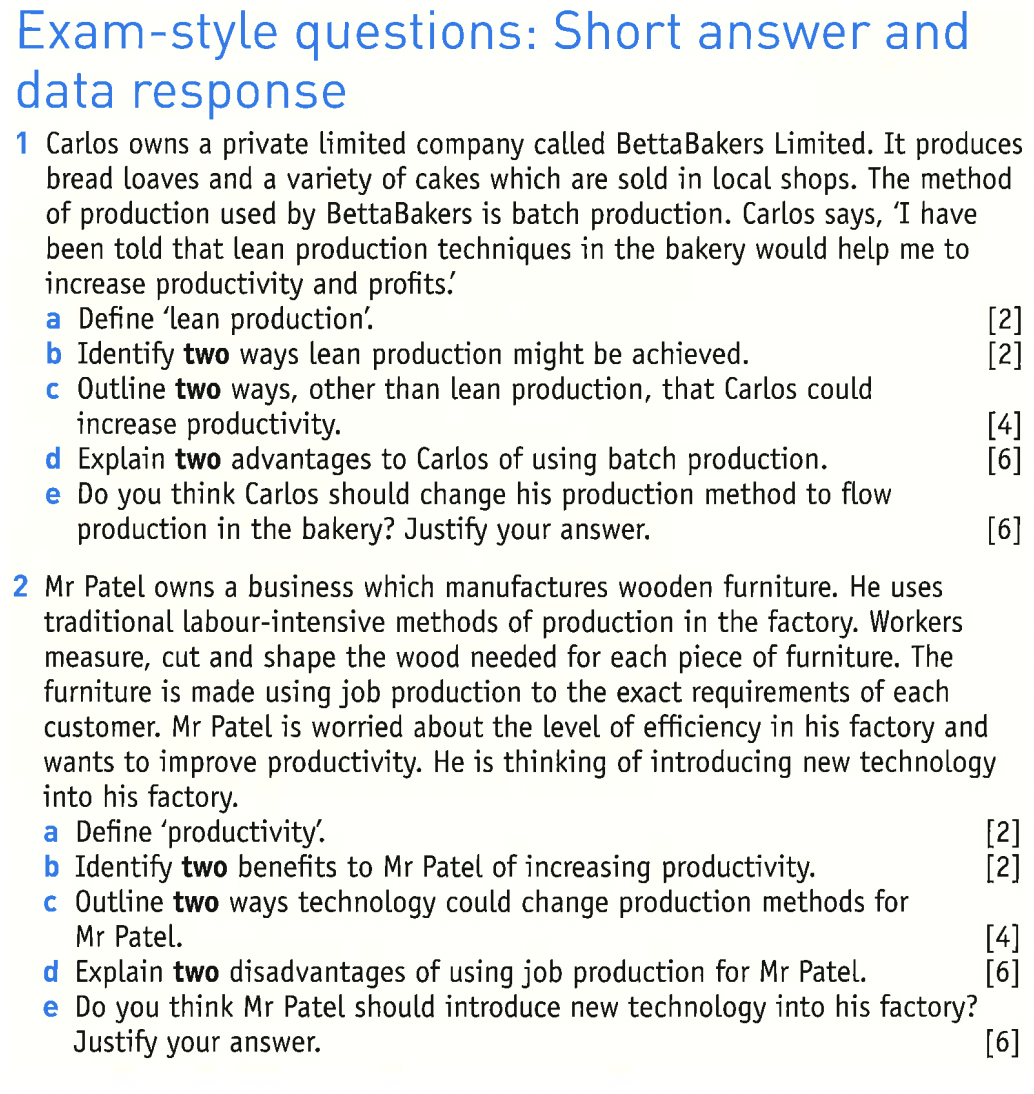
A) lean production is a term for techniques used to cut down on waste and increase efficiency
B) Carlos could achieve lean production by using the just in time method. Which means that he could bake the baked goods in small batches based on demand rather than producing large quantities in advance. Another way Carlos could achieve lean production is by using the Kaizen method. Where he could ask his bakers how to improve the efficiency of producing baked goods and minimize waste.
C)Carlos could increase productivity by hiring already well trained and skilled workers or train the ones he already has. This would increase productivity as the workers would get better at their jobs since they know how to do it well and no longer have to think about it (automatic) and therefore would produce the baked goods faster. Another way Carlos could increase productivity in his bakery is by investing into better technology such as fast ovens or dough mixers. This would increase productivity as it would be faster to produce the goods as a person doesn’t need to mix the dough and/or the goods are baked faster.
D) An advantage of carlos using batch production is that it is a flexible way of working. So when for example cakes are in more demand than bread it is easy to switch from making bread to making more cakes. Another advantage is that it gives a wider variety to workers which can increase motivation as they dont have to always make the same baked goods. e.g sometimes they bake bread other times cake.
E)
By switching to flow production in the bakery Carlos would be able to produce more as well as at a lower price which would mean that he could sell the baked goods for less which would increase sales. However in flow production more machines are used which means that if one of them fails or there is something wrong with them it would have a huge affect on the production which would lead to output loss whereas if he would stay with batch production it wouldn’t have as big of an affect. Another disadvantage to switching to flow production is that because the products carlos is producing are perishable by making a big amount at a time it decreases the quality as well as it being more likely to go bad/stale which means that a lot of the goods will go to waste/ he will not be able to sell them. In conclusion I think Carlos should stick to batch production as there are too many risks/disadvantages if he changed to flow production.
2)
A) the output measured against the inputs used to create it
B) By increasing productivity there would be lower average costs which means Mr Patel could charge less for their wooden furniture which can increase sales and competitiveness. Another benefit of increasing productivity is that there would also be an increased output of wooden furniture.
C) Using machines would increase efficiency as Mr Patel can use the machines to screw the tables together which would be faster. …
D) A disadvantage of job production is that it has higher costs as he has to hire skilled workers who are more expensive than machines or just any workers. This is a cost for Mr Patel as he has to charge higher price for the wodden furniture whcih can decrease sales
Types of costs and business decision making
Fixed Costs - costs that do not change with output - horizontal line on a graph e.g factory rent, insurance, managers salary. Formula - AFC = FC/Q
Variable costs - costs that change in direct proportion to output e.g workers salaries, costs of materials and resources. Formula - AVC = VC/Q
Total costs - all fixed and variable costs of producing total output. Formula - TC=FC+VC TC=ATCxQ Q = quantities produced ATC= average total costs
Average costs - costs of producing a single unit of output. Formula - AFC=FC/Q. AFC curve decreasing because FC don’t change but Q rises.
Total revenue - money the business received after selling its output. Formula - TR=QxP
Practice - TR = 400. FC = 120 Profit or Loss = -25 Q=0 P=10 TR=0. FC=120. VC=0. TC=120. Profit or Loss=-120
In short run the business can stay open and produce the good because the loss when they operate and produce is lower than the loss when they operate but do not produce the good
| Quantity produced & sold | FC | VC | TC | ATC | TR | Profit (+) or Loss (-) |
| 0 | 100 | 0 | 100 | - | 0 | -100 |
| 5 | 100 | 40 | 140 | 28 | 50 | - 90 |
| 13 | 100 | 100 | 200 | 15.4 | 130 | -70 |
| 23 | 100 | 150 | 250 | 10.9 | 230 | -20 |
| 30 | 100 | 200 | 300 | 10 | 300 | 0 |
| 35 | 100 | 220 | 320 | 9.2 | 350 | +30 |
| 37 | 100 | 230 | 330 | 8.9 | 370 | + 40 |
| 35 | 100 | 260 | 360 | 10.3 | 350 | -10 |
| 33 | 100 | 160 | 260 | 7.9 | 330 | - 70 |
Economies and diseconomies of scale
Scale of operations - Maximum output that can be achived using the available inputs (resources). does not = output ( real output can be lower than maximum output/scale of operations)
Economies of scale
reduction in average costs as a result of increasing the scale of operations.
Purchasing economies ( bulk buying → cheaper to deliver one large order → lower costs)
Technical economies ( mass production lines + computer systems → higher productivity → lower costs. affordable by big firms )
Financial economies ( lower interest rates from banks to large established firms. Selling shares in publicly held business)
Marketing economies ( marketing costs distributed over larger production → lower unit costs)
Managerial economies ( Large companies can hire specialised managers who can operate more efficiently than general managers
Diseconomies of scale
Factors that cause average costs to rise as the scale of operations increases.
communication problems ( large number of messages + longer chain of command + less feedback from employees → delays in decisions poorer decisions)
workers feel alienated ( big company → hard to make personal relationships with all workers + use of machines → demotivation of workers )
poor coordination + slow decision making ( many departments → challenging coordination → hard to make fast + good decisions)
Why do these scales matter
Businesses try to operate at the point where average costs are the lowest
diseconomies of scale often prevent one company from dominating the market. Exception - neutral monopoly
Transition between economies and diseconomies of scale is not clear → different for each business

Break even analysis
Review

0,100,0,100,100,0,-100. 5,100,40,140,28,50,-90. 13,100,100,200,15.4,130,-70
notes Break even point
Break even point - Level of output where revenues equal costs the business is making neither profit nor loss. TR=TC → 0 profit + 0 costs.
Break even analysis - shows relation between TR,TC and amount of output/sales.
Used to
calculate how many products need to be sold before making a profit
calculate effect on profit increasing / decreasing price (incl. elasticity of demand)
calculate effect on profit increase/decrease in business costs.
Prepare to make the analysis
Know TR at zero output and at maximum output (capacity)
Know FC
Know VC or TC at zero output and maximum output
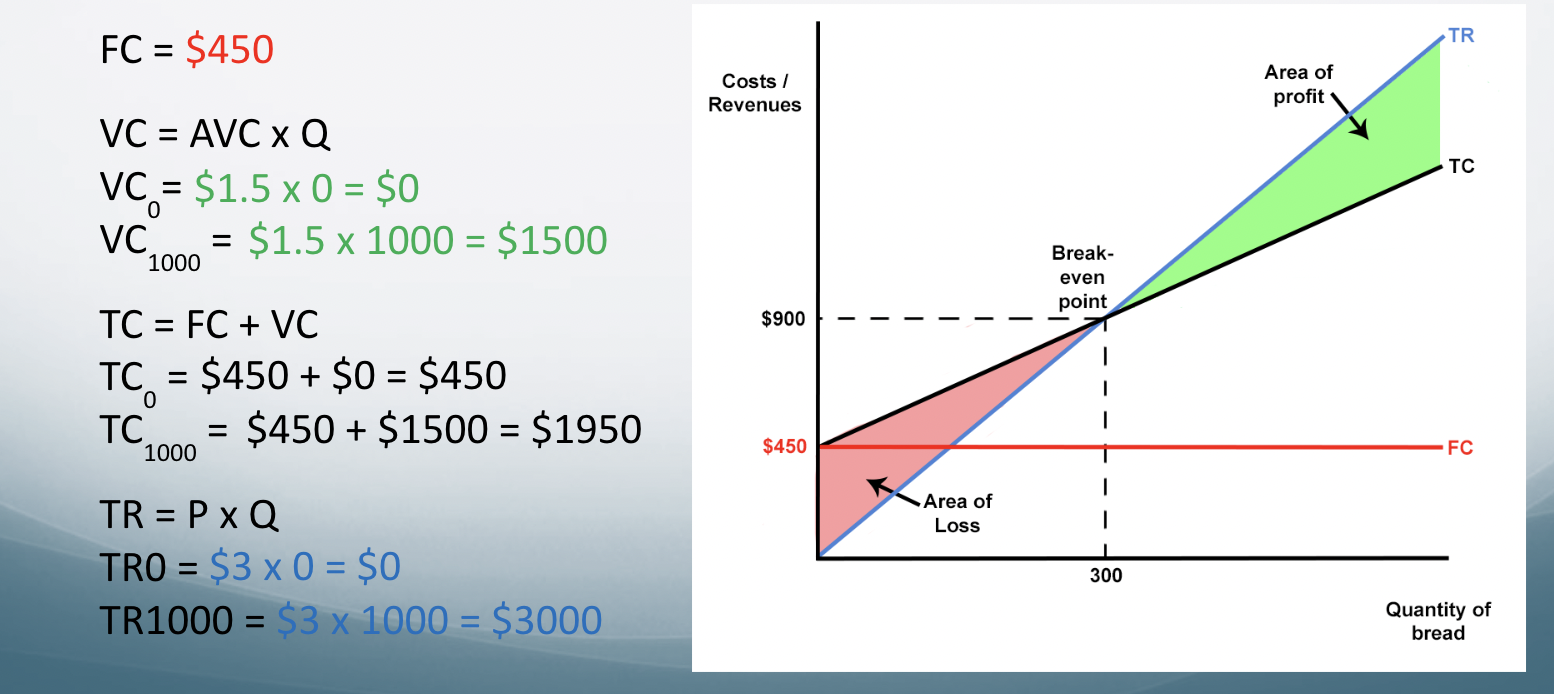
BREAK EVEN QUANTITY FORMULA
TC=TR
FC+VC=QxP
FC+ (AVCxQ)=PxQ
FC=QxP-(AVCxQ)
FC=Q(P-AVC)
FC/P-AVC=Q
450/3-1.5=450/1.5=300
AVC=VC/Q
QxP=1500
TC=FC(AVCxQ)
450+(1.5×500) = 1200
Margin of safety - difference between current level of output and break even output. Shows how much sales can drop before loss is made
Benefits and Disadvantages of break even analysis
Benefits
Easy to construct and interpret
Gives info about when profit starts being made
gives info about how various sales quantities affect margin of safety and profitability
can show effect of decision to change costs or prices
can help with decisions such as location/relocation of business
Quality production
Quality product - meets needs + requirements of its consumer
not necessarily the most expensive one or only the most advanced
expected quality found through market research
Producing by standards → competitive advantage → higher market share
Quality standards - minimum standards of production or service acceptable to consumers
design standards - to create the best possible product wanted by consumers
Process quality standards - to create such product at lowest possible costs.
Why is quality important ?
customer loyalty improves - easier to convince customers to buy again
charge higher price for product - quality convinces customers to pay higher price for product → increases profitability of product
less complaints + returns - good reputation
Lengthen product life cycle - quality will keep being needed by customers - longer life cycle especially in the maturity stage
develop brand image - trust for quality - easier to launch a new product
encourages wholesalers and retailers to stock its products - quality will convince middlemen to stock the product because they know it would get sold
Ensuring quality
Quality control - checking the quality of goods through inspection. Trained inspectors check a sample of finished/unfinished products.
Disadvantages
time consuming + costly - impossible to check every product → risk that faulty product will come to consumer
work can be repetitive → demotivational → quality check done poorly
Wasted resources if the fault is found only in the end of production process
employees not responsible
Quality assurance - system of setting agreed standards for everysingle stage of production.
Description
Quality standards agreed for
every stage of production
Raw materials & components
of required standards before
they enter production
Employees responsible for
quality of their work
Products designed to minimize
quality issues (CAD, PC testing)
Advantages
low costs and speedy inspections of quality
Low cost & speedy inspections of quality
Reduces costs of wasted resources
Encourages teamwork & motivator
Easy to get quality industry awards → improve brand image → more profit
Location decisions
Factors for a manufacturing firm
location of raw materials
location of the market
production method
availability + price of labor
government intervention
infastructure + external economies of scale
Bulk reducing production → factory better near the site of raw materials(cheaper transportation)
Bulk gaining production → factory better near the market
transport technologies diminished importance of this factor
If bulk gaining production or if we prodce perishable good, then location near the market is needed.
Job production → lower quantity of supplies need to be imported → transportation costs lower → location far from recources is ok
Flow production - factory near resources needed to cut transportation costs
Located where most needed workers live e.g steel factory next to a city with a technical university
Factors affecting location of services
Location of customers
where quick personal response is needed → site near customers (restaurants, supermarkets, post offices, hairdressers
where personal response not needed → can be further away
microlocation within shopping mall - where your target customers usually go e.g expensive items on the ground floor
Rent
if not a lot of customers needed → better be in outskirts to benefit from lower rent
Location of suppliers and competition
better near suppliers if quick response is needed (e.g fixing machines)
Be in cluster of similar businesses to attract target market e.g food courts
Availability and price of labor
need to be located where most needed workers live