Landry and Bartling
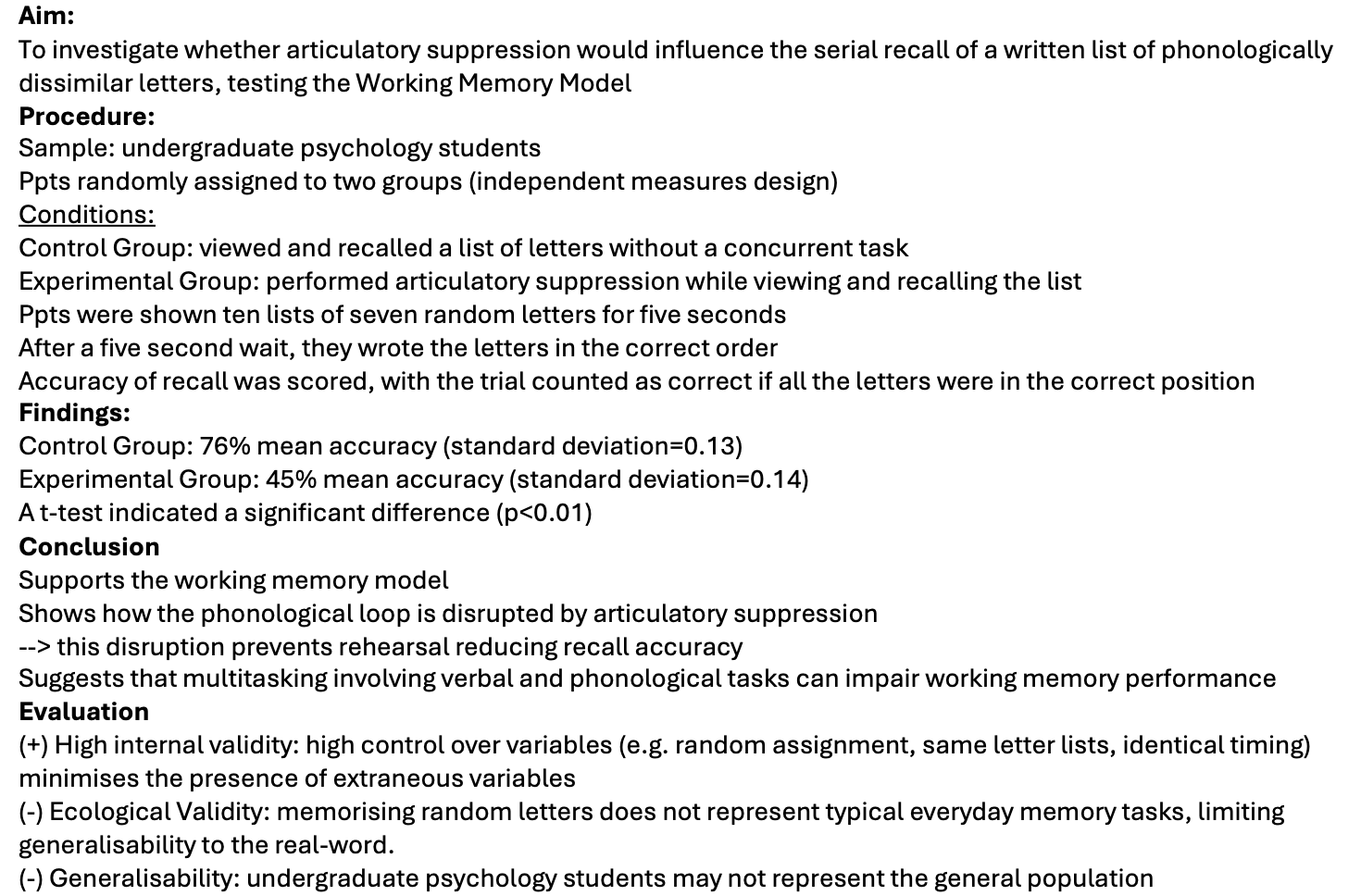
Aim:
To investigate whether articulatory suppression would influence the serial recall of a written list of phonologically dissimilar letters, testing the Working Memory Model
Procedure:
Sample: undergraduate psychology students
Ppts randomly assigned to two groups (independent measures design)
Conditions:
Control Group: viewed and recalled a list of letters without a concurrent task
Experimental Group: performed articulatory suppression while viewing and recalling the list
Ppts were shown ten lists of seven random letters for five seconds
After a five second wait, they wrote the letters in the correct order
Accuracy of recall was scored, with the trial counted as correct if all the letters were in the correct position
Findings:
Control Group: 76% mean accuracy (standard deviation=0.13)
Experimental Group: 45% mean accuracy (standard deviation=0.14)
A t-test indicated a significant difference (p<0.01)
Conclusion
Supports the working memory model
Shows how the phonological loop is disrupted by articulatory suppression
--> this disruption prevents rehearsal reducing recall accuracy
Suggests that multitasking involving verbal and phonological tasks can impair working memory performance
Evaluation
(+) High internal validity: high control over variables (e.g. random assignment, same letter lists, identical timing) minimises the presence of extraneous variables
(-) Ecological Validity: memorising random letters does not represent typical everyday memory tasks, limiting generalisability to the real-word.
(-) Generalisability: undergraduate psychology students may not represent the general population