Weight Training - LCHS
Weight Training Study Guide
Repetitions and Sets:
Repetitions are the number of times one does the exercise.
Sets are the number of times one performs each specific succession of repetitions.
Health Related Fitness Components:
Aerobic Fitness - The ability to perform large muscle, dynamic, moderate to high intensity exercise for prolonged periods.
Muscular Strength - The ability of a muscle or muscle group to exert a maximal force against resistance one time through the full range of motion (it is like lifting and carrying objects without assistance).
Muscular Endurance - The ability of a muscle or muscle group to exer a submaximal force repeatedly over a period of time.
Flexibility -The ability to move a joint through its complete range of motion.
Body Composition - The amount of lean body mass (all tissues other than fat, such as bone, muscle, organs, and body fluids) compared to the amount of body fat, usually expressed in terms of percent body fat.
Overload Principle:
• Muscular strength and endurance activities (weight training) breakdown muscles, but only if those muscles are overloaded. The forced contractions (repetitions) produce physiological changes, which eventualiy result in the muscle fibers repairing themselves. Over time the muscles adapt to the load they are lifting and become stronger.
The more overload on the muscle, the more strength gained. (2-8
reps) Muscular Strength = High Weight / Low RepetitionThe increased repetition, the more endurance gained. (12-15)
Muscular Endurance = Low Weight / High Repetition
Recovery Time:
• If you do not allow your muscles adequate time to recover they will begin to develop excess amounts of lactic acid which will lead to muscle fatigue and soreness. Lactic acid is the build up of waste products in the muscles (causing the soreness you feel after intense exercise.).
Breathing:
A common error in weight training is for an individual to hold their breath.
It is important to remember to breath. Use the following cue to help you remember:
o Inhale at the beginning of the lift and exhale during the release of
each weight.
Health Related Benefits to Weight Training:
Increases endurance and strength for sports and fitness activities.
Improves focus and concentration, which may result in better grades.
Reduces body fat and increases muscle mass.
Helps to burn more calories even when not exercising (Muscle burns more calories than fat! Muscle burns 35 calories per day compared to fat, which burns 2 calories per day.
May reduce the risk of short-term injuries by protecting tendons, bones, and joints.
Helps prevent long-term medical problems such as high cholesterol or osteoporosis (weakening of the bones) when you get older.
Terms associated with Fitness:
Resting Heart Rate - Number of beat per minute after a long rest.
Target Heart Rate - Heart rate range where the heart benefits the most from physical activity.
Maximum Heart Rate - Highest number of times your heart can contract in one minute through maximum effort.
Recovery Heart Rate - Heart rate measured after exercise after 1 minute and 3 minutes.
Pace - Moving at a steady rate so you can maintain that rate for an extended time.
Aerobic - Muscles work with oxygen for a long time. i.e. biking
Anaerobic -Muscles work without oxygen for a brief time. i.e. sprinting
Heart Rate Monitor - A device used to monitor the heart rate while exercising. Allows an individual to know if they are working in their target heart rate zone.
Pedometer - An instrument that gauges the approximate distance traveled on foot by registering the number of steps taken.
FITT:
Frequency - How often you exercise
Intensity - How hard you work during exercise
Time - How long you exercise to achieve benefits
Type - Aerobic or anaerobic exercise
Labeled Muscle Diagram
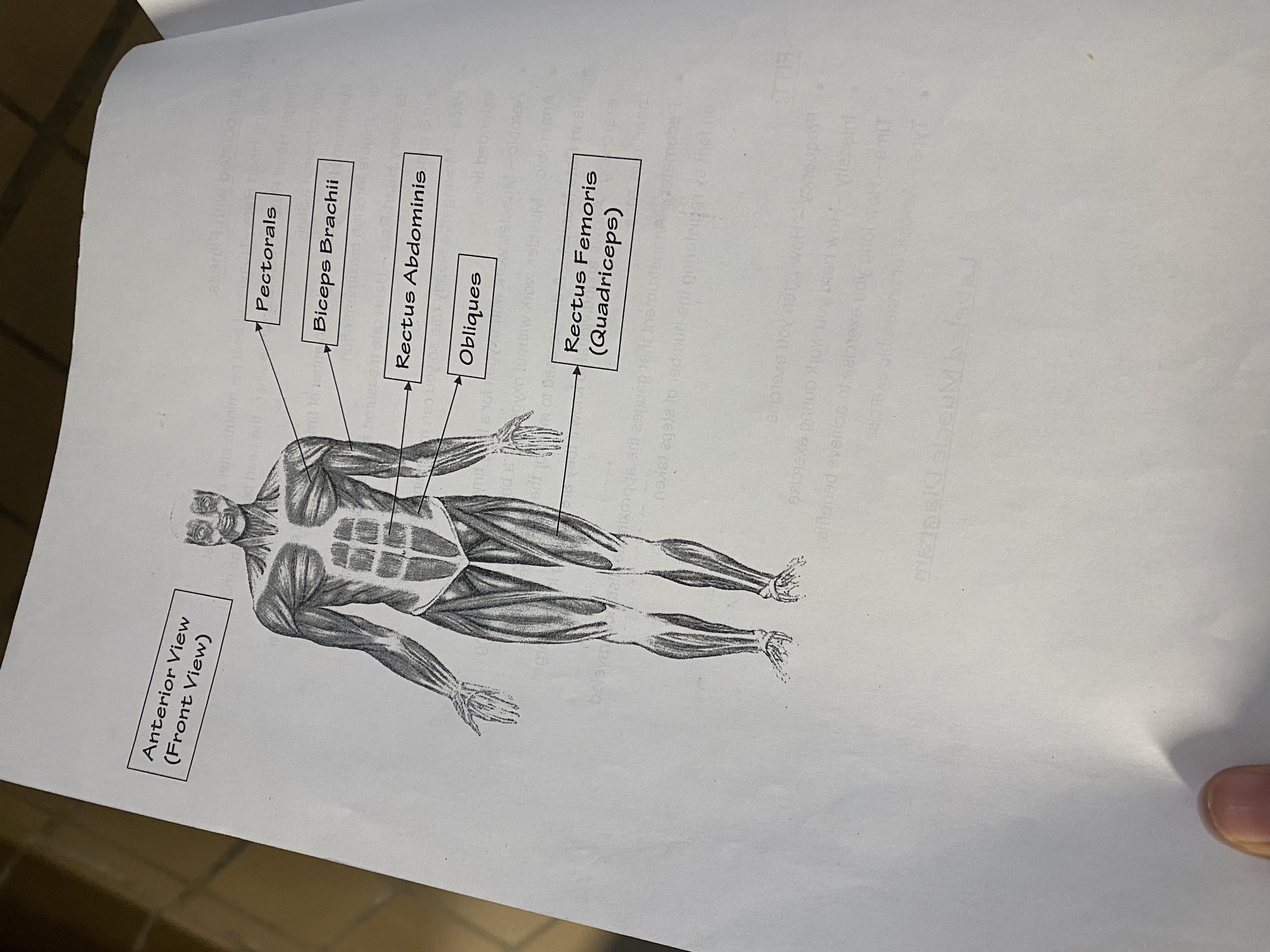
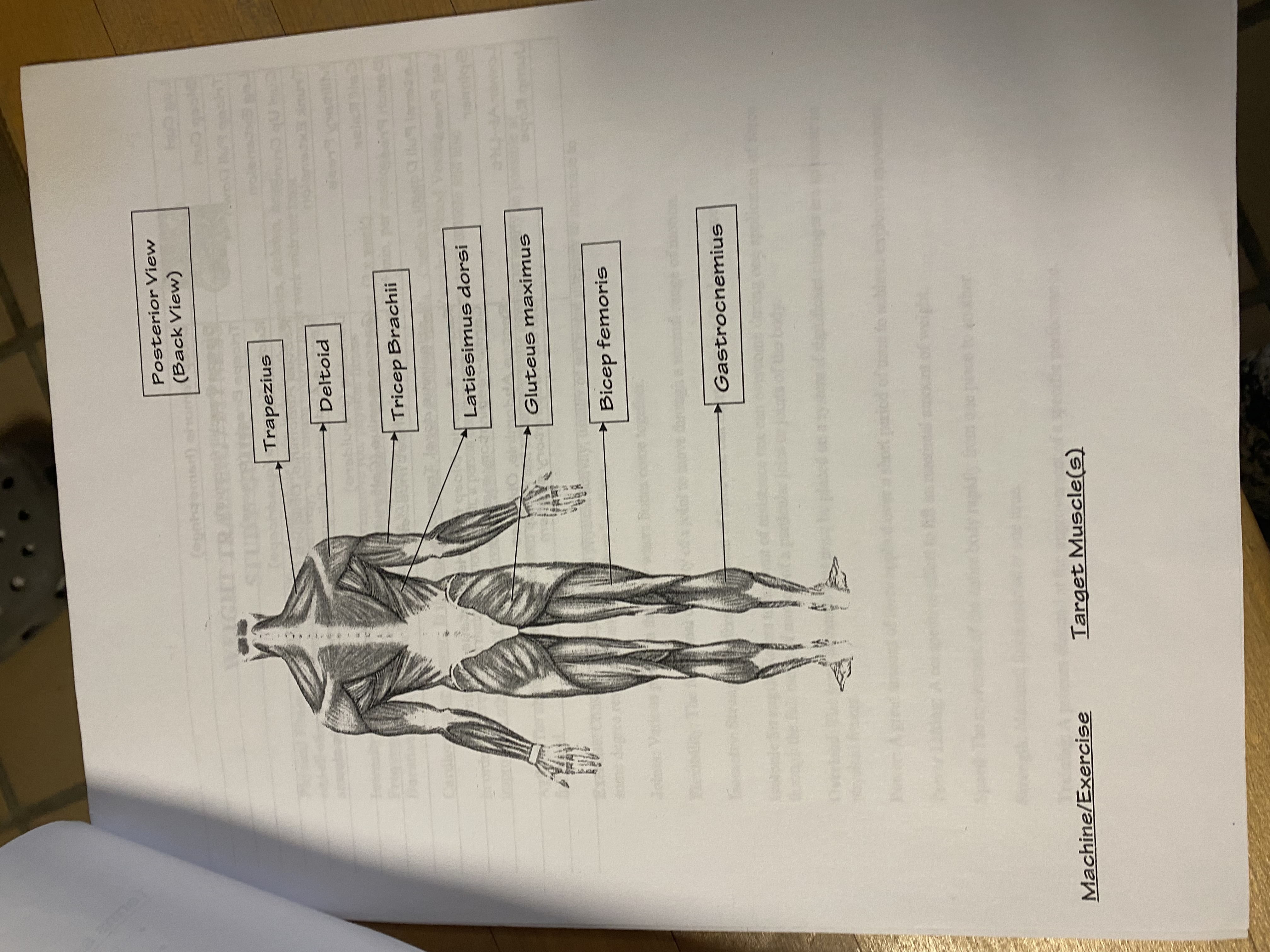
Leg Curl Bicep femoris (hamstrings) | ||
Bicep Curl | ||
Tricep Pull Down | Biceps Brachii (biceps) Triceps Brachii (triceps) | |
Leg Extension | Rectus Femoris (quadriceps) | |
Curl Up Crunch | Rectus Abdominis, Obliques (abs) | |
Trunk Extension | Rectus Abdominis, Obliques (abs), Lower back muscles | |
Military Press | Deltoids (shoulders) | |
Calf Raise | Gastrocnemius (Calf muscles) | |
Bench Press | Pectorals (Chest muscles) | |
Lateral Pull Down | Latissimus dorsi, Trapezius | |
Leg Press | Rectus Femoris, Bicep femoris, Gluteus maximus | |
Spinner | Cardio-respiratory system | |
Lower Ab-Lift | Rectus Abdominis, Obliques | |
Jump Rope | Cardio-respiratory system | |
WEIGHT TRAINING / FITNESS
STUDY GUIDE
Physical Fitness: This is the ability of your whole body, including the muscles, skeleton, heart, and all other parts to work together effectively, which means to do the most work with the least amount of effort.
Intensity: How hard you have to work to improve your physical fitness
Frequency: How often you need to exercise to improve your physical fitness (3 x week)
Duration: How long you have to exercise to improve your physical fitness (30+ min. per session)
Cardiovascular Fitness: Is the fitness of the heart, blood, and blood vessels. Cardio = heart
Vascular = Blood Vessels
In order to develop and maintain good health, a person needs to strengthen the heart muscle and also improve the other parts of the cardiovascular system.
Agility: The ability to change directions quickly and effectively while moving as nearly as possible at full speed.
Exercise: Conscious and purposeful physical activity, usually of sufficient intensity to increase to some degree respiratory and circulatory functions.
Joints: Various places in the body where bones come together.
Flexibility: The functional capacity of a joint to move through a normal range of motion.
Isometric Strength: Refers to amount of force one can exert against a fixed resistance.
Isotonic Strength: Refers to amount of resistance one can overcome during one application of force through the full range of motion of a particular joint or joints of the body.
Overload: The great demands that must be placed on a system if significant changes are to occur in physical fitness.
Power: A great amount of force applied over a short period of time to achieve explosive movement.
Power Lifting: A competitive effort to lift an maximal amount of weight.
Speed: The movement of the entire body rapidly from one place to another.
Strength: Maximal force exerted at one time.
Training: A process directed at the improvement of a specific performance.
M.H.R.: Stands for: Maximum Heart Rate = 220 - Age
Target Heart Rate Zone: Identifies for each person the safe and comfortable area in which cardio vascular exercise should occur to achieve a training affect.
Building Physical Fitness: 70% × MHR = lower limit
85% x MHR = upper limit
Pulse: The number of heartbeats in one (1) minute.
You can find your pulse by your neck, wrist, groin, tricep and bicep.
Resting Heart Rate: Taken while resting (sitting)
Working Heart Rate: Taken right after vigorous work (jogging, running, biking, etc...)
Warm-Up: Mild exercise and stretching prior to a vigorous workout.
Cool-Down: Keep moving around for a few minutes after exercise or a workout.
BASIC WEIGHT TRAINING TERMS
Repetitions: Number of times a complete exercise movement is performed.
Sets: Number of times a given number of repetitions are performed.
Full Range of Movement: It is important to carry each repetition to the full range of movement to exercise the entire range of the muscle and improve joint flexibility.
Intervals: Rest periods between station work on the weight machine or during circuit training.
Load: The actual weight or poundage used for the exercise.
Performance: Weight should be raised and lowered slowly to acquire full benefits. Do not arch the back, or jerk the weight.
Middle School Weight Training Tips
Start with a good warm-up and stretch prior to lifting weights
Perform an exercise (lift) with a weight (poundage) that you can do 10-12 repetitions
Perform the repetitions to a full range of movement (slowly-all the way up and down)Try to perform two (2) sets of each weight training exercise for a complete workout Do not perform back to back exercises working the same muscles (they need to rest)
End your workout with some light stretching (cool-down)
When in doubt - LIGHT WEIGHTS AND LOTS OF REPS!!!!
FIVE (5) - Health Related Fitness Components
Cardiovascular Endurance - A measure of the hearts ability to efficiently deliver oxygen through the blood to the other muscles in order to maintain vigorous exercise.
Muscular Strength - The amount of force put forth by a muscle or muscle group.
Muscular Endurance - The ability of muscles to exercise many times without getting tired.
Flexibility - The ability to use one's joints fully in order to prevent muscular injury.
Body Composition - A ratio of body fat relative to other body tissues.
10 Good Reasons to Exercise
To strengthen the heart and reduce the risk of coronary heart disease
To reduce the chance of developing back problems
To control your weight
To reduce stress
To increase muscular strength and reduce the chance of injury
To reduce bad cholesterol
To strengthen your body's immune system
To improve your complexion
To reduce the risk of cancer and cardiovascular disease
To build confidence and improve your social skills
Fitness Terms
AEROBIC
Using oxygen.
AEROBIC ACTIVITIES
Activities using large muscle groups at moderate intensities that permit the body to use oxygen to supply energy to maintain a steady state for more than a few minutes. See steady state.
AEROBIC ENDURANCE
The ability to continue anaerobic activity over a period of time.
AEROBIC POWER
See maximal oxygen uptake.
AGONIST
A muscle which directly engages in an action around a joint which has another muscle that can provide an opposing action.
ANAEROBIC
Not using oxygen.
ANAEROBIC ACTIVITIES
Activities using muscle groups at high intensities that exceed the body's capacity to use oxygen to supply energy and create and oxygen debt by using energy produced without oxygen.
ANAEROBIC ENDURANCE
The ability to continue anaerobic activity over a period of time (much shorter time than with aerobic activity).
ANAEROBIC THRESHOLD
The point where increasing energy demands of exercise cannot be met by the use of oxygen, and an oxygen debt begins to be incurred.
ANTAGONIST
A muscle that can provide an opposing action to the action of another muscle (the agonist) around a joint.
ATROPHY
Reduction in size, or wasting away, of a body part, organ, tissue or cell.
BALLISTIC MOVEMENT
An exercise movement in which a part of the body is "thrown" against the resistance of antagonist muscles or against the limits of a joint. The latter, especially, is considered dangerous to the integrity of ligaments and tendons.
CARDIOVASCULAR
Pertaining to the heart and blood vessels.
CIRCUIT TRAINING
A series of exercises, performed one after the other, with little rest between. Resistance training in this manner increases strength while making some contribution to cardiovascular endurance as well. (It remains controversial as to whether a significant cardiovascular benefit will be achieved in the absence of very consistent motivation or close supervision of the sessions.)
CONCENTRIC ACTION
Muscle action in which the muscle is shortening under its own power. This action is commonly called "positive" work, or, redundantly, "concentric contraction."
COOL DOWN
A gradual reduction of the intensity of exercise to allow physiological processes to return to normal. Helps avoid blood pooling in the legs and may reduce muscular soreness.
DEHYDRATION
The condition resulting from the excessive loss of body water.
DURATION
The time spent in a single exercise session. Duration, along with frequency and intensity, are factors affection the effectiveness of exercise.
ECCENTRIC ACTION
Muscle action in which the muscle resists while it is forced to lengthen. This action is commonly called "negative" work, or "eccentric contraction," but, since the muscle is lengthening, the word
"contraction" is misapplied.
ENDURANCE
The capacity to continue a physical performance over a period of time.
ENERGY
The capacity to produce work.
EXERCISE
Physical exertion of sufficient intensity, duration and frequency to achieve or maintain fitness, or other health or athletic objectives.
EXERCISE PRESCRIPTION
A recommendation for a course of exercise to meet desirable individual objectives for fitness.
Includes activity types; duration, intensity, and frequency of exercise.
EXPIRATION
Breathing air out of the lungs.
EXTENSION
strengthening of the arm.
A movement which moves the two ends of a jointed body part away from each other, as in
EXTENSOR
A muscle that extends a jointed body part.
FAST-TWITCH FIBERS
Muscle fiber type that contracts quickly and is used most in intensive, short-duration exercised, such as weightlifting or sprints.
FATIGUE
A loss of power to continue a given level of physical performance.
FITNESS
The state of well-being consisting of optimum levels of strength, flexibility, weight control, cardiovascular capacity and positive physical and mental health behaviors, that prepare a person to participate fully in life, to be free from controllable health-risk factors and to achieve physical objectives consistent with his/her potential.
FITNESS TESTING
Measuring the indicators of the various aspects of fitness.
FLEXIBILITY
The range of motion around a joint.
FLEXION
the arm.
A movement which moves the two ends of a jointed body part closer to each other, as in bending
FREQUENCY
How often a person repeats a complete exercise session.
HAMSTRINGS
The group of muscles at the back of the thigh, and their tendons.
HEART RATE
Number of heartbeats per minute.
HEAT CRAMPS
Muscle twitching or painful cramping, usually following heavy exercise with profuse sweating.
The legs, arms and abdominal muscles are the often affected.
HEAT EXHAUSTION
Caused by dehydration (and sometimes salt loss). Symptoms include a dry mouth, excessive thirst, loss of coordination, dizziness, headache, paleness, shakiness and cool and clammy skin.
HEAT STROKE
A life-threatening illness when the body's temperature-regulating mechanisms fail. Body temperature may rise to over 104 degrees F. skin appears red, dry and warm to the touch. The victim has chills, sometimes nausea and dizziness, and may be confused or irrational. Seizures and coma may follow unless temperature is brought down to 102 degrees within an hour.
ILLIAC CREST
The upper, wide portion of the hip bone.
INTENSITY
The rate of performing work; power. A function of energy output per unit of time.
INTERVAL TRAINING
An exercise session in which the intensity and duration of exercise are consciously alternated between harder and easier work. Often used to improve aerobic capacity and/or anaerobic endurance in exercisers who already have a base of endurance training.
ISOKINETIC CONTRACTION
A muscle contraction against a resistance that moves at a consistent velocity, so that the maximum force of which the muscle is capable throughout the range of motion to be applied.
ISOMETRIC ACTION
Muscle action in which the muscle attempts to contract against a fixed limit. This is also sometimes called "isometric contraction," although there is not appreciable shortening of the muscle.
ISOTONIC CONTRACTION
A muscle contraction against a constant resistance, as in lifting a weight.
LACTIC ACID
The end product of the metabolism of glucose for the anaerobic production of energy.
LIGAMENT
The fibrous, connective tissue that connects bone to bone, or bone to cartilage, to hold together and support joints.
LUMBAR
Pertaining to the lower back, defined by the five lumbar vertebrae, just above the sacrum.
MAXIMAL HEART RATE
The highest heart rate of which an individual is capable. A broad rule of thumb for estimating maximal heart rate is 220 (beats per minute) minus the person's age.
METABOLISM
The total of all the chemical and physical processes by which the body builds and maintains itself and by which it breaks down its substances for the production of energy.
NUTRIENTS
Food and its specific elements and compounds that can be used by the body to build and maintain itself and to produce energy.
NUTRITION
The processes involved in taking in and using food substances.
OBESITY
Excessive accumulation of body fat.
ONE REPETITION MAXIMUM, 1 RM
The maximum resistance with which a person can execute one repetition of an exercise movement. See repetition.
MUSCLE GROUP
Specific muscles that act together at the same joint to produce a movement.
OVERLOAD
Subjecting a part of the body to efforts greater than it is accustomed to, in order to elicit a training response. Increases may be in intensity or duration.
OVERUSE
Excessive repeated exertion or shock which results in injuries such as stress fractures of bones or inflammation of muscles and tendons.
OXYGEN DEBT
The oxygen required to restore the capacity for anaerobic work after an effort has used those reserves. Measured by the extra oxygen that is consumed during the recovery from the work.
PEAK HEART RATE
The highest heart rate reached during a work session.
PHYSICAL CONDITIONING
A program of regular, sustained exercise to increase or maintain levels of strength, flexibility, aerobic capacity and body composition consistent with health, fitness or athletic objectives.
PHYSICAL FITNESS
The physiological contribution to wellness through exercise and nutrition behaviors that maintain high aerobic capacity, balance body composition and adequate strength and flexibility to minimize risk of chronic health problems and to enhance the enjoyment of life.
PLYOMETRIC
A type of exercise that suddenly preloads and forces the stretching of a muscle an instant prior to its concentric action.
Work performed per unit of time. Measured by the formula: work equal force times distance divided by time. A combination of strength and speed.
PROGRESSIVE RESISTANCE EXERCISE
Exercise in which the amount of resistance is increased to further stress the muscle after it has become accustomed to handling a lesser resistance.
PRONATION
Assuming a face-down position. Of the hand, turning the palm backward or downward. O the foot, lowering the inner side of the foot so as to flatten the arch. The opposite of supination.
PROPRIOCEPTIVE NEUROMUSCULAR FACILITATION, PNF STRETCH
Muscle stretches that use the proprioceptors (muscle spindles) to send inhibiting messages to the muscle that is to be stretched.
QUADRICEPS
A muscle group at the front of the thigh connected to a common tendon that surrounds the kneecap and attaches to the tibia (lower leg bone). The individual muscles are the rectus femoris, vastus intermedius, vastus lateralis and vastus medialis. Acts to extend the lower leg.
RADIAL PULSE
The pulse at the wrist.
REPETITION
An individual completed exercise movement. Repetitions are usually done in multiples.
RESISTANCE
The force which a muscle is required to work against.
RESPIRATION
Exchange of oxygen and carbon dioxide between the atmosphere and the cells of the body.
SET
A group of repetitions of an exercise movement done consecutively, without rest, until a given number, or momentary exhaustion, is reached.
SHIN SPLINTS
Pain in the front of the lower leg from inflammation of muscle and tendon tissue caused by overuse.
SLOW-TWITCH FIBERS
Muscle fiber type that contracts slowly and is used most in moderate-intensity, endurance exercises, such as distance running.
SPECIFICITY
The principle that the body adapts very specifically to the training stimuli it is required to deal with. The body will pertorm best at the specitic speed, type of contraction, muscle-group usage and energy source usage it has become accustomed to in training.
SPRAIN
A stretching or tearing of ligaments.
STATIC CONTRACTION
See isometric action.
STRAIN
A stretching or tearing of a musculotendinous unit.
STRENGTH
The amount of muscular force that can be exerted.
STRESS
The general physical and psychological response of an individual to any real or perceived adverse stimulus, internal or external, that tends to disturb the individual's homeostasis. Stress that is excessive or reacted to inappropriately, may cause disorders.
STRETCHING
Lengthening a muscle to its maximum extension; moving a joint to the limits of extension.
SUB MAXIMAL
Less than maximum. Sub maximal exercise requires less than ones maximum oxygen uptake, heart rate or anaerobic power.
SUPINATION
Assuming a horizontal position facing upward. In the case of the hand, it also means turning the palm to face forward. The opposite of pronation.
TARGET HEART RATE (THR)
The heart rate at which one aims to exercise.
TENDON
The fibrous connective tissue that connects muscle to bone.
TENDONITIS
Inflammation of a tendon.
TESTOSTERONE
The sex hormone that predominates in the male, is responsible for the development of male secondary sex characteristics and is involved in the hypertrophy of muscle.
TRAINING ZONE
See target heart rate.
WARM-UP
A gradual increase in the intensity of exercise to allow physiological processes to prepare for greater energy outputs.
WORK
Force times distance. Measured in foot-pounds and similar units.
WORKOUT
A complete exercise session, ideally consisting of warm-up, intense aerobic and/or strength exercises, and cool down.