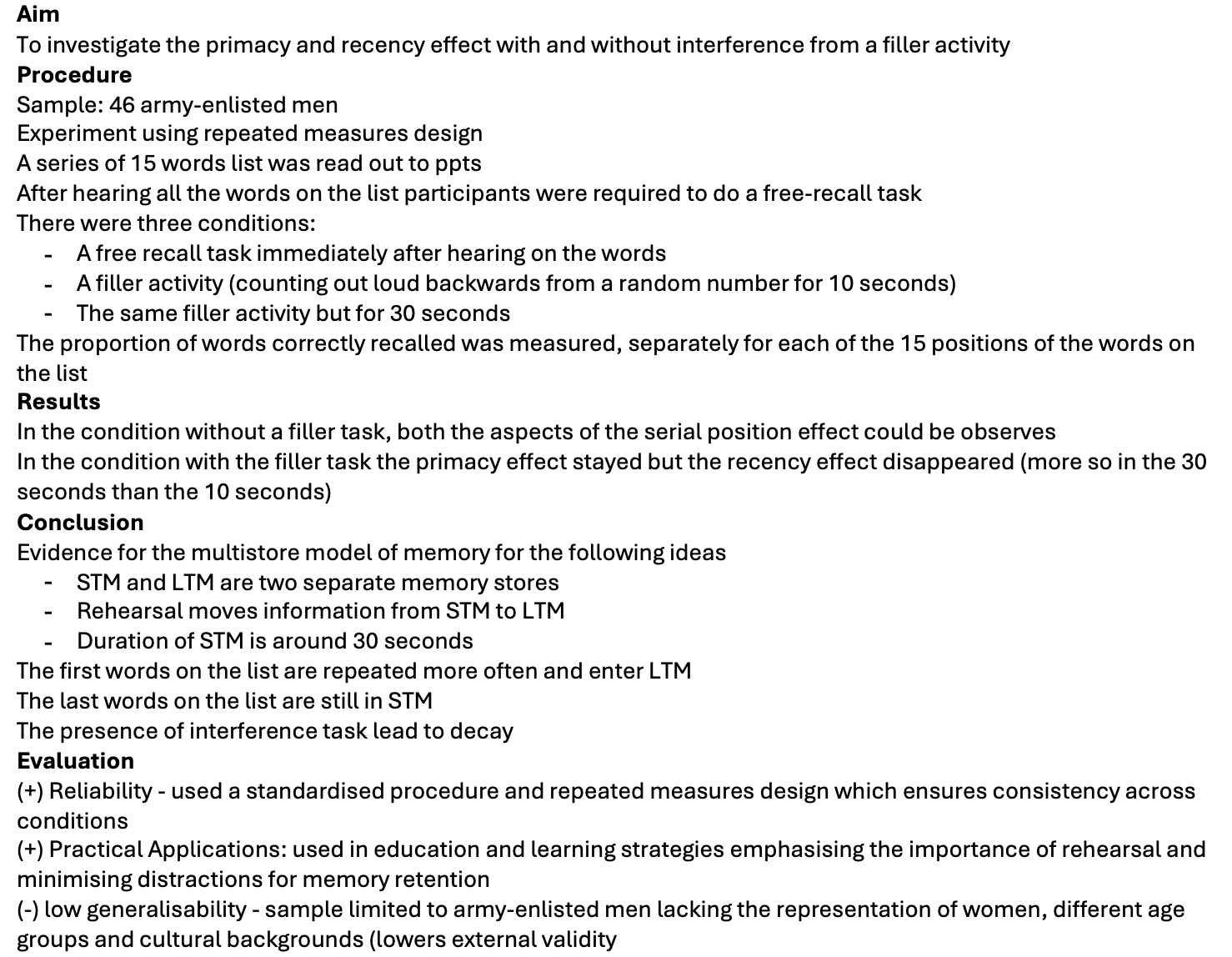
Glanzer and Cunitz
Aim
To investigate the primacy and recency effect with and without interference from a filler activity
Procedure
Sample: 46 army-enlisted men
Experiment using repeated measures design
A series of 15 words list was read out to ppts
After hearing all the words on the list participants were required to do a free-recall task
There were three conditions:
A free recall task immediately after hearing on the words
A filler activity (counting out loud backwards from a random number for 10 seconds)
The same filler activity but for 30 seconds
The proportion of words correctly recalled was measured, separately for each of the 15 positions of the words on the list
Results
In the condition without a filler task, both the aspects of the serial position effect could be observes
In the condition with the filler task the primacy effect stayed but the recency effect disappeared (more so in the 30 seconds than the 10 seconds)
Conclusion
Evidence for the multistore model of memory for the following ideas
STM and LTM are two separate memory stores
Rehearsal moves information from STM to LTM
Duration of STM is around 30 seconds
The first words on the list are repeated more often and enter LTM
The last words on the list are still in STM
The presence of interference task lead to decay
Evaluation
(+) Reliability - used a standardised procedure and repeated measures design which ensures consistency across conditions
(+) Practical Applications: used in education and learning strategies emphasising the importance of rehearsal and minimising distractions for memory retention
(-) low generalisability - sample limited to army-enlisted men lacking the representation of women, different age groups and cultural backgrounds (lowers external validity