8b: Working Memory
WORKING MEMORY
WHAT IS WORKING MEMORY?
Definition: Working memory refers to the temporary maintenance of information in memory while also processing other information concurrently.
temporarily holds and manipulates info while also processing other info at the same time
**Conceptualization: **
It is seen as the ability to control or regulate attention in pursuit of goals, especially amidst distracting information.
Quotation: "The ability to maintain information in the maelstrom of divergent thought" (Engle, 2018).
HOW DOES WORKING MEMORY WORK?
Influential Models: Alan Baddeley proposed several models of working memory, which, although revised over time, maintain fundamental distinctions.
**Components of Working Memory: **
Central Executive: The system responsible for attentional control, coordinating information from slave systems (stores info).
Slave Systems (controlled by central executive):
Visuospatial Sketchpad: Handles visual images and is connected to perception and action.
Phonological Loop: Stores and rehearse speech-based information; its fundamental units are phonemes.
EXAMPLES OF TESTS OF WORKING MEMORY MODELS:
Phonological Loop Test: Participants struggle more to remember similar-sounding letters compared to different-sounding letters. Semantic content similarity has no notable effect, confirming phonemes as fundamental to the phonological loop.
hard to remember similar sounds. brain remembers verbal info using phonemes (sounds), notmeaning
Visuospatial Load in Chess: Memory for board arrangements and decision-making in chess is affected by visuospatial load rather than verbal load, indicating separate stores for visuospatial and verbal information.
visual performance drops but not verbal
shows that visual and spatial memory is handled separately from verbal memory
HOW IS WORKING MEMORY CAPACITY MEASURED?
Literature Overview: A significant amount of research focuses on individual differences in working memory capacity, its structural aspects, and its associations.
Measurement Methods:
Simple Span Tasks: Require participants to simply remember information without concurrent (happening at the same time) processing. Less valid measures of working memory.
participant solely remember something, without having to proess anything else
Complex Span Tasks: Require remembering information along with simultaneous processing, providing more valid assessments.
participants tries to remember something while also processing something else
Common Complex Span Tasks Include:
Operation Span (OSPAN)
Reading Span
Symmetry Span
N-back Task
OPERATION SPAN (OSPAN):
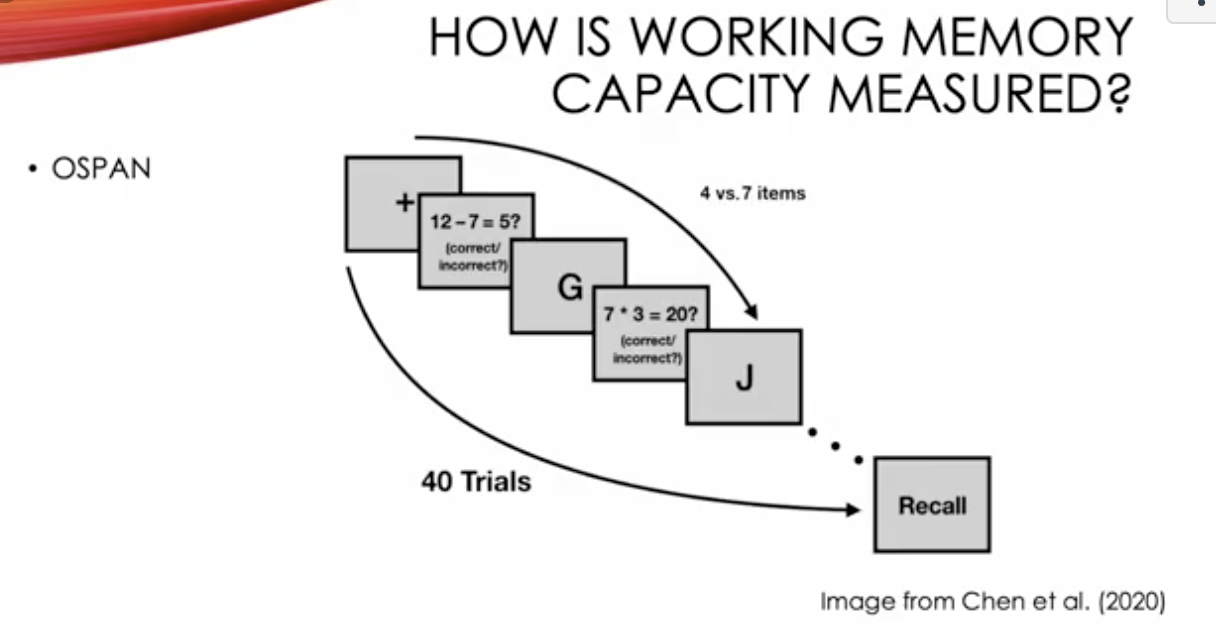
Participants solve equations while trying to recall letters. Here’s a sample test format:
Equation: 12 - 7 = 5? (correct/incorrect?)
Recall letters presented (e.g., G, J).
READING SPAN:
Participants read sentences and then later recall the last word of each sentence presented.
Example: "The athlete broke his lunchbox and could not participate in the race." The participant's response could be "Incorrect" or "Correct" depending on accuracy.
and then try to recall race (last word)
SYMMETRY SPAN:
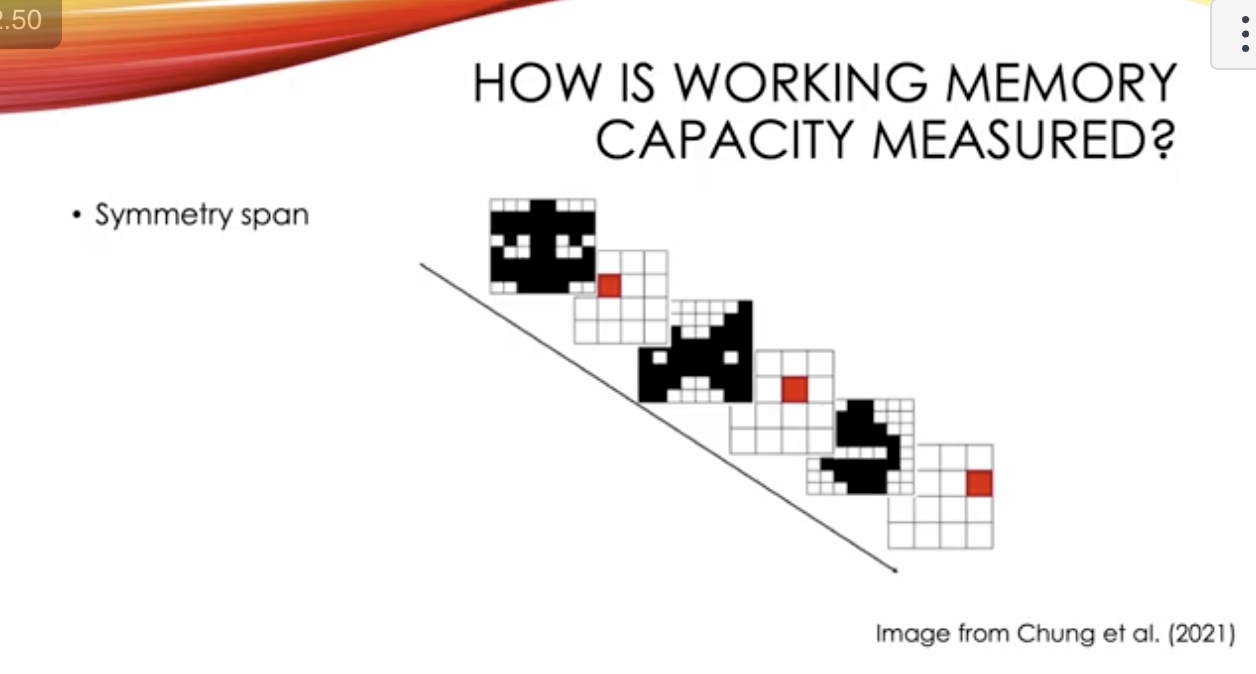
Visualization tasks where individuals recall symmetric shapes after briefly viewed.
is it symmetrical?
remember where the red dot is spatially
recall the sequence of red square locations in order
N-BACK TASK:
Involves identifying whether each stimulus matches the one shown n items before. However, it shows poor reliability as an individual differences measure, correlating weakly with WM complex span scores.
WHAT IS WORKING MEMORY CAPACITY ASSOCIATED WITH?
Adaptive Regulation of Attention: Individual differences in WMC (wowrking memory capacity) are closely linked to flexible spatial attention usage. (Bleckley et al., 2003).
people with higher wmc are better at adjusting their spatial attention based on task demands
Complex Span Tasks Correlations:
Reading Comprehension: (Turner & Engle, 1989)
Fluid Intelligence: (Engle et al., 1999; Kane et al., 2004)
Inhibition of Task-Irrelevant Information:
High WMC individuals show reduced noticing of their names in unattended streams (Conway et al., 2001).
They also exhibit a reduced Stroop effect (Kane & Engle, 2003), flanker interference effects (Redick & Engle, 2006), and attentional capture (Robison & Unsworth, 2017).
WMC is negatively correlated with mind wandering (McVay & Kane, 2009).
Related to performance on the anti-saccade task (Engle, 2018).
high WMC:
understands and remembers what they read better
juggles sentence meanings and context without losing track
solves new problems without relying on prior knowledge
strong working memory helps you spot patterns and think abstractly
better at ignoring distractions
Low-Level Processes: WMC is not correlated with less complex processes such as alerting and orienting (Redick & Engle, 2006).
WMC not strongly linked to basic attention functions (e.g. simply noticing something)
SOCIO-EMOTIONAL RELATIONS:
Anxiety and Attention Regulation:
People with high trait or social anxiety show biases toward threatening stimuli,
and difficulties in attention regulation generally.
They demonstrate less efficient inhibition of irrelevant information, less efficient task-switching, and have lower WMC scores on complex span tasks.
Unclear if lower WMC is due to intrinsic capacity differences or because anxiety-induced rumination consumes cognitive resources.
Cognitive Empathy (Theory of Mind):
Involves understanding others' thoughts and emotions. Higher WMC correlates with fewer egocentric errors in cognitive empathy tasks (Navarro et al., 2020).
High WMC is good at putting themselves in other’s shoes
Stress Response:
Study indicating that higher WMC individuals responded better to stressful events, suggesting WMC acts as a buffer against stress.
EMOTIONAL REGULATION STRATEGIES:
Reappraisal Strategy: WMC may enhance the ability to reappraise emotional situations, contrasting with ineffective suppression strategies.
Example of Reappraisal: Changing the narrative around failing a quiz from a threat of failure to a learning opportunity (Gross & John, 2003; McRae & Gross, 2020).
Benefits of frequent reappraisal include:
Increased positive emotions
Decrease in vulnerability to depression and anxiety
Enhanced self-esteem, optimism, and life satisfaction
Greater social connectedness (English et al., 2012; Gross & John, 2003; McRae & Gross, 2020; Preece et al., 2021).
high wmc are better at reappraisal because they can
hold multiple persepctives
shift focus from negative thougths to constructive ones
resist impulsive emotional reaction
WHAT DOES WORKING MEMORY LOAD IMPACT?
Changing Focus: Examines how manipulating a person’s working memory load affects task performance, often contrasting low and high load conditions.
Criteria of Automaticity: Used to evaluate efficiency of processes that include efficiency, unconsciousness, unintentionality, and uncontrollability.
EXAMPLES OF WM LOAD:
Tasks include:
Remembering strings of digits (e.g., 0 versus 2 versus 6).
Remembering the location of shapes.
Performing mental arithmetic on sequences of numbers.
Counting back from a specified number.
Tasks involving active manipulation of information yield more insights into WM load effects.
E.g., Remembering six digits does not alter attentional bias in socially anxious individuals (Boal et al., 2018), while mental arithmetic tasks do (Delchau et al., 2020).
PROCESSES AFFECTED BY WM LOAD:
Visual search efficiency (Han & Kim, 2004).
Attentional capture by irrelevant stimuli (Lavie & de Fockert, 2005).
Cognitive empathy and social reasoning (McKinnon & Moscovitch, 2007).
Global interference on directed Navon tasks (Ahmed & de Fockert, 2012).
Cognitive reappraisals of emotional responses (Gan et al., 2017).
Processes Not Impacted: Object individuation (Filmer, Wells-Peris, & Dux, 2017).
DOES WM TRAINING WORK?
Interest in WM Capacity Training: Training to increase working memory is enticing due to its association with various positive outcomes. Many applications and programs are based on this premise.
Mixed Evidence: Current empirical data presents various perspectives on the effectiveness of WM training.
TRAINING CONCEPTS:
Near Transfer vs. Far Transfer:
Near Transfer: Improvement on the same or closely related tasks due to training.
Far Transfer: Benefits of training extending to different tasks that engage different cognitive processes. Crucial for evaluating effectiveness as improvements in task-specific performance do not guarantee broader cognitive gains.
EXAMPLES FROM STUDIES:
Jaeggi et al. (2008): Utilized a novel n-back task training regimen that included working with simultaneous auditory and visual stimuli.
Meta-analysis Findings:
Redick et al. (2013) found no intelligence improvement post-training.
Melby-Lervåg & Hulme (2013) observed specific near-transfer effects but no far-transfer gains.
Rodas & Greene (2022) revealed practice effects but no general improvements in executive function.
Watrin et al. (2022) showed extended training with no significant far-transfer outcomes, only near transfer.
ADVICE ON WM TRAINING:
Enjoy using brain training applications or games if they are enjoyable.
Approach any claims of significant changes in working memory abilities with skepticism, based on existing research evidence.
For improving aspects tied to WM, it’s more advisable to work directly on those desired cognitive skills rather than relying on broad training programs.
THINKING EXERCISE IN PREPARATION FOR LECTURE:
Consider the reasons working memory and cognitive empathy might share common variance and functional similarities.
Reflect on alternative methods to enhance empathy if working memory capacity cannot be trained.