Indonesia and Java
Indonesia and Java overview
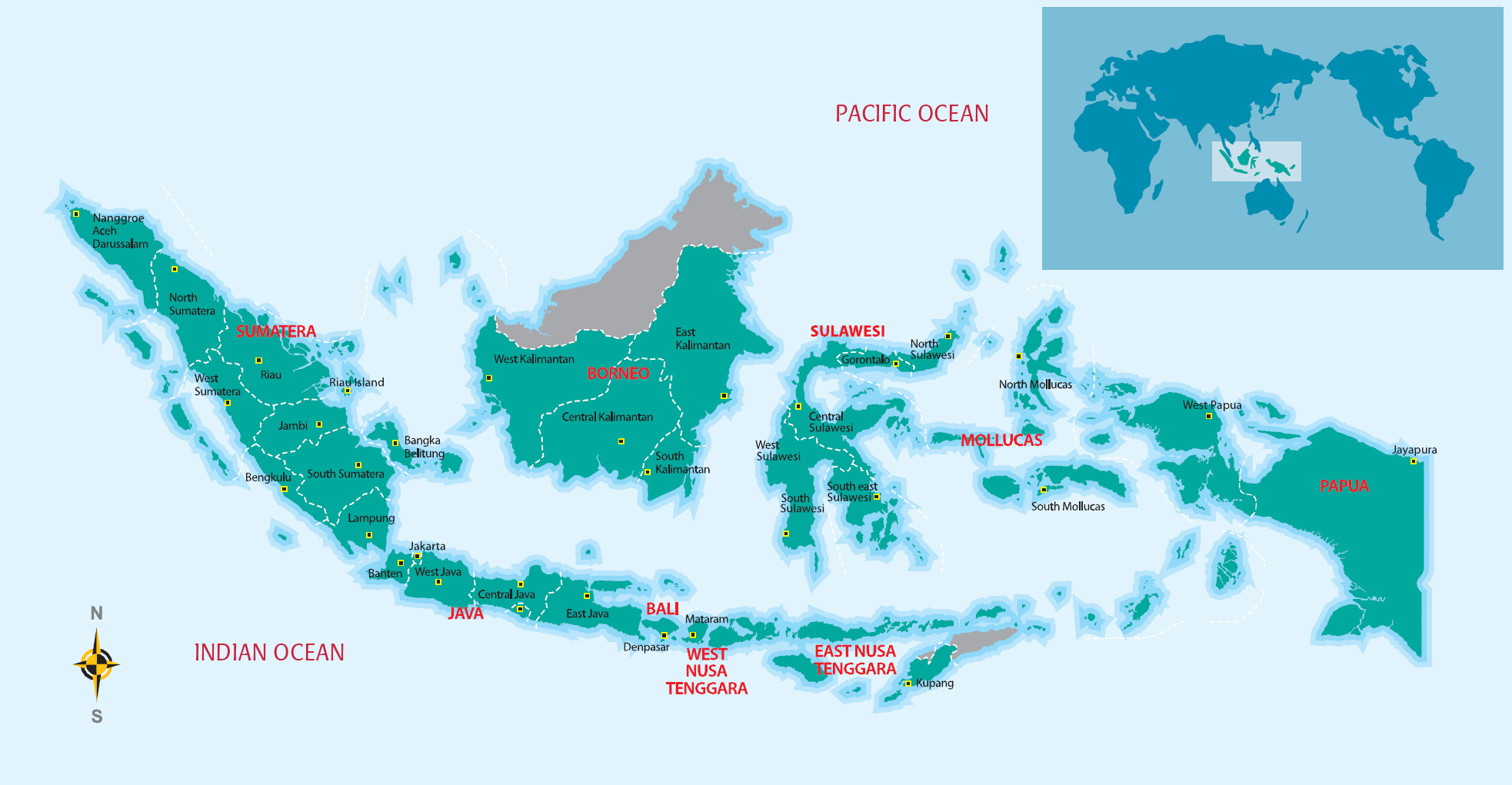
We will be focusing on the traditional music of two islands in Indonesia - Java and Bali.
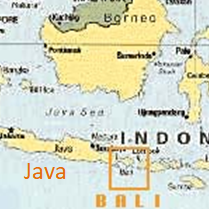
Indonesian music of Java and Bali, in general, is
Dominated by ensembles of bronze instruments
The most recognized of these is the Gamelan
What is a Gamelan ensemble?
It is a set of mostly idiophone metallic instruments (metallophones) that are unified by tuning and often by decoration.
See video – What is Gamelan [Note: when it says Gamelan was introduced in the late 70s, they are referring to its introduction to the UK. It has been the traditional music of Indonesia for nearly 2000 years – since c AD 230]
Primary Instruments of a Gamelan Ensemble
The primary instruments are gongs.
The gongs are struck in the center of the instrument with a mallet (not on the side of the instrument like a bell)
There are hanging gongs and kettle gongs held in a rack.
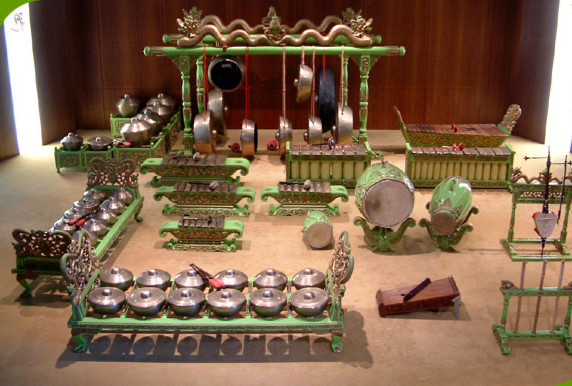
There are also xylophone-like instruments made of flat metal slabs and
There is usually a set of 1-3 membranophones, which are played with the hands.
There may be an added aerophone or chordophone instrument playing a melody, a zither-type instrument, or a singer.
Types of Gamelan Music
Gamelan music is used for
Court or devotional music – instrumental music or with voice/singer
Shadow Puppetry
Dance
Material/Construction of Gamelan Instruments
The primary material used to construct the instruments is bronze.
Iron and brass can also be used..
Be able to locate Indonesia – Java/Bali on a map.
What is a Gamelan ensemble?
A Gamelan ensemble is a set of mostly idiophone metallic instruments (metallophones) that are unified by tuning and often by decoration.
What are the main types of instruments in a Gamelan ensemble?
The main types of instruments in a Gamelan ensemble include gongs (hanging and kettle gongs), xylophone-like instruments made of flat metal slabs, and usually a set of 1-3 membranophone drums. Additionally, an aerophone or chordophone instrument, a zither-type instrument, or a singer may be added.
What is the primary material used to construct Gamelan instruments?
Bronze, but iron and brass can also be used.
What are the main uses and activities for Gamelan music?
Accompanying traditional ceremonies, such as weddings, funerals, and religious rituals.
Providing music for dance performances and theatrical presentations.
Serving as a backdrop for community gatherings and celebrations, fostering social cohesion.
What is Gamelan
Gamelan refers to the musical genres and associated instrumental ensembles found in Bali and Java. It is derived from the Javanese word ‘gamel’, meaning to strike or to handle
Gamelan Music in Java
Where in the world are we?
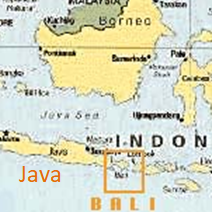
The court cities are cultural centers with refined forms of music and arts.
Agricultural areas have popular and folk music styles.
The main religion is Islam.
Review/Overview - Javanese Gamelan
Ancient beliefs about forging metal
Forging the metal has mystical significance in ancient Javanese tradition.
It is believed that as they forge the metal, the smiths (metal workers) become vulnerable to dangerous forces from the spirit world.
There is a ritual preparation to protect the smiths.
During the ritual, the head smith is transformed into the mythical hero Panji, and the Smith’s assistants become Panji’s family and servants. “The Panji tales (formerly spelled Pandji) are a cycle of Javanese stories, centered around the legendary prince of the same name from East Java, Indonesia.”
The Royal Court Pavilions
In Java, the court cities are cultural centers of refined music and the arts.
The court pavilions are a complex of small buildings symbolizing the macrocosmos (the ordered universe) and
The buildings are set up along the cardinal directions (north, south, east, west)
It is believed that the ruler is imbued with divine powers and that the Gamelan music in the court pavilions also has special powers.
Gamelan Music for the Royal Courts
This music likewise symbolizes the ordered universe.
Like the buildings of the royal court pavilions, the Gamelan instruments are similarly arranged along right angles according to the cardinal directions.
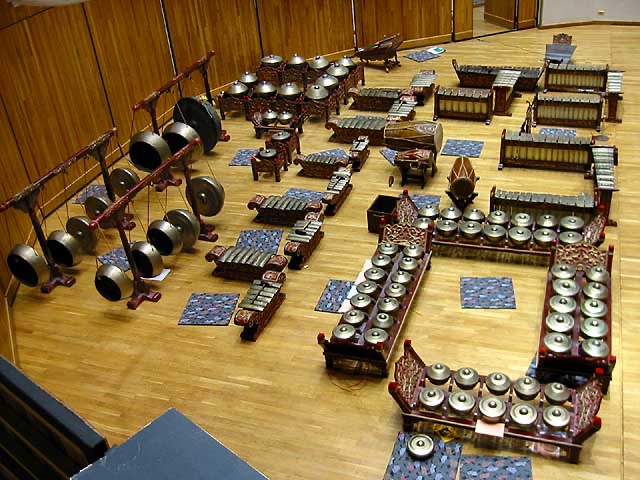
The structure of the meter and rhythmic cycles of the music also symbolize the ordered universe.
Think about how the planets move in their orbits and rotations – they move in regular, repetitive cycles, and they move independently in their own sphere and cycles. Every so often, they align together, and that is considered a big event.
The music is structured to reflect those cycles of the planets in their regular orbits.
The music is mathematically organized into repetitive cycles of beats, and just like there are divisions and subdivisions in the year that it takes for our planet to complete its cyclic orbit around the sun, there are also divisions and subdivisions within metric cycles of the music.
This example has a 16-beat cycle – don’t worry about every little detail, but try to notice how the instruments interact within the 16-beat cycle. Every instrument has its place and pattern within the cycle.
Pitches are identified by number (not letter name) – and you can follow along in the video where they play in the phrase.
Notice the lower melody note and the sound of the big gong at the end of the phrase – punctuating or marking the end of the cycle.
Notice how the different instruments interlock – it gets very hypnotic.
Every so often, all the beats align to create a stronger mark in the music.
And now for a more formal performance – video example – Java Gamelan degung
The music has a 16-beat cycle, which is punctuated by the most enormous gong on the last beat of the cycle (beat 16)
Each set of instruments plays its own rhythmic cycle within the bigger cycle.
Their cycles create interlocking patterns.
There are times during their cycles when the various beats align, creating a stronger, more significant mark in the music.
Things to watch for in the music
Notice how the instruments are set up and organized at right angles to each other (along the cardinal directions, it is assumed)
The music starts with a free-flowing flute melody, occasionally punctuated by the drum and a gong.
At about 1 minute in, there is longer punctuation by the drum and gongs.
At about 1:15, the kettle gong provides a brief introduction to the next section.
At 1:25, the repetitive 16-beat cycle begins.
The flute continues to play a melody.
The xylophone-type instruments play a faster melodic rhythm.
The set of hanging gongs in the back plays every four beats (playing a different gong on beat 12)
The most enormous gong in the back plays on beat 16, marking the end of the cycle, and then the cycle begins again (at one point in the video, you can see the big gong player counting the beats on her fingers)
The drum plays another somewhat syncopated rhythmic pattern in the background.
Shadow Puppetry in Java –
Shadow puppetry is a popular art form.
It is held in high esteem.
It is telling a story through puppetry, musical punctuation, and the musical enhancement of Gamelan and sound effects.
The stories depicted are well-known tales from national folklore and mythology – what is unique is the puppeteer's individual art in telling the familiar stories.
Gamelan music accompanies and enhances the storytelling (like a movie soundtrack) with other instruments and voices added as needed.
There are different types of pieces used depending on the situation in the story – calm, somewhat excited, and very excited.
The puppets are intricately decorated, and a select few watch the show from the side of the puppeteer, where they can see the puppet dolls. The puppets are held up against a screen, and the general audience watches their shadows on the other side.
Example - Java Wayang Kulit Shadow Puppetry (you may have to click the link to play in a separate tab/window outside of
Gamelan Music in Bali
Where in the world are we?
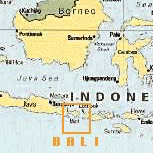
Balinese Gamelan –
Instruments
They are similar to Java but with some differences in name and sound (you don’t need to know all the names – listen to the subtle difference in sound between Bali and Java)
Musical characteristics
Hinduism is the main religion.
The music is often seen as an offering to a Hindu deity.
The music is supposed to attract the deity and also the audience.
It is usually faster and more colorful than Java.
It has a much higher rhythmic density than the Javanese style.
The music may have regular cycles, but often it doesn’t repeat.
Pairs of instruments are tuned slightly apart to produce a buzzy, shimmery sound that adds vibrancy to the music.
Sudden shifts of mood are standard.
Sectional solos, highlighting different groups of instruments, are also common.
Instead of regularity of cycles, there are dramatic starts and stops.
There are many dynamic changes (volume)
Overall high rhythmic density
Fast, interlocking rhythmic and melodic patterns are shared among instruments.
Used for dance, drama, devotional dances, martial arts dances, ritual observance, processions
Instruments are often set up around a temple (outside)
Balinese Dance
Traditional Balinese dance is considered a high art form, a form of ballet.
Music and dance work in harmony with each other and reflect each other’s movements
It is said that the dancers lead the Gamelan more than the Gamelan leads the dancers.
Balinese dance is a significant part of their culture and religious expression.
All the dance movements for the various parts of the body are highly codified with different names for the different kinds of movement –
Feet – 30 names/types of movement
Arms – 16
Hands and fingers – 19
Trunk – 14
Neck and shoulder – 20
Face – 16
Balinese dance is an integral part of their cultural identity – ingrained from an early age.
Training begins at a young age.
Balinese dances often use masks – especially in dance dramas – they represent different characters, emotions, and the spirit of dance.
There are more than 30 masks in the Balinese tradition.n
Peliatan is a vital center for Balinese dance, showcasing a profound unity between dance, drama, and music. This art form is a sophisticated language, with each body movement having specific, codified names (e.g., 30 for feet and legs, 16 for arms, 19 for hands/fingers, 14 for the trunk, 20 for neck/shoulder, and 16 for facial expressions). The harmony between dancers and the Gamelan orchestra is notable, with dancers often leading the musicians and vice versa.
BALINESE DANCE: THE LEGONG
The Legong is Bali's most famous, demanding, and feminine dance style.
Performed by young, pre-teen girls who undergo intensive training and typically retire by their mid-teens.
Features highly stylized movements.
BALINESE DANCE: THE TOPENG
Employs ceremonial masks, which are crucial for portraying spirits and characters.
Essential for temple ceremonies, telling tales of kings and warriors with varying tones from serious to humorous.
Performers, often older men, use half-masks to speak and full masks for pantomime, sometimes playing multiple characters by changing masks.
Involves a ritual preparation for the dancer to enter a trance state, allowing the spirit of the mask to embody them.
Peliatan, just to the south
A Traditional Balinese Dance Drama
The well-known dance drama is the “Calonarang”
Meaning of Masks
Introduction to Balinese Culture and Arts
It is difficult to separate culture, religion, and art in Bali; they are intertwined.
Speaker: Idawagus Anom Suryawan,
Roles: Mask maker, mask dancer, puppeteer, puppet maker.
Family lineage: Sixth generation of mask makers.
Preservation of Tradition
Mission revolves around keeping family tradition alive.
Significance of Masks in Balinese Culture
Every mask has multiple meanings:
Place of Spirit: Masks symbolize the dwelling of spiritual entities.
Performance Use: Integral to traditional performances.
Protection: Masks serve as barriers against harmful spirits.
Decoration: Aesthetic purpose in various settings.
Types of Masks and Their Uses
Protection Masks:
Positioned at entrances (gates, dining rooms, bedrooms).
Designed to protect from malevolent spirits.
The Creative Process in Mask Making
Story Exploration:
Before crafting, research the story behind each mask.
Connection to specific temple masks (e.g., Barong mask, Rangnam mask).
Cultural Rituals:
Balinese people pray to the spirit associated with the mask rather than the mask itself.
Masks are believed to uphold rituals within Balinese Hinduism.
**Building Holy Masks:
Community Involvement:**
Engage with local temples and social communities to determine what kind of mask they need.
Wood Sourcing:
Wood harvested near the temple or cemetery.
Ethical harvesting: Cut only what’s needed; avoid unnecessary deforestation.
Timing and Rituals:
Importance of selecting auspicious days for construction.
Completion Rituals:
After completion, masks are returned to the original tree (the source of the wood) for a ceremonial presentation.
Symbolizes reincarnation and spiritual guardianship for humanity and the universe.
Philosophical and Ethical Reflections
Emphasis on cultural preservation:
Maintaining traditional practices is vital; without tradition, modernity loses meaning.
Cultural identity is rooted in the continuity of practices and beliefs.
A strong correlation between culture and identity: Without culture, one's identity is lacking.
Barong and Rangda Overview
Two mythical figures in Bali: Barong (protector figure) and Rangda (witch).
Barong resembles a lion; Rangda is depicted as a fearsome witch.
Barong
Represents various composite animal features; multiple types exist (e.g., Barong Asu - dog/lion, Barong Machan - tiger).
Barong is seen as a guardian of villages and is revered in temple rituals.
Enacted in village performances, especially in the Calonarang drama.
Dancers operate the Barong figure; coordination is vital for its movements.
Barong's roots lie in ancient lion dance traditions in China and Indonesia.
Rangda
Often symbolizes evil; revered as a protector against malign influences.
Features a striking mask with bulging eyes and an aggressive appearance.
Linked to the goddess Durga, it represents rage and destruction.
Known for her trance-inducing powers, performance requires respect and skill from the actor.
Calonarang Drama
Central to Balinese culture, it portrays the battle between Barong and Rangda.
Based on an ancient text discussing themes of black magic and epidemic.
Features a fierce widow seeking revenge, leading to a climactic confrontation.
Villagers engage in ritualistic self-stabbing dance under Rangda's spell.
Integration of comedic elements to entertain audiences.
Adaptations for tourism emerged in the mid-20th century, simplifying performances.
Barong, a lion-like protector, and Rangda, a fearsome witch associated with the goddess Durga, are central figures in Balinese mythology. Their ongoing battle is depicted in the Calonarang Drama, a performance based on ancient texts that explore themes of black magic and epidemic. This drama, featuring a vengeful widow and ritualistic self-stabbing by villagers under Rangda's spell, also incorporates comedic elements. The Calonarang Drama remains relevant today for its themes of confronting adversity and fostering catharsis and resilience, particularly during societal challenges or widespread illness, while also offering entertainment and stress relief.