Sensation pt 2
Overview of PSYC100: Key Concepts in Psychology
Introduction to Retrieval Practice
Challenge to distinguish between types of research designs:
Experimental designs
Correlational designs
Descriptive designs
Importance of verifying conclusions through notes
Today's Class Agenda
Topics of Discussion
Case study of H.M.
Brain structure and memory systems
Relationship between genetics, memory, and brain function
The Case of H.M.
Key Discoveries
Significant findings from H.M.'s study have expanded our understanding of memory processes.
Attention to how different types of memory are affected by brain damage, particularly in explicit memory.
Advantages of Studying H.M.
Provides unique insights into the formation and retrieval of memories.
Offers a real-life example of the implications of neurological impairments on behavior and cognition.
Limitations of Findings from H.M.
Results may not be generalizable due to the uniqueness of H.M.'s case.
Ethical considerations in studying human subjects with severe impairments.
Analysis of Phineas Gage
Conclusions from Case Study
A. Emotional regulation issues post-accident:
Cannot generalize findings to all individuals with similar brain damage.
B. Phineas Gage's case laid a foundation for future research:
Key insights into brain structure, personality, and emotional control.
C. Specificity of findings:
Damage to particular brain areas leads to noted changes in emotional control and personality.
D. Summative conclusion:
All statements (A, B, C) can be made based on the study of Phineas Gage's case.
The Case of Clive Wearing
Memory and Brain Functionality
Explicit Memory Deficits: Clive Wearing cannot form new explicit memories due to brain damage.
Area of damage impacts memory formation and retrieval.
Implicit Memory and Skills:
Despite memory loss, he can play the piano, indicating functioning motor skills or implicit memory related to musical performance.
Intact area of the brain allows for procedural memory despite explicit memory deficits.
Emotional Recognition:
Clive shows affectionate responses to his wife, Deborah, despite not recognizing her consciously.
This indicates that emotional memory may be retained, connected to areas of the brain that regulate emotional responses.
Brain Structure Overview
Lobes of the Brain and Their Functions
Frontal Lobe: Responsible for thought, planning, and movement.
Parietal Lobe: Handles touch and spatial relations.
Temporal Lobe: Associated with hearing and memory functions.
Occipital Lobe: Primarily involved in vision processing.
The Role of Epigenetics
Introduction to Epigenetics:
Examines how environmental factors can influence gene expression and, consequently, behavior and cognitive function.
Importance in understanding the complexities of memory and brain function.
Research Methodology in Psychology
Random Sampling:
A method where every member of the population has an equal chance of being selected for the study, crucial for ensuring the generalizability of research findings to the larger population.
Experimental Design:
Random Assignment: To ensure unbiased representation in research groups.
Two groups: Experimental Group and Control/Comparison Group.
Independent Variable (IV): Condition manipulated by the experimenter.
Dependent Variable (DV): The outcome measure used to assess the effects of the IV.
Importance of reviewing relevant literature, specifically Figures 2.27 and 2.28, for visual representation of research designs.
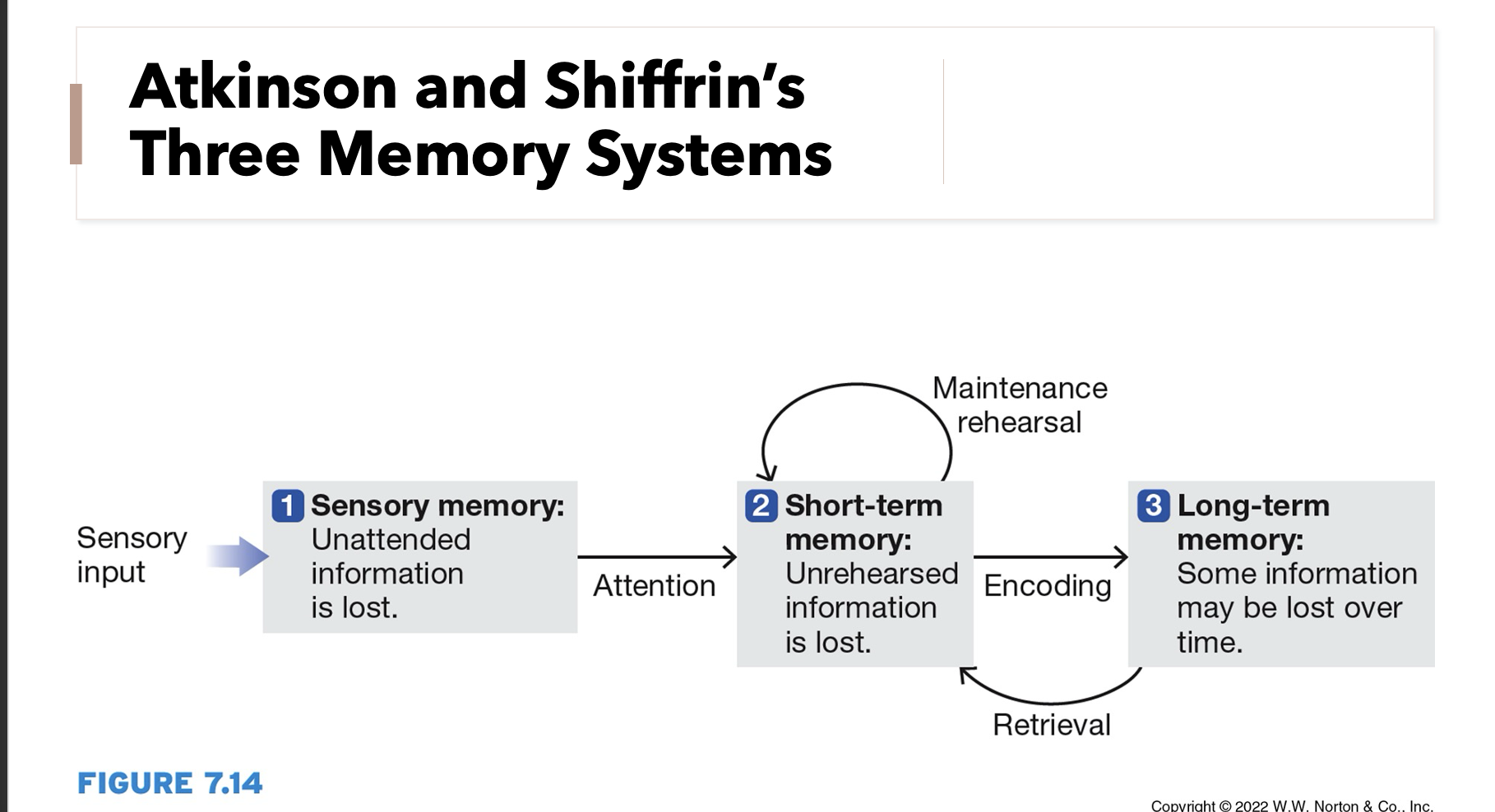
Memory Systems According to Atkinson and Shiffrin
Three Memory Systems:
Sensory Memory:
Brief storage of sensory input; unattended information is lost.
Short-term Memory:
Information that is unrehearsed is lost after a short duration; focus on maintenance rehearsal, attention, and encoding.
Long-term Memory:
Information may be lost over extended time frames; involves retrieval processes.
Visual Representation: Reference to Figure 7.14 for a structured view of these memory systems.