chemical change
Making Soluble Salts:
Make saturated solution by stirring copper oxide into sulfuric acid until no more will dissolve.
Filter the solution to remove excess copper oxide solid
Half fill baker with water and set over a Bunsen Burner to beat the water, place it on the evaporating dish on top of the beaker.
Add solution to evaporating basin and heat until crystals begin to form.
Once cooled, pour remaining liquid into crystallising dish and cool for 24 hours.
Remove crystals with spatula and pat between paper towels.
Process of Electrolysis:
Is a splitting up of an ionic substance using electricity
Two electrodes are required to be placed in the electrolyte.
Electrodes are conducting rods.
One is positive terminal and one is negative terminal
Electrodes are inert (often for graphite or platinum)
During it, opposites attract. + ions will be attracted to - electrode
When ions reach the electrodes, charges are lost and become elements.
Positive electrode are called the anode
Negative electrode are called cathode
Electrolysis of Aqueous Solution:
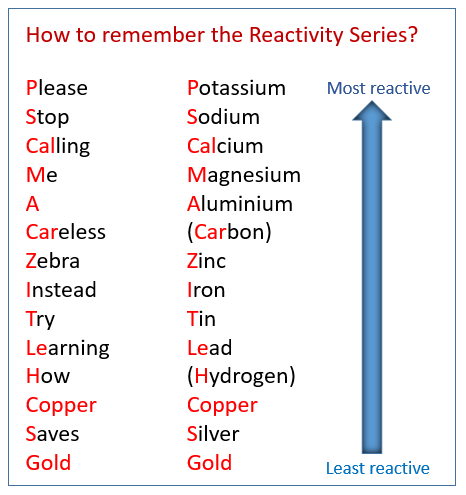
If metal is more reactive than hydrogen, the hydrogen will be produced by a negative cathode.
Positive anode, negatively charged ions lose electrons.
Called oxidation.
Electrolysis to extract metals:
Large quantities of energy is used to melt compounds.
Aluminum is manufactured by the process of electrolysis.
Aluminum oxide has a high melting point = using high amounts of energy.
Uses molten cryolite to lose melting point and reduce costs.
Oxidation
Is the
Loss of electrons
Reduction
Is the
Gaining of electrons.