Study Notes on Cerebral Cortex and its Functions
BIOS2033 Physiology of Electrically Excitable Tissues
Cerebral Cortex
Introduction
Instructor: Carl Stevenson, PhD
Location: B207, South Lab
Contact: carl.stevenson@nottingham.ac.uk
Upcoming Events
Animal Science Society
Date: February 19th
Time: 6 PM
Location: A46 Main Building
Announcement:
Committee for next year needed to sustain society.
Participation promotes leadership, social media presence, CV enhancement, event organization, and community memories.
Interested individuals urged to DM @uonanimalscience on Instagram.
Event: Lambing Speaker Event with Ella; questions encouraged.
Learning Objectives
Understand evolutionary differences in brain size and proportion among animals.
Provide an overview of cerebral cortex structure and diverse functions.
Understand the relationship between structure and functions in the cerebral cortex.
Understand the involvement of the prefrontal cortex in various higher-order brain functions.
Further Reading
Sherwood et al. (2005). Animal Physiology: From Genes to Organisms. Brooks/Cole.
Bear et al. (2007). Neuroscience: Exploring the Brain, 3rd Ed. Lippincott Williams & Wilkins.
Squire et al. (2008). Fundamental Neuroscience, 3rd Ed. Academic Press.
Other physiology textbooks (refer to the reading list in the module handbook).
Cerebral Cortex Overview
Structure
Described as the thin outermost layer of the brain in mammals.
Responsible for higher functions which include:
Sensation: "feeling"
Movement: "doing"
Cognition: "thinking"
Emotion: "feelings"
Particularly developed in the human brain.
Brain Evolution in Vertebrates
Neuronal Variation
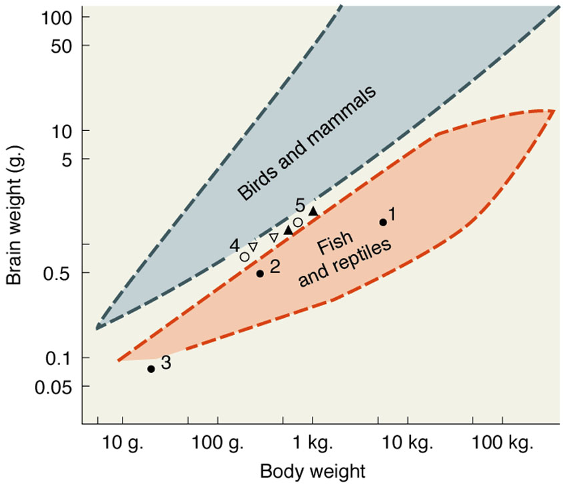
Nematodes have hundreds of neurons, while whales possess hundreds of billions.
The total brain weight of vertebrates is proportional to body weight.
More advanced vertebrates exhibit larger brains relative to body size.
More expanded, complex and specialised brains in mammals
Cerebral cortex is the most recently evolved part of the brain
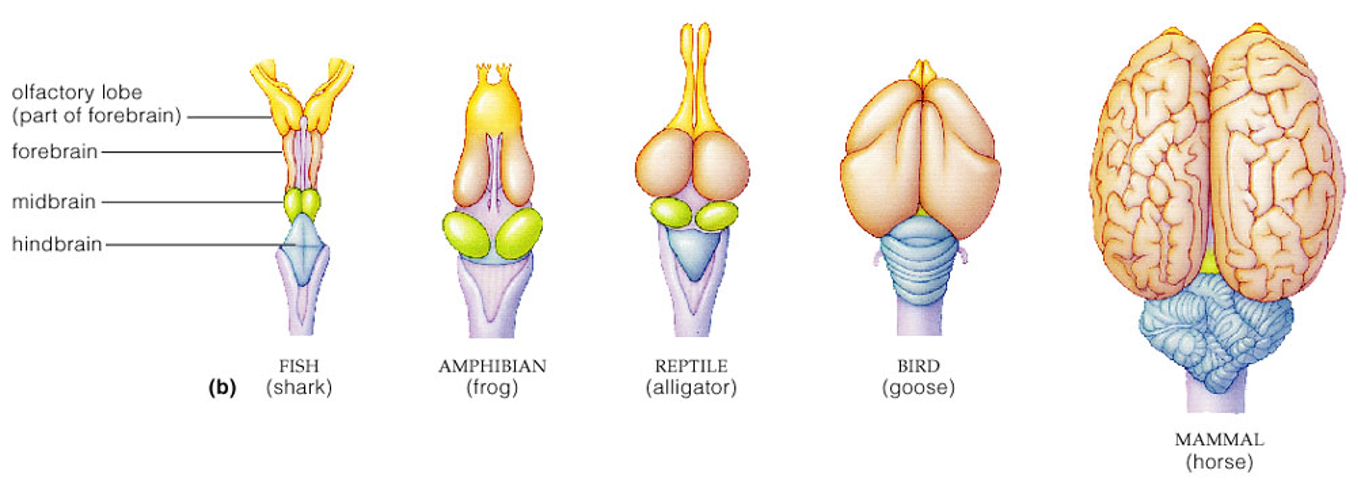
Brain Evolution in Mammals
Complexity and Specialization
As mammals evolved, their brains became more expanded, complex, and specialized.
The cerebral cortex is identified as the most recently evolved part of the brain.
Proportional Brain Development
More advanced mammals demonstrate a larger proportion of the cerebral cortex compared to the rest of the brain.
Example: In humans, it constitutes approximately 80% of the brain.
Dolphins have a larger auditory cortex specialized for echolocation.
Primates exhibit a larger prefrontal cortex responsible for higher cognitive functions.
Evolutionary Adaptation
Folding of the cortical structure emerged as an adaptation to enhance the surface area of the cerebral cortex while fitting inside the skull.
Gross Structure of Cerebral Cortex
Hemispheres and Lobes
The cerebral cortex is divided into left and right hemispheres.
Each hemisphere consists of four distinct lobes, each serving various functions:
Frontal
Temporal
Parietal
Occipital
Anatomical References
Directional Terms:
Dorsal (Superior)
Ventral (Inferior)
Anterior (Rostral)
Posterior (Caudal)
Planes for Visualizing the Brain:
Horizontal Plane
Coronal Plane
Sagittal Plane
Cortical Communication
White Matter Tracts
Comprise axons that connect different cortical areas within the brain.
Types of fibers include:
Association fibers: Connect within the same hemisphere.
Commissures: Connect between left and right hemispheres.
Corpus Callosum
The primary commissure connecting the left and right cerebral cortex; integrates information processing across hemispheres.
Fine Structure of the Cerebral Cortex
Neuron Organization
Neurons within the cerebral cortex are organized into parallel layers that form functional columns.
Extensive connections occur within a column while fewer exist between adjacent columns.
Cortical Columns
Layer Organization
Molecular Layer: Composed primarily of dendrites; receives afferent input from the thalamus/brain stem.
Granule Layers (II and IV): Comprised of granule and stellate cells; input from thalamus and cortex.
Pyramidal Layers (III and V): Contain pyramidal cells; output to cortex/or other parts of the CNS.
Multi-form Layer (VI): Consists of mixed neuronal types; output to other layers within the same column.
The organization of these layers is crucial for the regulation of excitability and functional specialization.
Cerebral Cortex Anatomy
Lobes & Functional Areas
Frontal Lobe:
Responsible for movement control and aspects related to speech, notably the Broca's area.
Involved in planning and executing movement (primary motor cortex).
Parietal Lobe:
Primary somatosensory area receives sensory input related to touch, temperature, pressure, and proprioception.
Temporal Lobe:
Various auditory processing functions.
Involved in memory arrangements through connections to the hippocampus.
Occipital Lobe:
Primary visual processing area; receives visual sensory information.
Cerebral Cortex Function
Understanding Functionality
Functions of various areas of the cerebral cortex are generally elucidated through:
Clinical observations (e.g., brain damage consequences like apraxia, aphasia)
Experimental designs (e.g., lesions, stimulation, and modern imaging techniques).
Types of Functions
Sensory Functions: Receive and process input from sensory organs (e.g., somatosensory for touch, proprioceptive for position, visual for sight).
Motor Functions: Localized to specific brain areas and control voluntary movement.
Association Functions: Integrate sensory and motor functions; found throughout various cortical regions.
Sensory Cortex Organization
Inputs processed by differing sensory modalities:
Somatosensory Cortex(Located in parietal lobe): Processes somatic sensations including touch and body position.
Visual Cortex(Located in occipital lobe): Processes visual inputs such as color and shape.
Auditory Cortex(Located in temporal lobe): Processes sound characteristics including loudness and pitch.
Primary Sensory Cortex
Each sensory area is organized based on thalamic projections, which indicates a somatotopic arrangement.
Sensory information received from contralateral sides of the body (e.g., left cortex receives input from the right body side).
Sensory Association Cortex
Engages in more complex interpretations and combinations of sensory information, such as recognizing a painting or listening to music.
Motor Cortex Organization
Location and Functions
Found in the frontal lobe, comprises several areas:
Primary Motor Cortex (M1): Responsible for voluntary movement projection; similar contralateral organization as sensory cortex.
Supplementary Motor Cortex: Involved in the planning of movements.
Premotor Cortex: Involved in preparation and coordination of complex behaviors.
Role of the Posterior Parietal Cortex
Integrates sensory information and plans motor actions accordingly. Facilitates recognition of objects and spatial awareness.
Temporal Cortex Functionality
Engages in higher-order processing regarding auditory and visual data. Contributes to memory through connections with the hippocampus.
Brain Stem Influence
Provides modulating inputs to the cortex through neurotransmitters affecting attention, alertness, and sleep-wake cycles.
Lateralised Cortical Function
Hemispheric Specialization
Some cognitive functions show lateralization; language functions tend to reside in the left hemisphere while spatial functions localize in the right.
Language Localization
In over 90% of individuals, language functions (Broca's area for speech production and Wernicke's area for comprehension) are predominantly situated in the left hemisphere.
Effects of Cerebral Damage
General Effects
Damage consequences depend on the location and extent, leading to deficits such as loss of sensation, paralysis, agnosia, apraxia, and aphasia.
Related Examples
Agnosia: Recognizing difficulties exemplified by damage to the posterior parietal cortex.
Aphasia: Language difficulties stemming from Broca’s or Wernicke’s areas.
Specific Damage Examples
Damage to the corpus callosum often involves subtle behavior changes referred to as 'split-brain'; patients retain some functions while exhibiting deficits in specific tasks based on hemispheric communication breaks.
Insights from Phineas Gage
An incident involving severe frontal lobe damage highlighted changes in personality and social behavior despite intact basic functions.
Prefrontal Cortex
Responsibilities and Evolution
Central to complex cognitive functions such as decision making, social conduct, and emotional regulation. Larger in humans, enhancing higher-order functions.
Connectivity
Exhibits extensive connections with sensory, motor, memory, and emotional regions, allowing integrated processing of information and the orchestration of voluntary behavior.
Prefrontal Cortex Functions
Attention: Maintaining focus on information.
Planning: Organizing tasks towards achieving future objectives.
Behavioral Inhibition: Regulating socially acceptable actions and emotions.
Neurotransmitter Modulation
Modulated by various neurotransmitters (e.g., noradrenaline, serotonin) influencing cognitive function, susceptible to pharmaceutical interventions.
Summary
Conclusion emphasizes evolutionarily large brains in mammals with a cerebral cortex organized in layers corresponding to specific functions.
The prefrontal cortex plays a pivotal role in adapting behavior based on internal and external environmental cues.