L8 - Constant rate infusions
Constant Rate IV Infusions
Overview: Focuses on various methods of drug administration, emphasizing constant rate IV infusions and leading to dosage regimen design.
Learning Outcomes:
Define constant IV infusion and compare it to other drug administration methods.
Understand effects of IV infusion on drug distribution in the body.
Evaluate the impact of drug clearance rate on maintenance dosing.
Analyze plasma concentration-time profiles for drugs via IV infusion, including calculating pharmacokinetic (PK) parameters.
Discuss clinical relevance and applications of IV infusions in practice.
Calculate infusion rates and loading doses.
Assumptions for IV Infusions
Constancy of infusion rate and zero-order input.
Short or long-term infusion relative to drug half-life.
Focus on long-term infusions.
Key Definitions
Therapeutic Index
Ratio indicating drug safety, defined as the toxic dose in 50% of the population over the effective dose in 50%.
Therapeutic Range
Range of drug concentrations that achieves desired therapeutic effects with minimal risk of toxicity.
Drug Administration Profiles
Single Dose Administration
Example: Paracetamol, exhibiting a characteristic plasma concentration-time profile with peaks and elimination phases.
T max: Time to maximum plasma concentration.
Multiple Dose Administration
Maintains steady state plasma concentration by administering a drug at regular intervals.
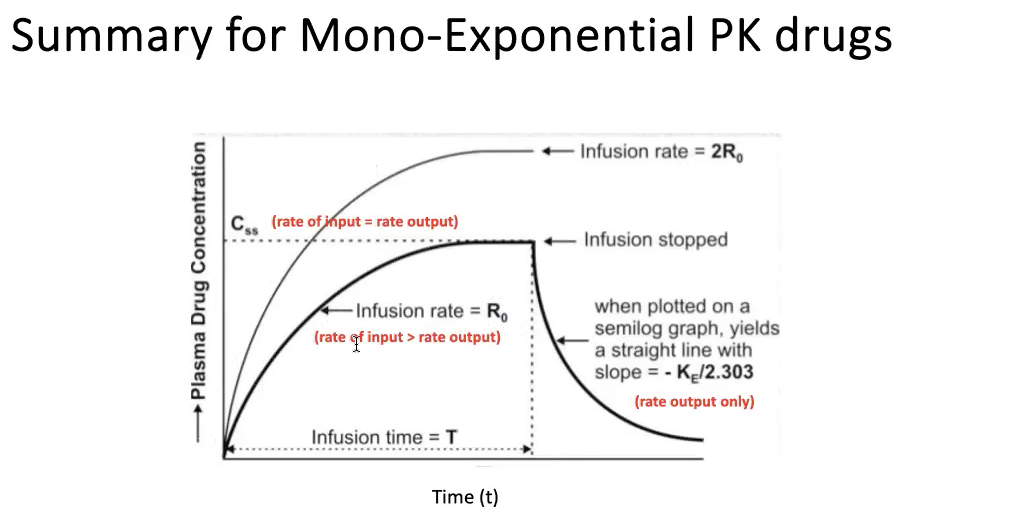
Steady state: Rate of input equals rate of elimination.
Optimal for achieving therapeutic efficacy while avoiding toxicity.
Therapeutic Range and Individual Variability
Therapeutic ranges are population averages; individual responses may vary due to genetic, metabolic, or elimination factors.
Therapeutic Drug Monitoring: Adjusting doses based on individual patient variability.
Continuous Drug Dosing Methods
Constant Rate Infusions and Repeat Oral Dosing.
Constant Rate Infusion
Administers drug directly into blood to bypass absorption barriers, ensuring rapid delivery and maintaining steady state.
Used in emergencies, anesthesia, chemotherapy, and when oral administration is not feasible.
Benefits and Limitations of IV Infusions
Benefits:
Precise drug control and avoidance of peak-trough fluctuations.
Immediate cessation in case of adverse effects.
Limitations:
Requires clinical supervision and is restricted to institutional settings.
Concentration-Time Relationships
Equations for Plasma Concentration
Plasma concentration at time t:
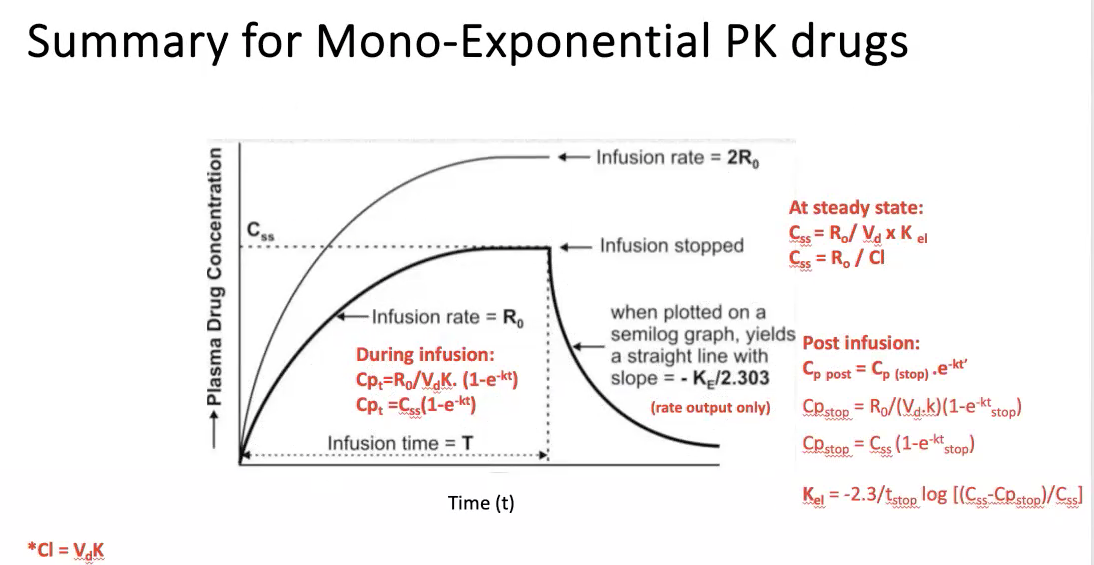
( C(t) = \frac{R_{0}}{V_{d}} e^{-k_{el}t} ) (pre-infusion equation)
At steady state: ( C_{ss} = \frac{R_{0}}{CL} ) where CL is clearance.
Time to reach steady state typically takes 5-7 half-lives.
Loading Doses
Purpose: Quickly reach steady state in critical situations.
Loading dose equation: ( LD = C_{ss} \times V_{d} )
Example calculation provided for loading doses and steady state concentrations.
Post-Infusion Kinetics
Post-infusion plasma concentration falls according to exponential decay, governed by elimination half-life.
Equations used include pre-infusion and post-infusion relevant terms to calculate concentration at specified times.
Multi-Compartment Models
Steady state reached after distribution equilibrium, often following different half-lives compared to single compartment models.
Summary of Key Concepts
At steady state, input = output.
Dose rate influences steady state concentration, but not the time to reach it (determined by half-life).
Different equations apply pre-infusion, during infusion, and post-infusion phases.
Example: Procanamide Infusion
Detailed case study example demonstrating the practical application of IV infusion concepts, including calculations for steady state, concentration, and volume of distribution.