Transportation in the cell membrane
Summary: This note goes into detail about how particles move across membranes. These particles are able to move through the membranes because of simple diffusion, facilitated diffusion, osmosis, and active transport.
Types of Transport:
- ==Osmosis==
- %%Facilitated Diffusion%%
- Active Transport
- @@Vesicular Transport@@
- ^^Bulk Transport^^
- @@Simple Diffusion@@
Simple Diffusion:
Diffusion is the net movement of molecules from a region of high concentration to a region of low concentration
- This directional movement along a gradient is passive and will continue until molecules become evenly dispersed (equilibrium)
- Small and non-polar (lipophilic) molecules will be able to freely diffuse across cell membranes (e.g. O2, CO2, glycerol)
The rate of diffusion can be influenced by a number of factors, including:
- ^^Temperature^^ (affects kinetic energy of particles in solution)
- Molecular size (larger particles are subjected to greater resistance within a fluid medium)
- %%The steepness of gradient%% (rate of diffusion will be greater with a higher concentration gradient)
Osmosis:
Osmosis is the net movement of water molecules across a semi-permeable membrane from a region of low solute concentration to a region of high solute concentration (until equilibrium is reached)
- Water is considered the universal solvent – it will associate with, and dissolve, polar or charged molecules (solutes)
- Because solutes cannot cross a cell membrane unaided, water will move to equalize the two solutions
- At a higher solute concentration, there are fewer free water molecules in the solution as water is associated with the solute
- ==Osmosis is essentially the diffusion of free water molecules and hence occurs in regions of low solute concentration==
Facilitated Diffusion:
Facilitated diffusion is the passive movement of molecules across the cell membrane via the aid of a membrane protein
It is utilized by molecules that are unable to freely cross the phospholipid bilayer (e.g. large, polar molecules and ions) \n
==This process is mediated by two distinct types of transport proteins – channel proteins and carrier proteins==
\n
Carrier Proteins
%%Integral glycoproteins bind a solute and undergo a conformational change to translocate the solute across the membrane%%
Carrier proteins will only bind a specific molecule via an attachment similar to an enzyme-substrate interaction
Carrier proteins may move molecules against concentration gradients in the presence of ATP (i.e. are used in active transport)
^^Carrier proteins have a much slower rate of transport than channel proteins (by an order of ~1,000 molecules per second)^^
\n
Channel Proteins
- %%Integral lipoproteins which contain a pore via which ions may cross from one side of the membrane to the other%%
- ^^Channel proteins are ion-selective and may be gated to regulate the passage of ions in response to certain stimuli^^
- @@Channel proteins only move molecules along a concentration gradient (i.e. are not used in active transport)@@
- ==Channel proteins have a much faster rate of transport than carrier proteins==
Active Transport:
Active transport uses energy to move molecules against a concentration gradient
This energy may either be generated by:
@@By the direct hydrolysis of ATP (primary active transport)@@
Coupling transport with another molecule that is moving along its gradient (secondary active transport)
\n Active transport involves the use of carrier proteins (called protein__pumps__ due to their use of energy)
%%A specific solute will bind to the protein pump on one side of the membrane%%
^^The hydrolysis of ATP (to ADP + Pi) causes a conformational change in the protein pump^^
==The solute molecule is consequently translocated across the membrane (against the gradient) and released==
Vesicular Transport:
==Endoplasmic Reticulum==
The endoplasmic reticulum is a membranous network that is responsible for synthesizing secretory materials
%%Rough ER is embedded with ribosomes and synthesizes proteins destined for extracellular use%%
Smooth ER is involved in lipid synthesis and also plays a role in carbohydrate metabolism \n
\n Materials are transported from the ER when the membrane bulges and then buds to create a vesicle surrounding the material \n \n
Golgi Apparatus
%%The vesicle is then transported to the Golgi apparatus and fuses to the internal (cis) face of the complex%%
Materials move via vesicles from the internal cis face of the Golgi to the externally oriented trans face
While within the Golgi apparatus, materials may be structurally modified (e.g. truncated, glycosylated, etc.)
\n Material sorted within the Golgi apparatus will either be secreted externally or may be transported to the lysosome
\n Plasma Membrane
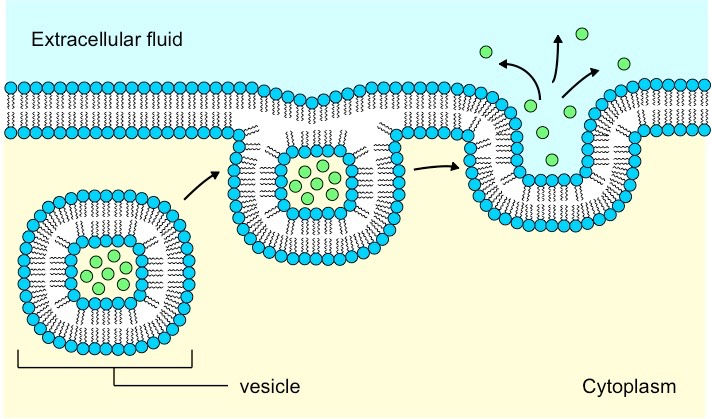
Vesicles containing materials destined for extracellular use will be transported to the plasma membrane
The vesicle will fuse with the cell membrane and its materials will be expelled into the extracellular fluid \n \n Materials sorted by the Golgi apparatus may be either:
- Released immediately into the extracellular fluid (constitutive secretion)
- Stored within an intracellular vesicle for a delayed release in response to a cellular signal (regulatory secretion)
Bulk Transport:
%%The membrane is principally held together by weak hydrophobic associations between the fatty acid tails of phospholipids%%
This weak association allows for membrane fluidity and flexibility, as the phospholipids can move around to some extent
This allows for the spontaneous breaking and reforming of the bilayer, allowing larger materials to enter or leave the cell without having to cross the membrane (this is an active process and requires ATP hydrolysis)
Endocytosis
^^The process by which large substances (or bulk amounts of smaller substances) enter the cell without crossing the membrane^^
An invagination of the membrane forms a flask-like depression that envelopes the extracellular material
The invagination is then sealed off to form an intracellular vesicle containing the material
\n There are two main types of endocytosis:
@@Phagocytosis – The process by which solid substances are ingested (usually to be transported to the lysosome)@@
==Pinocytosis – The process by which liquids / dissolved substances are ingested (allows faster entry than via protein channels)==
Exocytosis
The process by which large substances (or bulk amounts of small substances) exit the cell without crossing the membrane
^^Vesicles (typically derived from the Golgi) fuse with the plasma membrane, expelling their contents into the extracellular environment^^
@@The process of exocytosis adds vesicular phospholipids to the cell membrane, replacing those lost when vesicles are formed via endocytosis@@