taxonomy
Taxonomy
The branch of science concerned with classification, especially organisms.
Greeks and roman grouped animals and plants into basic units of groups (cats, oaks)
Classification allows scientists to:
Communicate with other scientists and others about their research
Find and work more easily
Group phenomena that have significance
Many organisms have several different common name
1700s Carolus Linnaeus
Devoted his life to cataloguing all different kinds of organisms known to science.
He adopted a polynomial system
The shorthand binomial (two name) system became universally accepted.
The Taxonomic Hierarchy
A taxon is a named group of organisms - 8 levels (family, order, class)
Do Keep Ponds Clean Or Fish Get Sick
Domains are the newest level - only 3 domains
The more taxonomic levels organisms share, the more closely related they are considered to be.
The Binomial System
Have two names
First part of the scientific name is the genus
Always written first and capitalised
Italics
Second part is the species name
Lowercase
Italics
Modern Taxonomy and Advances
Molecular Taxonomy: Uses genetic data to classify organisms.
DNA Barcoding: Technique that uses a short genetic sequence from a standard part of the genome (e.g., mitochondrial DNA) to identify species.
Bioinformatics: Software and databases used to analyze genetic sequences for classification.
Phylogeny
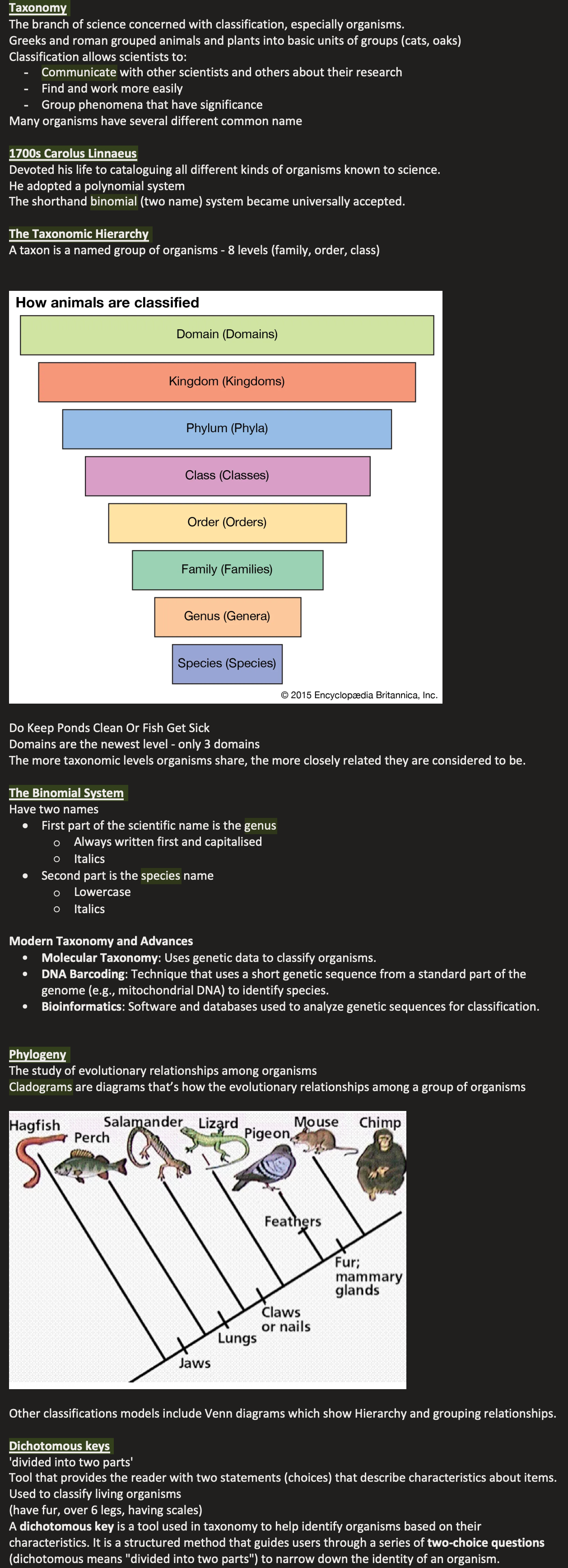
The study of evolutionary relationships among organisms
Cladograms are diagrams that’s how the evolutionary relationships among a group of organisms
Other classifications models include Venn diagrams which show Hierarchy and grouping relationships.
Dichotomous keys
'divided into two parts'
Tool that provides the reader with two statements (choices) that describe characteristics about items.
Used to classify living organisms
(have fur, over 6 legs, having scales)
A dichotomous key is a tool used in taxonomy to help identify organisms based on their characteristics. It is a structured method that guides users through a series of two-choice questions (dichotomous means "divided into two parts") to narrow down the identity of an organism.