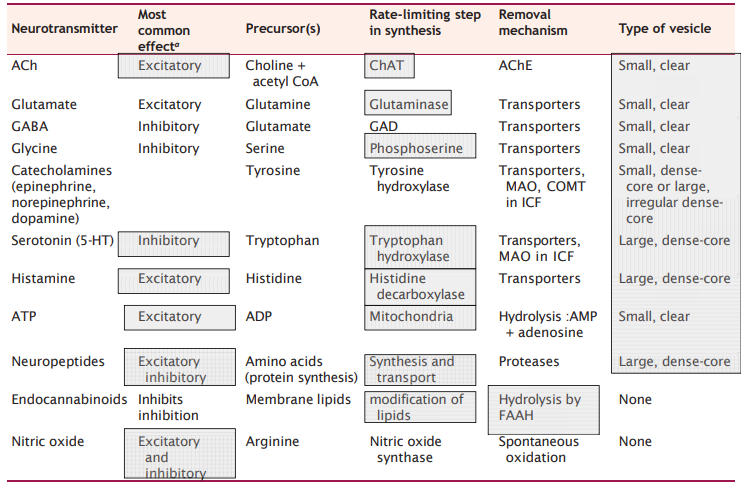
Neurotransmitters
Vocabulary:
Neurotransmitter: A chemical present/synthesized within a presynaptic neuron, gets released during synaptic activity as a response to Ca2+, there are postsynaptic receptors that will bind it, it produces a consistent physiological response when it binds to its receptor, and has a mechanism for removal/inactivation. After release, will diffuse, undergo reuptake to glial transport followed by enzymatic processing via amino acids and biogenic amines, degradation in the cleft (for ACh, ATP, and neuropeptides), bind to an intracellular receptor, or spontaneously oxidize
ACh: Made from choline (in plasma) and acetyl CoA (from glucose), removed from a synapse by acetylcholinesterase (AChE). Main source is the basal forebrain. Use a lot in the parasympathetic division of the visceral motor system, along with all somatic motor neurons at NMJs). Organophosphates in some insecticides deactivate AChE. After breakdown, the choline is reused and the acetate diffuses away. Within the CNS, contributes to attention and memory
Glutamate: Excitatory, made from glutamine, removed by transporters. Glutamine comes from plasma, which is converted via glutaminase. Inactivation after the reuptake of Na+ via cotransport into presynaptic terminals and glia. In glia, it is converted back to glutamine and released to be taken up again by a neuron. Most common neurotransmitter, vital for normal brain functioning. Trauma resulting in excess glutamate can lead to excitotoxicity. The glutamate-glutamine cycle regulates the amount of glutamate in the synaptic cleft
Gamma-aminobutyric acid (GABA): Inhibitory, made from glutamate via glutamic acid decarboxylase (GAD) which limits production rate, removed by transporters like Na+ and Cl-. Can be reuptaken by neurons and glia, enzymatic breakdown allows product to enter the tricarboxylic acid cycle. Most common inhibitory neurotransmitter, about 1/3 of synapses response to in. Found in local circuit interneurons, and projections from the corpus striatum, cerebellar cortex purkinje cells, and scattered in the PNS. GABAA is ionotropic, GABAB is metabotropic
Glycine: Inhibitory, made from serine during glucose metabolism, removed by transporters. Can be uptaken to a neuron or glia. Found in about half of inhibitory synapses in the spinal cord, always ionotropic. NDMA receptor co-agonist
Catecholamines: Consist of epinephrine, norepinephrine, and dopamine. Made from tyrosine, with production rate limited by tyrosine hydroxylase. Removed by transporters, MAD, or COMT in ICF
Serotonin: Made from tryptophan, removed by transporters or MAO in ICF
Histamine: Made from histidine, removed by transporters
ATP: Made from ADP, removed via hydrolysis breakdown to AMP and adenosine
Neuropeptide: Start as prepropeptides → propeptides, undergo anterograde axonal transport and after the propeptide is cleaved enzymatically it is an active signaling molecule, will only bind to GPCRs, act as neuromodulators frequently, undergo enzymatic degradation in the synaptic cleft by proteases
Prepropeptides: Will become neuropeptides, synthesized in the cell soma and cleaved to propeptides. Formed from amino peptides (made by protein synthesis). “pre” part helps it find the ER, cleaved there
Propeptide: A cleaved prepropeptide as it enters the endoplasmic reticulum, packaged along enzymes into large dense-core vesicles in the Golgi body, cleaved into neuropeptides “pro” part helps find the golgi apparatus
Endocannabinoids: Bind to intracellular receptors and undergo degradation in the neuron. Inhibit inhibition, made by membrane lipids, don’t use vesicles
Nitric oxide: Spontaneously oxidizes to be removed, made from arginine, production rate limited by nitric oxide synthase
Glutamic acid decarboxylase (GAD): Found almost exclusively in GABA-synthesizing neurons, coverts glutamate to GABA, requires pyroxidal phosphate (from vitamin B6) as a cofactor
Gamma hydroxybutyrate: The “date rape” drug, induces euphoria, memory deficits, and unconsciousness. Inactivates GABA
Hyperglycinemia: A genetic defect as a result of glycine irregularities, causes neonatal developmental delays, lethargy, and seizures
Strychnine: A competitive antagonist (blocks binding site) for glycine receptors in rat poison, leads to muscular convulsions
Myasthenia gravis: Autoimmune AChR destruction at NMJs, treated by blocking AChE
Neuromodulator: Increases or decreases synaptic activity, doesn’t directly activate ion-channel receptors, and has more prolonged effects that neurotransmitters. Act on groups of cells and diffuse widely, targeting both electrical and chemical synapses. They can act on presynaptic or postsynaptic neurons to regulate synthesis/release of synaptic transmitters, alter RMP, modify receptors, or modulate intracellular signaling pathways. Same molecules can also be neurotransmitters sometimes. Does not cause an electrical signal
Co-transmission: Release of neurotransmitters and neuromodulators at the same time, sometimes within the same vesicle
Small-molecule neurotransmitter: Have rapid effects ionotropically, though biogenic amines are a type that are slower with metabotropic receptors and GPCRs. Made in presynaptic terminals, packaged in vesicles by vesicular transport. Made in presynaptic terminals
Biogenic amine: Have slower effects than typical small molecule neurotransmitters, have ongoing effects, a subclass of small molecule neurotransmitters
Enzyme: Synthesized within the soma, brought to a synapse via anterograde axonal transport and remain in the axon terminal
H+ ATPase pumps: Pump protons into a vesicle during vesicular transport
H+ exchanger: Swaps protons in the vesicle for neurotransmitters
Vesicle: A membrane carrying something
Small diameter: Less than 50 nm, have a clear core
Large diameter: Have an electron-dense core
Sodium cotransport: Required in order to inactivate a neurotransmitter
Ionotropic receptors: Usually have 5 subunits, specified to be synapse-specific based on combinations of subunits
Metabotropic receptors: Have 1-2 subunits with 7 transmembrane domains, all GPCRs
G protein-coupled receptor (GPCR): Metabotropic, contain an intracellular binding site for a g protein. Exchange GDP for GTP to dissociate the g protein. Subclasses based on function of primary subunit
Gi: Decreases cAMP synthesis
Gs: Increases cAMP synthesis, can activate PKA
Gq: Increases levels of calcium, can activate PKC
G-protein: Binds to GPCRs, has alpha, beta, and gamma subunits. Released upon GDP → GTP, dissociating into alpha subunit and beta-gamma subunit to start signaling cascades
Alpha-bungarotoxin: Blocks NMJ receptors
Myasthenia gravis: An autoimmune disorder involving destruction of AChRs in NMJs, shows weakness with repetitive movements and is treated with AChE blocking drugs
Ionotropic neurotransmitter receptors and subunits:
ACh
nACh: Excitatory and nonselective to cations and nicotine, activated when 2 ACh bind. Located at NMJs with skeletal muscles, ganglia of visceral motor system, and CNS. Memory and attention
alpha 1-10
beta 1-4
gamma
delta
epsilon
Glutamate: Excitatory in vertebrates, permeable to Na+ and K+
AMPA: Produces large and fast/sharp currents
GluA1
GluA2
GluA3
GluA4
NMDA: Also permeable to Ca2+, require glycine as a co-agonist. Blocked by Mg2+ until a membrane is depolarized, typically due to nearby AMPAR. Function as coincidence detectors, requiring glutamate and depolarization
GluN1
GluN2A
GluN2B
GluN2C
GluN2D
GluN3A
GluN3B
Kainate: Produces shallow and long currents
GluK1
GluK2
GluK3
GluK4
GluK5
GABA: Permeable to Cl-, reverse potential lower than AP threshold. Agonists include benzodiazepines, sleeping pills, ketamine, and ethanol. Barbituates potentiate signaling and are used for anesthesia and epilepsy treatment
Alpha 1-6
Beta 1-3
Gamma 1-3
Delta
Epsilon
Theta
Meu
Rho
Glycine: Permeable to Cl-
Alpha 1-6
Beta
Serotonin
5-HT3A
5-HT3B
5-HT3C
5-HT3D
5-HT3E
ATP
P2X1
P2X2
P2X3
P2X4
P2X5
P2X6
P2X7
Metabotropic neurotransmitter receptors and subunits:
ACh
mACh: One protein with 7 transmembrane domains, can be inhibitory or excitatory. Has receptors in the CNS (like corpus striatum, vomiting center, and hippocampus) and PNS (like with the parasympathetic nervous system and sympathetic innervation of sweat glands). Agonistic to ACh and muscarine from poisonous mushrooms, antagonistic to atropine (for pupil dilation), scopolamine (to prevent motion sickness) and for asthma treatment
M1
M2
M3
M4
M5
Glutamate: Heterodimers
Class I: Excitatory (normally)
mGlu1
mGlu5
Class II: Inhibitory (normally), in retina
mGlu2
mGlu3
Class III: Inhibitory (normally), in retina
mGlu4
mGlu6
mGlu7
MGlu8
GABA: Inhibit adenylyl cyclase, cause the membrane potential to be more negative. Heterodimers, inhibitory
GABAB1
GABAB2
Dopamine
D1: Excitatory
D2: Inhibitory
D3
D4
D5
Adrenergic
Alpha
Alpha1A
Alpha1B
Alpha1D
Alpha2A
Alpha2B
Alpha2C
Beta
Beta1
Beta2
Beta3
Histamine
H1
H2
H3
H4
Serotonin
5-HT1A
5-HT1B
5-HT1D
5-HT1E
5-HT1F
5-HT2A
5-HT2B
5-HT2C
5-HT4
5-HT5A
5-HT6
5-HT7
Purines
Adenosine
A1
A2A
A2B
A3
ADP/ATP
P2Y1
P2Y2
P2Y4
P2Y6
P2Y11
P2Y12
P2Y13
P2Y14