L3 Forest stewardship
Objectives:
Describe forest stewardship as it applies to FPBC Bylaws and Code of Ethical and Professional Conduct.
Explain the seven principles of forest stewardship.
Describe key concepts associated with the application of the principles.
Demonstrate the alignment of the practice of professional forestry with the principles.
Definition of forest stewardship
FPBC Bylaw 1 defines forest stewardship as the responsible use of forest resources based on the application of an ecological understanding at the stand, forest, and landscape levels which maintains and protects ecosystem function, integrity and resilience, and an ethical responsibility to the land and people for current and future generations.
The practice of forestry is defined as.
FPBC further defines the practice of forestry by registrants in Bylaw 1 as having the same meaning as the Forest Professionals Regulation, and, for greater certainty, includes:
the provision of the services of managing, advising on, performing or directing works, services or undertakings respecting trees, forests, forest lands, forest resources, forest ecosystems, or forest transportation systems in a natural or managed, rural or urban environment, and any related, incidental or ancillary services or activities; and
the promotion and implementation of principles of forest stewardship.
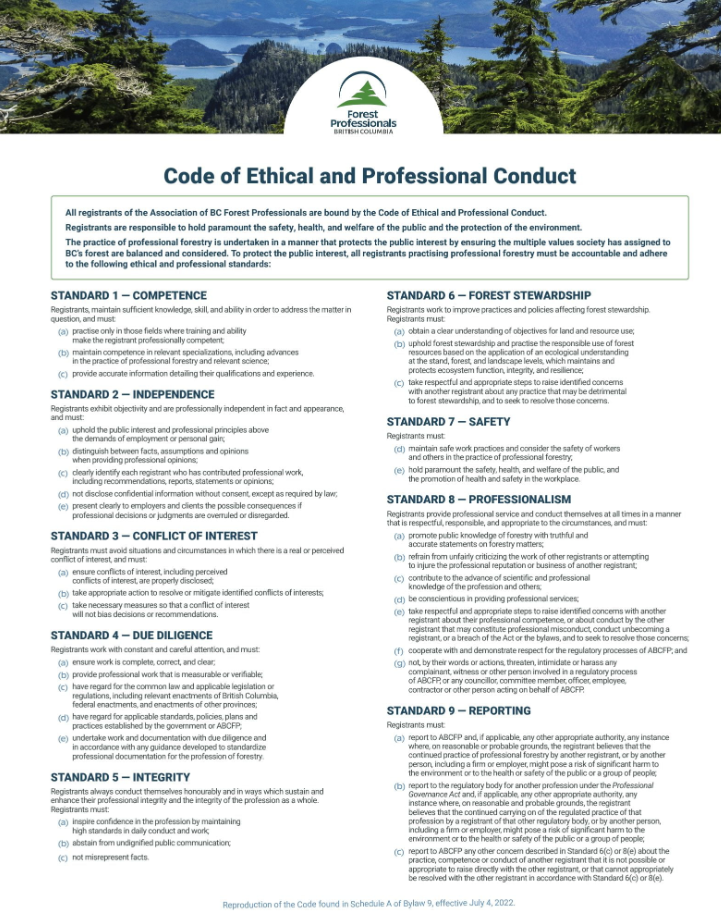
To achieve forest stewardship the following must be achived.
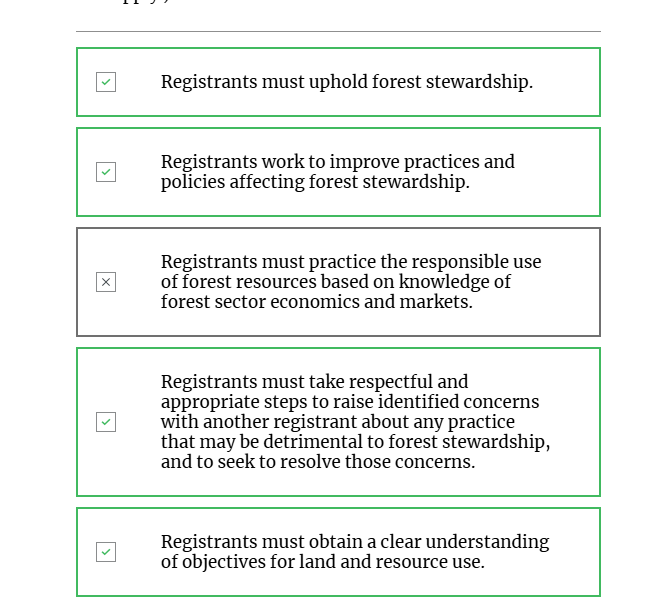
Obtain a clear understanding of objectives for land and resource use;
Uphold forest stewardship and practice the responsible use of forest resources based on the application of an ecological understanding at the stand, forest, and landscape levels, which maintains and protects ecosystem function, integrity, and resilience; and
Take respectful and appropriate steps to raise identified concerns with another registrant about any practice that may be detrimental to forest stewardship, and to seek to resolve those concerns.
The seven principles of forest stewardship are:
Ecological Integrity
Ecological Integrity refers to the wholeness of ecosystems, as well as their capacity to maintain it over time in response to disturbance or change. This concept requires the comprehension of Valued Ecosystem Component (VEC) or elements that have scientific, social, cultural, economic, historical, archaeological or aesthetic importance.
A VEC could be:
Site level - species at risk and soil conservation;
Landscape level - biodiversity and hydrology; and
Global level - carbon cycle and climatic effects.
Key Principle: Forest stewardship requires the maintenance of structure, composition and function of forest ecosystems within ranges that ensure long-term diversity and resilience.
Information and Understanding
As a forest professional, you must be aware of a wide range of information related to stewardship and forest management. This profession is multi-disciplinary and dynamic, requiring you to stay up-to-date on current scientific and social research as well as the traditional ecological knowledge of First Nations. You must also know how to access the information you need to make complex decisions that ensure that ecosystem integrity, function, and resilience is maintained.
Key Principle: Forest stewardship requires knowledge of the values present in the forest, as well as science-based understanding of how forest ecosystems function and change over time.
Forest Management Goals and Objectives
Goals and objectives for forests, forest lands, and forest ecosystems are established by government, Indigenous Peoples, and other landowners and are mostly in the form of legislation, policy, or other agreements, standards, and practices. Goals and objectives reflect social perspectives and values.
(Forest professionals often encounter challenges related to land-use choices and the desires of public interest groups or other parties that don’t have legal rights or contractual relationships with the government. These challenges are typically referred to as non-statutory expectations (NSE), as these challenges exist outside of legislated requirements.)
Recall that:
Goals: long-term aims related to a big-picture vision.
Objectives: concrete actions that achieve a given goal.
Key Principle: Forest stewardship requires clear goals and objectives to guide registrants’ professional service in forest resource activities.
Social Foundation
Forest stewardship is inherently social. Consequently, registrants require an understanding of the range of forest attributes that provide value to people, including economic, aesthetic, cultural, spiritual, or other values that may be more challenging to quantify.
Key Principle: Forest stewardship requires management strategies that will protect the public interest and reflect risks and benefits consistent with the values and interests of society.
Temporal Options
Forest stewardship ensures the public interest in forests, forest lands, and forest ecosystems is maintained for present and future generations.
Key Principle: Forest stewardship requires registrants to provide professional services that fully consider results — positive and adverse — over time without risking options for future generations to enjoy similar benefits.
Adaptive Practices
Forest professionals work in a dynamic and sometimes disruptive environment. Not only do ecosystems change, but so do social values and management objectives. Today, the effects of climate change are verifiable and measurable. Social values have changed as well. An adaptive practice approach ensures that you are being innovative and creatively solving problems.
The Adaptive Practice Approach
Requires periodic reassessment of basic assumptions.
Ongoing monitoring and research.
Adjustment of management strategies over time.
Anticipation of possible future events.
Flexibility and an open, learning approach.
Key Principle: Forest stewardship requires strategies to minimize and mitigate risk and uncertainty in forest management.
Spatial Strategies
Maintaining a full range of forest ecosystem values requires consideration of the larger scale of a watershed, landscape unit, or — on an even broader scale —the global ecosystem. This, in turn, guides decisions at the stand level and the activities on the ground.
Cumulative effects are changes to environmental, social and economic values caused by the combined effect of past, present, and potential future human activities and natural processes.
It is important for registrants to monitor and mitigate cumulative adverse impacts that may pose significant harm to the environment or risk to public safety.
Key Principle: Forest stewardship ensures an appropriate range of spatial scales are used to monitor, assess, and plan professional service.
Self-assessing your alignment
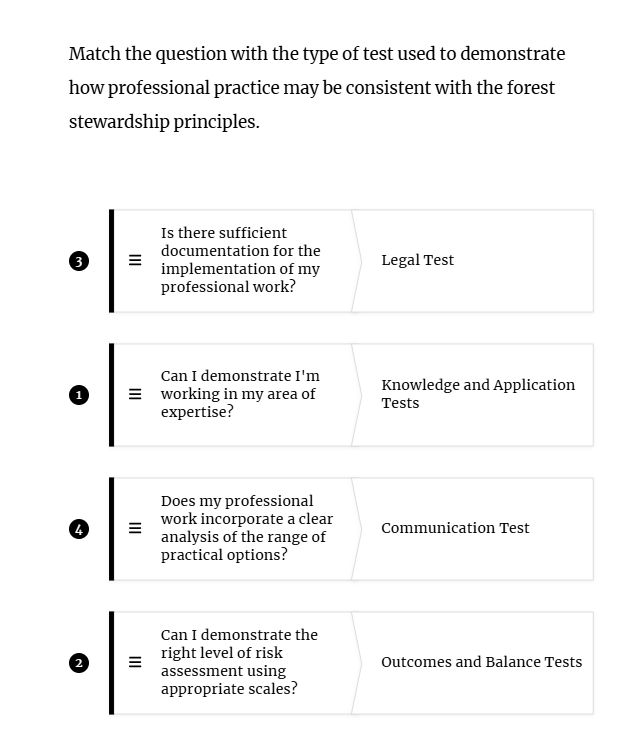
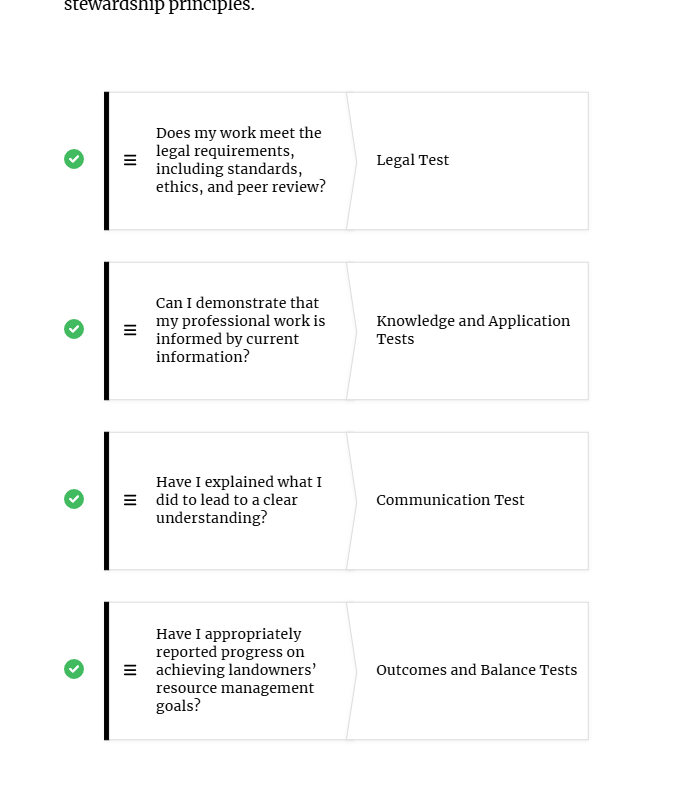
Legal Test: Dose my professional work comply with the applicable laws?
Knowledge and Application Test: Dose my professional work consider the requisite knowledge and information to ensure good forest stewardship?
Communication Test: Dose my pro work properly communicate the necessary information to show that it is consistent with the 7 principles?
Balance and Outcome Test: Do I use a reasonable and balanced approach in my professional work to ensure good forest stewarship?
TEST questions